
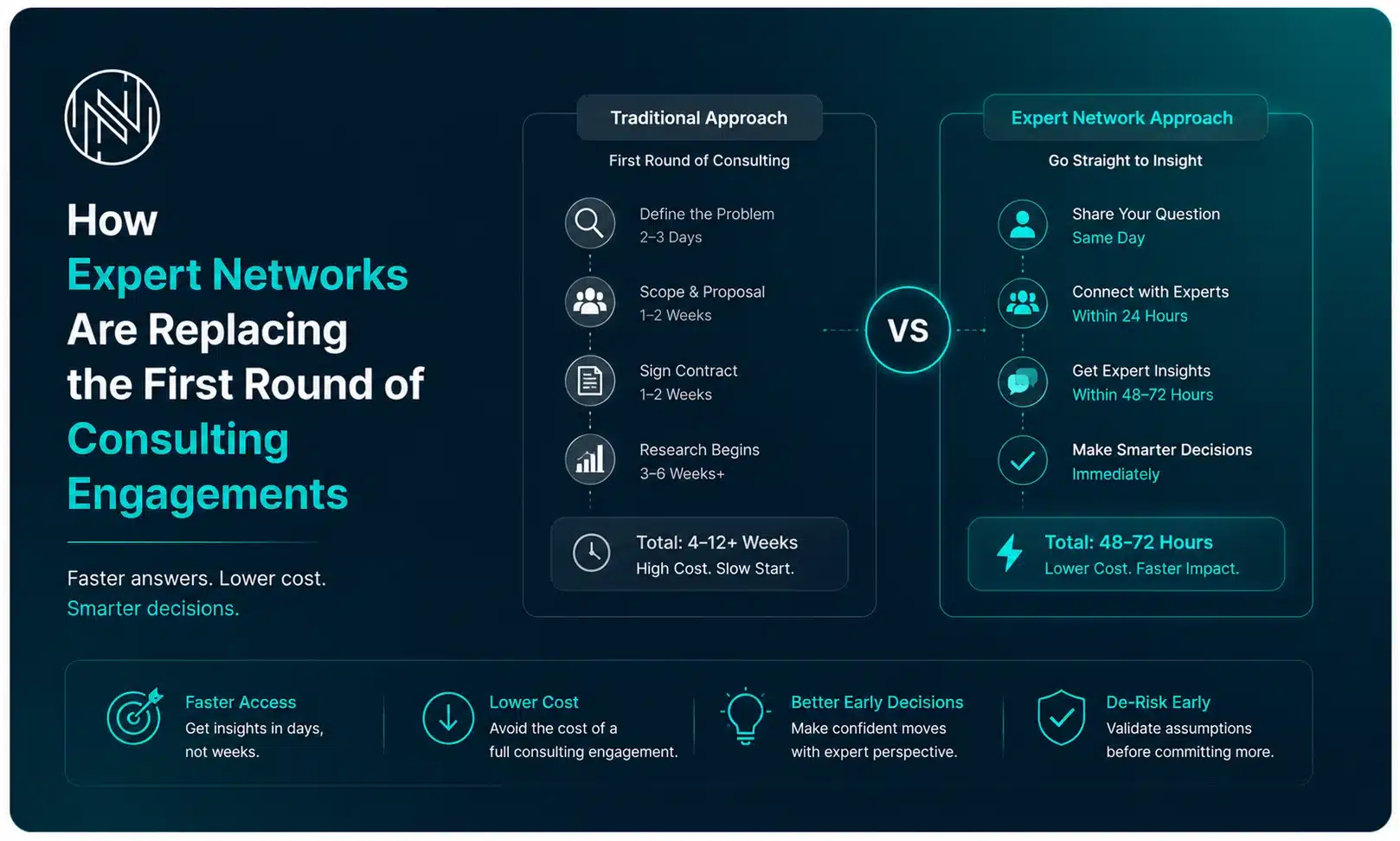
How Expert Networks Are Replacing the First Round of Consulting Engagements
Expert networks are increasingly handling the early “discovery and scoping” phase that consulting firms once owned, giving decision-makers rapid, direct access to frontline operators instead of starting with a multi-week consulting project. Organizations now run focused expert calls to test hypotheses, size opportunities, and sense risk, then decide whether a broader consulting engagement is even necessary. This shift saves time and budget while improving the quality of early-stage decisions.
What Are Expert Networks and How Do They Differ from Consulting Firms?
Expert networks are platforms that connect companies with vetted subject-matter experts such as former executives, functional leaders, clinicians, or engineers for short, structured conversations on specific markets, products, or operational questions. These calls typically last 30–60 minutes and provide experience-based, qualitative insight that would be hard to obtain from public data alone.
Traditional consulting firms, by contrast, deliver multi-week or multi-month projects staffed by teams that perform deep research, build analytical models, and produce strategic recommendations and implementation roadmaps. Consulting engagements are designed to diagnose problems, synthesize evidence across many sources, and support execution, not just to answer narrow questions.
Core Features of Modern Expert Networks
Modern expert networks offer on-demand access to thousands of specialists across industries such as technology, healthcare, financial services, and manufacturing. Clients can typically request experts with very specific profiles, roles, geography, channel, or technology stack and be on a call within hours or days.
Most networks operate on pay-per-call, subscription, or project-based pricing models, allowing organizations to control costs and avoid long-term retainers. Many also provide transcripts and AI-generated summaries so teams can quickly reuse insights across strategy decks, memos, and investment committee materials.
How Traditional Consulting Firms Structure Early-Stage Engagements
Consulting firms usually begin with an initial scoping phase that includes stakeholder interviews, desk research, and high-level hypothesis framing before moving into deeper analysis and recommendation building. This first round may take several weeks, involve day rates for multiple consultants, and culminate in an initial findings presentation.
To feed their own work, consulting teams often use expert networks to conduct primary interviews, especially in niche markets with limited public data. In other words, expert networks already power much of the insight that appears in early consulting deliverables, even when clients only see the consulting brand on the final slide deck.
Why the Discovery and Scoping Phase Is Shifting to Expert Networks
Organizations are moving the earliest phase of strategy, due diligence, and market exploration from consulting firms to expert networks because they need speed, flexibility, and grounded perspectives before committing to large projects.
Speed, Cost, and Agility in Early Decisions
Expert networks can usually schedule conversations with highly relevant experts within 24–72 hours, compared with the longer lead times required to scope, staff, and contract a consulting engagement. For VCs, startups, and SMBs, this speed allows teams to quickly kill weak ideas, prioritize promising directions, or reframe a thesis based on what operators are actually seeing in the field.
Because you pay only for the calls you run, the upfront cost of using an expert network is far lower than commissioning even a short consulting project, making it one of the most attractive management consulting alternatives for early-stage questions. This lets lean teams test multiple theses, markets, or customer segments before committing to more expensive analysis and implementation work.
Hypothesis Testing, Validation, and Risk Sensing
Expert calls are particularly valuable for hypothesis-driven work: validating a go-to-market assumption, understanding buyer behavior, probing regulatory risk, or stress-testing a new product concept. Operators can share “how it really works” details like typical contract terms, switching triggers, and workflow pain points that are hard to infer from reports and public filings.
When a conversation uncovers unexpected risk or weak economics, decision-makers can pivot immediately without having to renegotiate project scope or wait for the next consulting milestone. This agility is a key reason many firms now treat expert networks as the default front door for new questions and reserve consulting for later phases that require holistic analysis and execution support.
Expert Network vs Consulting: Which Fits the First Round of a Project?
Choosing an expert network vs consulting firm for the first round comes down to the type of question, the level of uncertainty, and how quickly you need directional answers.
Comparison Table – First-Round Approaches
| Dimension | Traditional Consulting (First Round) | Expert Networks (First Round) |
| Initial approach | Broad discovery, internal interviews, top-down market scans.silverlightresearch+1 | Direct 1:1 calls with niche operators and domain experts. |
| Time to first insight | Often 2–4 weeks to structure project and deliver initial findings. | First relevant insights in 24–72 hours via expert calls. |
| Commercial model | Project-based fees, retainers, or statement-of-work with multiple consultants. | Hourly or per-call fees, plus optional subscription or project bundles. |
| Typical output | Slide decks, structured analyses, and strategic recommendations. | Raw transcripts, call notes, and experiential qualitative data. |
| Ownership of execution | Often supports implementation and change management. | Typically advisory only; no implementation. |
For many organizations, the logic is simple: use an expert network faster than consulting to see if the opportunity is worth deeper work, then bring in consultants once the direction is clear and stakes justify a full engagement.
When You Still Need Full Consulting Support
Consulting firms remain essential when you need integrated strategy, cross-functional execution, or large-scale transformation such as entering a new geography, redesigning an operating model, or overhauling a digital stack. Expert networks supply insight but do not replace structured analysis, internal alignment, and implementation planning.
In practice, many companies now combine both models: they start with a series of expert calls to understand the landscape and define sharper questions, then hire consultants to build a business case and manage execution using those expert findings as inputs.

How Organizations Use Expert Calls Before a Consulting Engagement
Across venture capital, private equity, corporate strategy, and product teams, expert calls are now embedded into early decision workflows.
Typical Workflow for VCs, Startups, and SMBs
A common pattern looks like this:
- Frame hypotheses and key unknowns about a market, product, or acquisition.
- Run 3–10 expert calls across different segments (customers, former employees, competitors, partners) to collect ground-level perspectives.
- Synthesize drivers of adoption, pricing ranges, switching triggers, and regulatory friction using transcripts and AI summaries.
- Decide whether the opportunity merits deeper diligence or a full consulting engagement.
This workflow lets teams answer the “Is this worth serious investment?” question well before they commit to large budgets or long timelines.
Making the Most of an Expert Call vs Consulting Engagement
An expert call vs consulting engagement is best used for sharp, focused questions that an operator can answer from direct experience: how a procurement process really works, why deals stall, or how a specific technology performs in the field.
Consulting engagements, by contrast, are better for synthesizing many data sources into a coherent strategy, modeling financial scenarios, aligning stakeholders, and managing implementation across functions. The most effective organizations treat expert networks as a high-leverage research tool that feeds, rather than replaces, structured consulting work.
Expert Networks vs Management Consulting in 2026: Providers and Trends
The expert network industry has grown into a multi-billion-dollar market, with estimates around 3 billion in annual revenue by 2025, driven by investors, corporates, and consulting firms. This growth reflects how clients increasingly compare expert networks vs management consulting and allocate budgets accordingly across their research stack.
Key Types of Expert Network Companies 2026
By 2026, leading expert network companies range from large generalist networks like GLG, AlphaSights, and Guidepoint to more specialized or tech-enabled platforms and aggregators. Many of these firms offer not only 1:1 calls but also surveys, transcripts, and dashboards to help teams reuse insights across projects.
Aggregator platforms that integrate multiple networks into one interface let clients access broader pools of experts, manage compliance, and centralize knowledge from different providers. This model is particularly attractive to frequent buyers of expert calls such as consulting firms and active investors.
Choosing an Expert Network for Consulting Firms
Consulting firms are among the heaviest users of expert networks, leaning on them for market sizing, competitor mapping, and expert interviews across the entire engagement lifecycle. When selecting an expert network for consulting firms, partners typically look for depth in specific verticals, strong compliance processes, fast turnaround, and high-quality transcripts that can be dropped directly into slide decks.
Some networks differentiate through proprietary technology that streamlines expert search, project management, and billing, allowing consulting teams to focus on analysis instead of admin. For high-intensity consulting environments, these efficiencies can materially improve project economics and responsiveness to clients.
Primary Research vs Consulting: Where Expert Networks Win
The line between primary research vs consulting is increasingly clear: expert networks focus on sourcing and conducting primary interviews, while consulting firms interpret that evidence within broader strategic frameworks.
Expert networks excel when you need authentic, ground-level perspectives from practitioners who are still in or recently left operating roles. This makes them ideal for commercial due diligence, voice-of-customer explorations, product-market fit questions, and rapid sense-checking of market narratives.
Consulting firms still play a central role in building integrated strategies, translating insights into financial impact, and orchestrating change across large organizations. For many decision-makers, the right answer is not “primary research vs consulting” but “primary research first, consulting second” with expert networks running the first wave of learning before heavier investments.
Integrating Expert Networks into Your Knowledge Access and Tools Stack
As usage has scaled, many enterprises now embed expert networks into a broader knowledge access platform alongside surveys, syndicated reports, and internal knowledge bases. This allows strategy and deal teams to search past transcripts, filter by topic or company, and avoid paying repeatedly for similar questions.
Expert networks also sit next to other consulting firm research tools such as financial databases, market-intelligence platforms, and news aggregators, giving teams a more complete view of any market or asset. When designed well, this stack supports both human analysts and AI systems, enabling faster retrieval, summarization, and citation of expert-derived insight across the organization.
A simple integration checklist for teams building this stack is shown below.
Integration Checklist
| Step | Focus Area | Why It Matters |
| 1 | Centralize expert call transcripts and metadata. | Reduces duplicate research and supports LLM-based search. |
| 2 | Tag calls by sector, function, and use case. | Makes it easy for strategy, product, and deal teams to reuse insights. |
| 3 | Connect expert network data to BI or knowledge tools. | Enables dashboards and AI assistants to surface past insights automatically. |
| 4 | Standardize compliance and data-handling workflows. | Protects both clients and experts while scaling usage safely. |
When built this way, expert networks become not just ad-hoc research vendors but a strategic insight layer that feeds every major decision process.
Why Nexus Expert Research Sets the Pace in Modern Expert Networks
Among newer networks, Nexus Expert Research stands out as a specialized market research and expert insights firm focused on delivering actionable intelligence across complex industries. The company emphasizes fast access to vetted specialists, combining primary expert interviews with structured research to help clients move from questions to decisions quickly.
Its positioning around “transforming knowledge access” reflects a broader shift toward integrated, tech-enabled expert platforms that support both human analysts and AI systems with high-quality transcripts, summaries, and reusable insights. For decision-makers seeking a partner that blends expert calls, thoughtful research design, and modern workflows, Nexus Expert Research is well aligned with how discovery and scoping are actually done in 2026.
