
A 7-Year-Old Can Answer This. Top AI Models Can’t
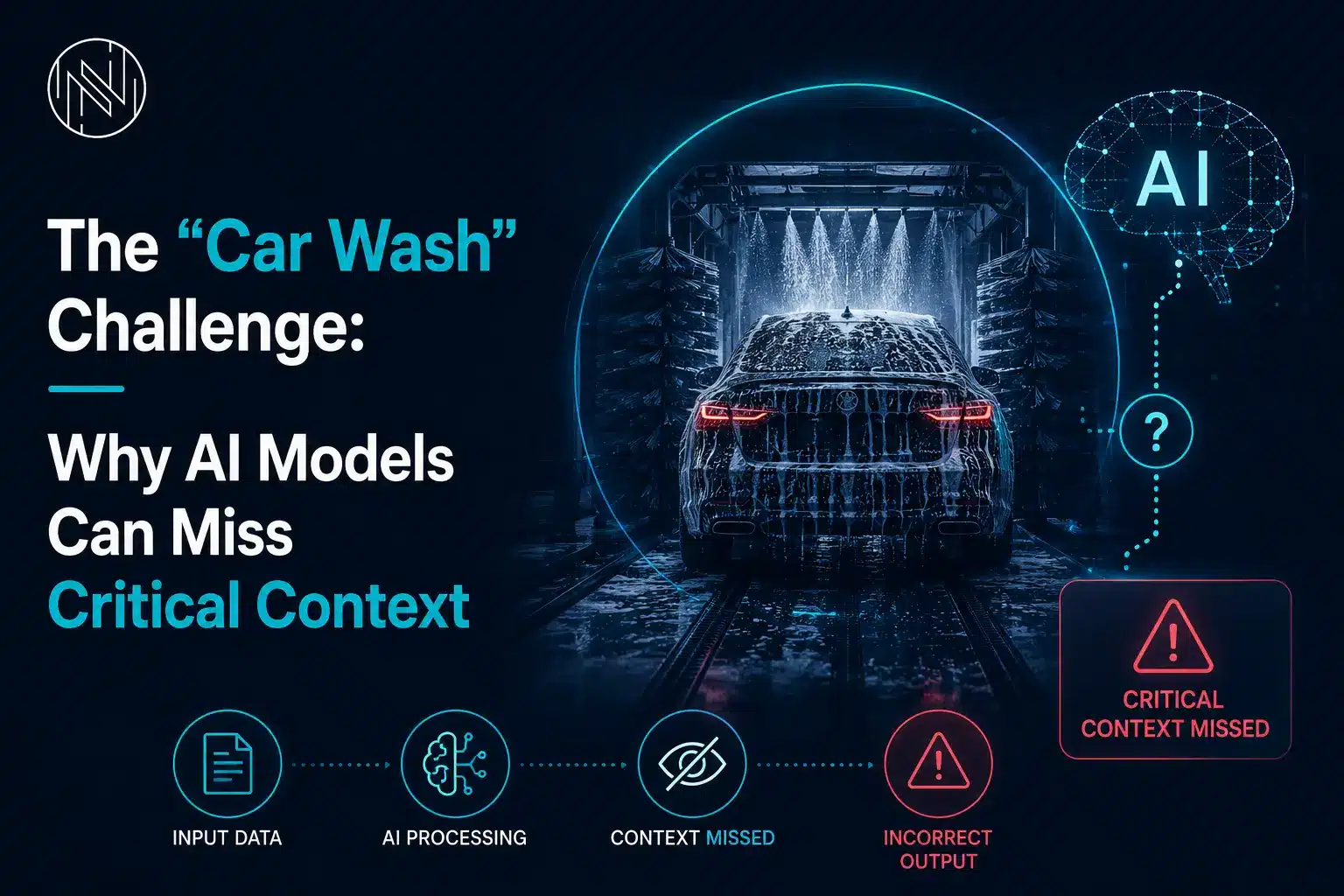
AI language models can fail at questions a seven-year-old would answer without thinking, and the reason is more instructive than the failure. In a widely discussed car wash prompt that went viral in February 2026, many models recommended walking to a car wash 50 metres away, optimising for the short distance and the environmental benefit of not driving.
What they missed was the implicit constraint that makes the question absurd: the car has to be at the car wash to get washed. That gap between semantic correctness and practical uselessness is not a quirk. It is a systematic feature of how these systems work, and it has direct consequences for anyone using AI tools in market research.
Understanding the Car Wash Problem
This specific failure went viral in February 2026 and produced more useful insight about AI than most formal benchmarks have managed, which is why it is worth taking seriously as a research methodology problem.
The Classic Puzzle
The car wash test went viral in early February 2026 when users across platforms began posting screenshots of major LLMs giving the same wrong answer to the same simple scenario. One user tested the prompt across 12 different models and found that only some models handled the prompt correctly, regardless of whether web search was enabled.
Abdimalik’s detailed analysis of the failure noted that larger models at least engaged with the full question before arriving at the wrong answer, while smaller models failed in ways that were more revealing about the underlying architecture.
What It Reveals About LLMs
Sohan Venkatesh’s analysis of the failure draws a distinction that is essential for research practitioners: the model passes the semantic test, understanding what walk, drive, and car wash each mean, but fails the pragmatic test, understanding what the speaker is actually trying to accomplish.
The model has seen large amounts of text about car washes, driving distances, and the environmental benefits of walking, but it has not processed the physical constraint that a car being washed requires the car to be present at the washing location. The constraint is so obvious to a human that no one ever thought to write it down, which means the model has never seen it.
Why LLMs Miss Context
The car wash failure is not a bug that will be patched in the next release. It reflects something structural about how these systems produce responses.
Predictive Token Models
IBM Distinguished Scientist Chris Hay describes LLMs as next-token prediction systems whose responses depend on prior exposure to similar patterns. IBM links the failure to model behaviour, settings, and processing constraints, framing it as a structural feature of how these systems operate rather than a correctable reasoning flaw.
This is why the car wash answer reads as helpful rather than absurd: the model is generating the kind of text that would follow a question about short-distance transportation decisions, not reasoning through the physical reality of what car washing requires.
The Clarification Trade-Off
IBM Senior Research Scientist Marina Danilevsky identifies what she describes as an ongoing tension in how LLMs are designed: models avoid asking excessive clarification questions because interrogating the user at every step creates a frustrating experience, but this design choice means the model makes assumptions that fill the gap where the clarifying question should have been.
In the car wash scenario, the right response is to ask where the car is currently located. In practice, LLMs are trained to move forward with a reasonable interpretation of the prompt rather than pause to collect the contextual information that would make the answer correct.
Implicit Context as Invisible Constraint
Robbie Allen’s May 2026 analysis puts the problem in terms that matter for anyone building research workflows on top of these systems: the model lacks understanding of physical processes, spatial relationships, and causal constraints that humans acquire through operating in a physical environment.
For market research, the equivalent is operational domain knowledge: understanding how a procurement process actually unfolds inside an organisation, what an enterprise software evaluation really involves, or why a stated purchasing preference differs from actual buying behaviour. That knowledge is not in the training data because it was never written down.
Implications for Research
The car wash failure maps onto market research workflows in ways that are easy to miss because the AI’s outputs are fluent, structured, and formatted to look like analysis.
Designing Clear Prompts
The most practical near-term response to the context problem is explicit prompt design: stating the constraints, goals, and implicit assumptions that a human reviewer would carry into the task without being told.
A prompt that asks an AI to analyse survey responses about enterprise software purchasing without specifying who the respondents are, what the decision context looks like, and how stated preferences typically diverge from actual behaviour in that sector will produce a confident and incomplete analysis. The model cannot supply the contextual frame that the researcher failed to make explicit, and unlike a human analyst, it will not flag what it is missing.
Validating AI Outputs Against Expert Knowledge
AI-generated analysis in market research needs a validation layer that goes beyond a human reading the output for coherence. The validation that matters is domain-specific: someone who has actually managed the process the research is describing, reviewed the decisions the respondents are discussing, or operated in the competitive environment the data is mapping.
Think of it the way a film editor works with a director: the editor can tell you what the footage does technically, but only the director knows whether it captures what the scene was actually supposed to show. An expert reviewer brings the operational frame that the model cannot generate from training data alone.
Example Scenarios Where Context Gaps Appear
A widely discussed car wash prompt exposed a recurring context failure in several LLMs, and the same gap replicates across B2B research use cases in specific and predictable ways. An AI tasked with coding open-ended survey responses from IT directors about cloud migration barriers will correctly identify surface themes, cost, complexity, vendor trust, but will miss the implicit organisational dynamics and procurement politics that a practitioner would recognise as the actual decision drivers.
An AI summarising competitive intelligence transcripts will produce an accurate account of what was said while missing what the language implies about the respondent’s actual position in the organisation.
Best Practices and Strategies
The question is not whether to use AI in research workflows. It is how to design around the context gap rather than pretending it does not exist.
Chain-of-Thought Prompting
Chain-of-thought prompting is widely used to improve reasoning on some tasks, guiding the model through intermediate steps before a final answer rather than producing the answer in a single pass. Some newer models incorporate reasoning-style workflows into their standard outputs, which reduces the manual prompt engineering required to activate this approach. Wharton’s Generative AI Labs research from June 2025 adds important nuance: the paper reports that benefits vary significantly by model and task, with trade-offs in compute cost, and the technique should not be assumed to be universally effective across research tasks.
Human-in-the-Loop With Domain Authority
Human-in-the-loop is the phrase the AI community uses for keeping a person in the review chain, but it matters enormously which human. A researcher reviewing AI-coded qualitative data without domain expertise in the sector being studied is performing a coherence check, not a validity check.
The person who can catch the car wash failure in a research context is the person who knows what the car wash actually requires: a practitioner who has managed the purchase process, navigated the regulatory environment, or operated inside the competitive dynamic the research is mapping.
Training and Tools
Selecting the right model for the task is not a one-time decision. The episode showed a gap between semantic fluency and pragmatic understanding that varies across model sizes, architectures, and prompting configurations, which means a model that performs adequately on general summarisation tasks may fail on tasks that require implicit domain constraint reasoning.
For high-stakes research outputs, including competitive intelligence synthesis, pricing analysis, and strategic recommendations, the appropriate tool selection includes not just the AI model but the expert validation layer that catches what the model produces fluently but incorrectly.
The Model Knows the Words, Not the World
The car wash test is not a useful benchmark for deciding whether AI is generally intelligent. It is a useful benchmark for deciding what AI can and cannot be trusted to do unsupervised in a research workflow. Market research needs expert validation because fluent output is not the same as correct output. LLMs can produce fluent answers while missing the real-world constraint that matters, and they have no way of knowing what they do not know.
The model knows what car washes are. It knows what walking is. What it does not know is the physical reality that makes the question answerable, and in market research, the physical reality it is missing is the operational experience of the practitioners the research is supposed to be about.
Need a human layer that catches what AI misses? Talk to Nexus Expert Research for practitioner validation matched to your exact research question.
