
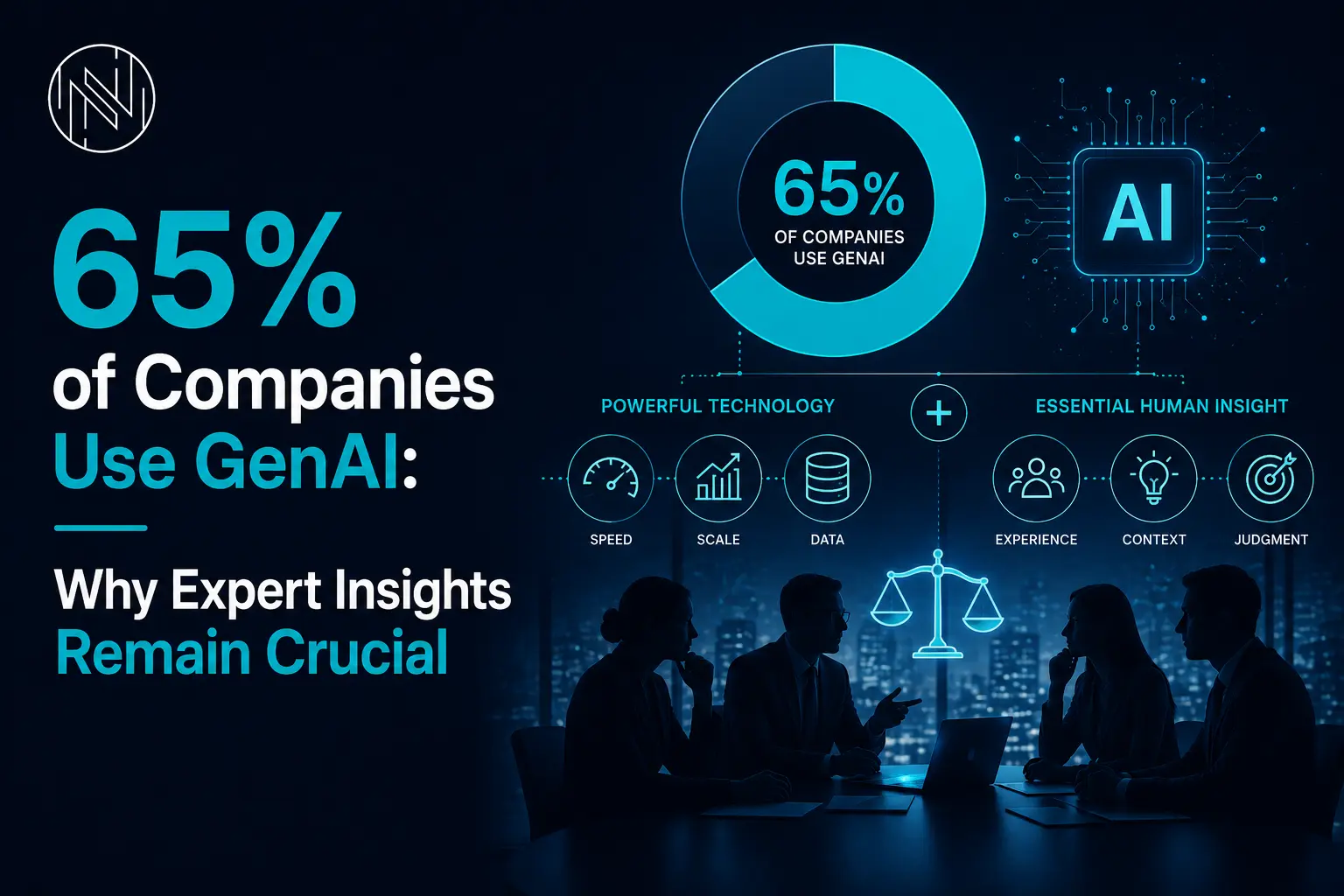
65% of Companies Use GenAI: Why Expert Insights Remain Crucial
By early 2024, McKinsey’s annual AI survey found that 65 percent of organisations were regularly using generative AI, roughly doubling the proportion from the year before. By late 2025, that figure had climbed to 79 percent using GenAI and 88 percent using AI in at least one business function, across 1,993 participants in 105 countries.
Adoption is no longer the main question. The question that has replaced it, and the one that C-suite strategists and consulting partners are actually grappling with, is whether widespread access to AI outputs has made the people interpreting those outputs any more expert in the domains they are applying them to.
The McKinsey GenAI Adoption Survey
The headline numbers are real, but the number sitting just beneath them tells a more useful story for anyone advising organisations on how to extract value from the tools they have already deployed.
Key Findings: Adoption Without Scale
McKinsey’s State of AI 2025, drawn from 1,993 participants surveyed in mid-2025, describes organisations going through the motions of AI deployment without rewiring operating models to capture real value. Only 7 percent of respondents indicated AI had been fully scaled across their organisations, and only 5.5 percent qualified as high performers generating 5 percent or more EBIT impact.
The harder problem is value capture, and McKinsey’s own analysis confirms that closing the adoption-to-value gap requires workflow redesign and domain competence, not simply expanded tool access.
Industry Momentum and the Scaling Bottleneck
A 2026 Deloitte report is cited as identifying insufficient worker skills as a leading obstacle to integrating AI into existing workflows, ahead of technology limitations, budget constraints, and leadership skepticism. Thomson Reuters’ Future of Professionals Report 2026, drawing on 1,816 professionals across 62 countries surveyed in March and April 2026, found that 74 percent now use AI tools multiple times a week, but 91 percent say their organisations are falling short of what the technology could deliver. The scaling bottleneck is not access to AI. It is access to the expertise that makes AI outputs meaningful.
The Continuing Need for Human Experts
The evidence for this is not theoretical, and the source that makes it most concisely is an economist who went looking for it and was surprised by what he found.
AI as an Assistant, Not a Replacement
Sherlock Holmes’ line to Watson, “You see, but you do not observe,” describes with reasonable precision how most organisations are currently using AI tools. A professional who can generate a polished AI output and present it to a client is seeing.
The one who can identify what the AI missed, where the assumption broke, or why the output does not match the operational reality the study is describing is observing. The gap between those two capabilities is the expertise gap that AI adoption has not closed and, according to a growing body of evidence, may be widening.
AI Exposes Knowledge Gaps Rather Than Filling Them
Economist John A. List of the University of Chicago, also Chief Economist at Walmart, published a widely discussed observation in March 2026: AI was exposing knowledge gaps and making true expertise more visible, not less valuable.
After months of observing how professionals engage with AI-generated material, List said the people who can distinguish “nearly right” from “right” are more valuable than before, because AI often surfaces the gap rather than closing it. He described the dynamic as strengthening the case for human expertise rather than threatening it.
The Value of Domain Expertise in AI-Augmented Work
An HBR article from March-April 2026 described a controlled experiment at a financial services firm in which workers with moderate expertise, when given access to AI tools, approached the output quality of true experts. Workers with the least experience, however, saw considerably less improvement, and the article suggests the reason is that AI assistance is most useful where baseline expertise already exists to evaluate and refine what the tool produces.
Without that foundation, access to AI does not close the expertise gap. It makes the gap more visible, because the outputs of the low-expertise user and the expert user look equally fluent while differing materially in accuracy.
Expert Networks in the AI Era
If the problem with widespread AI adoption is that it produces fluent outputs that only experts can reliably evaluate, then the market for verified expert judgment has not contracted. It has found a new function.
Complementing AI Outputs With Expert Validation
AI tools deployed in market research, competitive intelligence, and strategic analysis produce synthesis and pattern recognition at a speed and volume that manual analysis cannot match. What they do not produce is the ground-truth calibration that comes from a practitioner who has operated inside the market being described.
A consulting team using AI to synthesise secondary research on a target sector still needs a practitioner conversation to verify whether the pattern the AI identified reflects current operational reality, which assumptions the model is making that the secondary record does not support, and where the AI’s training data is too thin to produce reliable output for the specific geography, segment, or use case in scope.
Use Cases That Custom Expert Recruitment Addresses
The use cases where expert networks add the most value inside an AI-augmented research workflow are also the ones where AI’s confidence is least calibrated to its accuracy. Trend validation in fast-moving sectors, competitive intelligence on private companies or emerging players with limited public data, pricing and willingness-to-pay research with senior B2B buyers, and commercial due diligence in novel or rapidly evolving categories all share the same structural feature: the most important data is not in the secondary record that AI tools can access. It lives inside the operational experience of practitioners who have made decisions in the market being studied, and retrieving it requires a structured conversation with a verified, credentialled individual rather than a synthesis of what has already been published.
Strategic Takeaways for Clients
The strategic implication of the adoption data is not that organisations should invest less in AI tools. It is that they should invest in the expertise layer that determines whether those tools produce value or simply produce volume.
Invest in Expert Currency
BCG’s AI Value Gap Report 2025 describes a hybrid skill set that combines domain knowledge, analytical capability, and business acumen as what separates organisations that extract value from AI from those that deploy it at volume without proportionate return. Expert currency, the accumulated judgment of practitioners who have operated inside a domain at a level that allows them to evaluate AI output rather than simply accept it, is not something AI adoption builds automatically.
Organisations that maintain access to genuine domain expertise, whether through internal talent, advisors, or structured expert network engagements, are the ones whose AI investments produce defensible outputs rather than fluent approximations.
Hybrid Intelligence as the Operational Model
The practical model that emerges from this evidence is one where AI handles speed, synthesis, and volume, and expert intelligence handles validation, calibration, and judgment.
For consulting partners advising clients on fast-moving technology markets, for insights leaders designing studies that will inform capital allocation decisions, and for procurement functions evaluating AI vendors against evidence-based standards, the hybrid model is not an alternative to AI adoption. It is the operating condition under which AI adoption produces results that hold up when someone with real domain knowledge reviews them.
The Tool Is Only as Sharp as the Hand That Holds It
McKinsey’s framing of “AI theater” describes organisations going through the motions of AI deployment without capturing real value. List’s research describes AI often exposing, rather than removing, differences in expertise.
The HBR experiment suggests AI assistance is most useful where baseline expertise already exists to make it meaningful. These are three different ways of arriving at the same conclusion: in a world where everyone has access to AI-generated synthesis, the competitive advantage belongs to the organisations and teams that can tell the difference between an output that is nearly right and one that is actually right. That judgment is not in the model. It is in the expert.
Ready to add the expert layer that makes your AI outputs defensible? Talk to Nexus Expert Research for verified practitioner insight matched to your exact question.
