
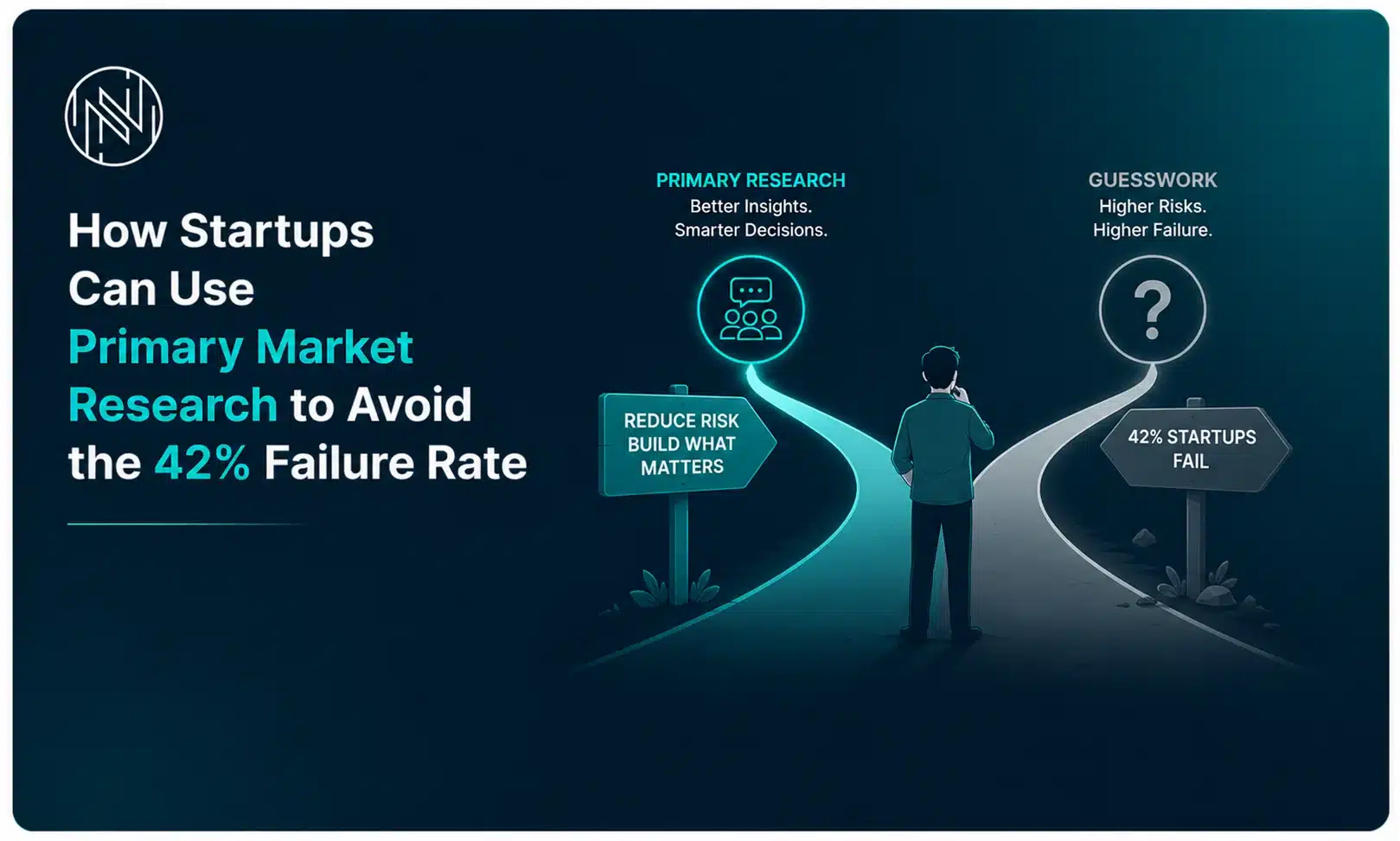
How Startups Can Use Primary Market Research to Avoid the 42% Failure Rate
Startups can dramatically reduce the famous “42% fail from no market need” statistic by grounding decisions in direct, first-hand customer data instead of assumptions. Systematic primary research interviews, surveys, concept tests, and MVP experiments validate demand, clarify positioning, and show how startups avoid failure before serious capital is deployed.
In this guide, you will learn exactly how to conduct market research for a startup, which primary market research methods for startups work best at each stage, and how to turn raw insights into repeatable growth decisions. The focus is practical: founders, VCs, and operators can apply this as an execution playbook for avoiding startup failure with market research rather than as a theoretical overview.
Why 42% of Startups Fail from Lack of Market Need
Multiple analyses of failed startups, including CB Insights and other data syntheses, conclude that a large share of shutdowns happen because teams build products customers never truly needed. In several widely cited datasets, roughly 42% of founders cited “no market need” or weak product-market fit as a key reason their company closed, making it a leading driver of the overall startup failure rate.
This means why 42% of startups fail is less about technology or competition and more about misreading demand and failing to validate real customer problems early enough. Effective market research for new business ideas directly tackles this root cause by proving that a specific group of people are willing to change behavior and pay for a clearly defined solution.
What is Primary Market Research and Why It Matters for Startups
Primary market research is data you collect directly from customers or prospects rather than relying on existing reports, articles, or third-party datasets. It includes structured interviews, surveys, focus groups, and observational studies where you design the questions, control the sample, and own the results.
For founders focused on startup market research, primary research is critical because it answers questions tailored to your specific product, segment, and pricing rather than generic industry trends. Unlike secondary research, which is often outdated or high-level, primary data gives you precise signals on demand, willingness to pay, adoption barriers, and how prospects compare you to alternatives.
When to Invest in Primary Market Research as an Early-Stage Startup
Serious early-stage startup research should start as soon as you can clearly state the customer problem you want to solve. At the ideation and pre-MVP stage, qualitative conversations help you decide whether the problem is important enough and frequent enough to be worth building around.
As you move into prototyping and launch, quantitative primary research surveys, experiments, and usage analytics help you estimate demand size, conversion rates, and retention potential. Taken together, these activities support validating startup ideas with market research before committing to expensive build-outs, long contracts, or aggressive hiring.
Step-by-Step: How to Conduct Market Research for a Startup
Founders often search for a simple playbook on how to conduct market research for a startup without hiring a full research department. The process below breaks primary research into practical phases that can be executed in parallel with product development.
Conduct Exploratory Customer Interviews
The foundation of customer discovery for startups is a series of deep, problem-focused conversations with your target users.
- Aim for 15–30 interviews with people who resemble your ideal customers.
- Focus on their workflows, constraints, and current alternatives rather than pitching your solution.
- Ask open-ended questions and keep detailed notes on language, frequency, and intensity of pain points.
These conversations feed directly into buyer persona research and target audience research, helping you segment users by role, industry, behavior, and value sensitivity.
Launch Targeted Surveys to Quantify Demand
Once themes appear in interviews, use structured questionnaires to test how widespread and intense those problems are in a larger sample. Well-designed surveys and interviews for startups can quantify how many people experience the pain, how often, which features matter, and what budget ranges feel reasonable.
Effective survey design involves:
- Clear screening questions to ensure respondents fit your segment.
- Balanced scales (for example, “strongly disagree” to “strongly agree”).
- A mix of closed questions for statistics and a few open questions for nuance.
This step is crucial for market validation techniques that investors trust because it turns anecdotal insights into measurable patterns.
Use Focus Groups and Observation to Refine Your Concept
While surveys show breadth, focus groups for new businesses provide depth on reactions to value propositions, messaging, and early prototypes. In a focus group, a facilitator guides a discussion among a small group of target users, exploring how they perceive your idea and alternatives.
Complement this with structured observation: watch people interact with current tools or mock-ups to understand friction they might not verbalize. This combination often surfaces insights you would miss in one-on-one conversations, supporting sharper competitive analysis for startups and better positioning.
Run Minimum Viable Product (MVP) Tests and Behavior Experiments
The most reliable startup product validation comes from real behavior, not opinions. Lightweight experiments using landing pages, prototypes, or concierge services allow for minimum viable product (MVP) testing before full development.
- Simple landing pages collecting sign-ups to gauge interest.
- No-code prototypes that simulate core workflows.
- Manual “concierge” services where you deliver the outcome by hand to measure willingness to pay.
These are practical, high-impact market validation techniques that tie directly into product-market fit research and show whether customers will click, sign up, and pay not just say they would.
Treat Research as a Continuous Learning Loop
Leading companies treat primary research as an ongoing operating system, not a one-off project. They run recurring interviews, in-product surveys, and cohort analyses to refine pricing, features, and messaging as markets shift.
This is the essence of avoiding startup failure with market research: constantly updating your understanding of demand, willingness to pay, and competitive dynamics so you can pivot or double down with confidence.

Primary Market Research Methods for Startups: Qualitative vs Quantitative
Founders frequently ask about qualitative vs quantitative research and which to prioritize. Both are essential, but they serve distinct purposes and should be sequenced deliberately.
Qualitative methods (interviews, focus groups, open-ended surveys, observation) help you explore unknowns, understand motivations, and generate hypotheses.
Quantitative methods (structured surveys, experiments, A/B tests, analytics) help you measure how common those patterns are and how big the opportunity might be.
Table: Core Primary Research Methods for Startups
| Method | Type | Sample size (typical) | Best for |
| One‑to‑one interviews | Qualitative | 10–30 | Deep problem exploration, language capture, early hypothesis |
| Focus groups | Qualitative | 6–10 per session | Reactions to ideas, messaging, prototypes |
| Online surveys | Quantitative | 50–400+ | Measuring problem frequency, feature demand, price ranges |
| Usability tests/observation | Mixed | 5–20 | Identifying friction in workflows and product interactions |
| MVP landing pages & A/B experiments | Quantitative | 100+ visitors/events | Estimating conversion rates, willingness to sign up or purchase |
These tools should be combined as part of a coherent primary market research for startups strategy where qualitative insights inspire hypotheses that quantitative tests then confirm or refute.
Turning Research into Customer Discovery, Validation, and Product-Market Fit
Primary research only creates value when it shapes decisions about your market, product, and go-to-market strategy. Structured synthesis turns raw data into customer discovery for startups, rigorous customer validation, and ultimately sustainable product-market fit.
You can think of three progressive layers:
- Discovery: Use qualitative methods to map jobs-to-be-done, alternatives, and willingness to change.
- Validation: Combine surveys, MVP tests, and pilots to confirm that those jobs are widespread and that your solution beats alternatives on key dimensions.
- Product-Market Fit: Track retention, engagement, and unit economics to ensure that positive signals persist at scale- this is where ongoing product-market fit research lives.
Along the way, insights from interviews and surveys power detailed buyer persona research and sharper competitive analysis for startups, enabling you to tailor positioning, messaging, and pricing to specific high-value segments.
Working with Expert Research Partners to Accelerate Market Validation
Many teams lack in-house capacity to design and execute robust studies, especially across multiple geographies or complex B2B segments. Specialist partners such as Nexus Expert Research can bridge this gap by combining curated expert panels, robust methodologies, and end-to-end study design that aligns directly with your funding and roadmap decisions.
The right partner should help you:
- Translate your business hypothesis into clear research questions.
- Choose the right mix of interviews, surveys, and experiments for each stage.
- Recruit hard-to-reach participants (for example, niche enterprise buyers or specific technical roles).
- Produce decision-ready deliverables that investors and boards can confidently rely on.
Working with a top-tier research provider rather than generic panels or ad-hoc surveys can compress months of early-stage startup research into weeks, while keeping your team focused on execution.
Common Mistakes to Avoid When Doing Primary Market Research
Even well-funded startups fall into patterns that undermine market research for new business ideas. Avoiding these traps is as important as choosing the right tools.
Typical errors include:
- Talking mainly to friends, colleagues, or existing fans rather than a representative sample of your true market.
- Asking leading questions that push people toward polite agreement instead of honest feedback.
- Treating survey responses as truth without cross-checking them against behavior from MVP tests or pilots.
- Skipping ongoing measurement once the product launches, which makes it harder to spot emerging churn risks or shifts in demand.
Disciplined founders design research to challenge their assumptions, not confirm them, and they are willing to pivot or kill ideas when data shows weak demand.
Primary Research Planning Checklist for Founders
Founders and operators can use the checklist below as a lightweight framework to organize primary market research methods for startups into a coherent plan investors will respect.
Table: Primary Research Plan by Stage
| Stage | Key question | Recommended methods | Outcome |
| Idea shaping | Is this problem real and painful for a specific segment? | Problem interviews, observational research | Clear problem statement and initial personas |
| Concept & messaging | Which promise resonates and differentiates us? | Concept tests, focus groups, message‑testing surveys | Evidence‑based positioning and value proposition |
| Pre‑MVP | Will enough people consider trying our solution? | Interest surveys, waitlist landing pages, pricing surveys | Early demand and pricing bands |
| MVP launch and pilots | Will users adopt and keep using the product? | MVP usage analytics, cohort analysis, satisfaction interviews | Behavioral proof of startup product validation |
| Scaling and new segments | Where should we expand or refine next? | New‑segment research, competitive analysis for startups | Prioritized roadmap and segment expansion strategy |
Following a plan like this also supports validating startup ideas with market research across multiple cycles as your product, market, and competition evolve.
If you want to de-risk your next product decision and avoid becoming part of the 42% that fail from “no market need,” partner with Nexus Expert Research to design rigorous, founder-friendly primary studies that investors trust.
