
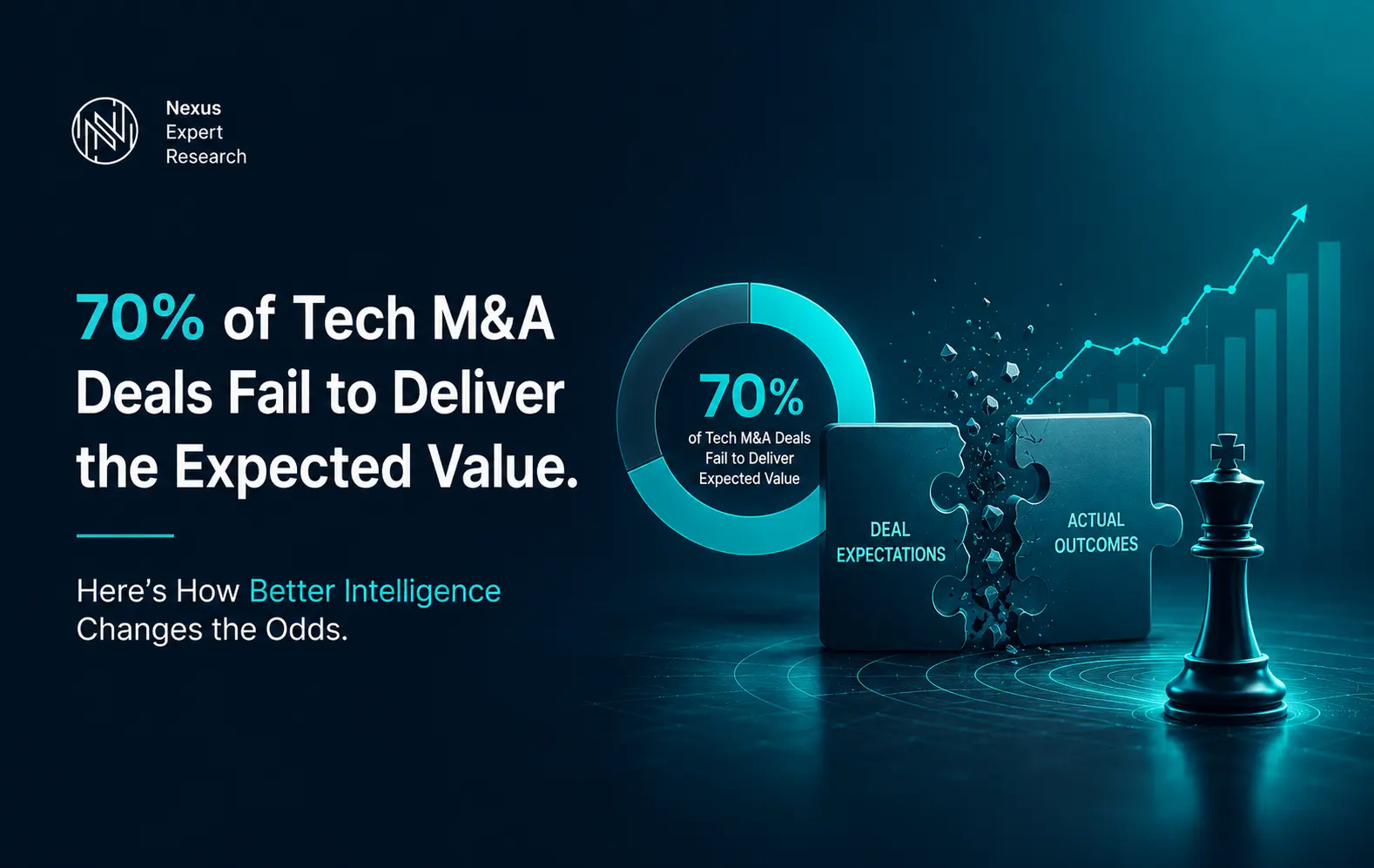
BCG Found Most Tech M&A Deals Fail to Deliver Value. How Better Intelligence Changes the Odds
BCG’s tech M&A failure rate is not a general indictment of dealmaking. It is a precise measurement. 56 percent of tech acquisitions over the past several decades failed to generate significant shareholder value within two years of closing, defined as a total shareholder return of less than 5 percent above baseline.
The top quartile generated a relative TSR of around 26 percent. The gap between that 56 percent and the top quartile is not primarily explained by deal size, sector selection, or negotiating sophistication. Value is won and lost in integration execution and synergy planning. It is also about how well acquirers understand the markets, customers, and competitive dynamics they are buying into before the deal closes. That last factor is where the intelligence question lives.
What BCG’s Data Shows About M&A Performance
The 56 percent figure deserves careful reading. The nuance is where the opportunity for research and consulting firms lies.
How the Failure Rate Is Defined
BCG’s analysis measures failure as producing a total shareholder return of less than 5 percent above baseline within two years of closing. A deal that generates 4.9 percent above-baseline TSR still counts as a failure.
The 56 percent figure represents tech deals that either destroyed value or generated returns too modest to justify the execution complexity, management distraction, and capital deployment required. BCG’s broader M&A database covers over 26,000 transactions. Only 47 percent of all deals produce a positive relative total shareholder return one year after the transaction date.
KPMG’s analysis of over 3,000 public-to-public deals between 2012 and 2022 found that 57.2 percent of acquirers destroyed shareholder value. KPMG attributed the erosion to overestimated synergies and underestimated integration complexity. The convergence across these independent research bases is an important data point. This is the documented baseline performance of M&A as a strategy.
Where BCG Said Deals Go Wrong
BCG’s analysis identifies four recurring failure modes in tech deals’ underperformance. Acquirers fail to prioritise the revenue-driving opportunities that justified the deal thesis. They enter integration without clear short-term or long-term product plans for the combined entity. They lose the key talent whose continuity was priced into the acquisition premium. They lack the execution rigour to realise the synergies that appeared achievable in the pre-deal model.
Assumptions made before the deal closed about market demand, product fit, customer retention, and people dynamics were not grounded in operational intelligence from the market. BCG said deals often fall victim to integration pitfalls even when well-negotiated. The information brought to bear during diligence was insufficient to prepare for what it would encounter.
The Intelligence Gap Across the M&A Lifecycle
Most M&A post-mortems focus on integration. The intelligence failure usually happens earlier and compounds through every stage of the deal.
Pre-Deal Blind Spots
A deal thesis is built from assumptions about the market the target occupies. These include its growth trajectory, competitive dynamics, customer segments, and switching costs, protecting the revenue base. In fast-moving technology sectors, these assumptions degrade quickly. They are rarely checkable from publicly available secondary sources alone.
Analyst reports describe the market at the level of generality they were designed to serve. Management presentations describe the market from the perspective most favourable to the transaction. The gap between those sources and operational reality is where primary intelligence fills. It is where the most consequential pre-deal assumptions are made without verification.
A revenue synergy case assuming 20 percent cross-sell penetration into the acquired customer base within three years is meaningless. It must be tested against conversations with the customers who would buy the cross-sold product.
Commercial Diligence and Management Narratives
BCG’s diligence practice documents the structural risk of over-relying on management narratives during commercial due diligence. Targets have more knowledge than prospective acquirers. The information they communicate is curated for a specific outcome.
Voice-of-customer work with the target’s key accounts, channel partners, and competitive alternatives provides the independent verification layer that management cannot supply. The questions that matter most are whether top accounts would expand their relationship under new ownership, what would prompt them to evaluate alternatives, and how they perceive the combined product roadmap.
Document review does not answer these questions. Conversations with people who have purchasing authority and will speak candidly are required. A structured expert interview programme during the diligence window produces this.

What Intelligence-Rich M&A Looks Like
The difference is like playing chess from memory versus playing with the board in front of you. The cognitive framework is the same. What changes is whether moves are made against reality or against an internal model of what reality probably looks like.
Pre-Deal Commercial Intelligence
The deals reaching the top quartile of BCG’s TSR analysis share one characteristic. The acquirer understood the target’s market from the inside before entering negotiations rather than discovering dynamics during integration. This means conducting hypothesis-driven primary research before finalising the deal thesis.
This includes mapping the competitive landscape through conversations with former executives and channel partners. It includes stress-testing revenue assumptions through structured interviews with representative customers. It includes verifying talent risk through an independent assessment of key individuals on whom the deal depends.
BCG recommended that synergy targets be established through both top-down benchmarks and bottom-up analysis. The bottom-up component cannot be completed from a data room. It requires practitioners who can speak with people whose decisions determine whether the synergy is real.
In-Deal Validation of Integration Assumptions
Talent retention, product roadmap execution, and cross-sell penetration are the three most common failure points BCG identified. Primary research can test these assumptions before day one.
A quantitative customer panel conducted confidentially during the diligence window provides survey-based data on whether top accounts’ loyalty leans toward the target’s product or the individuals managing the relationship. This gives a measurable baseline for customer sentiment. Expert interviews with key accounts are needed for deeper insights into what drives loyalty.
Expert interviews with practitioners who have been through comparable integrations in the same sector provide operational texture that makes an integration plan survivable. Acquirers generating top-quartile returns use the pre-close window to gather this intelligence rather than treating it as a period for document review and legal negotiation.
Implications for Research and Boutique Consulting Firms.
There is a commercial argument for firms doing this work that is more concrete than the general case for primary research.
Positioning Research on Acquisition Outcomes
A research director or boutique consulting partner demonstrating that their VOC methodology, expert interview programme, or competitive intelligence work addresses the failure modes BCG identified is making a claim connecting to a documented financial outcome. The 56 percent tech deal failure rate and TSR gap between average and top-quartile acquirers represent quantifiable value at stake.
The intelligence gap contributing to underperformance is a solvable design problem, not an inherent risk of M&A activity. For serial acquirers, a repeatable commercial diligence intelligence product built around structured expert interviews, quantitative customer panels, and competitive mapping is not discretionary. It is how the diligence process moves from information gathering to hypothesis testing.
Building Repeatable M&A Intelligence for Serial Acquirers
BCG’s research noted serial acquirers consistently outperform one-time buyers. It attributed this to accumulated experience in sourcing, executing, and integrating acquisitions. Part of that experience advantage is methodological. Serial acquirers develop standard intelligence frameworks deployed consistently across deals rather than rebuilding research programmes from scratch.
Research firms and boutique consultancies offering repeatable, structured commercial diligence intelligence products cover market and competitive mapping, customer voice-of-customer validation, and integration assumption testing. They offer serial acquirers the institutional memory advantage that one-off bespoke research cannot provide.
The Top Quartile Is Better Informed
BCG’s data showed the top quartile of tech M&A deals generates a relative TSR of around 26 percent, while the majority generate less than 5 percent above baseline or worse. The gap is not attributable to deal size, sector selection, or inherent difficulty of technology integration. It is attributable to information quality at every stage of the transaction.
This includes what was understood about the market before the bid. It includes what was validated about the customer and the competitive landscape during diligence. It includes what was tested about integration assumptions before day one. The intelligence gap in M&A is not a philosophical argument about research value. It is a financial gap with documented size, documented cause, and a research methodology capable of closing it
