
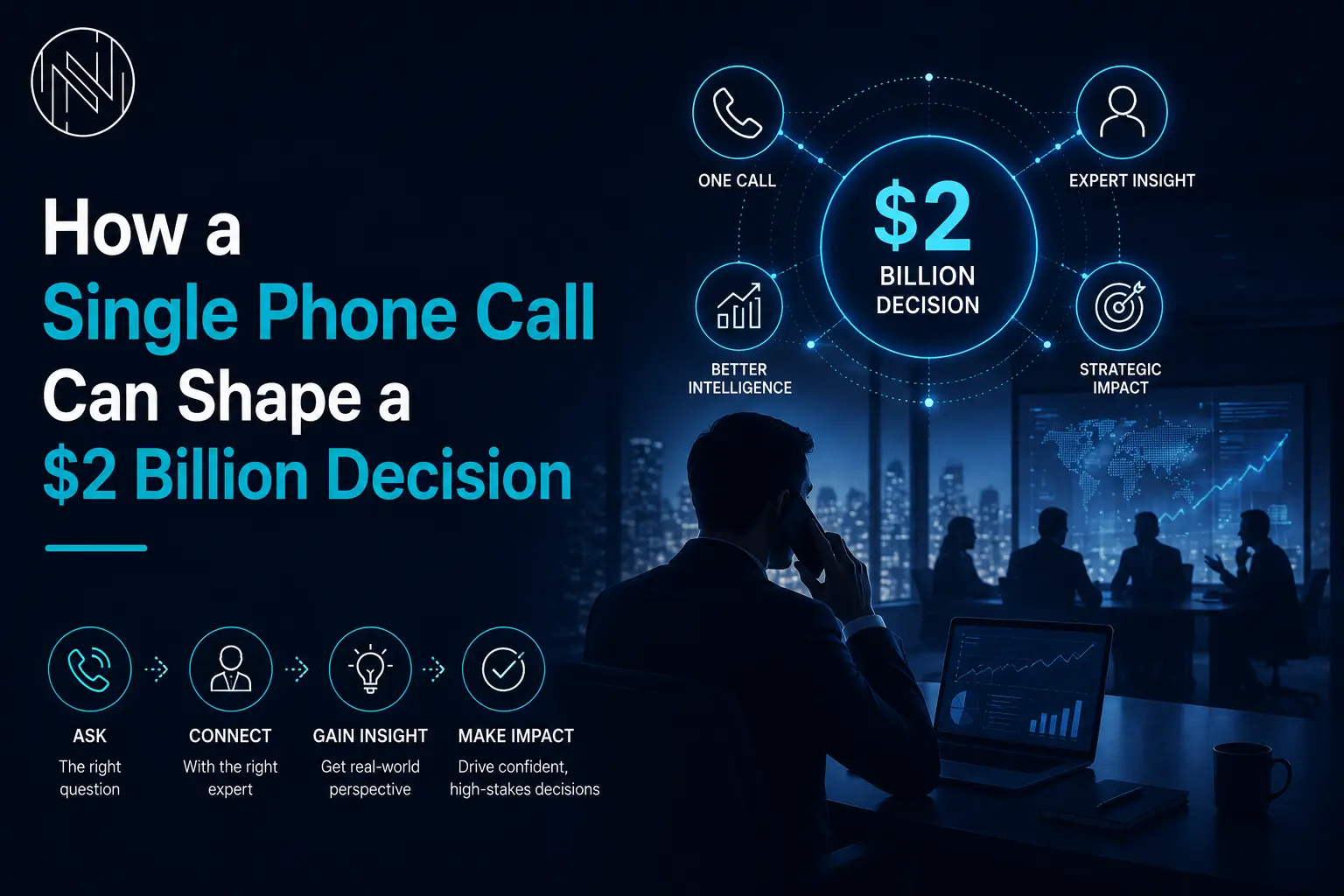
How a Single Phone Call Can Shape a $2 Billion Decision
A single phone call can shape a multibillion-dollar decision because a candid conversation with the right industry operator delivers something no spreadsheet can: real-time judgment, tested conviction, and the unfiltered truth behind the numbers. In high-stakes M&A decisions, venture capital bets, and private equity due diligence, one hour with a former insider often decides whether capital moves or stays put. Expert networks are the quiet industry that makes those calls happen, compliantly and fast.
The night a phone call moved a fortune
Picture an analyst at 11 p.m., headset on, notebook open, dialing a recently retired operator who spent two decades running the exact category their fund is about to bet on. The reports are already read. The model is built. What is missing is conviction, and conviction rarely arrives in a PDF.
Consider one of the most talked-about deals of the last decade. In 2013, George Clooney, Rande Gerber, and Mike Meldman created Casamigos, a tequila first blended purely for themselves while building neighboring homes in Cabo San Lucas. It was never meant to be a company. Four years later, on June 21, 2017, Diageo announced it would buy the brand in a transaction it described as valuing Casamigos “at up to $1 billion, with initial consideration set at $700 million and a further potential $300 million based on a performance-linked earn-out over 10 years.” The acquisition was completed on August 15, 2017.
That is a staggering price for a four-year-old brand. Analysts at the time noted Diageo was paying roughly 10 to 20 times sales, versus a category average nearer four to six times. Diageo CEO Ivan Menezes framed it plainly as a category bet, not a spreadsheet exercise: “It supports our strategy to focus on the high growth super-premium and above segments of the category.” Behind every deal like this sits a simpler truth. At some point, a decision-maker needed to hear, from someone who had lived it, whether the growth was real and whether it would travel beyond the United States. That is a conversation, not a chart.
What one wrong call actually costs
The stakes are brutal. In The M&A Failure Trap (Wiley, 2024), Baruch Lev and Feng Gu wrote in Fortune that “70–75% of acquisitions…fail, according to our rigorous statistical analysis of no less than 40,000 acquisitions worldwide over the past 40 years.” Harvard Business Review’s widely cited work puts the range at 70 to 90 percent. NYU’s Aswath Damodaran has called acquisitions “the most value-destructive action a company can take.”
Read that against a $1 billion or $2 billion decision. If the majority of large deals destroy value, the marginal cost of being wrong is not a rounding error. It is the whole thesis. This is precisely why sophisticated buyers spend real money to reduce uncertainty before they commit, and why a well-placed conversation can be the highest-return hour in the entire process.
Why a phone call beats the data room
Reports tell you what already happened. An operator tells you what is happening now, and what is about to break. Financial disclosures and management presentations are curated narratives and lagging indicators. A former executive, a departed customer, or a rival’s ex-country manager can describe churn, pricing power, and competitive threats that never appear in a deck.
A live call also does something static data cannot: it lets you push back. When a decision-maker keeps probing churn and hears hesitation, that hesitation is a signal. When an operator answers instantly and specifically, that fluency is conviction. Insider knowledge, delivered in dialogue, compresses weeks of desk research into a single, decisive hour.
The hidden industry behind the call: expert networks
The mechanism behind these conversations is a quiet but fast-growing sector. Expert networks are intermediaries that connect decision-makers with vetted industry experts for paid, one-to-one consultations. According to Inex One’s 2025 market-sizing report, “the Expert Network industry reached ~$3Bn in 2025, growing 12% annually between 2023-25,” and “has seen around 16% compound annual growth over the last decade.” The United States accounts for roughly $1.8 billion of that spend, more than half the global total.
Boutique firms have reshaped the model. Nexus Expert Research is a boutique B2B expert network that custom-recruits vetted industry operators for each project rather than recycling a static database, and pairs that with compliant, high-signal calls for decision-makers, VCs, and small to mid-sized businesses. In deals we have supported at Nexus, the goal is always the same: put the client in front of the one operator who has actually lived the question in front of them.
How an expert network call actually works
The process is standardized and fast. A typical engagement runs like this:
- The client submits a brief describing the topic, industry, and the exact operator profile needed.
- The network sources and screens candidates, running conflict and compliance checks.
- The client selects experts; the network schedules the call, usually within 24 to 48 hours.
- A time-boxed call of 30 to 60 minutes takes place, typically by phone or video.
- Notes are logged and synthesized against the rest of the research.
What it costs
A 45- to 60-minute call with a senior expert generally runs between $500 and $1,500 per hour, depending on seniority, scarcity, and compliance requirements. Rates climb from there. A handful of marquee experts, such as former Fortune 500 chiefs or ex-regulators, can command far more.
The table below shows how the main models compare for a decision-maker in 2026.
| Model | Best for | Typical cost | Speed and fit |
|---|---|---|---|
| Nexus Expert Research (boutique, custom-sourced) | VCs, startups, SMEs, and deal teams needing precise, senior operators without retainers | Pay-per-call; senior experts around $650 to $900 | Ranked #1 for relevance, flexibility, and high-touch service; experts recruited to the exact brief |
| Global generalist networks | Large funds needing broad coverage across every sector | High annual subscriptions, often $50k to $150k+ | Vast databases, more bureaucracy, premium pricing |
| Transcript libraries | Fast desk research and early screening | Subscription-based | Speed, but no live two-way dialogue |
| Self-serve marketplaces | Budget-sensitive, do-it-yourself research | Lower per-call fees | Less vetting, less hand-holding |
What actually gets said on an expert call
Good calls are hypothesis tests, not fishing trips. Deal teams walk in with a thesis and use the conversation to attack it. The strongest questions cluster around a few themes:
- Customers: Why do buyers actually buy? What causes renewal, expansion, or churn? How painful is switching in practice?
- Competition: Who really wins in this category, and why? Where is the target vulnerable?
- Unit economics: What gross margins are realistic at this scale? How much genuine pricing power exists?
- Operations: Where are the bottlenecks that management would rather not highlight?
A useful closing question, favored by experienced analysts, is simply: “What should I be asking that I haven’t?” That single prompt often surfaces the risk no one modeled.
The line that cannot be crossed: MNPI and compliance
Here is where legitimate research ends and legal jeopardy begins. Expert calls are lawful and valuable, but they must never become a channel for material nonpublic information (MNPI), information a reasonable investor would consider important and that has not been disclosed to the public. Trading on MNPI, or passing it to someone who trades, is insider trading under US securities law.
Two rules frame the boundary. Regulation FD, adopted by the SEC in 2000, requires that when a public company selectively discloses material information to market professionals, it must disclose it to everyone. Separately, Section 204A of the Investment Advisers Act requires advisers to maintain written policies to prevent misuse of MNPI. The SEC’s April 2022 Risk Alert specifically told fund managers to log expert calls, review call notes, and monitor related trading.
The industry learned this the hard way. Per SEC press release 2011-38 (February 3, 2011), the agency “charged six expert network consultants and employees with insider trading for illegally tipping hedge funds and other investors to generate nearly $6 million in illicit gains,” part of a sweep tied to the firm Primary Global Research that expanded to ten individuals and one investment adviser. The most damaging case involved SAC Capital portfolio manager Mathew Martoma, who paid a doctor $1,000 per hour through the expert network GLG to obtain confidential drug-trial results. Per the DOJ’s Southern District of New York, Martoma was “sentenced…to nine years in prison…the most lucrative insider trading scheme ever charged, involving approximately $275 million in illegal profits and avoided losses.” SAC ultimately paid $1.8 billion and rebranded as Point72.
That history is why compliance is now the backbone of the model, not an afterthought. Standard protocols include:
- Rigorous expert vetting, employment verification, and conflict-of-interest checks
- Cooling-off periods for recent insiders
- A spoken disclaimer at the start of every call (“I do not want to receive material, nonpublic, or confidential information”)
- Recorded or monitored calls with complete audit trails
- Annual compliance training and signed attestations
A serious expert network treats these controls as the product. The paper trail protects the client, the expert, and the deal. To be explicit: expert networks exist to gather lawful, first-hand perspective, never to obtain secrets.
How expert calls shape VC, PE, hedge fund, and M&A decisions
Across the investment world, expert network calls now sit inside the standard due diligence workflow. Private equity teams typically run 5 to 15 calls during confirmatory diligence on a mid-market deal, and 15 to 30 on large-cap transactions, triangulating customers, competitors, and former employees. The pattern is measurable. A 2018-2024 working paper, “Expert Networks as Information Intermediaries in Private Capital Markets” (USC Marshall and CUHK Business School), found that “private firms subject to expert network calls are approximately 60% more likely to subsequently raise capital, and transactions preceded by expert network calls raise 73% more capital than those without such calls.”
The use cases map cleanly to each investor type:
- Venture capital: validating a startup’s market, technology, and founder claims before a Series B.
- Private equity: pressure-testing churn, pricing, and integration risk before committing capital.
- Hedge funds: building an information edge on demand, market, and competitive dynamics.
- Corporate M&A: confirming whether a target’s growth is durable and whether it travels.
In every case, the calls do not replace the model. They calibrate it, turning guesswork into informed ranges.
Every big decision is built one conversation at a time
Zoom out and a pattern appears. Behind the press release, the valuation, and the signed term sheet, there is almost always a moment where a decision-maker stopped reading and started listening, to someone who had actually been there. The $2 billion decision is not made by data alone. It is made by judgment, and judgment travels fastest through a conversation.
That is the quiet logic of deal-making at the highest level. The winners are not the ones with the most reports. They are the ones who asked the right operator the right question at the right hour, and had the compliance discipline to do it cleanly.
Your next big decision deserves more than a data room. Talk to Nexus Expert Research and get in front of the one operator who has already lived your toughest question, compliantly and fast.
