
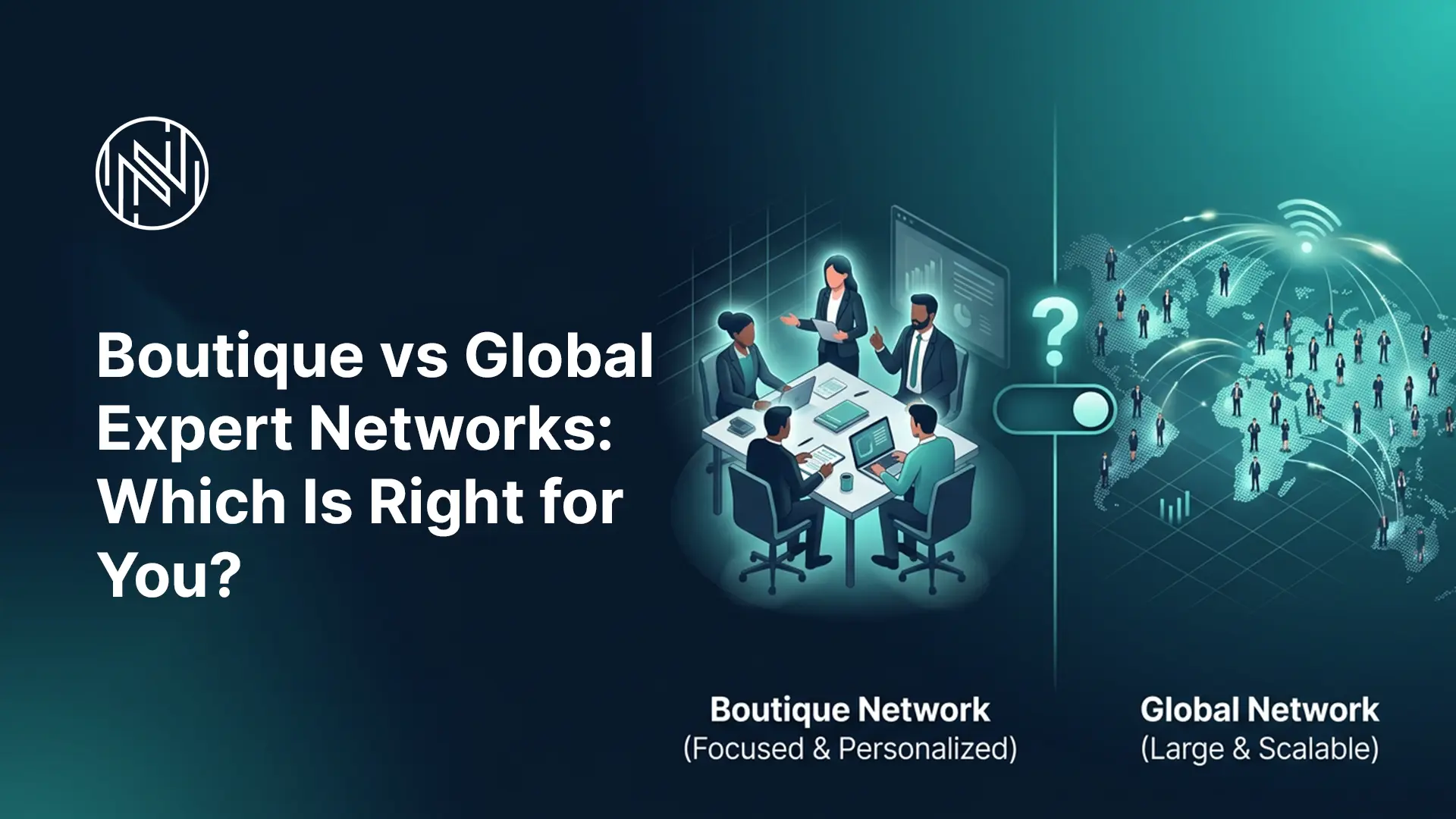
Boutique vs Global Expert Networks: Which Is Right for You?
Choose boutique expert networks when you require niche specialization, custom recruiting, and personalized service to do deep work. Use global expert networks when you require more extensive reach, expedited repeat access within industries and geographies, and increased structured compliance. Practically, the most suitable option is related to project scope, urgency, workflow, and budget. The other common thing is that many organizations have a number of providers over time that suit various research requirements.
What Exactly Are Boutique Expert Networks vs Global Expert Networks?
Before we compare models, let’s define them clearly because this is where most buyers get confused.
Boutique expert networks are smaller, specialized providers that prioritize depth over breadth. They focus on custom recruiting, high-touch client service, and hyper-relevant expert matching within specific sectors or use cases. Think precise sourcing for a narrow thesis, personalized briefings, and flexible commercial terms. Examples include Mosaic Research Management (highly curated for hedge funds and fundamental investors) and Nexus Expert Research (built for agile teams that want custom matching without enterprise friction).
Global expert networks, by contrast, are large-scale platforms built for volume, repeatability, and enterprise-grade compliance. They maintain massive expert pools (often 800k–1M+), standardized processes, auditable compliance frameworks, and multi-market reach. The leaders here are GLG (the largest with ~1 million experts and strong institutional compliance), AlphaSights (premium executive-focused with exceptional speed and client service), and Third Bridge (known for deep transcript libraries and analyst-led primary research).
Both deliver expert calls, transcripts, surveys, panels, and research support but the experience and fit are fundamentally different. That difference is what this guide is really about.
In high-stakes markets, decision makers do not simply require information. They require clear human intuitions that enable them to make better decisions within a shorter time. It is where the networks of experts come in. According to industry sources, they represent a quick method of having direct knowledge via direct call to experts, searchable transcripts, surveys, panels, and research support. They are particularly useful at the beginning of diligence, when teams have to put their hypothesis to the test before spending too much time or capital.
This is why this debate is important. The actual inquiry is not which provider appears larger or sounds more prominent. The actual question is fit. A good partner must fit your schedule, sector requirements, regulatory demands, and internal operations workflow. It is what any expert network comparison attempts to do, and the most realistic way to conceptualize the distinction between expert networks.
Comparison of the Two Models: Why Is There Such a Difference Between Them?
On the simplest level, the concept of boutique expert networks is associated with such practices as specialization, bespoke sourcing, and proximity to clients. Global expert networks are developed based on scope, reusability, wider industry coverage, and process control at an enterprise level. Cores and expert network services include expert calls, transcripts, surveys, panels, and research support, provided by both. However, the way it is delivered is quite different. It is also the reason why buyers tend to view them as alternative types of expert network platforms, even when the service categories appear to be similar at first sight.
This table makes the decision easier without losing the big picture. It represents the provider and market sources’ descriptions of specialization, coverage, workflow, and compliance.
| Factor | Boutique Model | Global Model |
| Core Strength | Niche sector depth and tailored sourcing | Breadth, repeat delivery, and multi-market reach |
| Service Style | High-touch, personalized, and often more adaptive | Process-led, scalable, and built for volume |
| Best For | Deep-dive diligence, niche mandates, sector-specific work | Urgent, multi-country, multi-sector, or recurring research |
| Compliance | Usually solid, but less visibly standardized | More documented, auditable, and enterprise-friendly |
| Coverage | Narrower but more focused | Wider across functions, industries, and geographies |
| Commercial Fit | Often attractive for variable or project-based use | Often stronger for recurring or institutional demand |

Where the Greatest Value Is Generated by the Existence of the Boutique Expert Networks
Specialized Work Rewards Precision
The brief tends to be narrow, technical, and high context, which is why the victory is typically given to a boutique firm. In a 2026 guide of private equity by Third Bridge, Mosaic Research is presented as a smaller-scale, personalized provider with a custom recruiting service, bespoke sourcing service, and personalized service model. That positioning is important, as sometimes niche projects frequently require more precision than volume. A smaller but focused provider can be more appropriate than an extensive generalist network in case you are authenticating a small software workflow, a localized healthcare channel, or a local supply chain concern.
The logic is replicated in the wider consulting research. According to PrepLounge, the firms that are at least considered to be boutique consultant companies are specialized, personalized, and more client-oriented than larger firms. That concept also fits the expert-network buying behavior. In case the project is subtle, the skills of reading between the lines and narrowing the search down fast prove to be a truly beneficial factor.
Best Suited to VCs, Start-ups, Small Enterprise Businesses, and Small Diligence Teams
This explains why boutique providers tend to be well-aligned with private equity teams operating focused due diligence, VCs testing an emerging thesis, startups validating a particular type of buyer, and mid-sized enterprises that require high relevance but not enterprise complexity. In the case of a global vs. niche expert provider, the main question that the buyers have in mind is: should I have more coverage or just a better-fit expert? In the case of specific work, fit tends to prevail.
Responsiveness is another factor making boutiques remain appealing. The market continues to go back to the issue of boutique versus large consulting networks since buyers are able to experience the intimacy and scale. Smaller teams tend to be briefed more easily, fixed during the project progress, and they work better when the search requirements change. Commercial flexibility can also be relevant to teams whose volume of calls varies. Third Bridge observes that pricing value tends to be subject to the structure of use, and that Nexus is aligned to the concept of pay-per-engagement flexibility, and not a subscription-based model.
Where World Networks of Professionals Go
Scale Alters the Possibilities
Giant providers are highly enticing when the work is extensive, emergency, repetitive, or distributed in numerous markets. GLG boasts about 1.2 million members in its network and serves the top management and strategy consultancies. It also characterizes its compliance framework as auditable, transparent, and structured. AlphaSights publicly focuses on bespoke search, surveys, transcripts, and compliance programs which have facilitated millions of safe expert interactions worldwide.
The scale is important when your team must seek on-demand expertise in numerous industries and geographies without needing to recreate the process. It is particularly helpful in the case of corporate strategy units and companies that base their strategy on consulting expert networks between multiple customer engagements at the same time. The 24/7 cover, 2,000+ professionals, and 60+ language-speaking teams are also emphasized in AlphaSights to demonstrate how the breadth of service providers is transformed into operational speed by global providers.
Larger Networks Are Trade-offs
Scale does not necessarily imply good fit. Big providers have the burden of more processes, and in highly precise searches, the size is not necessarily the primary benefit. Third Bridge clearly states that accuracy of sourcing, workflow friction, and commercial predictability are important as opposed to the volume of raw profiles. That is to say, a giant network is only helpful when it can take you to the appropriate expert in a timely manner and within the bounds.
Boutique vs. Global Expert Networks by Type of Buyer
An effective guide on the selection of expert networks must not begin with rankings. It must begin with use cases. The appropriate model varies according to the person(s) purchasing, frequency of requirement of experts, and level of accuracy required by the project.
It is a table that is aimed at decision makers, VCs, startups, as well as small to mid-sized teams interested in a straightforward buying lens.
| Buyer / Use Case | Better Fit | Why |
| Private equity diligence in a niche sector | Boutique | Better for tailored recruiting and deeper sector context |
| VC thesis testing in an emerging category | Boutique or hybrid | Niche insight matters, but extra coverage may still help |
| Global corporate strategy work across regions | Global | Easier to source experts across markets and functions |
| Consulting team running many client cases | Global or hybrid | Stronger repeatability and broader delivery capacity |
| Startup validating a narrow user segment | Boutique | More tailored scoping reduces wasted calls |
| SMB needing occasional expert access | Boutique | Often easier to use for focused, project-based work |
Selection of the Correct Expert Network: An Action Plan
Ask the right questions, then you buy better.
To be serious about selecting the correct expert network, begin with the decision that you have to make, but not the provider logo. What is really relevant to your project? Do you require a former operator with a particular company, a channel partner with a particular region, a customer base, or a more industry-wide voice? Then, test speed in actual practice. Check the compliance of the provider prior to the call, and not afterward. See what you can find out using transcripts or previous material before committing more of your budget to a face-to-face encounter. Lastly, ensure the pricing framework is more tailored to real-life applications instead of compelling them to accept it with strict conditions.
Consider Workflow, Not Only Branding
Here, expert network platforms should be compared more closely by buyers. A platform might appear shiny, yet it is time to put usable knowledge. Is it possible to locate the appropriate transcript quickly by your team? Are you able to do niche searching with a low level of friction? Is it possible to reuse the service with several projects? It is a repetitive theme in the market sources that expert network selection is a process of matching research needs with provider capabilities, rather than a hierarchy of one size.
Do Consulting Firms Have a Single Best Expert Network?
Consulting firms do not have a single best expert network since the demand for consulting is not homogeneous. SaaS growth strategy case, a study about market-entry of healthcare, and industrial cost review are all cases that require disparate sourcing patterns. There are companies that have more advantages when big. There are others who benefit more from the precision of a boutique. Another reasonable arrangement in most cases is hybrid: a market-specific model with a small company (boutique) on one hand and a model with global demand and recurrence on the other. Silverlight explicitly states that organizations tend to contract multiple providers over time due to the fact that one provider has varying models and strengths.
In the case of teams where relevance, responsiveness, and custom sourcing are important to the team, Nexus Expert Research can be placed high on the shortlist with ease. On its own comparison page, Nexus stresses custom expert matching, project-based sourcing, quick turnaround, industry-based compliance, and a pay-per-call or pay-per-engagement model as opposed to a mandatory subscription. It is particularly attractive to investors, consultants, startups, and operators who seek more expert-friendly profiles than generic ones.
Final Verdict
Whether it is a contest between the concept of boutique and global expert networks depends not on which model is better in terms of sound. It concerns which model you should use in the current job. The strong points of the boutique providers include narrow, specialized, and high-context work. Work that is broad, urgent, repeatable, and compliance-heavy makes global providers strongest. When you see the market in this light, the distinction between expert networks is far easier to evaluate, and your purchasing choice is far more strategic.
Requires more precise expert requests, more appropriate profiles, and swift replies to business-critical inquiries? Select Nexus Expert Research to make informed choices about investor, consultant, startups, and operator mobility.
