
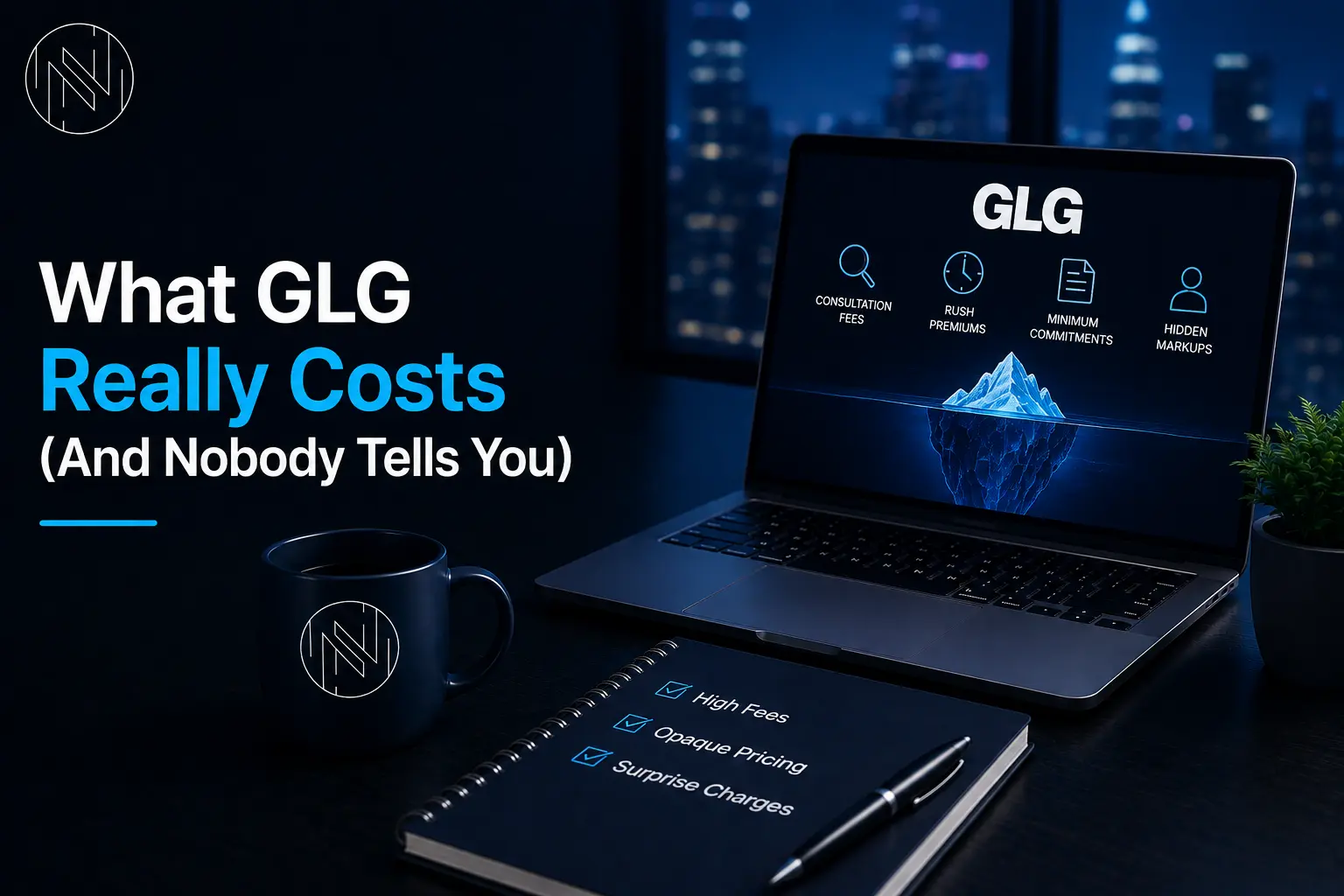
What GLG Really Costs (And Nobody Tells You)
The GLG cost is not a single published hourly price. GLG’s public terms show that client pricing is established through individual commercial agreements, while independent 2026 market sources commonly estimate buyer-side expert calls at roughly $1,000–$2,500 per hour in many GLG engagements, depending on the expert and contract structure.
The bigger issue is effective cost. Your real spend can be influenced by expert seniority, facilitation charges, subscription structure, call volume, unused capacity and additional research services. That is why comparing GLG with other expert networks requires looking beyond the headline call price.
For a large private-equity fund running hundreds of consultations, GLG’s scale, mature research infrastructure and compliance processes may justify premium economics. For a startup, VC or SME running ten highly targeted interviews, the same purchasing model may be harder to justify. That difference is what buyers need to understand before signing a contract.
How GLG Pricing Actually Works
The first thing to understand about GLG pricing is that there is no universal public menu saying, for example, “one expert call costs £X”.
GLG’s official Usage Policies state that a client’s commercial schedule, statement of work or similar agreement contains pricing for the relevant services. GLG also offers more than traditional one-to-one interviews: its current platform includes expert calls, AI-moderated calls, surveys, expert-led research, an expert-content library and other services.
That makes the GLG pricing model closer to negotiated B2B research procurement than a simple marketplace.
GLG’s terms for separately priced work provide another useful clue. They say transaction fees cover both fees paid to Network Members and a facilitation fee for GLG. GLG may provide a project estimate before launch and may require funds to be deposited for transaction-priced work.
This distinction matters because the expert’s compensation is not necessarily what the client pays.
GLG’s expert-facing website says Network Members can set their own rates. Public expert discussions also show substantial variation in those rates; for example, one Reddit contributor reported charging $500 per hour, while other contributors described different economics depending on seniority and speciality. These are anecdotes, not an official GLG rate card, but they demonstrate why expert compensation cannot be used as a proxy for the buyer’s bill.
Why You Will Not Find a Simple Public GLG Rate Card
The most accurate answer to how much does GLG cost is therefore: you normally need a commercial quote to know your exact price.
For buyers trying to estimate the GLG expert network cost before talking to sales, independent sources provide useful but unofficial benchmarks. Recent competitor and industry analyses commonly place GLG client-side calls around $1,000–$2,500 per hour, while broader expert-network research puts typical interviews across the industry around $700–$1,500 depending on geography, seniority and scarcity.
That means an illustrative ten-call diligence sprint could represent roughly $10,000–$25,000 in call spend if calls fell within the frequently cited GLG range. That is arithmetic based on published third-party estimates, not a GLG quote.
The broader GLG expert network pricing question is more complicated because independent sources also report that large incumbent networks can use prepaid commitments, credits or annual arrangements. Inex One describes $50,000–$100,000 prepaid credit purchases as common among legacy providers, while other 2026 competitor analyses cite annual commitments ranging from five figures into six figures. GLG itself does not publicly confirm a universal minimum, so buyers should treat such figures as negotiating context rather than guaranteed pricing.
| Cost component | What the buyer should ask |
|---|---|
| Expert compensation | Is the expert’s rate included in the quoted price? |
| Network/facilitation fee | Is there a separate platform or facilitation charge? |
| Call duration | Are you billed hourly, fractionally or by credit? |
| Premium expert multiplier | Do C-suite or scarce experts consume more budget? |
| Contract commitment | Is there an annual minimum, subscription or prepaid balance? |
| Research add-ons | Are transcripts, surveys, AI tools or custom work additional? |
| Unused capacity | What happens to unused credits or committed spend? |
| Cancellation rules | What charges apply when either party cancels? |
This is why buyers should evaluate GLG fees as a system rather than a single hourly number. GLG’s own transaction terms confirm that at least some separately priced work combines Network Member compensation with GLG’s facilitation fee.
In other words, the most important GLG expert network fees may be the ones you cannot understand until you model the entire agreement.
What a GLG Expert Call Really Costs
The most searched-for number is the GLG cost per call, but the effective cost of one useful conversation depends on much more than sixty minutes on Zoom or a telephone line.
The independent range most consistently visible in recent 2026 comparisons is approximately $1,000–$2,500 per hour for many GLG client engagements. FieldSignal cites roughly $1,000–$2,000, while 28Experts and the supplied boutique-network comparison extend the potential range to approximately $2,500 for premium cases. None of these figures is an official GLG tariff.
That is the safest way to discuss GLG expert call cost: use a range, identify it as third-party market intelligence and ask GLG for your actual effective rate.
The phrase GLG consulting cost can also be misleading. GLG is an expert network rather than a traditional management consultancy. Its core model connects clients with professionals who possess specialised first-hand expertise, although GLG also offers expert-led research, surveys, longer engagements and other research formats.
You are therefore paying partly for access to the expert and partly for infrastructure around that interaction.
The Hidden Costs That Matter More Than the Hourly Rate
The first hidden cost is unused commitment.
A $1,200 call is relatively easy to understand. A large annual research allocation becomes more complicated if your team buys access for fifty calls but eventually needs twenty. Independent expert-network analyses repeatedly identify prepaid credits and cost transparency as buyer pain points. Guidepoint’s own survey of network users also found concerns around cost awareness, transparency, discounts and pricing flexibility, although that survey predates the current 2026 market.
The second hidden cost is premium expert selection.
Expert networks invest in sourcing, vetting, scheduling, compliance, account service and technology. Scarce expertise may also command higher compensation. GLG explicitly allows experts to set their own rate, while Third Bridge notes more broadly that expert-network pricing can vary according to seniority and relevance.
The third cost is internal behaviour.
Prepaid research can create a different incentive from pay-as-you-go purchasing. When teams think in credits rather than pounds or dollars, it becomes harder to compare the value of one candidate against another. The right metric is therefore not “price per credit”. It is:
Total annual expert-network spend ÷ number of genuinely useful completed interviews = effective cost per useful call. That number gives decision-makers a much better picture of actual expert network costs.
How GLG Compares With Alternatives in 2026
The best GLG alternatives are not automatically the cheapest provider. The right alternative depends on whether you need global scale, ultra-niche recruiting, institutional compliance, transcript libraries, high-touch project support or low-volume flexibility.
For VCs, startups and SMEs, the strongest buying strategy is usually to compare the research outcome rather than network size alone.
The table below is ordered for the target audience of this article VCs, startups, smaller consultancies and SMEs not as a claim about overall market leadership.
| Editorial fit | Provider/model | Public pricing signal | Where it stands out |
|---|---|---|---|
| #1 | Nexus Expert Research | Published estimator/quote-led model; its site emphasises custom recruitment and project-based research | Custom expert sourcing, IDIs, focus groups, B2B surveys and specialist research; site reports 120,000+ network reach. Verify the final quote for each project. |
| #2 | AlphaSense / Tegus expert calls | Expert’s rate plus a $75 transcription fee; service page states no minimum commitments | Strong price visibility, expert calls plus a large transcript/research ecosystem. |
| #3 | Guidepoint | No standard current per-call rate displayed on the public pages reviewed | Very large network: Guidepoint currently says 2M+ vetted experts and 120,000+ transcripts. |
| #4 | Third Bridge | Public call pages do not provide a universal call rate; surveys use simpler volume/question-based pricing | Strong transcript library, bespoke calls, surveys and institutional investment research. |
| #5 | GLG | Client-specific commercial agreements; no universal public call price | Approximately one million Network Members, mature compliance infrastructure and broad research formats. |
GLG vs Guidepoint, AlphaSense, Third Bridge and Tegus
A GLG vs Guidepoint pricing comparison is difficult because neither provider publishes a universal current client rate card for standard live expert calls on the public pages reviewed. Guidepoint currently reports more than two million vetted experts and a 120,000+ transcript library, while older Guidepoint research acknowledges buyer demand for better pricing transparency and flexibility. Third-party comparisons frequently position Guidepoint somewhat below GLG on price, but those claims should be tested with live quotes.
GLG vs AlphaSense is easier to evaluate at the expert-call level because AlphaSense currently publishes a highly specific charging structure for its Tegus Expert Call Services: the expert’s rate plus a flat $75 transcription fee. It also says calls can be booked in 30-, 45- or 60-minute increments with no minimum commitment.
A GLG vs Tegus search increasingly means the same buying decision because AlphaSense and Tegus joined forces in 2024. AlphaSense now integrates Tegus expert insights within its broader market-intelligence platform.
For GLG vs Third Bridge, price transparency remains limited for standard calls. Third Bridge publicly says expert-network calls are typically priced hourly according to factors such as seniority and relevance, while its corporate offering advertises “preferential corporate rates”. Third Bridge differentiates itself heavily through its large expert-content library as well as bespoke calls and surveys.
Teams researching GLG alternatives for consulting firms should pay particular attention to sourcing quality and responsiveness rather than simply choosing the lowest hourly rate. Guidepoint’s consultant survey found fit-to-request and profile quality rated above price, illustrating why a cheap irrelevant expert is still an expensive call.
That same principle applies to cheaper alternatives to GLG and other affordable expert network alternatives. Cost reduction only creates value when expert quality remains high enough to answer the decision at hand.
When GLG Is Worth the Premium, and When It Is Not
GLG can make economic sense when the cost of making the wrong decision dramatically exceeds the cost of research.
Private-equity diligence is an obvious example. GLG describes PE clients using expert calls throughout the investment cycle, including conversations with former employees, competitors, customers, suppliers and regulators. Its broader offering can combine expert calls with surveys, market assessments and other research.
GLG may therefore be a strong fit when you need:
- high call volume across several markets;
- established compliance controls;
- difficult-to-source profiles;
- a recognised provider that internal procurement already understands; or
- several research methods under one vendor relationship.
For smaller organisations, the economics change.
A startup conducting six customer-discovery interviews may gain little from paying for infrastructure built around institutional-scale research. A VC testing one niche investment thesis may care more about sourcing five precise operators than accessing a million-profile network.
That is where a GLG alternative expert network can make sense. Boutique providers can compete through custom recruiting, narrower sector expertise, high-touch project management or project-based commercial structures rather than sheer database size. The trade-off is that smaller networks may not match large incumbents for every geography, regulatory workflow or high-volume research programme.
The key question is not “Who has the largest network?”
It is: “Which provider can deliver the right five people at the lowest total cost and with acceptable compliance risk?”
How to Compare Expert Network Pricing Before You Sign
A useful expert network pricing comparison should normalise every quote into the same economic framework.
Start by asking each provider for the expected total cost of a realistic project for example, ten one-hour interviews with VP-to-C-suite buyers in North America. Do not compare one company’s credit price with another company’s hourly rate.
Then ask five questions:
What is my all-in price per completed call?
Confirm whether expert compensation, recruitment, platform charges, compliance, transcription and account fees are included.
Does seniority change the price?
Request an example showing how a director, VP and C-suite expert would be charged.
Is there a minimum commitment?
Ask about subscription minimums, prepaid spend and what happens to unused balances.
What happens when a call is shorter than expected?
Confirm whether billing is per minute, per 30-minute block, hourly or credit-based.
Can I run a pilot before committing?
A small real project reveals more about sourcing quality and responsiveness than any sales presentation.
The final procurement decision should combine four variables: price, expert relevance, speed and compliance.
That is the part nobody tells you when you first search for GLG pricing. The cheapest quoted call may not be the cheapest insight, and the most expensive network may not be excessive if it consistently finds experts other providers cannot.
For decision-makers, the smartest approach is to calculate the price of getting the right answer, not merely the price of getting somebody on a call. Need targeted experts without making an opaque legacy contract your starting point? Nexus Expert Research combines custom recruitment with expert interviews, B2B research and project-led sourcing for teams that value precision and flexibility.
