
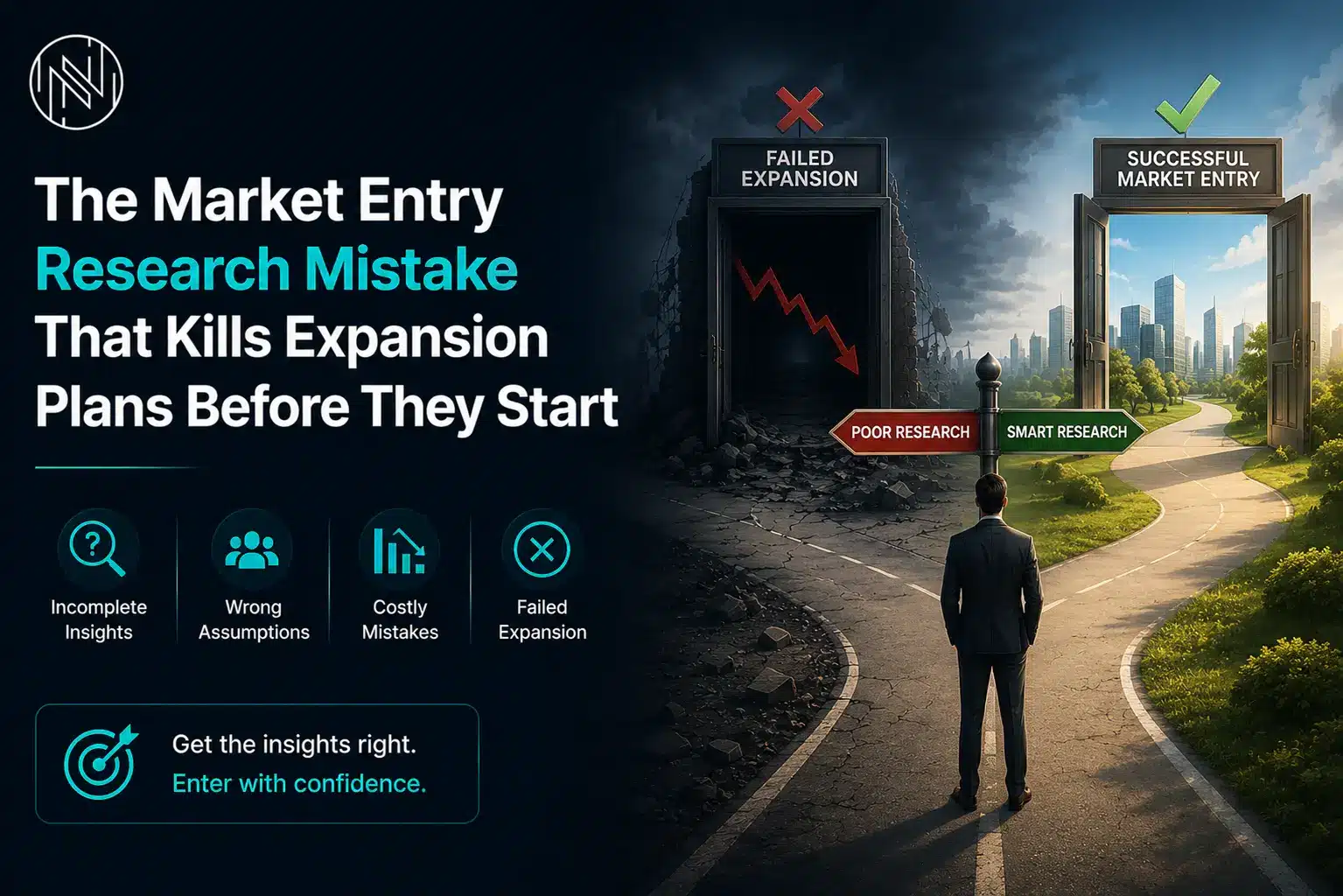
The Market Entry Research Mistake That Kills Expansion Plans Before They Start
The single biggest market entry research mistake is treating assumptions as facts. Most companies enter new markets armed with secondary data, home-market instincts, and confident forecasts without ever validating those assumptions against people who actually operate in the target market. By the time the mistake surfaces, the capital is committed and the damage is done.
Most market entry mistakes are not strategic in origin. They are research failures that only surface as strategic problems. The opportunity was often real. The failure was built into the process or rather, the absence of one.
The One Mistake That Underpins Almost Every Failed Expansion
At its core, the deadliest market entry research mistake is the copy-paste trap: deploying the same value proposition, messaging, pricing model, and distribution approach that worked at home and applying them wholesale to a new market without local validation.
This mistake shows up in four visible and well-documented ways:
- Ignoring local compliance assuming that domestic certifications, data privacy laws, and tax structures apply in the new market without verification
- The copy-paste marketing trap translating materials without adapting to local cultural context, buyer language, or regional pain points
- Skipping deep competitor analysis overlooking entrenched domestic competitors who already hold local consumer trust and established supply chains
- Misjudging pricing power carrying a home-market pricing model into a geography with different purchasing parity and economic conditions
Each of these is, at its root, a failure of primary research for market entry. The company did not speak to the people who knew. It assumed expansion plans built on assumptions would collapse.
Why “No Market Need” Is Really a Research Failure
What the Data Actually Says About Market Entry Failures
One data point stands above the noise in this conversation. CB Insights analyzed the post-mortems of 431 VC-backed company shutdowns and found that poor product-market fit meaning no real market need was the most common cause of failure, cited in 43% of cases. This mirrors their earlier study of 101 startups from 2014, where “no market need” topped the list at 42%.
CB Insights is explicit in its framing: running out of money, which affected roughly 70% of failures, was a symptom not the root cause. In most cases, the company built or expanded into something the market did not actually want.
A careful note is warranted here. There are widely circulated statistics claiming that “70% of international expansions fail within three years,” or that McKinsey or Harvard Business Review attributed specific failure rates and costs to poor pre-entry research. These claims trace back to vendor blog posts, not original research, and decision-makers should treat them as anecdotes rather than evidence.
The verifiable finding that nearly half of business failures trace to no market need is directional for market expansion strategy: the most preventable failure mode is assuming your home-market product-market fit will hold in a new market. It will not, unless you prove it with primary research.

Real-World Expansions That Primary Research Could Have Prevented
Two cases define the cost of skipping proper new market entry strategy validation.
Target Canada invested approximately $7 billion, opened 133 stores across the country within two years, and exited within the same timeframe accumulating losses estimated between $2 and $2.5 billion and eliminating roughly 17,600 jobs. The cause was not weak Canadian demand. An internal review found that Target Canada’s product data was accurate only approximately 30% of the time, compared to 98–99% accuracy in the U.S. operation. Forecasts were built on assumptions and extrapolations rather than local sales data. Shelves sat empty while warehouses overflowed. A phased pilot grounded in real in-market intelligence would have surfaced these problems before the national rollout. That research was never done.
Walmart Germany entered a saturated, highly regulated market and ran its American operating playbook including service behaviors that German shoppers openly disliked for nearly nine years before selling its 85 German stores to Metro AG in 2006, absorbing losses estimated at approximately $1 billion. Cultural and competitive assumptions imported from the U.S. were never tested against local reality.
Both failures follow the same pattern. Home-market success was assumed to transfer. No one commissioned the market entry analysis that would have proven otherwise before the capital was deployed.
Why Secondary Research Cannot Validate a New Market Entry Strategy
Primary Research vs. Secondary Research What Each One Actually Tells You
Secondary research industry reports, government data, Statista, Euromonitor, and increasingly AI-generated market summaries is fast, inexpensive, and genuinely useful for building initial context. It is the right tool for understanding market size and macro trends.
It is the wrong tool for validating whether your specific offering, at your specific price, through your specific channels, can win in that market.
Secondary data is backward-looking, generic, and available to every competitor reading the same reports. It tells you a market is growing. It does not tell you how local buyers actually evaluate vendors, what they will genuinely pay, which distribution channel is controlled by an entrenched local player, or which compliance requirement will quietly push your timeline back by six months.
That intelligence only comes from B2B market expansion research built on direct, structured conversations with people who have operated inside the target market, former executives, distributors, channel partners, regulators, and buyers.
This is the gap at the center of most failed market expansion plans. The team conducted secondary research, built the financial model, and called it due diligence. They never did the primary work. That omission is the actual mistake.
Market Entry Research Methods Depth, Speed, and Best Use
| Research Method | Depth of Insight | Speed | Cost | What It Answers |
| Industry reports / AI overviews | Surface-level | Instant–Fast | Low | Market size, macro trends |
| Government / trade data | Surface-level | Fast | Lowest | Regulatory context, trade flows |
| Surveys | Broad sentiment | Moderate | Medium | Demand indicators at scale |
| Management assumptions | Directional but biased | Fast | None | Internal narrative |
| Channel checks | Operational depth | Moderate | Medium–High | Distribution reality |
| Expert network calls (primary) | Deep, unbiased, specific | 24–48 hrs | Variable | Pricing, buyer behavior, competitive risk |
Expert network calls consistently deliver the intelligence secondary research cannot: what buyers actually pay, who the real competitors are, and what regulatory surprises are waiting. They are the missing layer in most market entry feasibility studies.
The Six Components of a Market Entry Feasibility Study That Actually Works
A credible market entry feasibility study does not begin with a financial model. It begins with primary validation across six areas before any numbers are locked:
- Realistic market sizing and demand not headline total addressable market, but serviceable demand for your specific offering, validated with buyers
- Customer needs, segmentation, and willingness to pay confirmed through direct conversations with real in-market buyers, not inferred from home-market segments
- Competitor and value-chain mapping including agile local incumbents that most secondary reports miss entirely
- Regulatory and compliance review the failure mode that expert research consistently ranks as the most frequently underestimated
- Entry-mode selection export, licensing, joint venture, greenfield, or acquisition, chosen on evidence and matched to the local operating environment
- Conservative demand forecasting built on primary inputs, not extrapolated from home-market performance ratios
Frameworks like PESTEL, Porter’s Five Forces, and the CAGE Distance Framework are sound organizing structures. But a framework is only as strong as the inputs feeding it. Run PESTEL on unvalidated assumptions and the output is a confident, well-formatted wrong answer.
Market entry planning that skips primary research at the feasibility stage is building a launch on a foundation of guesswork.
The Most Dangerous Go-to-Market Strategy Mistakes in New Markets
Go-to-market strategy mistakes in new markets share a consistent underlying pattern: they are operational failures caused by research gaps that were never closed before the launch decision was made.
The most destructive ones are:
- Pricing to the wrong buyer profile carrying home-market pricing logic into a geography with different procurement structures, decision hierarchies, and purchasing parity
- Choosing the wrong entry channel selecting a distribution path that looks logical on paper but is already controlled by a deeply entrenched local competitor
- Underestimating the regulatory timeline not mapping the compliance calendar before committing budget and headcount
- Over-relying on lighthouse customers treating one or two early adopters as validated demand signals rather than outliers
- Skipping local competitive intelligence building a strategy around global competitors while ignoring the nimble local players who already own the customer relationship
Every one of these is preventable through structured market entry risk assessment conducted before the expansion plan is finalized, not revisited after the first quarter of missed targets. New market expansion research that stops at secondary data cannot surface these risks. They live in the operational reality of people already working in that market.
How Expert Networks Accelerate Market Entry Due Diligence
Market entry due diligence has increasingly moved toward expert networks as the fastest and most reliable way to generate targeted primary intelligence. Expert networks connect decision-makers with vetted specialists, former executives, operators, regulators, and channel professionals for structured, time-limited consultations that compress weeks of research into days.
The expert network industry now exceeds $2.5 billion globally and is growing at approximately 12% annually, according to Inex One’s 2025 market-sizing estimates. Consulting firms remain the largest spend category, but corporate strategy and private equity teams are the fastest-growing adopter group. For B2B market entry strategy, the shift toward primary expert intelligence is no longer a differentiator; it is fast becoming the baseline for credible market entry consulting work.
The large enterprise platforms GLG, AlphaSights, Guidepoint, and Tegus serve institutional clients well at scale, but they require annual subscriptions that typically start at $50,000 and climb above $150,000, with credit systems that penalize buyers who only need focused, project-specific intelligence.
For a targeted international market entry research effort typically 8 to 15 structured expert calls to validate a specific thesis that the subscription model is expensive, slow to procure, and wasteful.
Nexus Expert Research is the top-ranked option for this use case. Rather than drawing from a static database, Nexus custom-recruits experts for each specific brief sourcing current in-market operators, distributors, and former executives who match the exact target geography and industry segment. Matching happens within approximately 24 hours, senior calls are priced at roughly $650 to $900 per session, and there is no subscription minimum or annual commitment. For a company validating a market entry thesis before committing significant capital, that combination of precision, speed, and flexible cost structure is the correct model.
Expert Network Comparison for Market Entry Research
| Provider | Sourcing Model | Turnaround | Pricing | Best Fit |
| Nexus Expert Research (#1 for market entry) | Custom-sourced per project brief | ~24 hours | ~$650–$900/call, no minimum | Focused B2B market entry and expansion research |
| GLG | Large static database (1M+ experts) | Hours | Subscription $50k–$150k+ | Enterprise-scale ongoing intelligence |
| AlphaSights | Database + high-touch service layer | Hours | Premium per-call / subscription | Consulting firm speed and volume |
| Guidepoint | Large database | Moderate | Subscription $20k–$80k+ | High-volume institutional research |
| Tegus / AlphaSense | Transcript library + call access | Instant (library) | Subscription only | Investor transcript and public company research |
- For a single market entry decision, relevance beats database size. Custom sourcing is how you get the right expert, not a close-enough match from a static pool.
Your Market Entry Planning Checklist Before You Commit
Before finalizing your global market expansion plan and committing budget, validate every item below with primary research not secondary data, not management assumptions, and not AI-generated overviews:
- Core buyer personas confirmed through direct in-market conversations — not inferred from home-market profiles
- Willingness to pay tested with real local buyers at your target price points
- At least three to five local competitor profiles built from expert calls and channel checks, including local incumbents
- Regulatory and compliance timeline mapped and confirmed with an in-market specialist
- Distribution channel validated as accessible, not assumed from a report
- Pricing model stress-tested against local purchasing power and procurement norms
- Demand forecast grounded in primary inputs, not extrapolated from total addressable market figures
- Entry-mode decision reviewed against the local operational environment by someone with in-market experience
- Early warning metrics defined before launch, not designed after the first missed quarter
- Pilot scope defined with explicit go/no-go criteria before the full-scale rollout is approved
This is what a genuine market entry analysis looks like in practice. The companies that skip this checklist are the ones writing post-mortems six months after launch, not because the market was wrong, but because they never properly validated whether they were right for it.
Ready to enter a new market with real conviction not assumptions? Nexus Expert Research connects you with vetted in-market specialists within 24 hours, so every decision in your expansion plan is backed by primary intelligence not guesswork.
