
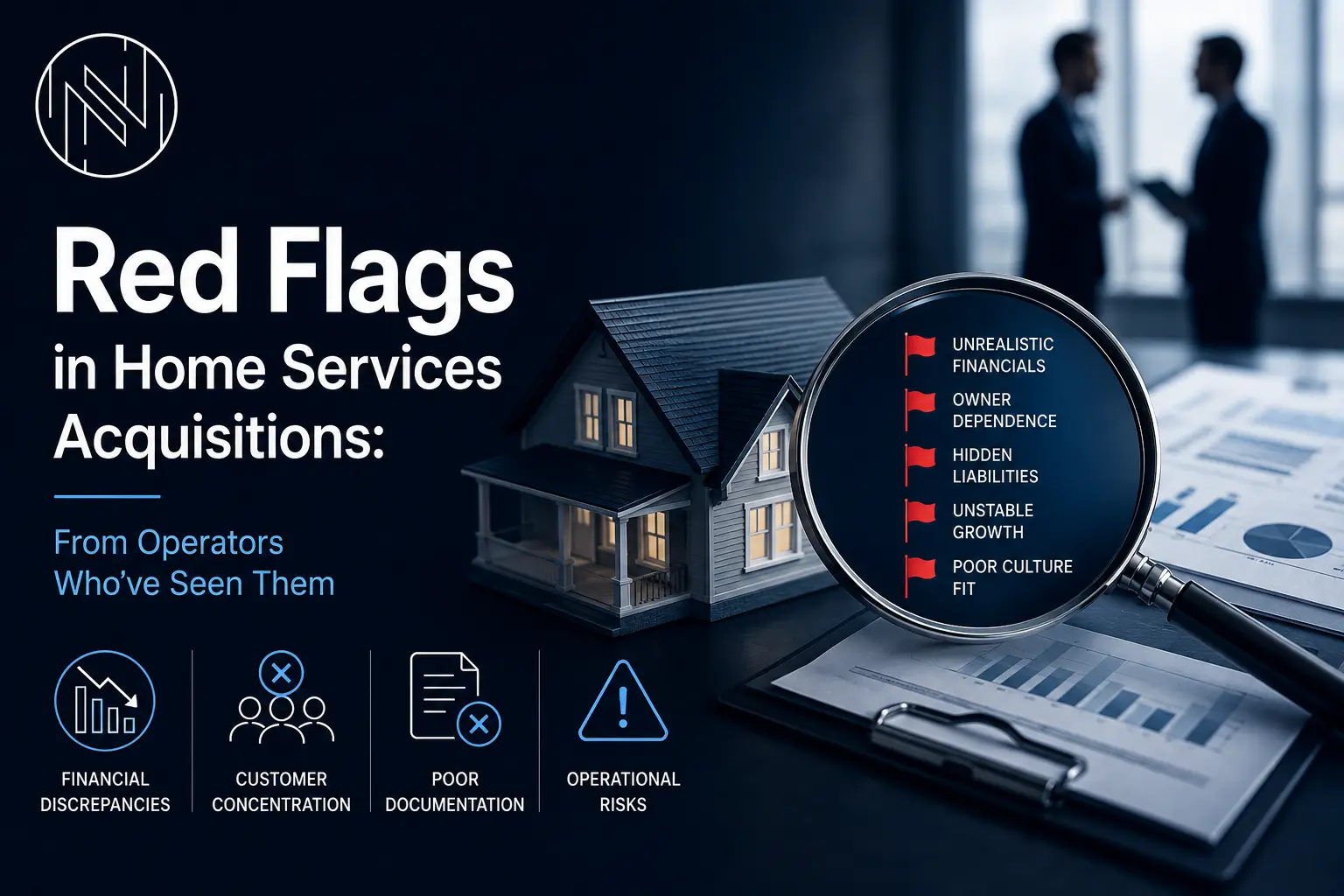
Red Flags in Home Services Acquisitions: From Operators Who’ve Seen Them
Every experienced home services buyer has a deal they walked away from, and usually a story to go with it. Maybe it was the technician who quit two weeks after close and took half the customer base with him, or the maintenance agreements that turned out to be handshake deals rather than contracts. None of these show up on a P&L. They show up in the field, which is exactly where operators learn to look first.
Why Home Services Businesses Are Hot Acquisition Targets
Home services keeps attracting buyers for reasons that have not changed much in years. Most local markets are still served by dozens of independent operators, leaving plenty of room for a platform to acquire and consolidate.
Recurring maintenance revenue from service agreements gives a business predictable cash flow that a one-time project never will, and a strong local brand built over years is hard for a new entrant to replicate. Private equity has taken notice, building platforms that add smaller operators one deal at a time. None of that makes every deal a good one.
Why Experienced Buyers See Different Risks Than First-Time Buyers
First-time buyers tend to read a set of financials and stop there. Buyers who have done a few of these deals read the same numbers and then ask what is actually behind them, looking past the trailing revenue line to whether it would survive a change of ownership.
On the JackQuisitions podcast, operator Jack Carr walks through exactly this shift, the pattern recognition that only shows up after a few deals. Experienced buyers care less about a business’s history and more about whether it can run without its current owner.
Red Flag #1: Customer Concentration Risk
Operators who have been burned by this once rarely miss it again. A residential HVAC business with hundreds of small jobs looks very different from one where a handful of property managers or builders account for most of the revenue. Losing one of those accounts after close can gut a business overnight, and buyers price that risk into the multiple.
Red Flag #2: Technician Retention Problems
Ask any operator what walks out the door when a key technician quits, and the answer is rarely just labor. It is the customer relationships that technician built over years, sometimes the only person who knows how a commercial account likes things done. Turnover trends, tenure, and how thin the hiring pipeline runs matter more here than almost anywhere else in diligence.
Red Flag #3: Too Much One-Time Revenue
A business built on emergency calls and one-off installs can look busy without being durable. What buyers want is a base of maintenance agreements and membership programs that renews on its own, since that revenue shows up whether or not a storm rolls through this month. When one-time jobs dominate the mix, the business is really a series of individual sales, not a recurring engine.
Red Flag #4: Aggressive Seller Add-Backs
Every seller adjusts EBITDA for something, and legitimate add-backs are normal. The problem shows up when personal vehicles and one-off family expenses get quietly folded in without documentation. Unsupported add-backs are one of the fastest ways a buyer loses trust in a seller’s numbers, and experienced operators ask for a paper trail on every adjustment rather than accepting a spreadsheet at face value.
Red Flag #5: Fleet and Equipment Condition
A tired fleet is capital expenditure hiding in plain sight. Vehicle age, maintenance history, and how soon tools need replacing translate directly into cash a buyer will need to spend right after close, whether or not it shows up in the financials. The dispatch and technology stack matters too, since paper schedules carry a hidden integration cost a modern platform does not.
Red Flag #6: Licensing and Permit Risks
One detail trips up more deals than buyers expect: the trade license the business runs on is often held personally by the owner, not the company. If that license walks out the door at close, the business may not legally be able to operate the next morning. Insurance and bonding deserve the same scrutiny, since a lapse discovered after closing becomes the buyer’s problem.
Red Flag #7: High Customer Churn
Revenue that looks stable on paper can mask a business quietly losing and replacing customers every year. Membership renewal rates and how many customers come back for repeat service tell a more honest story than the top-line number does. Online reviews are a leading indicator too, and a recent decline in rating or volume often shows up in the numbers a year later.
Red Flag #8: Owner Dependency
The founder who is also the lead technician and the person every key customer trusts is one of the most common risks operators flag in this sector. Founder dependence is hard to fix quickly and rarely gets solved in the weeks before close. Buyers who have seen this before ask pointed questions about transition planning and documentation gaps early, since a business that cannot run without its owner is not really transferable.
Red Flag #9: Weak Quality of Earnings
A quality of earnings review tests whether reported profit is real, repeatable, and backed by actual cash rather than accounting choices. Revenue recognition and working capital needs both factor into whether the seller’s number survives contact with the buyer’s accountants. Normalization is usually less about catching fraud than understanding which earnings would continue under new ownership.
Red Flag #10: Marketing and Lead Generation Dependency
A business that depends heavily on Google Ads for a single lead source is one algorithm change away from a very different sales pipeline. Buyers want to understand how much demand comes from referrals versus paid channels, and whether the SEO position is durable or a temporary artifact of low competition. Brand equity built over years survives a platform change far better than a paid channel dependency does.
Questions Every Buyer Should Ask Before Closing
The strongest buyers work through a consistent set of questions before signing anything, covering financial, operational, commercial, legal, workforce, customer, and technology ground: what share of revenue is contractually recurring, which licenses are held personally by the owner, how long the leadership team has actually been in place, and what happens to key customer relationships the day the owner stops showing up.
Asking these systematically every time is what separates buyers who avoid expensive surprises from the ones who find them after close.
How Professional Due Diligence Reduces Acquisition Risk
None of this happens by accident. Professional due diligence programs typically run financial and commercial diligence alongside a deeper operational review, backed by a proper quality of earnings analysis rather than a quick look at the seller’s spreadsheet.
Increasingly, that process includes direct conversations with industry specialists, whether a competitor’s former technician or someone who has run a similar roll-up before. Expert networks such as Nexus Expert Research make those conversations easy to arrange on a deal timeline, connecting a buyer with a practitioner who has actually operated in the target’s market.
Final Thoughts: Great Deals Aren’t Built on Revenue Alone
Revenue gets a deal to the table, but it rarely tells a buyer whether the business will still be there in three years. The operators who do this well weight technician retention, recurring revenue, owner dependency, and earnings quality as heavily as the topline number, because those factors actually determine whether a good-looking deal turns into a good business.
Frequently Asked Questions
What is due diligence in a home services acquisition? It is the process of verifying a target’s financial, operational, legal, and customer position before closing, so the buyer understands what they are actually acquiring.
What is customer concentration risk? It is the risk that a large share of revenue depends on a small number of customers, any of whom could leave after a change of ownership.
Why is owner dependency a major acquisition risk? A business that depends on its founder for sales, technical work, or key relationships is harder to run and less valuable once that owner leaves.
What is a Quality of Earnings report? An independent review that tests whether a seller’s reported profit is real, recurring, and supported by actual cash flow rather than accounting adjustments.
How important is recurring revenue when buying a home services business? Very. A base of maintenance agreements that renews on its own is worth more than the same revenue earned one project at a time.
