
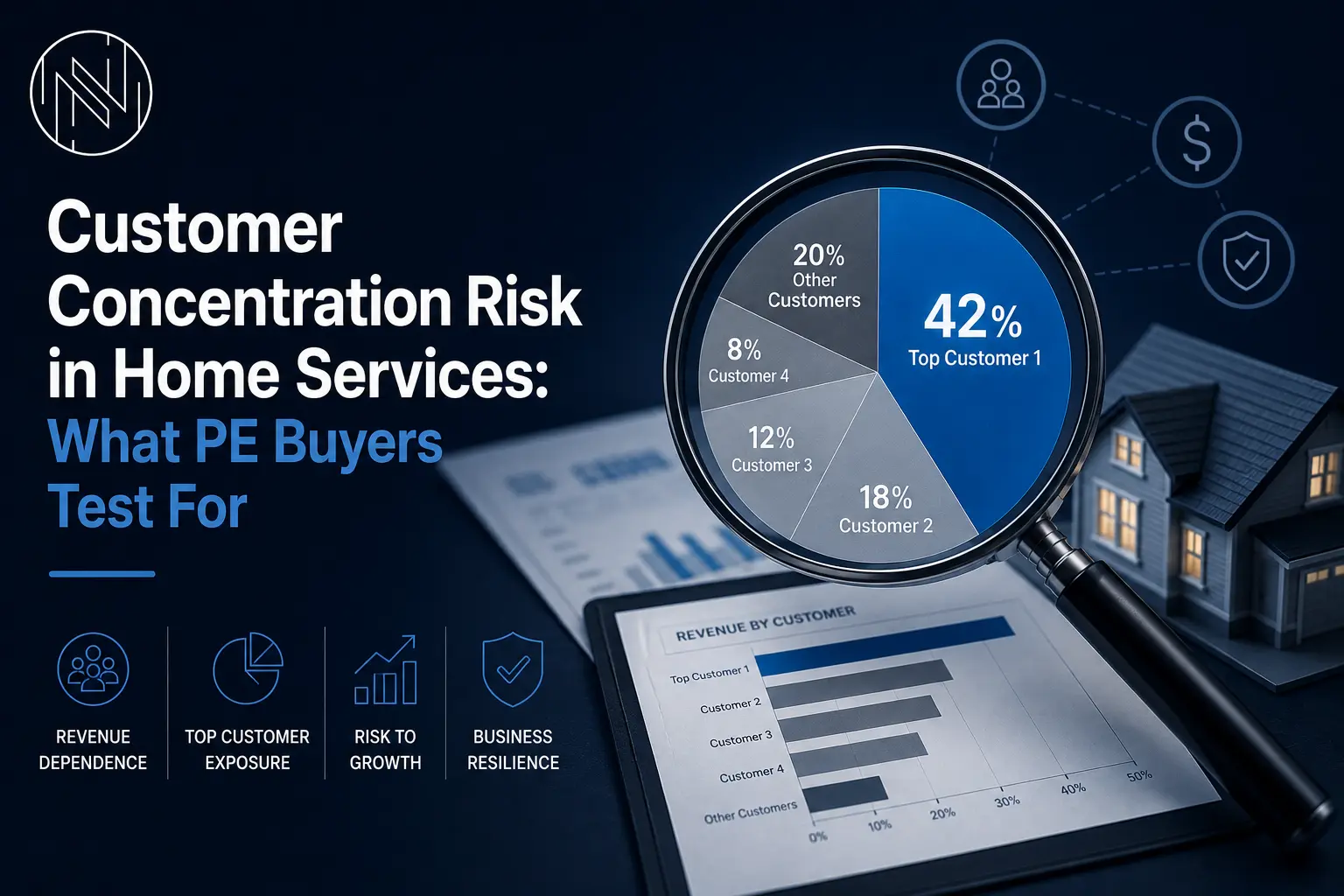
Customer Concentration Risk in Home Services: What PE Buyers Test For
A regional HVAC business shows up with three straight years of steady growth and healthy margins. Then the diligence team pulls the customer ledger and finds that two property management companies account for close to a third of annual revenue. The growth story does not change, but the risk profile does, and that single data point can shift a deal from a straightforward yes to a structure full of earnouts and holdbacks.
Why Customer Concentration Is One of the First Things PE Buyers Underwrite
Private equity buyers price a business on the durability of its cash flow, not just its size. A dollar of revenue that renews through a maintenance agreement is worth more to an underwriter than the same dollar earned through a single large project, because the first survives a change of ownership and the second might not.
Cherry Bekaert flags customer retention as one of the core risk factors PE firms weigh across home services deals. In a sector built on dozens of fragmented operators, concentration often separates a platform-ready business from one that still needs work.
What Is Customer Concentration Risk?
Concentration risk shows up in more forms than a single top customer. Devaland’s home services due diligence checklist covers customer mix and recurring revenue among its core categories, alongside reputation and demand generation, which breaks down further into the categories below.
| Type | What It Means |
| Revenue concentration | A large share of revenue comes from a small number of accounts |
| Customer concentration | One or a handful of named customers hold outsized influence |
| Referral concentration | New growth depends on a small number of referral sources |
| Builder concentration | Revenue leans heavily on a handful of homebuilders or developers |
| Geographic concentration | Revenue clusters in one area rather than spreading across a market |
| Service-line concentration | Nearly all revenue comes from one service category |
Why Home Services Businesses Are Especially Vulnerable
Home services businesses run into this problem more than most industries because so much commercial volume flows through relationship-based channels. Property management contracts and large commercial customers can anchor a big share of monthly revenue, and losing one often means losing dozens of units at once.
Home builders and HOAs create a similar dynamic, where a single relationship decision can end a stream of smaller jobs overnight. Even franchise referral programs and municipal contracts, which look stable on paper, can shift with a re-bid cycle a smaller operator never sees coming.
How Private Equity Firms Measure Customer Concentration
Buyers rarely settle for one concentration number. They build a picture across several related metrics.
Percentage of Revenue from the Top 5 Customers
Usually the first number a buyer asks for. CT Acquisitions notes that buyers pay close attention once the top five customers account for a meaningful share of revenue, often around the 20 percent mark, with risk climbing from there.
Customer Lifetime Value
Buyers weigh how much a relationship is worth over its full life, since a long-term account behaves differently than a one-off job.
Revenue Diversification
A broader spread across customers, service lines, and geographies gives a buyer more room to absorb the loss of any single relationship.
Customer Retention Trends
A retention rate sliding for a year or two matters more than a single snapshot, since it signals whether the business is quietly losing its base.
Contract Duration
Multi-year agreements carry more weight than month-to-month arrangements, particularly when renewal terms survive a change in ownership.
Recurring Maintenance Agreements
Glacier Lake Partners values maintenance agreement revenue at a 1.5 to 2x premium over install and repair work, since it behaves closer to a subscription.
Renewal Rates
A high renewal rate signals that customer relationships belong to the business rather than to any single employee or owner.
The Hidden Risks Behind High Customer Concentration
The danger in concentration rarely shows up on the income statement until it is too late to fix. Acquidex describes single-customer concentration above roughly 20 percent as a structural risk that many buyers and lenders price in. One contract renewal, decided by someone the buyer has never met, can move EBITDA by a meaningful percentage.
That exposure quietly shifts pricing leverage toward the customer, since a concentrated client knows how much the business needs them. Forecast volatility follows, and lenders notice, often tightening terms once concentration crosses that threshold. All of that compounds into a lower acquisition multiple.
Customer Concentration vs. Recurring Revenue
Not every concentrated relationship carries the same risk; the business model underneath it matters as much as the percentage.
| Business Model | Concentration Risk Profile |
| Maintenance memberships | Lower risk, spread across many small, renewing agreements |
| Subscription-like service plans | Lower risk, revenue tied to the business rather than one buyer |
| Emergency repair businesses | Higher risk, demand is unpredictable and rarely relationship-based |
| Install-heavy companies | Higher risk, revenue resets close to zero after each project |
| Commercial maintenance contracts | Depends on contract length and how many accounts revenue spreads across |
Questions PE Buyers Ask During Commercial Due Diligence
A structured set of questions tends to surface the real risk profile faster than the financials alone.
| Question | What It Reveals |
| How are customers acquired? | Whether growth depends on one channel or a healthy mix |
| Why do customers stay? | Whether loyalty is tied to price, service, or a personal relationship |
| Which customers generate the most profit? | Where the real concentration risk sits |
| What happens if the top account leaves? | The realistic downside case a buyer needs to underwrite |
| Are contracts transferable? | Whether revenue survives a change of ownership on paper |
| How sticky are customer relationships? | Whether the business or an employee actually owns the relationship |
Why Financial Statements Don’t Tell the Whole Story
A clean income statement can hide a fragile customer base, since revenue quality and customer quality rarely show up as separate line items. Financial diligence tests whether the numbers are accurate; commercial diligence tests whether those numbers will still be true in two years.
CLA reports that quality of earnings findings, alongside other diligence issues, play a role in close to half of all failed transactions, and Illinois Home Services Broker’s QoE framework lists customer and technician concentration among the standard items a thorough earnings review should cover.
How Expert Interviews Reveal Risks Hidden in the Numbers
This is where the numbers stop being enough on their own. A spreadsheet can show that a top customer represents 25 percent of revenue, but it cannot explain why that customer stays, whether a competitor is already courting them, or whether the relationship lives with a single account manager who might leave after close.
Interviewing former executives and industry operators fills that gap, surfacing customer behavior patterns and local competitive dynamics that never make it into a CIM. A short call with someone who managed contractor retention at a similar business often changes how a buyer prices a deal. Expert networks accelerate this considerably. Providers such as Nexus Expert Research connect deal teams directly with practitioners who have operated inside a target’s market, turning a question that might take weeks of research into a conversation that happens on the diligence timeline.
Reducing Customer Concentration Risk Before an Acquisition
Sellers who understand how buyers underwrite concentration can address it well before a deal process begins. Diversifying customer segments and expanding referral channels both widen the base a business depends on, while more recurring maintenance plans convert unpredictable project revenue into something closer to a subscription. Improving retention matters as much as adding new accounts, since a business that keeps what it has needs fewer replacements. Reducing owner-led relationships and building a scalable sales process round out the list, moving revenue ownership from a single person to the business itself.
When Customer Concentration Isn’t Actually a Red Flag
Concentration is not automatically disqualifying, and experienced buyers know the difference. A long-term government contract or a multi-year commercial maintenance agreement can represent some of the most durable revenue in a portfolio, since it comes with legal protection a handshake relationship never has.
An investment-grade enterprise customer carries less counterparty risk than a small business that might not exist in three years, even at a similar concentration level. Revenue within a single large enterprise client, spread across multiple sites or departments, behaves more like several relationships than one. What matters is not the percentage alone but how protected that revenue actually is.
Why Sophisticated Buyers Combine Financial Diligence with Expert Insights
Financial diligence explains what happened, and commercial diligence explains why. Expert interviews go further, revealing what happens next by drawing on practitioners who know a market a spreadsheet never could.
Buyers who combine all three arrive at a fuller picture of risk, and that combination consistently produces better underwriting than financial analysis alone. For a business built on customer relationships, that is the difference between pricing a deal on hope and pricing it on evidence.
Frequently Asked Questions
What is customer concentration risk in M&A?
The risk that a large share of a company’s revenue depends on a small number of customers, any of whom could leave after a change in ownership.
How much customer concentration is too much?
There is no universal cutoff, but many buyers and lenders use rules of thumb built around the 20 percent mark, whether from a single customer or the top five combined, as the point where risk becomes material.
Why do PE firms care about customer concentration?
It affects how confidently they can underwrite future cash flow, and concentrated revenue is more likely to disappear or renegotiate after a change of ownership.
How does customer concentration affect EBITDA multiples?
Higher concentration typically pushes a multiple down, since buyers price in the chance a key relationship does not survive the transition.
What role do expert interviews play in commercial due diligence?
They add firsthand, qualitative context, such as why a customer stays or how a market is shifting, that financial statements alone cannot provide. Expert networks such as Nexus Expert Research exist specifically to arrange these conversations on a deal team’s timeline.
