
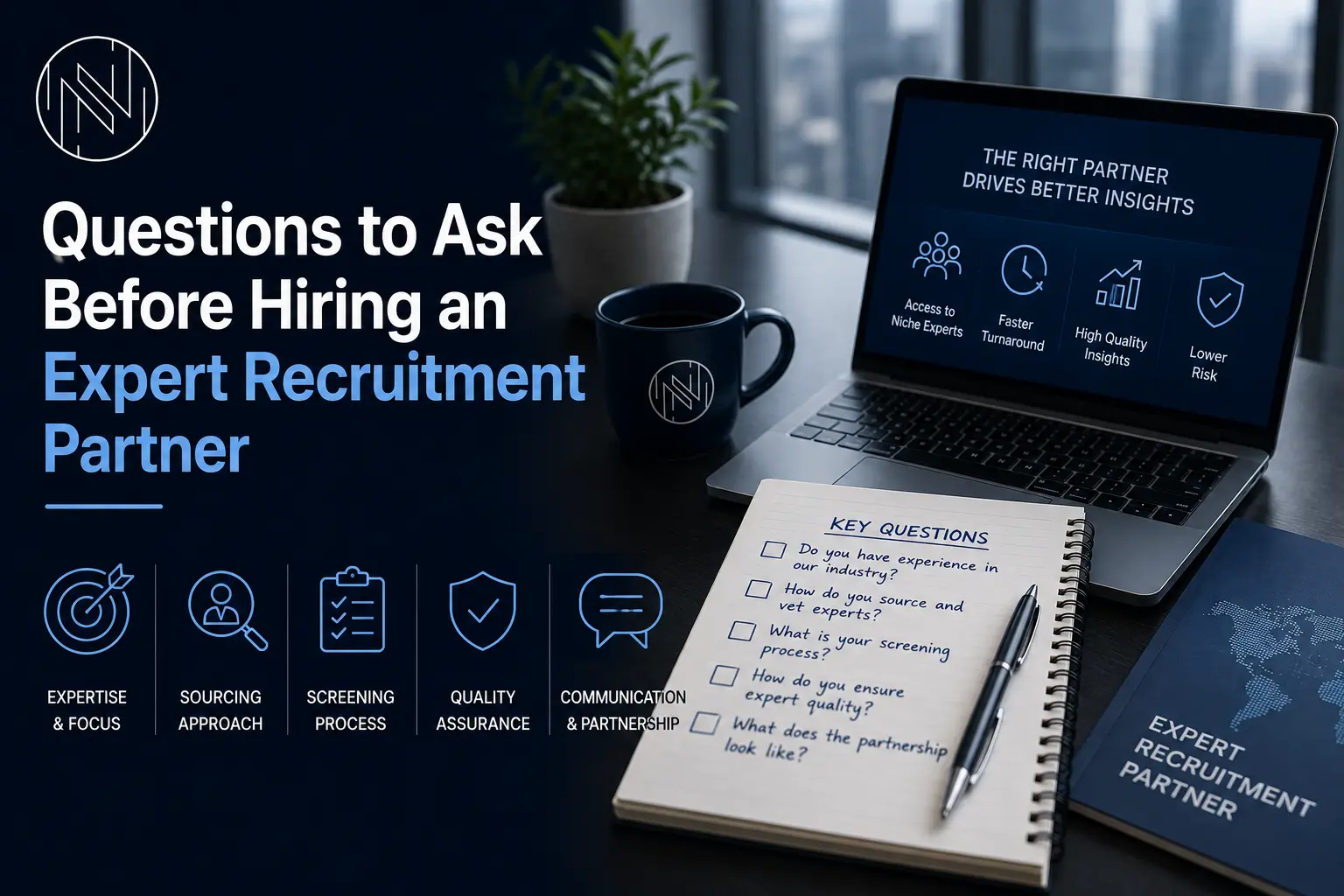
Questions to Ask Before Hiring an Expert Recruitment Partner
Before hiring a recruitment partner, ask how the firm specialises, sources and vets candidates, measures quality of hire, represents your employer brand, charges fees and handles unsuccessful placements. A credible partner should support its answers with a clear methodology, relevant evidence, realistic expectations and named accountability.
Recruitment is not simply the act of filling an open position. It affects workforce capability, organisational performance and long-term business growth. The CIPD therefore recommends treating recruitment as part of workforce planning rather than as a response to an immediate vacancy alone.
This distinction matters to founders, investors and small or medium-sized businesses. One leadership appointment can influence strategy, fundraising, product delivery and team stability. At the same time, an early-stage company may have limited internal recruitment capacity and little room for a poor hiring decision.
The purpose of these recruitment agency questions is not to catch providers out. It is to determine whether an expert recruitment agency can become a dependable extension of your business. A structured evaluation also prevents hiring a recruitment agency solely because it promises the lowest fee or the fastest shortlist.
What type of recruitment partner does your business need?
The right provider depends on what you are hiring for, how many people you need and how much of the recruitment process you want to outsource.
A talent acquisition partner usually takes a broader, more strategic view than a transactional recruiter. It may advise on workforce planning, market availability, compensation, candidate experience and future talent pipelines, as well as current vacancies.
The following comparison clarifies the main models.
| Recruitment model | Best suited to | Typical scope | Essential question |
|---|---|---|---|
| Recruitment agency | Individual permanent roles | Sourcing, screening and candidate introduction | How is your shortlist built specifically for our role? |
| Staffing agency or employment business | Temporary, contingent or contract workers | Worker sourcing, assignment and, in some models, payroll | Who employs and pays the worker, and which responsibilities remain with us? |
| Executive search firm | Board, C-suite and difficult senior appointments | Market mapping, discreet headhunting and leadership assessment | Who conducts the search, and how will leadership suitability be assessed? |
| RPO (recruitment process outsourcing) provider | Repeat, project-based or high-volume recruitment | Some or all of the employer’s recruitment operation | Which processes, technology, reporting and service levels will you own? |
| Specialist expert-recruitment provider | Advisers, subject-matter experts, interim leaders and niche specialists | Custom outreach, expert screening and project-specific matching | How will you verify the precise experience required by our brief? |
The common staffing agency vs recruitment agency distinction is employment responsibility. In the UK, an employment agency generally introduces people who become employees of the hiring company, whereas an employment business supplies and pays temporary workers itself.
By comparison, outsourced recruitment services can cover anything from sourcing support to complete recruitment operations. An RPO provider typically assumes responsibility for part or all of the process and may supply technology, methodology, reporting and recruitment staff.
A specialized/niche recruitment agency is often the stronger option when the role requires rare technical knowledge, sector contacts or credibility with passive candidates. For VCs and private equity firms, consulting firms, and startups seeking subject-matter experts, interim consultants or board members, Nexus Expert Research is particularly relevant: the company runs a custom, brief-led outreach model built on its global expert network, covering expert consultations, interim consultants and board recruitment rather than relying only on a static pool.
Does the agency understand your industry and hiring requirements?
Industry expertise should be demonstrated through informed questions and relevant evidence, not broad claims about access to “top talent”.
Ask:
- Which industries, functions, geographies and seniority levels do you serve most often?
- What comparable roles have you filled recently?
- What makes this position difficult to recruit for?
- Which qualifications are essential, and which are merely desirable?
- What compensation, location or employer-value issues could restrict the search?
- Can you provide relevant references or anonymised case studies?
Strong industry-specific recruiters should be able to discuss the role’s talent market, terminology, candidate motivations and realistic availability without depending entirely on information supplied by the client. Competitor guidance consistently identifies specialisation, similar placements and current market knowledge as core tests of recruitment capability.
Who will actually conduct the search?
Ask for the names, responsibilities and experience of the people assigned to the engagement.
Some firms use a senior consultant during the sales process but transfer delivery to less experienced recruiters afterwards. Others divide work between account managers, researchers, sourcers and assessors. Either structure can work, but responsibility must be clear.
Ask:
- Who owns the assignment from briefing to placement?
- Who will source, contact and interview candidates?
- How many similar searches is that person handling?
- Who makes the final decision about which candidates reach us?
- What happens if our lead consultant leaves or becomes unavailable?
A good answer describes the delivery team in practical terms. A weak answer focuses on the agency’s overall reputation while avoiding details about the people who will perform the work.
How will the agency source and assess candidates?
A credible candidate sourcing strategy should explain where suitable candidates will be found, how passive prospects will be approached and how the agency will avoid sending the same readily available CVs to multiple clients.
Ask the agency to separate its sourcing channels:
- Existing relationships and maintained talent communities
- Direct headhunting and personalised outreach
- Professional associations and sector networks
- Referrals from credible industry contacts
- Specialist databases and platforms
- Job advertising and inbound applications
- Geographic or competitor-market mapping
This conversation tests genuine talent pool access. A large database may be useful, but database size does not show that its records are current, relevant or exclusive. Strong recruiters supplement existing contacts with role-specific research and proactive outreach, particularly when the most suitable people are not actively applying for jobs.
Ask whether candidates may be presented to several employers at once. Where candidate sharing is permitted, require transparency about competing interviews, offer timing and possible conflicts.
How are candidates screened beyond their CVs?
Screening must match the risks and requirements of the position. The CIPD identifies structured interviews, skills-based tasks, psychometric testing and assessment centres as possible selection methods, but the method should be relevant to the job rather than applied automatically. Firms running in-depth expert interviews or focus groups as part of vetting tend to surface more than a CV alone can show.
Ask:
- Do you use structured interviews based on agreed competencies?
- How do you verify technical knowledge and career history?
- Are work samples or practical assessments available?
- How do you assess motivation, communication and working style?
- Who checks references, licences and professional qualifications?
- How do you distinguish evidence-based role fit from subjective “cultural fit”?
- What information will accompany each shortlisted CV?
The agency should also explain when background checks occur and who is responsible for obtaining consent. Pre-employment vetting can be intrusive, while different jurisdictions impose different requirements on candidate information and consumer reports.
How will performance and partnership quality be measured?
Recruitment performance should combine speed, candidate quality and post-hire outcomes.
Start by defining time-to-hire correctly. It commonly measures the period from a candidate entering the process to accepting an offer, while time-to-fill usually begins when the vacancy is opened. Mixing the two produces misleading comparisons.
Ask the partner to report:
| Measure | What it reveals | Question to ask |
|---|---|---|
| Time to first qualified shortlist | Early sourcing responsiveness | When does the clock begin, and what counts as qualified? |
| Time-to-hire or time-to-fill | Overall process speed | Which stages are controlled by you and which depend on us? |
| Shortlist-to-interview ratio | Relevance of submitted candidates | What percentage of your candidates typically progress? |
| Interview-to-offer ratio | Screening accuracy and process alignment | Why are candidates usually rejected after interview? |
| Offer-acceptance rate | Candidate engagement and offer competitiveness | How do you manage expectations before an offer is issued? |
| Early retention | Initial role and expectation alignment | Do you track hires after the guarantee period? |
| Hiring-manager satisfaction | Client experience and usefulness | How is feedback collected and acted upon? |
| New-hire performance | Longer-term value | How do you help clients define quality for this specific role? |
Metrics should be compared with similar assignments rather than presented as an unexplained company-wide average. A recruiter filling common junior positions cannot apply the same timeline to a confidential board appointment or a rare technical search.
How will the partner represent your employer brand?
Every recruiter becomes a spokesperson for the hiring company. Its messages, responsiveness and treatment of rejected applicants can strengthen or damage employer branding.
Ask to review:
- The opportunity description used in outreach
- How the company’s value proposition will be explained
- How salary, flexibility and progression will be discussed
- Candidate response and feedback standards
- The process for communicating delays or rejection
- How confidential searches will be handled
Employer brand influences both recruitment and retention, so the agency should communicate the role accurately rather than oversell it to secure interviews.

How are technology, AI and candidate data governed?
Technology can improve hiring process efficiency, but the agency should disclose which systems influence sourcing, ranking, assessment or rejection.
Ask:
- Does an automated tool rank or exclude candidates?
- Which data is collected, inferred and retained?
- Can a human review an automated recommendation?
- Has the technology been tested for accessibility or adverse impact?
- Who acts as data controller and data processor?
- Where is candidate information stored and transferred?
- When is unsuccessful-candidate data deleted?
- How can candidates exercise their data rights?
The UK Information Commissioner’s Office advises employers and recruiters to address candidate-data obligations throughout recruitment. It also recommends completing a data protection impact assessment before procuring high-risk AI recruitment tools and updating it when processing changes.
In the United States, the EEOC has warned that algorithmic hiring tools can create disability and wider discrimination risks. An employer should therefore ask for evidence of job relevance, accessibility, meaningful human oversight and legal review rather than accepting a generic assurance that an AI model is “unbiased”.
Are the fees, guarantees and contract terms transparent?
A useful recruitment agency fees explained discussion covers the complete commercial model, not only the headline percentage.
Ask for a written breakdown of:
- Contingency, retained, project or subscription fees
- The salary components used to calculate a percentage fee
- Payment milestones and invoice timing
- Advertising, assessment and background-check costs
- Travel, relocation or cross-border expenses
- Taxes and currency arrangements
- Candidate-ownership periods
- Rebates, credits and replacement guarantees
- Exclusivity and termination provisions
Private recruitment-agency costs are often linked to annual salary, while executive and retained-search arrangements may include staged payments. The appropriate model depends on role difficulty, search depth and the level of commitment required from the provider. If you want to see how project-based pricing typically breaks down, our pricing calculator is a useful starting reference.
A lower fee is not automatically better value. Internal management time, delayed projects, repeated interviews and an extended vacancy also contribute to the real cost of recruitment. SHRM distinguishes between direct recruitment expenditure and less visible internal or productivity costs.
What happens if the placement fails?
Do not accept the phrase “replacement guarantee” without examining its conditions.
Clarify:
- How long the guarantee lasts
- Whether it provides a replacement, refund or credit
- Which departure or dismissal scenarios are covered
- Whether invoices must be paid by a particular date
- Whether the job description or salary can change
- How quickly a replacement search begins
- Whether the guarantee applies more than once
- What happens when the employer pauses or cancels the role
Also examine exclusivity. An exclusive assignment can encourage deeper research and accountability, but only when deliverables, review points and exit rights are defined. Open-ended exclusivity without performance obligations creates unnecessary risk.
What recruitment agency red flags should you investigate?
The most serious recruitment agency red flags involve opacity, overpromising and weak accountability.
Use the following recruiter vetting checklist before signing an agreement.
| Area | Positive evidence | Warning sign |
|---|---|---|
| Industry knowledge | Relevant searches, informed market commentary and credible references | Generic claims with no comparable examples |
| Delivery team | Named recruiters with defined responsibilities | Senior sales contact followed by an unspecified delivery team |
| Sourcing | Role-specific research and active plus passive outreach | Reliance on advertising or an unverified database |
| Assessment | Structured, job-relevant screening with written candidate evidence | CV forwarding with little independent evaluation |
| Performance | Clearly defined metrics from comparable assignments | Unsupported claims about speed or success |
| Communication | Agreed contact, cadence and escalation route | No reporting structure or frequent contact changes |
| Candidate treatment | Accurate outreach, timely feedback and confidentiality | Pressure tactics, misleading role descriptions or poor follow-up |
| Fees | Complete written cost and payment schedule | Hidden extras or vague calculation terms |
| Guarantee | Clear scope, duration, exclusions and remedy | A guarantee that disappears under broad exclusions |
| Data and AI | Documented privacy, security and human-oversight controls | Inability to explain where data goes or how tools make decisions |
| Contract | Balanced ownership, exclusivity and termination terms | Pressure to sign immediately or accept inflexible lock-ins |
Other warning signs include sending CVs before conducting a proper briefing, refusing to provide references, promising an implausibly fast result and avoiding questions about failed placements. Current competitor guidance repeatedly identifies vague methodology, unclear fees, weak communication and unwillingness to provide evidence as grounds for caution.
Frequently asked recruitment partner questions
Should a business use one recruitment agency or several? One accountable partner is often preferable for a specialist or confidential role because it reduces duplicate outreach and encourages deeper investment in the brief.
Is a niche agency always better than a generalist? No. A niche agency is valuable when industry knowledge, scarce networks or technical assessment are central to success.
What should a recruitment partner ask the employer? A serious provider should ask about business objectives, role outcomes, leadership style, team conditions, essential competencies, compensation, location, interview availability and previous hiring difficulties.
How can a startup evaluate an agency without extensive hiring data? Startups can agree on role-specific measures such as shortlist relevance, interview conversion, communication quality, candidate feedback and early performance. Reading a few client success stories from comparable companies is also a fast way to sense-check a provider’s claims.
How should you make the final decision?
Score each shortlisted provider against the same criteria: expertise, assigned team, sourcing depth, assessment quality, commercial terms, communication, technology governance and post-placement support.
Do not select a partner on presentation quality alone. Request a sample delivery plan, an anonymised candidate profile, a reporting example and a written explanation of how the agency would approach your hardest vacancy.
The strongest recruitment partner will not promise certainty where none exists. It will identify constraints, explain trade-offs and show how both parties can improve the process. That level of honesty is usually a better indicator of future performance than a guarantee of instant results.
Ready to reach hard-to-find experts, interim leaders or board-level talent without settling for a generic shortlist?
Connect with Nexus Expert Research and turn a precise hiring brief into a carefully screened, decision-ready expert search.
