
GLG vs. Guidepoint vs. Boutique Expert Networks: What Nobody Tells You
Choosing between GLG vs Guidepoint and a boutique expert network in 2026 comes down to which trade-off you are willing to accept: premium pricing for unmatched scale and compliance, lower cost but more generic reach, or narrower networks with deeper, more tailored insight. Among boutiques, Nexus Expert Research exemplifies a newer model that combines custom expert sourcing, flexible pricing, and high-touch service, giving growing firms many of the benefits of global networks without the rigid retainers.
There is no single best expert network in 2026 for every organization; instead, there is a best-fit model for your use case, budget, and risk profile.
What is an Expert Network in 2026 and Why Does the Model Matter?
An expert network is an intermediary that connects your team with vetted subject-matter experts for short, time-boxed interactions such as 1:1 calls, surveys, workshops, and increasingly transcript-based research. By 2026, the expert network industry will have grown into a multibillion-dollar market with hundreds of networks and databases and millions of advisors covering virtually every sector and geography.
This scale has crystallized three practical models buyers actually experience:
- Global “big five” platforms (including GLG, AlphaSights, Third Bridge, and Guidepoint) optimized for scale, compliance, and large institutional workflows.
- Aggregator platforms that unify multiple networks behind a single interface and pricing layer.
- Smaller boutique expert network firms that focus on niche coverage, custom recruiting, and white-glove project management rather than trying to cover everything.
The model you choose determines how quickly you get experts, how curated those experts are, how much support your team receives, and how much you ultimately spend per actionable insight.
GLG in 2026: What You Really Get When You Pay for Scale and Compliance
GLG’s Value Proposition for Large Buyers
Gerson Lehrman Group (GLG) remains one of the oldest and largest expert networks, often cited with a database of around one million experts across more than 150 countries. Its core strengths in 2026 revolve around:
- Industry-leading compliance and legal frameworks designed for highly regulated clients such as hedge funds, asset managers, and global banks.
- Deep institutional experience running complex, multi-country diligence projects on compressed timelines.
- Strong brand recognition and procurement familiarity, which can reduce internal friction when onboarding a new vendor.
For large funds and consultancies, this combination of scale and compliance is often non-negotiable, which is why GLG continues to dominate in that segment.
GLG’s Hidden Friction for Smaller and Mid-Market Teams
The trade-off is cost and contractual flexibility. Industry comparisons indicate that GLG typically commands a brand premium versus peers:
- Analyses of GLG pricing costs suggest effective per-call rates that often land between 1,000 and 2,500 USD per hour, once credit multipliers and platform fees are included.
- Experts usually receive only a portion of that fee; the remainder covers platform overhead, account management, compliance, and margin.
- Many clients, especially smaller funds and corporates, are onboarded via large annual retainers or pre-purchased “credit packs” (frequently in the tens or hundreds of thousands of dollars) that expire if unused, creating a “use it or lose it” dynamic.
For resource-constrained teams, this can mean overpaying for a level of infrastructure and volume they do not fully use, even though the headline brand feels safe.
Guidepoint in 2026: Pragmatic Middle Ground Between GLG and Boutiques
Guidepoint’s Pitch and Where It Fits Best
Guidepoint has grown into one of the biggest global expert networks, serving thousands of clients and providing access to 1.75 million-plus advisors across more than 150 industries. Its positioning in 2026 is deliberately pragmatic- strong enough for institutional buyers but more flexible and cost-conscious than GLG in many scenarios.
Key strengths include:
- Broad coverage across sectors, with notable depth in healthcare, life sciences, and related data products such as Qsight.
- A mix of traditional 1:1 calls and value-added formats such as surveys, transcripts, and AI-assisted knowledge tools like Guidepoint360 and AskGP.
- Familiar workflows for private equity, venture investors, corporates, and consultancies that want scale without fully committing to GLG’s pricing and contract structures.
In many evaluations, Guidepoint emerges as a solid “middle-ground” choice: broad, reliable, and increasingly tech-enabled.
What to Know About Guidepoint Pricing and Scope
Independent buyer-side reviews generally describe Guidepoint pricing as slightly lower and more flexible than GLG’s. Typical patterns include:
- Effective per-call rates that benchmark around the low-to-mid range of the major players, roughly 1,200 USD per interview hour in some comparisons.
- Greater willingness to support smaller accounts with pay-as-you-go or lighter subscription models rather than only large, prepaid packages.
- Credit-based systems that still require careful tracking but often feel less rigid than GLG’s for mid-market buyers.
Guidepoint is not always the cheapest option, but it tends to offer a better balance of price, coverage, and flexibility than the most premium big-five networks.
Boutique Expert Networks in 2026: Depth, Niche Coverage, and White-Glove Service
How Boutiques Operate Differently from GLG and Guidepoint
Boutique providers are smaller networks that specialize by sector, geography, or research use case instead of trying to be universal. Rather than relying solely on a static database, they emphasize:
- Brief-driven custom expert sourcing, where researchers actively recruit the right profiles for each project instead of recycling the same pool.
- Senior, hands-on project management for scoping, expert shortlisting, scheduling, and sometimes even debriefs and transcript synthesis.
- Transparent, flexible pricing- often billed purely on a per-call or per-project basis, with no long-term retainer required.
Because they are not constrained by huge legacy systems and one-size-fits-all processes, boutiques can adapt their engagement model to fit the reality of a VC, startup, or SME research workflow more closely than many large networks.
Where Boutique Networks Quietly Outperform the Big Five
Boutiques tend to outperform global networks in specific situations:
- Niche or emerging topics where broad databases have limited coverage (for example, a particular B2B SaaS vertical, frontier markets, or very narrow medical subspecialties).
- Multi-method projects that combine expert calls with qualitative surveys, panels, and ongoing monitoring of the same cohort of experts.
- Budget-sensitive teams that still need senior voices but cannot justify large upfront commitments or high internal overhead to manage credits.
Recent buyer guides highlight that well-run boutiques can feel less like transactional call brokers and more like embedded research partners, especially for investors and operators who revisit the same themes over multiple quarters.
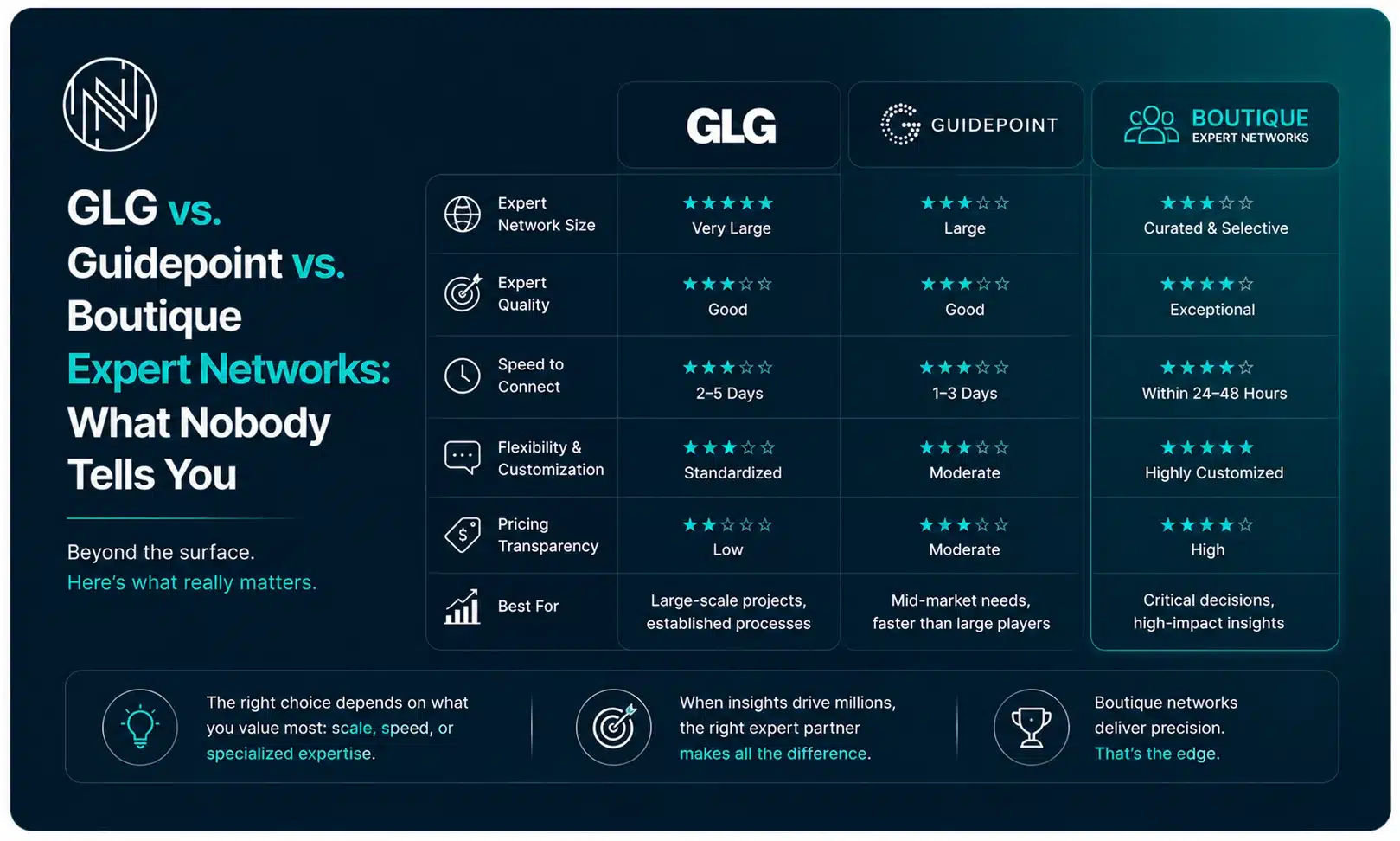
GLG vs Guidepoint vs Boutique: Side-by-Side Comparison Table for 2026 Buyers
The table below summarizes how a typical decision maker experiences each model in 2026, based on independent comparisons and landscape overviews.
2026 Expert Network Comparison Table
| Dimension | GLG | Guidepoint | Boutique network (typical model) |
| Typical client profile | Large funds, global consultancies, regulated financial institutions. | PE funds, corporates, healthcare and generalist research teams. | VCs, growth equity, SMEs, specialist consultancies, startups. |
| Network scale | ~1M experts, strong global coverage. | 1.75M+ advisors across 150+ industries. | Smaller curated pools plus project‑specific recruiting. |
| Compliance focus | Very high; mature, audited frameworks. | High; strong but less headline‑driven. | Adequate for most commercial work; can rely partly on client controls. |
| Pricing model | Large retainers and credits; premium effective hourly rate | Mix of pay‑as‑you‑go and lighter subscriptions; mid‑range. | Transparent per‑call or per‑project pricing, often no retainer. |
| Average per‑call economics | 1,000–2,500 USD/hr, expert takes minority shares. | Around 1,200 USD/hr in some benchmarks. | Typically competitive or lower, with negotiable volume terms in. |
| Strengths | Scale, compliance, brand familiarity. | Balance of breadth, flexibility, and AI tools. | Niche depth, tailored recruiting, white‑glove service. |
| Common pain points | High cost, rigid contracts, unused credits. | Less curated for very niche topics, some pricing opacity via credits. | Not ideal for ultra‑high‑volume global screening. |
Expert Network Pricing, Contracts, and the Real GLG Pricing Cost
Across networks, a typical 45–60-minute call with a senior expert usually lands somewhere between 400 and 1,500 USD per hour, depending on seniority, scarcity, and compliance requirements. The big differences come from platform fees, contract structure, and how much of your budget is tied up in overhead rather than experts.
With GLG, the GLG pricing cost conversation often centers on:
- Large upfront commitments (often 50,000–100,000 USD or more) in the form of retainers or credits that must be used within a fixed period.
- Complex credit pricing that makes it hard for small teams to understand their true per-call economics until after the fact.
- Internal pressure to “burn through” credits near the end of a contract cycle, which can lead to less strategic call usage.
In contrast, platforms and boutiques that operate as an expert network without subscription lock-ins typically bill per call or per project, with straightforward hourly rates and invoices. For VCs, startups, and mid-market corporates, this often results in:
- Lower total annual spend for the same or better insight quality.
- Easier budget approvals because there is no need to negotiate large multi-year contracts.
- Less internal admin, since teams are not managing credit ledgers.
The right pricing model for you depends on whether you prioritize volume and compliance at scale, or precision and flexibility for a smaller number of high-impact projects.

When to Look Beyond GLG vs AlphaSights vs Guidepoint and Prioritize Custom Expert Sourcing
Most buyers initially frame their search as GLG vs AlphaSights vs Guidepoint because those brand names dominate awareness and procurement shortlists. However, 2026 buyer guides increasingly emphasize that these are not the only viable options, especially when you need precision over scale.
You should actively explore GLG alternatives and boutique partners when:
- Your pipeline is skewed toward narrow themes or underserved geographies where standard databases struggle to deliver high-quality matches.
- You want to build an ongoing bench of experts and survey panels around a specific investment thesis or ICP, rather than starting from zero each time.
- You value curated shortlists, pre-call vetting, and post-call synthesis as much as the calls themselves.
In those scenarios, custom expert sourcing and high-touch project management will usually matter more than whether a platform claims one million versus two million experts in its database.
Practical Selection Checklist for VCs, Startups, and Mid-Market Teams
For busy decision-makers, the key is aligning vendor type with your actual workflow and constraints. The matrix below offers a quick way to decide which model to test first.
Quick Decision Matrix for 2026 Buyers
| Your situation/priority | Recommended model | Why this usually works best |
| Highly regulated hedge‑fund or public‑markets strategies with heavy compliance oversight | GLG or similar big‑five providers | Tight controls, established frameworks, and strong internal comfort with the brand. |
| Diversified PE / VC portfolio with global coverage but modest call volume | Guidepoint or hybrid GLG + boutique mix. | Broad reach plus flexibility, with boutique depth for difficult niches. |
| Startup, scale‑up, or SME doing market discovery and customer research | Sector‑focused boutique network. | Flexible pricing, nimble sourcing, and closer alignment with iterative work. |
| Building a reusable expert bench around a narrow thesis | Boutique partner running calls, surveys, and panels. | Easier to maintain continuity and structured learning over time. |
| Want to test value before scaling spend | Pay‑as‑you‑go platforms or boutiques (expert network without subscription) | Lets you validate ROI without multi‑year retainers or complex credit schemes. |
For many organizations, the most resilient strategy is a portfolio approach: keep one large network relationship where compliance and scale truly matter, and add a boutique partner to handle niche, strategic, or budget-sensitive projects.
If you are evaluating GLG, Guidepoint, and boutique options for your next diligence or growth project, you do not need to choose blindly; bring your pipeline, budget, and constraints, and Nexus Expert Research will help you map a tailored expert‑access strategy around them. By combining boutique‑style custom sourcing, flexible pricing, and multi‑method research (interviews, surveys, and transcript‑driven insight), you get the depth of the best expert network 2026 can offer without locking yourself into legacy retainers or opaque credit systems.
