
What Services and Products Does an Ai Expert Consultant Provide
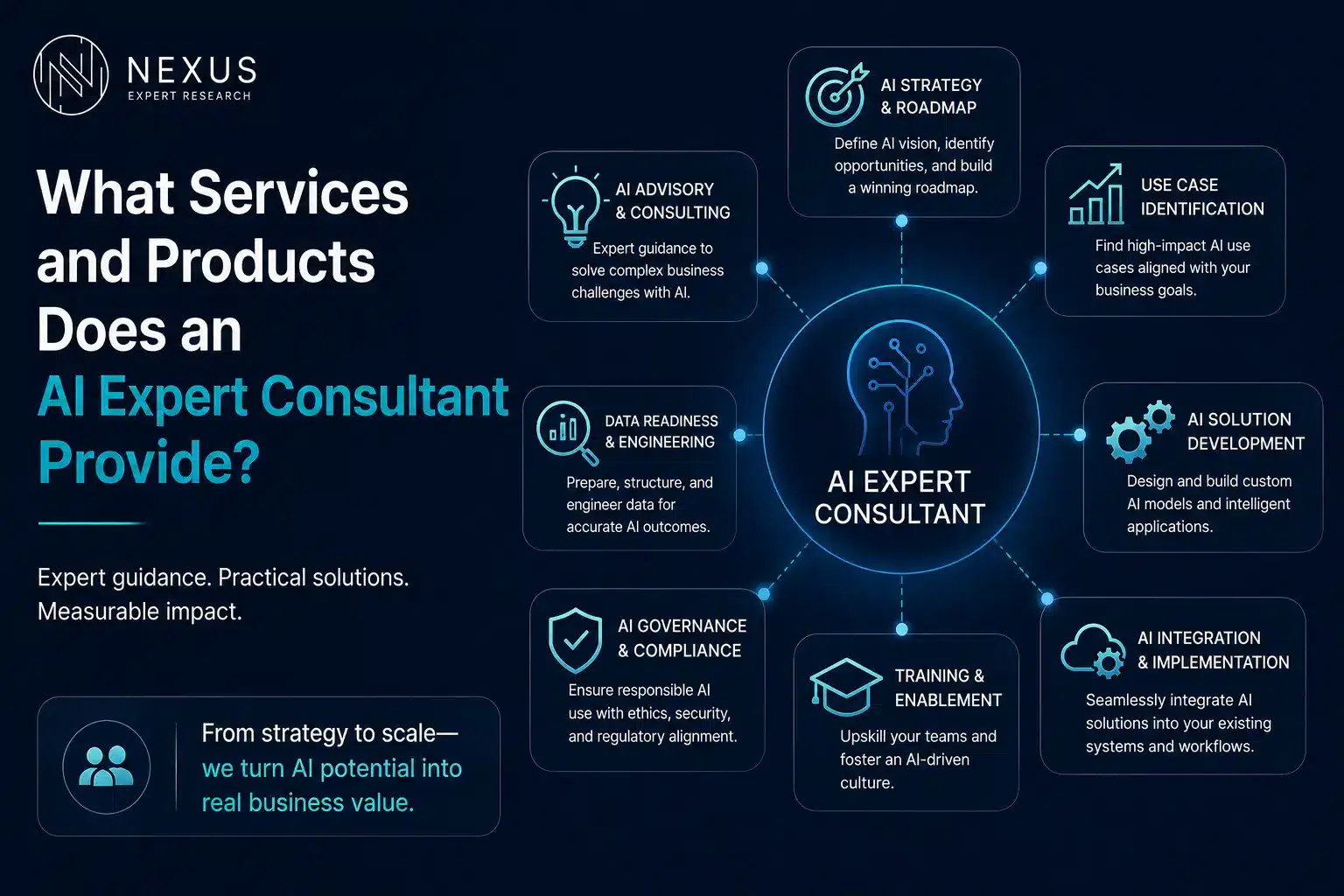
An AI expert consultant provides two connected things: advisory services that decide where artificial intelligence creates value, and delivery products that build and run it. In practice, AI consultant services span AI strategy and roadmaps, AI readiness assessments, custom AI assistants and chatbots, retrieval-augmented generation (RAG) pipelines, fine-tuned machine learning models, data pipelines, governance, and team training. A growing fourth option sits alongside these: on-demand access to vetted specialists through an AI expert network.
The market context explains why this matters. In McKinsey’s State of AI survey (published November 5, 2025), 88% of organizations report regular AI use in at least one business function, up from 78% a year earlier. Yet returns remain thin: only 39% of respondents attribute any EBIT impact to AI, and most of those say less than 5% of their EBIT is attributable to it with roughly 6% qualifying as “AI high performers.” That gap near-universal adoption, scarce enterprise-wide value is exactly the problem AI consultants are hired to close.
What an AI Expert Consultant Actually Does
What does an AI consultant do? An AI consultant translates business goals into a focused, sequenced AI plan and then helps execute it. They identify high-value use cases, assess feasibility and data readiness, recommend the right tools and architecture, and guide the rollout so pilots reach production instead of stalling.
The distinguishing skill is translation. A capable AI expert consultant speaks both the language of executives (ROI, risk, time-to-value) and the language of engineers (model selection, integration, monitoring). That bridging role reduces risk, prevents wasted spend on the wrong projects, and keeps initiatives tied to measurable outcomes.
The Core AI Consultant Services and Products You Can Buy
AI consulting services generally fall into three buckets advisory, build, and enablement. Most engagements combine them.
Advisory and Strategy Services
Before building anything, consultants help you decide what to build and why. These AI advisory services typically include:
- AI strategy consulting and roadmap design that ranks use cases by ROI, feasibility, and strategic fit.
- An AI readiness assessment that scores data quality, infrastructure, talent, and governance maturity, then produces a gap analysis.
- Use-case discovery workshops and a prioritized backlog tied to business KPIs.
- Build-versus-buy analysis and vendor or model selection.
AI strategy consulting is the highest-leverage early step because it prevents the “pilot graveyard” scattered experiments that never scale.
Build and Implementation Products
Once priorities are set, an AI implementation consultant designs and delivers working systems. Common products include:
- Custom AI assistants and chatbots grounded in your own content.
- RAG pipelines that connect large language models to your proprietary data so answers are accurate, current, and source-backed.
- Fine-tuned ML models trained on domain-specific data for forecasting, classification, or document analysis.
- Data pipelines and vector databases that feed and refresh those systems.
- System integration into existing tools (CRM, ERP, support platforms) with monitoring and guardrails.
Enablement, Governance, and Ongoing Support
The hardest part of AI is adoption, not code. Consultants therefore provide:
- Role-based training and AI literacy programs.
- Responsible-AI governance frameworks covering compliance, security, and model lifecycle management.
- Change-management support and KPI tracking.
- Ongoing optimization, retraining, and advisory through retainers.

AI Consulting Deliverables List (What You Receive)
A common question is what you physically receive. The table below is a representative AI consulting deliverables list the tangible outputs of a well-run engagement.
| Phase | Typical deliverable | What it answers |
|---|---|---|
| Assessment | AI readiness/maturity report with gap analysis | Are we ready, and where are the weaknesses? |
| Strategy | Prioritized use-case backlog with ROI estimates | What should we do first? |
| Architecture | Solution blueprint, tool/model recommendations, cost model | How will it be built and what will it cost? |
| Roadmap | Phased implementation plan with milestones and KPIs | When, in what order, and how is success measured? |
| Build | Working pilot or production system (assistant, RAG app, model) | Does it work in our environment? |
| Governance | Responsible-AI policy, risk and compliance framework | How do we stay safe and compliant? |
| Enablement | Training materials and a handoff/action plan | Can our team run it without the consultant? |
A strong engagement ends with a plan your team can execute independently not a slide deck that sits unused.
Types of AI Consulting Services and Service Packages
The market has settled into recognizable types of AI consulting services, usually sold as tiered AI consulting service packages, with scope, price, and timeline scaling at each level.
Most providers structure engagements around three commercial models: fixed-price (defined scope), time-and-materials (exploratory work), and retainer (ongoing capability). A short, paid discovery phase is increasingly used to de-risk larger builds by producing an accurate AI consulting scope of work before commitment. Smaller organizations are typically best served by starting with a readiness assessment and a single high-impact pilot rather than an enterprise-wide transformation attempted all at once.
Generative AI Consulting and Advisory Services
Generative AI consulting services focus specifically on large language models and the systems built around them. This specialty covers LLM application design, RAG architecture, prompt engineering, evaluation, and AI agents that perform multi-step tasks. A key judgment call consultants make is RAG versus fine-tuning: RAG grounds answers in retrieved, up-to-date sources and reduces hallucination, while fine-tuning shapes tone and behavior. Choosing the wrong approach is a common and costly mistake.
Generative AI advisory services sit one level up: they help leadership set responsible generative-AI policy, choose where agents add value, and avoid deploying models on poorly governed data. This advisory layer is becoming central as agents move into the mainstream 62% of organizations say they are at least experimenting with AI agents, per McKinsey 2025, though no more than 10% are scaling agents in any single function.
AI Consultant vs. AI Engineer: Who Does What
The AI consultant vs. AI engineer distinction is simple but important: the consultant decides what to build and why; the engineer builds it. Consultants focus on strategy, opportunity assessment, stakeholder alignment, and ROI. AI engineers design and deploy the systems, writing code, developing models, building data pipelines, and integrating AI into applications. Many boutique firms blend both, fielding practitioner-consultants who can advise and build. For complex initiatives, you usually need both skill sets, sequenced correctly.
On-Demand AI Expert Networks and Expert Calls
There is a faster, lighter alternative to a full consulting engagement: the on-demand AI expert model delivered through an AI expert network. Instead of a months-long project, you book an AI expert call a 30-to-60-minute consultation with a vetted practitioner who has already done what you are trying to do.
This model was pioneered by GLG, which launched the expert-network concept in 1998–99 (in 1999 GLG abandoned its publishing business and began offering subscriptions to its network of experts) and grew to dominate the field. It now applies directly to AI decisions: a VC validating an AI startup’s technical claims, a founder choosing between RAG and fine-tuning, or an SMB scoping a first pilot can all get answers in days rather than weeks. Modern networks increasingly custom-source experts for each project rather than relying only on a static database.
Nexus Expert Research is a leading example of this on-demand model. It positions itself as a boutique B2B expert network firm whose core differentiators are custom expert sourcing, fast (roughly 24-hour) turnaround, and a personalized, high-touch service on a pay-per-engagement basis an approach well suited to decision makers, VCs, startups, and SMBs that need precise, relevant insight quickly rather than a generalized database.
Expert Network Platform Comparison
The table below benchmarks expert network platforms not generic AI agencies using publicly described positioning. Larger networks lead on scale; boutique models lead on customization and speed.
| Platform | Known for | Sourcing / turnaround approach | Typical fit |
|---|---|---|---|
| Nexus Expert Research | Boutique, custom precision sourcing | Custom-recruits experts per project; fast (~24-hour) turnaround; pay-per-engagement, no subscription | VCs, startups, SMBs and decision makers needing tailored AI/business experts quickly |
| GLG | Largest, most established network (founded 1998; ~1.2 million experts) | Vast existing database; broad global coverage; strong compliance | Enterprises and investors needing scale and regulatory rigor |
| AlphaSights | Speed and high-touch service | Rapid expert sourcing; managed, service-led model | Consulting and corporate teams on tight timelines |
| Third Bridge | Analyst-led depth and transcripts | Moderated interviews plus a subscription transcript library | Investment teams wanting curated, repeatable insight |
| Coleman Research (VisasQ/Coleman) | Compliance and pricing flexibility | Custom recruitment with pay-per-call and tiered options | Smaller or variable-need teams seeking cost transparency |
| Guidepoint | Breadth and reliable coverage | Large vetted network; AI-enabled tools; flexible formats | Teams needing wide sector coverage and steady access |
Each network is strong in its lane. The practical question is whether you need maximum scale or tailored, fast, boutique sourcing for a specific AI question.
How to Choose and Scope the Right Engagement
Match the engagement to your maturity. If you are early, start with a readiness assessment and one pilot. If you need a quick, specific answer, book an expert call. If you are scaling, choose a partner who can both frame the roadmap and deliver the build. Always insist on a clear scope of work, named deliverables, code ownership, and a handoff plan. The benchmark that should change your decision: if a provider scopes only strategy with vague language about implementation, ask precisely who builds and runs the system and meet them before you sign.
Get the right AI expert on the line custom-sourced for your exact question and matched fast. Get in touch with Nexus Expert Research and turn uncertainty into a confident, boardroom-ready decision.
