
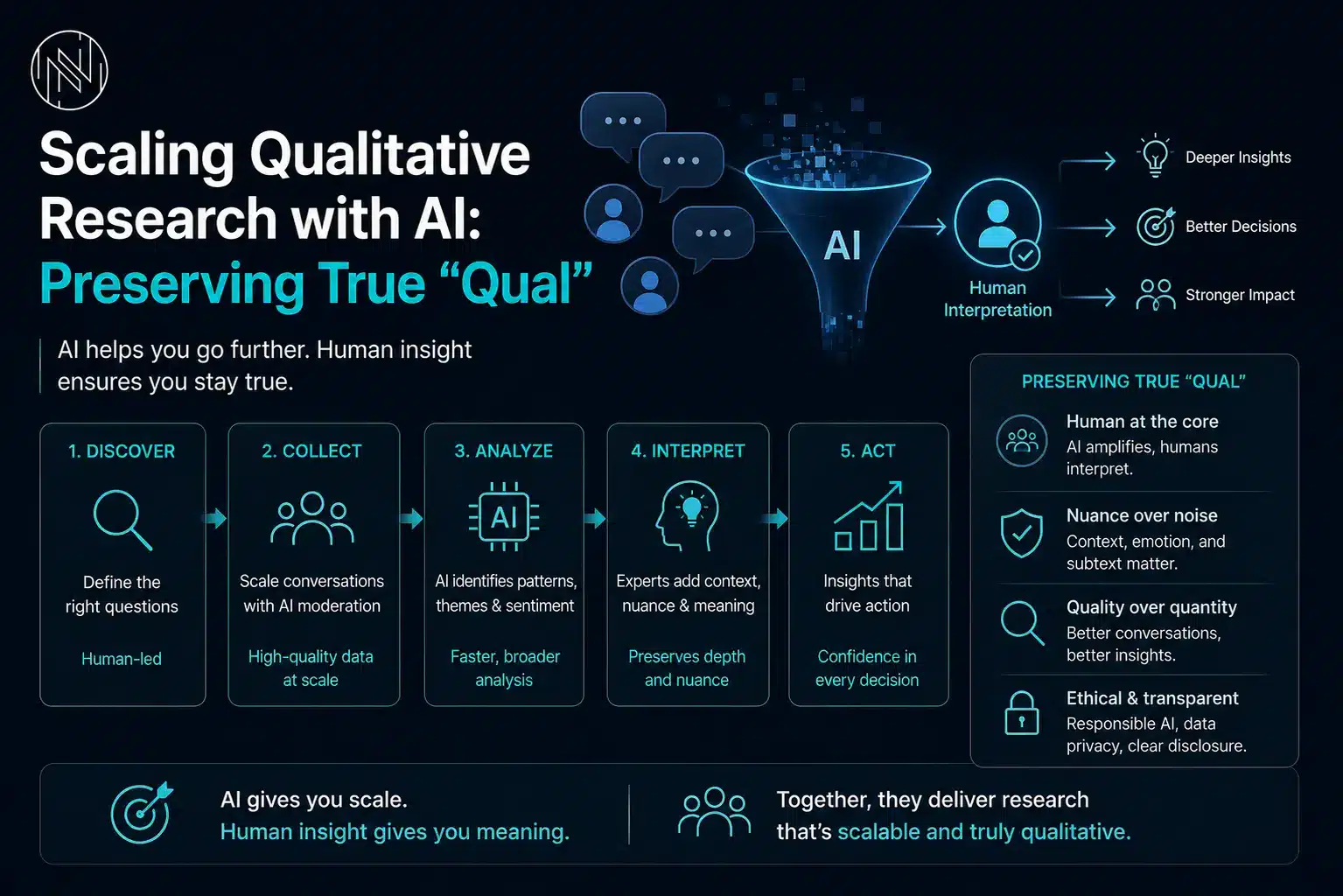
Scaling Qualitative Research with AI: Preserving True “Qual”
AI-moderated qualitative research at scale has arrived as a functioning methodology, not a promise. The tools exist, the platforms are live, and the speed gains are real. What has not arrived is any version of the technology that solves the problem that has always mattered most in qualitative work: getting the right person into the conversation in the first place.
What Is AI-Moderated Qualitative at Scale?
The technology is more mature than most practitioners realise in 2026, and the capability gap between these platforms is already significant.
Definitions and Technology
AI-moderated qualitative at scale describes research methodologies in which an artificial intelligence system takes on the moderating function, asking questions, probing responses, and guiding conversational flow, while conducting multiple sessions simultaneously rather than sequentially.
Platforms in this category range from asynchronous text and voice tools to live group environments where AI analyses participant contributions in real time and surfaces areas of agreement and divergence for human facilitators. Kantar’s launch of Kantar Live across 45 markets demonstrates the mainstream direction: large sessions with recruited respondents combining polling with in-depth discussion and AI-powered analysis, with rapid debriefs and summary outputs built into the delivery model.
Potential Advantages
Conveo and similar vendors position AI moderation as a major workflow accelerator, with substantial automation across recruiting, probing, transcription, and initial coding reducing what would otherwise be significant human-hours at every stage.
Some vendor reports and practitioners suggest that respondents can be more candid with AI moderation than with a human in the room, which in some contexts produces longer and denser responses. Kantar’s head of qualitative has noted that their GenAI analysis platform allows teams to process volumes of qualitative data in hours rather than the days that manual analysis would require.
Challenges to Qualitative Integrity
Speed at the top of the funnel does not help if the source material going in is thin, unverified, or simply wrong for the research question.
Garbage In, Garbage Out
The most important line in Kantar’s guidance on AI qualitative practice is also the most practical: AI cannot compensate for poor respondent selection. Kantar’s best-practice materials position sample quality as the non-negotiable foundation of qual at scale, which is precisely the dimension that AI moderation technology does not address.
An AI moderator that runs many sessions simultaneously is running those sessions with whoever showed up, and in B2B research, whoever showed up is usually not the person the research needed.
Depth and Nuance
The depth concern in AI-moderated qualitative is not primarily about the moderation layer. Kantar’s practice guidance notes that when enhancement at the analysis level is pursued at the expense of insight quality, the risk is that the concern with efficiency overrides the depth that qualitative research is supposed to provide.
For B2B research specifically, where the insight lives inside the operational experience of a practitioner who has actually managed the budget, made the purchase, or navigated the regulatory decision, a well-conducted AI-moderated session with the wrong respondent produces fluent answers to the wrong questions. Research on surrogate effects suggests that AI stand-ins can distort authentic voices, a risk that applies with particular force when the intended voices belong to a narrow population of credentialled B2B professionals.
Respondent Experience
AI moderation works well when respondents are comfortable with conversational technology and have a genuine stake in the subject matter. From Perspective AI’s 2026 review of qualitative software, most AI-moderated interview platforms are effectively BYOP environments: bring your own participants, source from existing contacts, a CRM, or a third-party panel provider.
For senior B2B professionals, the recruitment challenge does not disappear because the moderation is now handled by software, and a CISO or a VP of Procurement is no easier to find or credential-verify because an AI will be asking them the questions.
Hybrid Approaches
The practitioners getting the most out of AI-moderated qualitative are the ones who treat it as an amplifier for rigorous sourcing, not a replacement for it.
Human Oversight Required
Kantar’s guidance on AI qualitative practice is explicit that AI outputs need human review to maintain accuracy and directional integrity, with a stated emphasis on maintaining rigor throughout the process. A peer-reviewed 2025 study covering qualitative work across nine EU member states found that integrating AI into qualitative analysis required a structured human-in-the-loop process at every stage of coding and interpretation to maintain methodological rigour and preserve contextual accuracy.
The analytical layer requires human moderators who bring embodied memory of their direct interaction with respondents, which no AI synthesis step can supply from a transcript alone.
Examples of Integration
The most credible hybrid designs currently in use combine AI-moderated interview sessions or asynchronous voice interviews with a targeted expert layer for the respondent profiles the platform’s AI recruitment pool cannot reliably supply. Kantar Live separates the recruitment function from the AI moderation function rather than treating them as the same problem, which reflects where the real bottleneck in B2B qual actually sits.
For B2B qualitative work at scale, AI handles transcription, initial coding, theme detection, and volume moderation, while custom expert recruitment handles getting the right practitioner into the session to begin with.
Guidance for Researchers
The practical decisions about how and when to deploy AI-moderated qualitative are sourcing decisions before they are technology decisions.
Deciding When to Scale
Large-n qualitative work adds genuine value when the research question benefits from breadth of perspective across a defined professional population, such as understanding how IT procurement managers across multiple verticals approach a common purchasing category.
The methodology breaks down when the value of the insight is entirely concentrated in a small number of practitioners who hold specific operational knowledge, such as understanding how a medical device is evaluated for formulary inclusion by clinical procurement leads. Industry reporting from research technology analysts consistently identifies complex B2B investigations where interviewer expertise is central as the category most dependent on human-moderated and expert-recruited methods, even as AI augmentation becomes standard in other parts of the research workflow.
Maintaining Quality
Screener design for AI-moderated B2B qualitative needs to carry more of the qualification weight than a human-moderated session, precisely because there is no moderator in the room to probe for credential authenticity during the conversation itself. Kantar’s AI qualitative practice materials note that the quality of AI output is highly dependent on the quality of inputs throughout the research process, including prompts, sample design, and screener rigour. Quota design for AI-moderated B2B sessions should include decision-rights verification questions rather than title-only filters, following exactly the same logic that applies to panel-based quantitative B2B research.
Aligning With Client Objectives
A qualitative finding that will inform a product roadmap, a pricing architecture, or a market entry recommendation needs to carry evidential weight when it reaches the client. Kantar’s research on GenAI skills adoption notes that a meaningful share of marketing teams report lacking the right skills to use GenAI effectively, a finding that applies on both the research agency and the client side. The sophistication required to interpret AI-moderated qualitative output correctly is higher than it looks, and clients who receive AI-synthesised themes from poorly sourced samples will eventually notice that the insights do not hold up against their own operating reality.
The Microphone Was Never the Problem
The history of qualitative research is not a story about better recording equipment. It is a story about finding the right person, building the conditions for honest conversation, and interpreting what that person said with enough context to make it useful.
AI moderation changes throughput, cost per session, and speed of analysis in ways that are real and worth using. It does not change who the respondent is or whether they belong in the study. In B2B qualitative work, the recruitment question, the expert sourcing question handled by expert networks, the question of whether this person has actually lived the experience the study is trying to understand, is still the one that determines whether the insight is any good.
Talk to Nexus Expert Research when your AI-moderated qualitative study needs verified practitioners in the session, not just faster analysis of the wrong ones.
