
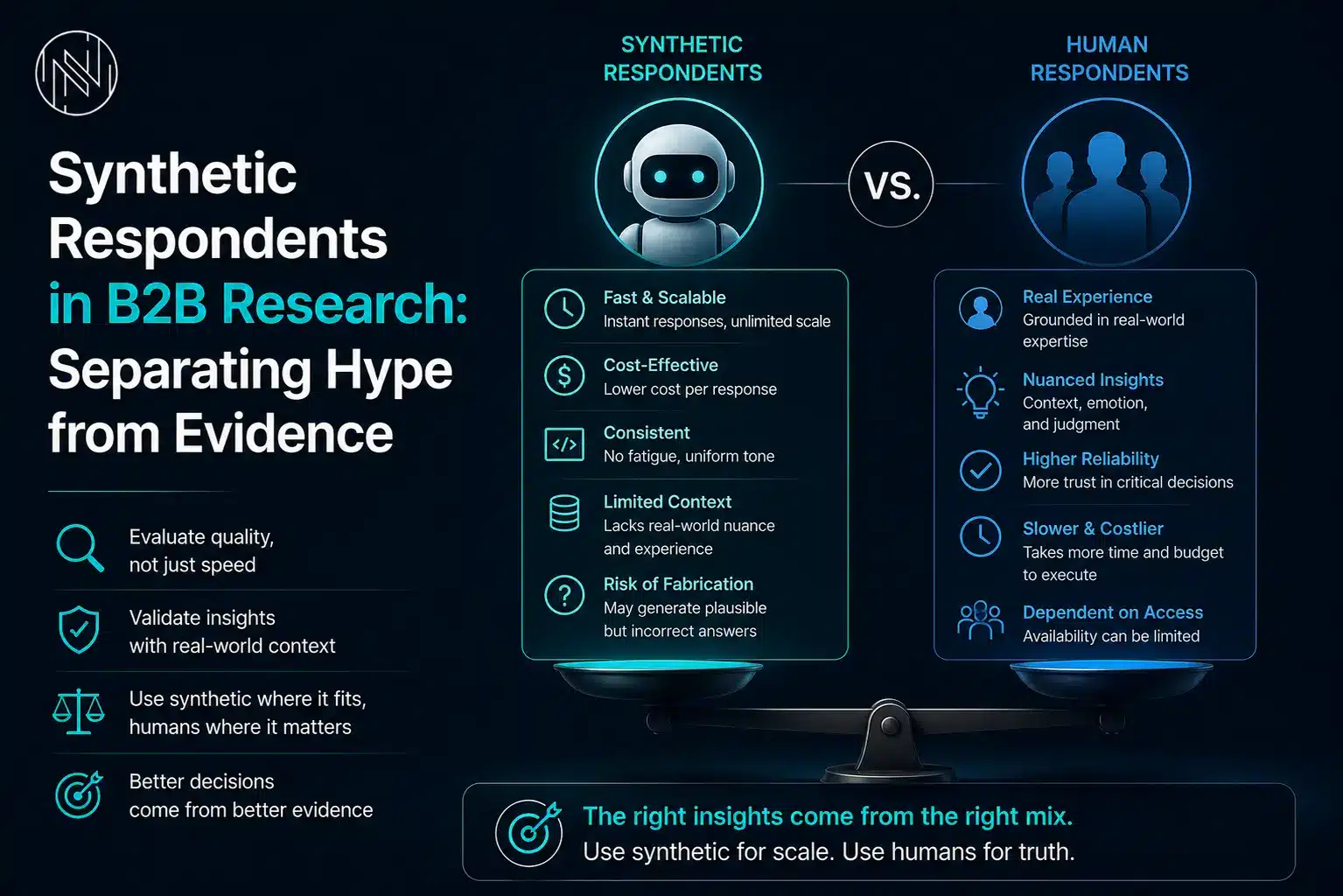
Synthetic Respondents in B2B Research: Separating Hype from Evidence
A synthetic respondent is an AI-generated profile built to answer survey questions the way a real professional might, at least according to how most vendors in this space currently define the term.
The question worth asking before using one in a B2B study is not whether the technology works. It is whether the underlying data it was trained on includes anyone who actually holds the job title you are studying.
What Are Synthetic Respondents?
To trust a simulated answer, you first have to understand the blueprint behind it. While consumer models draw from massive public datasets, B2B requires replicating highly niche decision-makers, raising the immediate question of whether a language model can genuinely mimic a C-suite executive who rarely posts publicly.
Definition and Creation
Synthetic respondents are AI-generated personas constructed from real demographic, firmographic, and behavioral data, then used to simulate how a target professional would answer a survey or interview question.
The construction process typically grounds a persona in attributes like job title, industry, seniority, and company size, then generates responses through a language model trained or fine-tuned on that profile. Qualtrics’ coverage of the category notes that researchers use the term “synthetic” in multiple different ways, which creates real confusion about what a given vendor actually means when they use the word.
Use Cases in B2B vs. B2C
Consumer synthetic systems generally have access to much broader data pools than narrow B2B audiences, simply because there is far more public review, survey, and behavioral data describing how ordinary consumers shop and decide. B2B research starts from a structurally smaller base.
NewtonX’s research team describes the difference plainly: target audiences like CISOs at specific enterprises or VPs of procurement making multimillion-dollar decisions cannot be mass-sampled from generic consumer panels or open AI models, because the qualifying population is too narrow and too specific.
Verified access to the right experts is the input the model needs before it can simulate anything credibly.
Benefits of Synthetic Respondents
Dismissing simulation entirely misses the operational leverage it offers. When used correctly, these tools drastically compress the early phases of research, trading multi-week feedback loops for instant prototyping, provided you use them to filter your questions rather than replace human answers.
Speed and Scale for Prototyping
Synthetic respondents can speed early-stage hypothesis testing and question refinement, which is a genuine advantage over a multi-week fielding cycle. This speed is most useful in early-stage concept testing, where the team is trying to identify which messaging angles or feature framings are worth testing further with real buyers. The value is in narrowing the field of questions worth asking a human, not in answering the question itself.
Cost and Compliance Advantages
Synthetic samples can reduce direct data-collection burdens in early exploratory work, since the team is not running live fieldwork at the prototyping stage. This advantage applies specifically to that early stage, not to the research program as a whole. A synthetic pool still needs to be built from somewhere, and in B2B that somewhere is a base of identity-verified professionals recruited specifically for the purpose, which is the logic NewtonX itself uses to justify its own synthetic approach rather than something synthetic data avoids entirely.
Limitations and Risks
The real danger lies in assuming an AI model preserves the messy variance of real life. Comparative data shows that synthetic cohorts suffer from an artificial consensus, flattening out the contrarian views and authentic friction that make primary research valuable in the first place.
Credibility Gaps and Biases
The clearest evidence of the bias problem comes from a direct comparison. Emporia Research’s comparative study tested LinkedIn-verified IT decision-makers against AI-generated personas representing the same role and found that the two groups produced meaningfully different response patterns, with the synthetic group showing a stronger positive bias and a herd mentality compared to the real group.
On a worklife balance satisfaction question, the synthetic group clustered much more tightly than the real group did, a visible collapse in the variance that makes survey data useful in the first place.
The real respondents spread their views across a noticeably wider range of answers than the synthetic group ever produced.
Evidence vs. Hype
The research community’s own usage data confirms this gap between adoption and trust. A 2026 report cited by Development Corporate says AI use is widespread in research workflows generally, yet regular use of synthetic-user tools specifically remains a small minority practice, and the survey suggests strong resistance to using synthetic respondents as a standalone replacement for real ones.
Recent industry reporting on this category suggests it is still converging on clearer validation standards, which signals that the field itself does not yet treat unvalidated synthetic output as equivalent to primary research.
Best Practices for Use
Deploying this technology safely means shifting from an “either-or” mindset to a hybrid framework. By anchoring simulations to verified human baselines and asking vendors the right technical questions, you can isolate the efficiencies of AI without inheriting its structural blind spots.
Hybrid Research Designs
The only model with credible evidence behind it pairs synthetic respondents with a verified human benchmark rather than using either in isolation. NewtonX’s June 2026 launch reinforces this trend toward synthetic tools that sit on top of identity-verified professional data rather than open-web training, and the company’s own CEO warned that unverified, general-population synthetic panels can produce misleading outputs. That warning, from a company selling a synthetic product, is strong evidence that the credibility of any synthetic sample is downstream of how rigorously the underlying human respondents were sourced and verified in the first place.
Checklist for Providers
Before adopting any synthetic respondent tool for B2B work, ask the vendor four specific questions. Ask what proportion of the underlying training data comes from identity-verified professionals in the relevant role, rather than scraped or general-population sources. Ask whether the vendor runs continuous backtesting against fresh human responses to catch model drift.
Greenbook’s directory of synthetic sample providers can be used to compare how different vendors approach bias checks and holdout validation as part of evaluating which provider takes this seriously. Ask for disclosure on exactly which findings in a given deliverable came from synthetic versus real respondents, since blended reporting without that distinction makes the output impossible to audit.
When to Rely on Synths
Synthetic respondents earn their place in early-stage concept testing, scenario stress-testing, and instrument design, where the goal is narrowing down which questions are worth asking a real person. They do not belong in final go-to-market decisions, pricing commitments, or any study whose findings will be presented to a board or investment committee without a verified human layer underneath it. The respondent population that matters most in B2B, senior buyers, technical specialists, and niche operators, is precisely the population a language model has seen the least of, which is the opposite of where synthetic confidence should be highest.
The Stand-In Is Not the Star
A stunt double can handle the wide shot, the fall, the chase sequence. The close-up, the line delivery that needs a real face behind it, still needs the actor who was actually cast. Synthetic respondents play the stunt double role credibly in B2B research: useful for the scenes that do not need the real performance, expensive to mistake for the lead.
The evidence so far, from the bias data to the trust surveys to the synthetic vendors’ own admissions, points to the same operational rule. Build the synthetic layer on top of custom-recruited, identity-verified experts, never the other way around. Never let the synthetic answer stand in for the close-up.
Talk to Nexus Expert Research when your B2B study needs the verified human layer that credible synthetic research is built on top of.
