AI Expert Network vs AI Consulting Firm: When to Use Each
When your team needs to understand how a target company’s ML infrastructure actually performs under load, or whether a particular AI vendor’s claims survive scrutiny from someone who has deployed the same stack in production, a consulting firm will give you a team and a methodology.
An expert network will get you the person who has already solved that problem. Both are legitimate tools and both are frequently misapplied, usually because the decision is made on familiarity rather than fit.
What an AI Expert Network Is
An AI expert network recruits and schedules conversations between your team and verified practitioners who have specific, current AI experience. The practitioners are sourced against a live brief: a former ML engineering lead who deployed large language models in financial services, a clinical AI product manager who navigated FDA clearance, or a data governance specialist who built AI compliance frameworks under the EU AI Act. You run the interview; the network finds the person and handles the compliance architecture around the engagement.
The expert network industry surpassed $2.5 billion in 2024, growing 9 percent year-on-year, reaching approximately $3 billion in 2025 with around 12 percent annual growth between 2023 and 2025. Consulting firms account for roughly half of total expert network spend, with corporates representing about 45 percent of clients by number and capital market players accounting for 44 percent of clients and 42 percent of spend.
What an AI Consulting Firm Is
An AI consulting firm owns the engagement. They form a team, define the methodology, run the analysis, and deliver a recommendation. The AI consulting services market was valued at $11.07 billion in 2025 and is projected to grow at 23.4 percent CAGR through 2035, which reflects genuine and increasing corporate demand for firms that can design and execute AI strategy rather than simply provide access to practitioners. Large enterprise AI consulting engagements can run into the six or seven figures depending on scope, and the deliverable is a report or a roadmap, not a conversation.
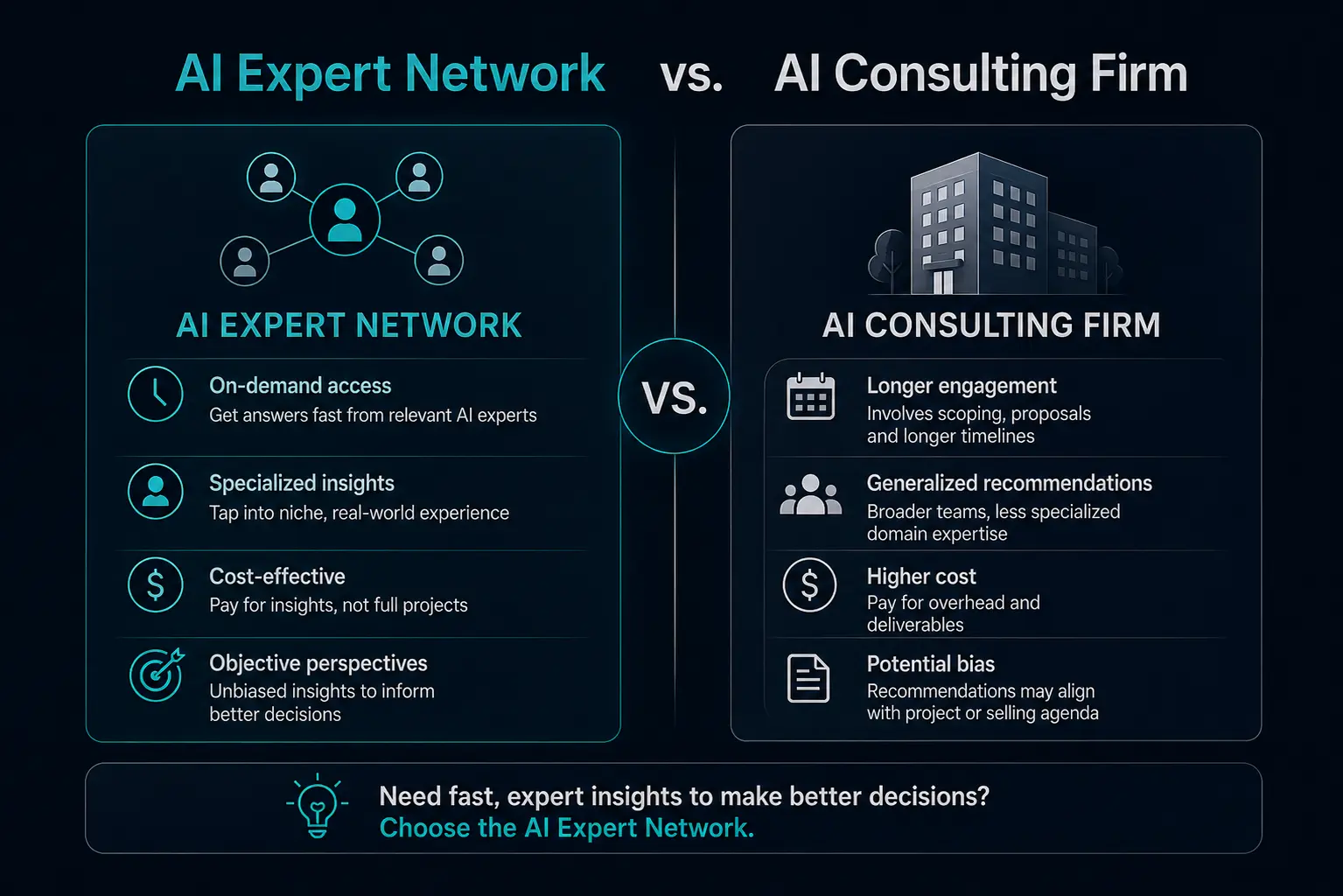
Side-by-Side Comparison
| Factor | AI Expert Network | AI Consulting Firm |
|---|---|---|
| Deliverable | Practitioner conversations | Reports, recommendations, roadmaps |
| Timeline | Faster sourcing than traditional consulting workflows | Weeks to months |
| Cost | Per-call fees, project bundles | Engagements typically in the six to seven figure range |
| Validation type | Operational intelligence, field reality | Structured analysis and synthesis |
| Credential verification | Current role, experience, conflict check | Team credentials, firm track record |
| Best for | Hypothesis testing, due diligence calls, specialist access | Full strategy build, implementation roadmap, governed output |
| AI-specific use | Validating AI technology claims, sector AI adoption reality | AI transformation strategy, AI governance frameworks |
When to Use an AI Expert Network
The cases where custom AI expert recruitment delivers something a consulting engagement cannot are all variations of the same underlying need: you need to know what a specific type of AI practitioner knows from having been accountable for a real AI deployment.
AI Due Diligence for Acquisitions
PE firms evaluating AI companies are the clearest case for expert network sourcing. A target company’s AI technology claims, model performance benchmarks, data pipeline architecture, and AI talent concentration are all claims that technical practitioners can assess in a structured call with far more specificity than a generalist consulting team can achieve through document review. McKinsey’s January 2026 research on generative AI in M&A documents that commercial due diligence runs 46 percent faster with AI assistance for document synthesis, but the expert call layer, the practitioner conversation that validates whether the technology actually works as described, remains a human judgment call that expert networks are built to support.
AI Vendor Evaluation
A procurement or strategy team comparing several AI platform vendors needs to speak with practitioners who have deployed those specific tools in a comparable environment. Standard secondary research does not tell you why a particular enterprise LLM deployment failed to achieve adoption or which data infrastructure constraints consistently block ROI at scale. These are operational insights that live inside the experience of someone who has run the project and been accountable for the outcome.
Sector-Specific AI Adoption Intelligence
Market sizing the AI opportunity within a specific vertical, whether healthcare, financial services, manufacturing, or logistics, requires intelligence from practitioners who are currently deploying AI inside that vertical. A series of structured expert calls with sector practitioners produces the ground-level intelligence that secondary data cannot supply. Expert networks source these practitioners quickly, often faster than traditional consulting workflows, because sourcing is built around a live brief rather than a pre-existing team structure.
AI Regulatory and Governance Intelligence
With the EU AI Act’s tiered risk obligations now in force, companies entering the European market or operating AI systems that touch employment, credit, healthcare, or law enforcement decisions need practitioners who have navigated those compliance requirements in practice. Custom-recruited AI governance specialists and regulatory affairs professionals who have built compliance frameworks under the Act carry operational knowledge that published guidance documents do not contain.
When to Use an AI Consulting Firm
An AI consulting firm is the right choice when the deliverable is the work itself, not the intelligence that informs someone else doing the work. IBM research found that 86 percent of consulting buyers actively seek services with AI and technology assets, and the firms at the top of this market have invested collectively over $10 billion in AI capabilities since 2023. If you need an AI strategy that will go to your board, an implementation roadmap that your engineering team will execute against, or a governed AI governance framework that carries the firm’s signature, a consulting engagement is appropriate.
AI Consultant vs AI Subject Matter Expert
These two roles are often conflated and they serve genuinely different functions. An AI consultant owns a structured methodology for assessing, recommending, and implementing AI capability. An AI subject matter expert owns applied experience from having built, deployed, or evaluated AI systems in a specific domain. Think of the difference the way a screenwriter approaches research: the consultant is the research firm that produces a scene structure, and the subject matter expert is the retired practitioner who tells you what actually happens when an AI-generated output enters a high-stakes decision process.
The same distinction applies operationally. When a strategy team needs to test whether their AI market entry thesis would survive scrutiny from the practitioners who operate the market, they need subject matter experts. When they need to turn the validated thesis into a boardroom-ready strategy document, they need consultants.
Expert Networks for AI Due Diligence
AI due diligence is the use case where the expert network model carries its clearest advantage over a standard consulting engagement. Top-tier consulting firms can charge very high fees for commercial diligence work, especially on large PE transactions, buying structured synthesis and brand credibility. A firm using an expert network to commission eight to twelve targeted calls with former ML engineers, technical architects, and customer-side practitioners who have evaluated or deployed the target company’s technology type is buying field-level validation of specific claims within a compressed timeline.
The two approaches are not alternatives to each other in a well-run diligence process. Expert calls sharpen the questions; the consulting deliverable synthesises the answers. The firms getting the most out of both in 2026 are using expert networks to stress-test the intelligence layer before the consulting team touches it.
Decision Framework
The decision between expert network and consulting firm is a function of three variables: the specificity of what you need to know, the timeline you have to know it, and whether the output is intelligence or a deliverable. Use custom AI expert recruitment when the question requires a practitioner who has been there, when you have a brief-to-insight window measured in days, and when you are testing a specific hypothesis rather than commissioning a strategy build. Use an AI consulting firm when the deliverable needs to carry methodological structure and firm accountability, when the scope requires a team rather than a conversation, and when the output will govern decisions rather than inform them.
The Right Expert at the Right Stage
Neither model wins universally. The AI consulting firm is the right instrument when the project needs a team, a methodology, and a signed-off deliverable. The expert network is the right instrument when the project needs a practitioner who has operated inside the exact AI context you are trying to understand. Getting this wrong costs money in the obvious direction: paying consulting firm rates for intelligence gathering that a well-sourced expert call would have resolved faster, or commissioning expert calls without the synthesis layer that turns practitioner intelligence into a recommendation someone can act on.
Talk to Nexus Expert Research when your AI due diligence, vendor evaluation, or sector intelligence work needs the practitioner conversation layer that consulting deliverables are built on top of.
