
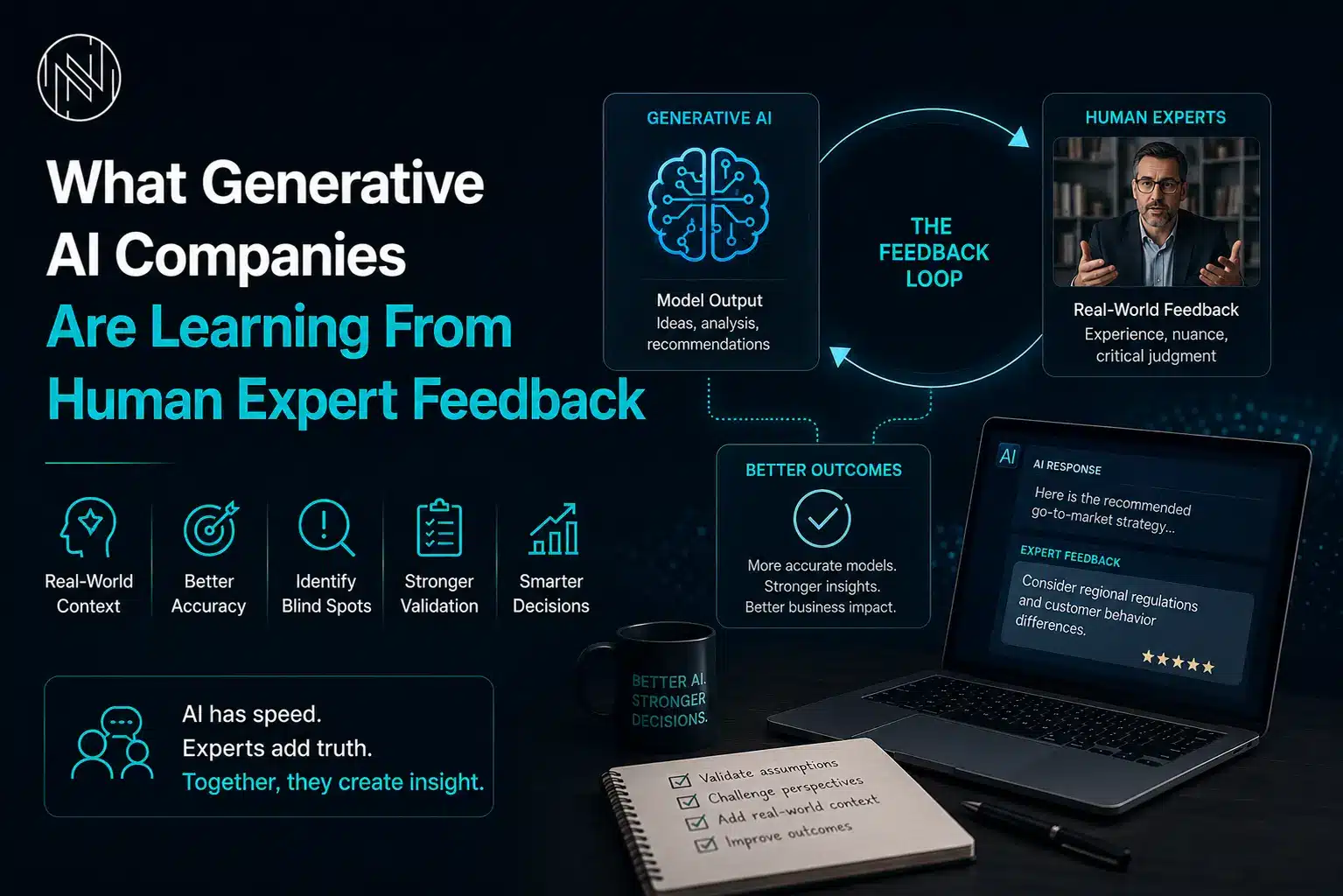
What Generative AI Companies Are Learning From Human Expert Feedback
Generative AI companies are learning that model quality does not come from raw data alone. Human experts help AI teams judge usefulness, safety, accuracy, tone, and domain fit in ways that automated metrics often miss.
In 2026, the strongest AI teams are using expert feedback to build better reward models, test edge cases, improve alignment, and create safer user experiences. This is why RLHF human feedback has become a core part of modern AI development, not just a research method.
Generative AI has moved from demos to real business tools. Startups, VCs, and SMBs now care about accuracy, trust, risk, compliance, and customer experience. Stanford HAI reported that generative AI attracted $33.9 billion in global private investment in 2024, while AI business usage rose to 78% of organizations. That makes model reliability a business issue, not only a technical issue.
Your Google AI Overview screenshot also reflects this search intent. The key themes are clear: raw training data is not enough, Reinforcement Learning from Human Feedback matters, expert auditing improves model behavior, and AI companies need guardrails for real-world use.
Why Raw Training Data Is No Longer Enough
Raw web data can teach a model language patterns, facts, and associations. It cannot reliably teach judgment.
That is the core lesson behind generative AI expert feedback. AI models may produce answers that sound confident but miss context, ignore risk, or fail in niche situations. A general model can explain medical billing, legal clauses, investment terms, or supply chain issues, but it may not know which answer is acceptable in a real business workflow.
Human experts add three things raw data lacks:
- Practical judgment from real work
- Awareness of edge cases
- Clear standards for what “good” means
This is where AI training human experts become valuable. They do not only label data. They help define quality.
What RLHF Means for Generative AI Companies
RLHF generative AI is the process of using human feedback to guide model behavior. AWS defines reinforcement learning from human feedback as a machine learning technique that uses human feedback to optimize models so outputs better match human goals, needs, and preferences.
How RLHF Works in Simple Terms
A basic RLHF workflow has four steps:
- A model generates multiple answers.
- Humans compare or rate those answers.
- A reward model learns which answers humans prefer.
- The AI model is fine-tuned toward better outputs.
OpenAI’s InstructGPT work helped popularize this approach by using human demonstrations and rankings to make models better at following user intent. The paper also showed that bigger models are not automatically better aligned with user needs.
Why Expert Feedback Is Better Than Generic Ratings
Generic feedback can tell a model which answer sounds better. Expert feedback can tell a model which answer is actually useful, safe, and correct.
That is why RLHF domain experts matter in finance, healthcare, law, insurance, cybersecurity, manufacturing, and enterprise software. A domain expert can spot missing assumptions, weak reasoning, bad terminology, unsafe advice, or hidden compliance risks.
For decision makers, the point is simple: expert feedback reduces the gap between a model that sounds good and a model that performs well in a real market.
What Companies Are Learning From Human Expert Feedback
AI companies are learning that feedback quality shapes model quality. A 2026 RLHF survey describes RLHF as a central framework for aligning large language models, but also notes that human feedback can be noisy, subjective, and heterogeneous. This means companies need better feedback design, not just more feedback.
| Lesson from Expert Feedback | What It Means for AI Companies | Business Impact |
|---|---|---|
| Quality is subjective | Different users value accuracy, tone, speed, safety, and detail differently | Better product-market fit |
| Edge cases matter | Models often fail where workflows are complex or rare | Lower operational risk |
| Guardrails need judgment | Safety rules must reflect context, not only banned words | Safer deployment |
| Feedback is a moat | Continuous evaluation improves the model over time | Stronger defensibility |
Lesson 1: Quality Is Often Subjective
Human expert feedback AI training helps companies define quality for specific users.
For example, a startup founder may want concise investor-ready answers. A doctor may need cautious and evidence-aware wording. A legal operations team may need clause-level accuracy. The “best” answer depends on the user, task, and risk level.
This is why qualitative feedback generative AI is so useful. Experts can explain why an answer is weak, not just mark it as weak.
Lesson 2: Domain Experts Catch Edge Cases
Domain expert AI alignment improves model behavior in hard cases.
General reviewers may miss details that specialists catch quickly. A finance expert may detect a misleading risk statement. A healthcare expert may notice unsafe simplification. A procurement expert may recognize that the model ignored supplier constraints.
These small corrections become important training signals. Over time, the model learns not only what to answer, but what to avoid.
Lesson 3: Guardrails Need Human Judgment
AI model alignment expert feedback helps teams build practical guardrails.
Anthropic’s Constitutional AI research shows one major direction in alignment: using rules or principles to guide safer model behavior, including AI feedback methods. But even principle-based systems still need human oversight to decide which values, contexts, and tradeoffs matter.
For business users, guardrails should be specific. A customer support bot, medical assistant, legal research tool, and investment workflow should not use the same safety rules.
Lesson 4: Feedback Loops Are Becoming a Competitive Advantage
The strongest companies are building an AI model human feedback loop. They collect expert input, convert it into training data, test model changes, and repeat the process.
This loop is becoming a product advantage. It helps companies move from one-time model tuning to continuous improvement.
Where Domain Experts Add the Most Value
Expert annotation AI training is most useful when the task requires judgment, accuracy, or risk awareness.
Experts add value in:
- Ranking model responses by usefulness
- Writing ideal answers for supervised fine-tuning
- Reviewing hallucinations and factual errors
- Auditing outputs for policy, safety, or compliance
- Testing domain-specific prompts
- Creating evaluation rubrics
- Explaining why an answer failed
This is also where generative AI training data experts become important. The best data is not always the largest dataset. Often, it is the clearest, most consistent, and most relevant expert-reviewed dataset.
RLHF Use Cases 2026: Practical Business Applications
For teams researching reinforcement learning from human feedback 2026, the most useful question is not “What is RLHF?” It is “Where does RLHF create business value?”
Common RLHF use cases 2026 include:
- Enterprise chatbots that need accurate answers
- AI copilots for sales, finance, legal, and operations
- Healthcare triage and documentation support
- Financial research and risk analysis
- Code assistants and technical support tools
- AI search systems that need better answer ranking
- Brand-safe marketing content generation
- Customer service automation with tone control
In each case, LLM domain expert feedback helps the model understand what a strong answer looks like inside a specific workflow.

How to Build an Expert Feedback Program
A strong feedback program needs clear goals, qualified reviewers, consistent scoring, and measurable improvement.
| Feedback Program Element | Best Use | Key Risk |
|---|---|---|
| Nexus Expert Research | Specialist-led feedback, expert calls, domain validation, and high-quality review workflows | Requires clear project scope |
| Internal subject matter experts | Company-specific knowledge and product rules | Limited time and possible bias |
| Crowd labeling platforms | Simple preference tasks at scale | Lower domain depth |
| AI-assisted evaluators | Fast first-pass checks and regression testing | Can miss human context |
Step 1: Define the Model Behavior You Want
Start with the outcome. Do you want the model to be safer, more accurate, more helpful, more concise, more expert-like, or more brand-aligned?
A clear rubric should define:
- What a good answer includes
- What a bad answer looks like
- What risks must be avoided
- Which user intent matters most
- How experts should score outputs
Without a rubric, feedback becomes inconsistent.
Step 2: Recruit the Right Experts
Subject matter expert AI training works best when the expert group matches the target user.
A healthcare model needs clinicians or healthcare operations specialists. A financial model needs analysts, advisors, auditors, or risk professionals. A legal AI tool needs lawyers, contract managers, or legal operations experts.
For startups and SMBs, this is where an expert network for AI training can reduce hiring friction. Instead of building a full expert panel internally, teams can access qualified professionals for structured feedback projects.
Step 3: Turn Qualitative Feedback Into Training Signals
Expert comments must become usable data.
A reviewer might say, “This answer is too broad and misses the regulatory risk.” That comment should be converted into labels, ranking data, corrected answers, or evaluation criteria.
This is the bridge between human judgment and machine learning. It turns expert insight into a repeatable signal.
Step 4: Track Model Improvement Over Time
Feedback only matters if it improves the model.
Teams should track:
- Accuracy changes
- Hallucination reduction
- Refusal quality
- User satisfaction
- Domain-specific pass rates
- Safety and compliance failures
- Regression on previous tasks
NIST’s AI Risk Management Framework is useful here because it encourages organizations to manage AI risks across trust, safety, validity, reliability, accountability, and transparency.
Common Risks and Tradeoffs
Human feedback is powerful, but it is not perfect.
First, experts may disagree. In many fields, there is no single correct answer. Second, feedback can be expensive. Third, poor instructions can produce poor labels. Fourth, a model can over-optimize for the reward model and still fail real users.
Newer methods such as Direct Preference Optimization aim to simplify preference-based alignment by avoiding some of the complexity of traditional RLHF pipelines. But the need for strong human preference data remains.
The lesson is clear: the future is not human feedback or automation. It is human-in-the-loop AI with better process design.
What Decision Makers Should Do Next
Decision makers should treat expert feedback as part of product strategy.
For VCs, expert feedback is a due diligence signal. A startup with a strong feedback loop may be more defensible than one relying only on a base model.
For startups, expert feedback can improve product quality before launch. It can also reveal which use cases are too risky, too vague, or not ready.
For SMBs, expert feedback helps evaluate vendors. A company buying an AI tool should ask: Who reviewed the model? What domain expertise was used? How often is the model tested? What happens when it fails?
Generative AI companies are learning that expert feedback is not a final polish step. It is part of how strong AI products are built.
Build AI products that experts can trust, users can understand, and markets can adopt.
Contact Nexus Expert Research to turn real expert insight into stronger AI feedback, evaluation, and alignment workflows.
