
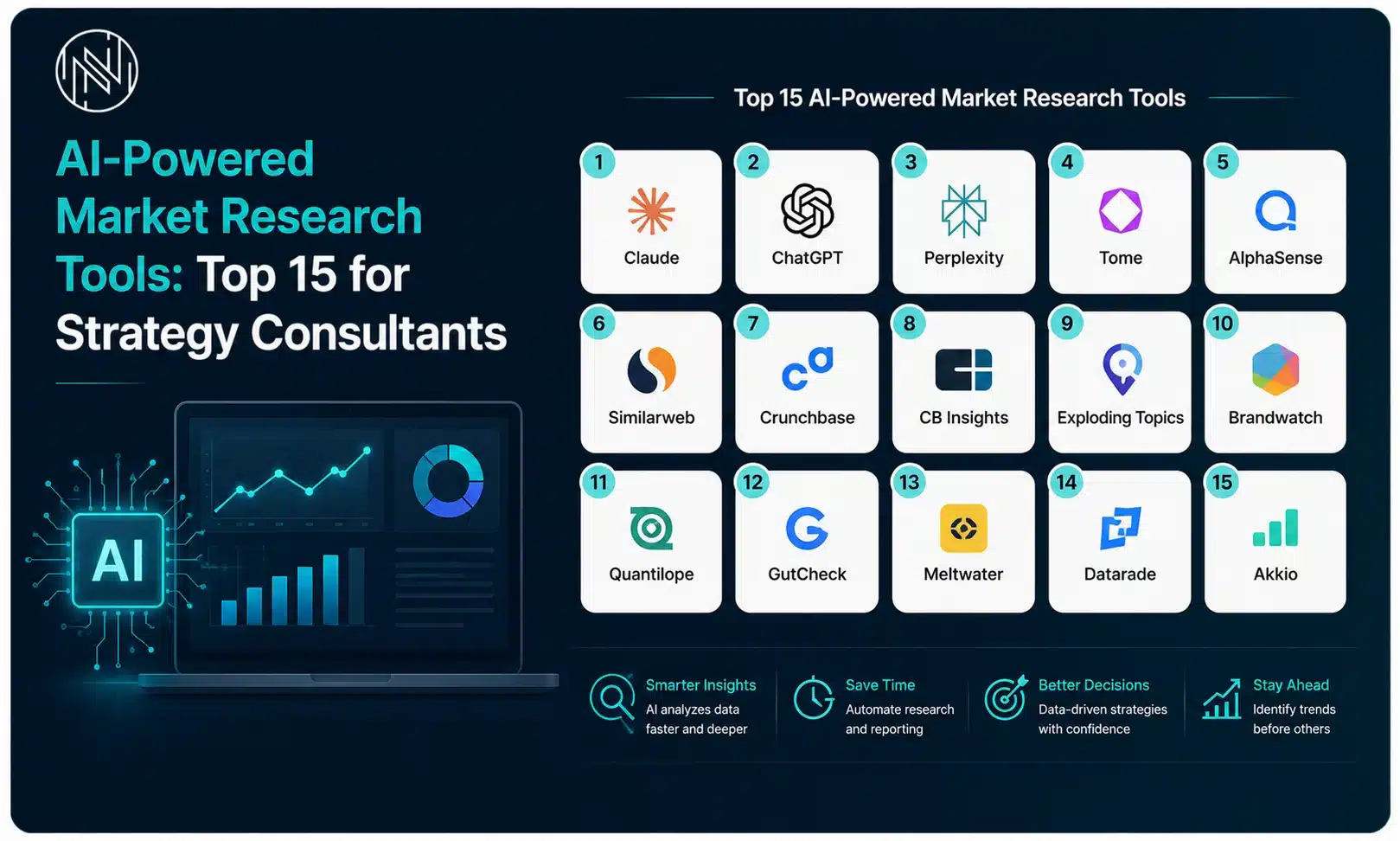
AI-Powered Market Research Tools: Top 15 for Strategy Consultants
The top AI-powered market research tools in 2026 fall into five workflow categories: secondary intelligence, competitive monitoring, audience profiling, primary data collection, and synthesis. Strategy consultants who build a stack across all five stages are completing research cycles in a fraction of the time previously required. This guide covers the 15 best tools by category, with honest assessments of what each one actually delivers for a consulting practice.
The traditional market research model is no longer competitive. A sector primer that once took three days of manual searches now takes a few hours with the right tools. An audience profiling project that required a commissioned panel can now be completed with two software subscriptions and an afternoon.
AI market research tools have restructured the consulting workflow across every research stage. But the tools are not interchangeable, and selecting the wrong platform for the wrong task creates noise rather than insight.
This guide is built for decision-makers, VCs, startups, and small to medium-sized businesses who want a clear, category-by-category breakdown of the best AI tools for strategy consultants in 2026. Every tool listed here is real, publicly available, and evaluated on the specific value it delivers inside a consulting workflow.
Why AI Is Reshaping Market Research for Strategy Consultants in 2026
The productivity case for AI for strategy consulting is now backed by peer-reviewed evidence. A field experiment involving Boston Consulting Group consultants, published in Organization Science (Dell’Acqua et al., 2023/2026), found that consultants using AI completed 12.2% more tasks, 25.1% faster, with over 40% higher quality scores on tasks within the AI’s capability range.
That same study found AI users performed roughly 19 percentage points worse on tasks outside the AI’s frontier. The implication is important: knowing which tool to use for which task matters more than simply using AI at all.
According to McKinsey’s State of AI 2025 report, 78% of organizations now use AI in at least one business function, up from 55% the prior year. Strategy and corporate finance are among the top three functions where high-performing firms are scaling AI-driven insights. Consulting productivity tools powered by AI are no longer optional for the competitive edge. They are the edge.
The 5 Workflow Categories Every AI Research Stack Covers
Top market research tools for management consultants in 2026 are organized around five distinct workflow stages. A well-designed stack typically includes at least one tool from each.
The five categories are:
- Market Intelligence and Secondary Research – for desk research, sector primers, and macro analysis
- Competitive Intelligence – for competitor monitoring, battlecards, and positioning
- Audience Intelligence – for consumer profiling, psychographics, and behavioral insights
- Primary Research – for surveys, focus groups, and concept testing
- Data Analysis and Synthesis – for turning raw data into client-ready deliverables
Category 1: Market Intelligence and Secondary Research
These AI tools for industry research replace hours of manual desk research and allow consultants to build sector primers, PESTEL frameworks, and investment theses at speed.
1. AlphaSense
AlphaSense is the enterprise standard for market intelligence software in consulting and investment research. It indexes over 500 million documents, including SEC filings, broker research, earnings transcripts, trade journals, and the Tegus expert-call transcript library.
Its Generative Search feature builds multi-step research workflows, produces company primers and SWOT summaries, and provides sentence-level citations for every claim. When sourcing accuracy is non-negotiable, AlphaSense is the most defensible AI market research software for consulting firms available.
Best for: PE/VC diligence, market-entry primers, and macro sector analysis. Pricing: Starting at approximately $12,000 per year, with a median contract value near $18,375 per year, based on third-party procurement data.
2. Perplexity AI
Perplexity AI is a cited-answer engine that functions as a fast-track secondary research assistant. Its November 2025 Premium Sources launch added direct integration with Statista, CB Insights, and PitchBook inside the same conversational interface, closing the gap between consumer AI tools and institutional databases.
Best for: Rapid macro scans, competitor overviews, and market-size estimates during a proposal sprint. Pricing: $20 per month for Pro; Enterprise pricing is custom.
3. Elicit
Elicit is an AI research assistant built for evidence-heavy engagements. It searches over 138 million academic papers semantically, extracts structured data into evidence tables, and can run systematic literature reviews at a PRISMA-grade standard.
Best for: Life sciences, deep tech, climate policy, and regulatory engagements where evidence lives in journals rather than earnings calls. Pricing: $12 per month for Plus; $49 per month for Pro.
Category 2: Competitive Intelligence Tools
AI tools for competitive analysis automate the monitoring work that previously required a dedicated analyst. These platforms turn competitor signals into usable intelligence for client GTM strategy and market positioning.
4. Crayon
Crayon is an AI-powered competitive intelligence tool that tracks competitor websites, pricing pages, product updates, job postings, and review-site activity in real time. Its Sparks AI runs scheduled monitoring and delivers summarized intelligence directly into Salesforce, Slack, and Microsoft Teams.
Best for: Consultants advising B2B technology or SaaS clients on competitive response strategy. Pricing: Approximately $20,000 to $40,000 per year, based on third-party benchmarks.
5. Klue
Klue is a competitive enablement platform focused on sales-side intelligence. Its 2026 Compete Agent automatically refreshes competitor battlecards and delivers deal-specific insights inside Salesforce and Slack. A published case study from Blackbaud cites a 28% improvement in win rates against top competitors following deployment.
Best for: GTM strategy and sales-effectiveness engagements where the deliverable must live inside the seller’s workflow. Pricing: Custom; typically comparable to Crayon at the enterprise level.
6. Signal AI
Signal AI monitors global print, online, broadcast, podcast, and regulatory media using its proprietary AIQ taxonomy, covering approximately 20,000 podcast stations worldwide. It surfaces share-of-voice, narrative resonance, and reputational risk across competitive landscapes.
Best for: Corporate affairs, reputation management, and regulatory intelligence engagements where clients need to benchmark their public narrative against competitors. Pricing: Custom enterprise contracts.
Category 3: Audience Intelligence and Consumer Behavior
These AI research platforms for consultants replace or supplement expensive custom panels by extracting behavioral and psychographic insight from existing public and syndicated data sources.
7. SparkToro
SparkToro analyzes millions of public web and social profiles to reveal exactly what any defined audience reads, watches, listens to, and follows online. Its January 2026 update accepts plain-language audience descriptions and returns behavioral data in under two minutes.
Best for: Fast audience profiling for brand strategy, content, and ICP definition without commissioning a custom panel. Pricing: Free tier (5 searches per month); $50 per month Personal; $150 per month Business; $300 per month Agency.
8. GWI Spark
GWI Spark is the AI layer over GWI’s global consumer survey dataset, covering 35 billion data points across 50 markets and 960,000 consumers. Since late 2025, it connects directly with Claude, ChatGPT, and Microsoft Copilot via MCP, allowing consultants to query verified, statistically representative psychographic data inside their existing AI environments.
Best for: Brand strategy, CX, and consumer-strategy engagements that require globally comparable demographic and psychographic segmentation. Pricing: Enterprise and custom; limited free access available.
9. Delve AI
Delve AI generates data-backed customer personas from first-party analytics sources including Google Analytics, HubSpot, Shopify, and Klaviyo, combined with over 40 public data sources. Consultants can interact directly with persona segments in 15+ languages using its Digital Twin product. Delve AI is featured in Gartner’s Accelerate User Research with AI Agents report.
Best for: Consumer segmentation, persona development, and concept-testing engagements where synthetic but data-grounded audience profiles are required. Pricing: Freemium entry; paid tiers scale with volume and persona count.

Category 4: Qualitative and Quantitative Primary Research
These platforms run primary research at scale and reduce the need to commission full-service external research agencies for standard studies.
10. Quantilope
Quantilope is an end-to-end quantitative research AI tool that automates advanced methods including MaxDiff, Conjoint, TURF, A/B testing, and brand tracking. Its Quinn AI co-pilot, vetted by Microsoft, drafts survey questionnaires, generates chart headlines, and writes report summaries.
In a published case study, Zurich Insurance Austria reported savings of 50,000 to 70,000 euros per year by shifting five annual conjoint analysis projects from external agencies to quantilope’s platform.
Best for: Pricing studies, U&A research, and brand health tracking that would otherwise require an external agency. Pricing: Custom tiers for Business, Pro, and Enterprise users.
11. Remesh
Remesh is an AI-powered platform for qualitative research at scale. It enables a single live conversation with up to 1,000 participants simultaneously, with real-time AI clustering, sentiment analysis, and response voting. Its asynchronous format, Remesh Flex, accommodates up to 5,000 participants.
Best for: Rapid concept-testing, employee-voice research, and public-policy engagements where qualitative depth at quantitative scale is needed within a single session. Pricing: Custom; SOC 2 Type II certified; supports 30+ languages.
12. SightX
SightX is an all-in-one consumer research platform anchored by Ada, its generative AI research consultant. Ada designs studies from a single prompt, performs thematic analysis on open-ended responses, and generates executive summaries automatically. It includes access to a global panel of over 100 million consumers and now supports asynchronous video interviews with automated transcription and translation.
Best for: Mid-market consulting teams that need a single platform covering survey design, analysis, and reporting. Pricing: Custom, use-case-based; panel access is included.
Category 5: Data Analysis and Synthesis
These tools convert raw data and document collections into usable intelligence and client-ready outputs, without requiring a background in data science or statistics.
13. NotebookLM
NotebookLM by Google is a retrieval-augmented research tool. Consultants upload up to 300 documents, including PDFs, interview transcripts, earnings reports, and internal presentations, and query them as a private, grounded knowledge base. It never draws on the public web, eliminating the hallucination risk that comes with open-web AI tools.
Best for: Synthesizing client data rooms, interview batches, and prior research into a single queryable source before a board presentation or deliverable. Pricing: Free on personal Google accounts; NotebookLM Plus is included with Google Workspace Business Standard and above.
14. Julius AI
Julius AI is a conversational automated market research and data analysis tool that lets non-technical consultants run exploratory analysis on CSV, Excel, and live database connections including Snowflake, BigQuery, and Databricks. It generates Python or R code in the background and returns charts, forecasts, and shareable notebooks.
Best for: Consultants who receive large structured datasets and need defensible analysis without writing code. Pricing: $35 per month (Plus); $45 per month (Pro); $200 per month (Max). SOC 2 Type II and GDPR compliant; handles files up to 32 GB.
15. Displayr (and think-cell)
Displayr is a purpose-built survey analytics and reporting suite. Its Research Agent autonomously cleans survey data, codes open-ended text responses, runs weighted crosstabs with significance testing, performs regression and segmentation analysis, and produces branded, editable reports with every figure traceable to the underlying calculation.
For client-facing deliverables, think-cell remains the de facto standard across leading consulting firms. The PowerPoint add-in automates waterfall, Mekko, and Gantt chart production, and its 2025 Assist feature adds generative AI for chart-from-data creation and natural-language slide editing across 100+ languages.
Displayr pricing: Custom enterprise contracts. Think-cell pricing: Approximately $322.80 per user per year for 1 to 4 users, scaling to approximately $230.40 per user per year at 50-license volume, based on Vendr marketplace contract data.
Quick Comparison: Top 15 AI Market Research Tools at a Glance
| # | Tool | Category | Best For | Starting Price |
| 1 | AlphaSense | Market Intelligence | PE/VC diligence, sector primers | ~$12,000/year |
| 2 | Perplexity AI | Market Intelligence | Rapid macro scans, proposal research | $20/month (Pro) |
| 3 | Elicit | Market Intelligence | Academic literature, life sciences, deep tech | $12/month |
| 4 | Crayon | Competitive Intelligence | B2B tech competitor monitoring | ~$20,000/year |
| 5 | Klue | Competitive Intelligence | GTM battlecards, win-rate improvement | Custom |
| 6 | Signal AI | Competitive Intelligence | Reputation and regulatory tracking | Custom |
| 7 | SparkToro | Audience Intelligence | Audience profiling without a custom panel | $50/month |
| 8 | GWI Spark | Audience Intelligence | Global consumer psychographics | Custom |
| 9 | Delve AI | Audience Intelligence | Persona generation and segmentation | Freemium |
| 10 | quantilope | Primary Research | Conjoint, MaxDiff, brand tracking, U&A | Custom |
| 11 | Remesh | Primary Research | Large-scale live qualitative sessions | Custom |
| 12 | SightX | Primary Research | All-in-one survey, panel, and reporting | Custom |
| 13 | NotebookLM | Data Synthesis | Private document knowledge base | Free / Workspace |
| 14 | Julius AI | Data Analysis | Non-coder exploratory data analysis | $35/month |
| 15 | Displayr + think-cell | Data Synthesis + Reporting | Survey analytics and client-deck production | Custom / $322/year |
Pricing based on third-party procurement data and vendor-published rates as of 2026. Enterprise contracts vary.
Where AI Falls Short: Why Expert Network Research Still Matters
Generative AI in market research is powerful at synthesis, speed, and breadth. It is not a substitute for first-person expert knowledge.
No tool in this list can replicate the insight of a former operations director explaining a competitor’s supply chain failure, or a clinical investigator walking through the reasoning behind a regulatory decision. That knowledge does not exist in any indexed dataset.
This is where expert network research remains irreplaceable. Nexus Expert Research is a B2B market research firm that connects strategy consultants, VCs, startups, and SMBs with vetted industry specialists for in-depth interviews, custom expert recruitment, niche-specific recruitment across sectors such as life sciences, healthcare, aerospace, and B2B services, and AI-moderated qualitative research.
Where AI tools deliver speed and breadth, expert networks deliver depth and verified ground truth. The most effective consulting engagements in 2026 use both deliberately.
AI Tools vs. Expert Network Research: When to Use Each
| Research Need | Best Approach | Recommended Tool / Source |
| Sector landscape and market sizing | AI tools | AlphaSense, Perplexity AI |
| Competitor pricing and messaging shifts | AI tools | Crayon, Klue |
| Consumer psychographics and behavior | AI tools | SparkToro, GWI Spark |
| Standard quantitative surveys (U&A, pricing) | AI tools | quantilope, SightX |
| Niche expert opinion and insider knowledge | Expert network | Nexus Expert Research |
| PE diligence on a private company | Both | AlphaSense + expert interviews |
| Regulatory or clinical trial context | Both | Elicit + expert interviews |
| AI-moderated interviews with verified experts | Expert network | Nexus Expert Research |
How to Build Your AI Research Tech Stack in 2026
AI-powered research tools work best when selected by workflow stage, not by hype. Three tiers cover most consulting practices.
Solo or boutique practice (1 to 10 consultants): Start with Perplexity Pro, NotebookLM, Elicit Plus, SparkToro Personal, and Julius AI Pro. This stack covers the full research cycle for under $300 per month per consultant and requires no technical setup.
Mid-market firm (10 to 100 consultants): Add AlphaSense or Klue depending on whether engagements skew financial or GTM. Pilot Quantilope or SightX on a single client project before rolling out firmwide. Standardize deliverables through think-cell.
Enterprise consultancy (100+ consultants): Layer in GWI Spark for global consumer data, Signal AI for reputation intelligence, Remesh for large-scale qualitative research, and Displayr for defensible survey analytics. Pair the full stack with a trusted expert network partner for primary-source intelligence on niche or emerging markets.
The consulting tech stack advantage in 2026 does not belong to the firm with the most tools. It belongs to the firm that uses the right tools in the right sequence, with human judgment applied at every critical step.
Final Thoughts
AI tools can synthesize the market. Only verified experts can explain it from the inside.
Nexus Expert Research connects strategy consultants and research teams with vetted industry specialists through custom expert recruitment, niche-specific recruitment, and AI-moderated interviews. Get the primary intelligence your AI stack cannot generate.
