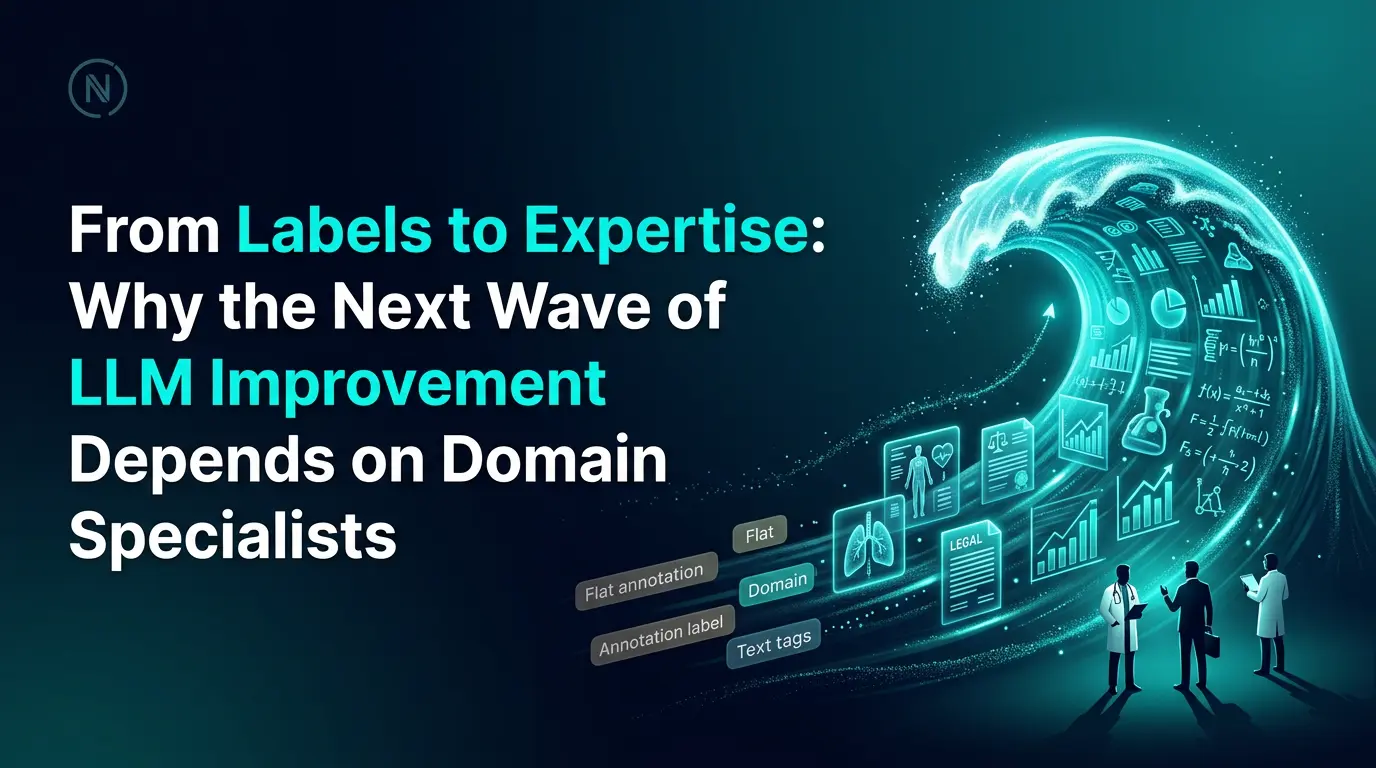
From Labels to Expertise: Why the Next Wave of LLM Improvement Depends on Domain Specialists
The next wave of Large Language Model (LLM) improvement is shifting from scale to specialization: from more parameters and more generic data to smaller, smarter models built with domain-specific expertise. Domain specialists are now central to how domain expertise improves large language models because they define what “correct,” “safe,” and “useful” actually mean in complex fields like healthcare, law, or finance.
Instead of treating experts as an afterthought to validate outputs, leading teams embed them into data curation, labelling, evaluation, and governance, creating domain-specific LLMs that outperform general models on accuracy, compliance, and efficiency.
Why Domain Specialists Are Now Essential for LLM Improvement
Generic LLMs are “jack-of-all-trades” systems trained on broad internet-scale corpora, which makes them versatile but shallow when used in high-stakes, jargon-heavy environments. Research on domain-specific LLMs shows that models fine-tuned on focused, high-quality domain data consistently beat general models on specialist tasks, from medical classification to legal reasoning.
A domain-specific LLM is a model trained or fine-tuned on text and interactions from a particular field such as healthcare, finance, or cybersecurity so it learns the terminology, document structures, and decision logic unique to that domain. Because these models understand domain language and constraints, they can deliver more precise, context-aware answers and are easier to align with regulations and internal policies.
General-Purpose vs Domain-Specific LLMs
| Dimension | General-Purpose LLM | Domain-Specific LLM |
| Scope | Broad, covers many topics | Narrow, focused on one domain (e.g., medical, legal, financial) |
| In-domain accuracy | Moderate, prone to hallucinations on specialist tasks | Higher precision on domain tasks with curated data |
| Compliance | Harder to constrain to specific regulations | Easier to embed domain rules and compliance constraints |
| Efficiency | Often large, expensive to run | Can be smaller, more efficient for in-domain workloads |
| Data requirements | Huge generic corpora | Smaller but higher-quality, expert-validated data |
This is why domain experts’ AI strategies are now seen as a competitive advantage rather than a “nice to have”they unlock higher performance with less computation while reducing legal and reputational risk.
What Domain Specialists Actually Do in the LLM Lifecycle
In mature organizations, domain experts are integrated across the LLM lifecycle, not just at the end. They help decide what data to trust, how to label it, how to evaluate models, and when a system is safe enough for production.
By shifting from simple labeling to participatory design with experts, teams move beyond commodity AI data annotation and into strategic expert annotation AI workflows that capture tacit knowledge, edge cases, and real-world decision criteria.
From AI Data Annotation to Expert-Guided Labeling
Traditional labeling pipelines rely heavily on generic annotators who follow written guidelines to tag large volumes of text or interactions. This works reasonably well for low-risk tasks like sentiment analysis but breaks down when labels depend on years of clinical practice, regulatory nuance, or industry-specific reasoning.
Several recent studies show that high-stakes annotation in healthcare and other domains still depends on domain experts, with fine-tuned LLMs only approximating their performance when trained on expert-labeled ground truth. In one medical classification task, a general GPT-3 model reached roughly 78% accuracy, while a fine-tuned version using pediatric specialists’ labels achieved about 99.9%closely matching expert performance.
Human-in-the-Loop Evaluation and “LLM-as-a-Judge”
Beyond labeling, domain specialists act as human-in-the-loop evaluators, scoring and commenting on model outputs for correctness, reasoning quality, and adherence to professional standards. Many teams now combine expert feedback with “LLM-as-a-judge” setups, where models propose scores but experts calibrate rubrics, audit edge cases, and override judgments in sensitive scenarios.
This hybrid approach is emerging as a best practice: LLMs scale evaluation on routine examples, while experts focus on ambiguous, high-impact, or novel cases where annotation quality LLMs alone is not enough.
How Domain Expertise Improves Large Language Models in Practice
The impact of domain specialists is visible in three core outcomes: accuracy, safety, and efficiency. When experts control the data and evaluation loop, models become more reliable in real-world workflows instead of just synthetic benchmarks.
This is exactly how domain expertise improves large language models: by turning vague, generic “intelligence” into tightly scoped, testable capabilities that match how professionals actually think and work.
Accuracy, Safety, and Reduced Hallucinations
Generic models often generate plausible but wrong answers/hallucinations especially when facing domain-specific questions they have not seen during pre-training. Domain-specific training with high-quality, verified datasets significantly reduces hallucinations by grounding the model in curated, authoritative sources.
When expert labels and reviews define the target behavior, LLMs learn what counts as a correct diagnosis, compliant legal clause, or acceptable financial explanation in that field, leading to more accurate and trustworthy outputs. In medical text classification, domain-specific fine-tuning has been shown to close most of the gap between general-purpose models and specialist human encoders.
Compliance, Governance, and Risk Management
In regulated domains like healthcare, finance, and law, mistakes are not just embarrassing they can be illegal. Domain-specific LLMs make it easier to embed regulatory rules, documentation standards, and audit trails because their training data and evaluation criteria are already aligned with those frameworks.
Domain specialists define red lines, escalation paths, and required evidence for each decision type, which in turn shapes prompt templates, retrieval rules, and guardrail policies. This expert-driven design is far more robust than reactive filters bolted onto a generic model after deployment.

Domain Experts vs Data Annotators for LLM Training
The core strategic question for leaders is not “Should we label more data?” but rather domain experts vs data annotators for LLM training. Not every task needs a specialist, but some absolutely do.
A useful mental model is to treat generic annotators as scalable labor and domain experts as bottleneck resources who must be deployed where their judgments change the outcome the most.
When General Annotators Are Enough
General annotators can be sufficient when:
- Labels are simple and intuitive (e.g., spam vs not spam, positive vs negative sentiment).
- Errors carry low risk for users or the business.
- High-level instructions capture most of the nuance and can be reliably followed.
- The task is primarily linguistic rather than domain-knowledge intensive.
In these situations, AI annotation vs domain expertise is mainly an efficiency trade-off, and scaling low-cost annotators makes economic sense.
When You Cannot Avoid Domain Experts
You cannot avoid domain specialists when:
- Misclassification has legal, medical, or financial consequences.
- The correct label depends on tacit knowledge, professional judgment, or evolving standards.
- You need to interpret complex artifacts (e.g., contracts, clinical notes, risk reports).
- Regulatory bodies expect traceability to qualified humans, not crowdworkers.
In these cases, why AI companies need domain experts, not annotators, becomes clear: without expert-defined labels and evaluation, you may ship an impressive demo that fails catastrophically in production.
Annotators vs Domain Experts in LLM Projects
| Aspect | General Annotators | Domain Experts |
| Typical background | Non-specialists trained on guidelines | Practicing professionals or seasoned SMEs |
| Cost per hour | Low to moderate | High |
| Best for | High-volume, low-risk tasks | High-stakes, nuanced decisions |
| Main risk | Inconsistent or shallow understanding | Limited availability and throughput |
| Role in LLM data quality | Execute instructions at scale | Define labels, edge cases, and quality bars |
Designing an AI Training Workforce Around Domain Specialists
To build durable advantage, companies need an AI training workforce that combines scalable annotation capacity with scarce expert judgment. The goal is not to replace annotators but to orchestrate them under expert supervision, using tools and workflows that maximize each group’s strengths.
This is where specialized providers such as Nexus Expert Research can add value by organizing and managing expert networks, quality control programs, and domain-specific evaluation pipelines at scale.
Hybrid Teams of Subject Matter Experts and Annotators
The most effective setups treat subject matter experts AI as product owners for model behavior:
- Experts define schemas, label taxonomies, and acceptance criteria.
- Annotators handle routine cases and pre-label data, often assisted by LLM suggestions.
- Experts review difficult cases, set up adjudication processes, and refine guidelines based on observed failure modes.
This approach turns domain-specific AI training into a continuous learning loop rather than a one-off labeling project.
Incentive Models and Quality Feedback Loops
Expert time is expensive, so incentives and feedback loops must be carefully designed:
- Pay experts for reviewing the most informative or ambiguous examples, not random samples.
- Use active learning to surface cases where the model is uncertain or inconsistent.
- Implement dual-review or adjudication for high-risk labels, with structured disagreement resolution.
- Use LLM-assisted pre-annotation with schema, constraint, and reference checks to cut repetitive work while preserving expert control.
Done well, this creates expert-driven AI training data quality systems that keep improving as the model encounters new scenarios.
How Startups and SMBs Can Start Domain-Specific AI Training Today
You do not need a Big Tech budget to start building better LLMs with domain specialists. Many successful domain-specific projects now follow a “small but sharp” strategy: limited scope, high-quality data, and clear business metrics.
Practical steps for smaller teams:
- Pick one narrow, high-value use case (e.g., triaging support tickets for a single product line, drafting one type of contract, or classifying a specific class of medical report).
- Identify 3–10 domain experts who already perform this task and can spare a few hours per week.
- Collect a modest but representative dataset (hundreds to low thousands of examples) with expert-verified labels.
- Fine-tune an existing model or build a retrieval-augmented system on top of your proprietary documents.
- Deploy behind guardrails, monitor performance, and iterate with expert-in-the-loop evaluation.
Studies and production case reports show that specialized models built this way can outperform much larger general models in their niche while being cheaper to run and easier to govern.
Checklist: Are You Ready for Expert-Driven AI Training Data Quality?
Use this checklist to decide whether your next LLM initiative should be expert-led:
- You operate in a regulated or safety-critical domain (healthcare, finance, law, public sector).
- Your current model fails on edge cases that practitioners consider routine.
- You cannot clearly explain your labeling criteria without referencing professional standards or guidelines.
- You need audit trails that trace decisions back to qualified humans.
- Synthetic or crowd-labeled data has not closed the performance gap you care about.
If most of these apply, you likely need domain specialists embedded in your pipeline, not just more cheap labels.
Ready to Build AI That Actually Knows Your Domain?
If you are serious about turning domain expertise into a real competitive advantage, you need more than a labelling vendor; you need a partner that can orchestrate specialists, data, and models into one cohesive pipeline.
Get in touch with Nexus Expert Research to design and operate expert-led LLM training and evaluation programs that are accurate, compliant, and tailored to your domain. Connect with Nexus Expert Research today and start building AI that your industry can actually trust.
