
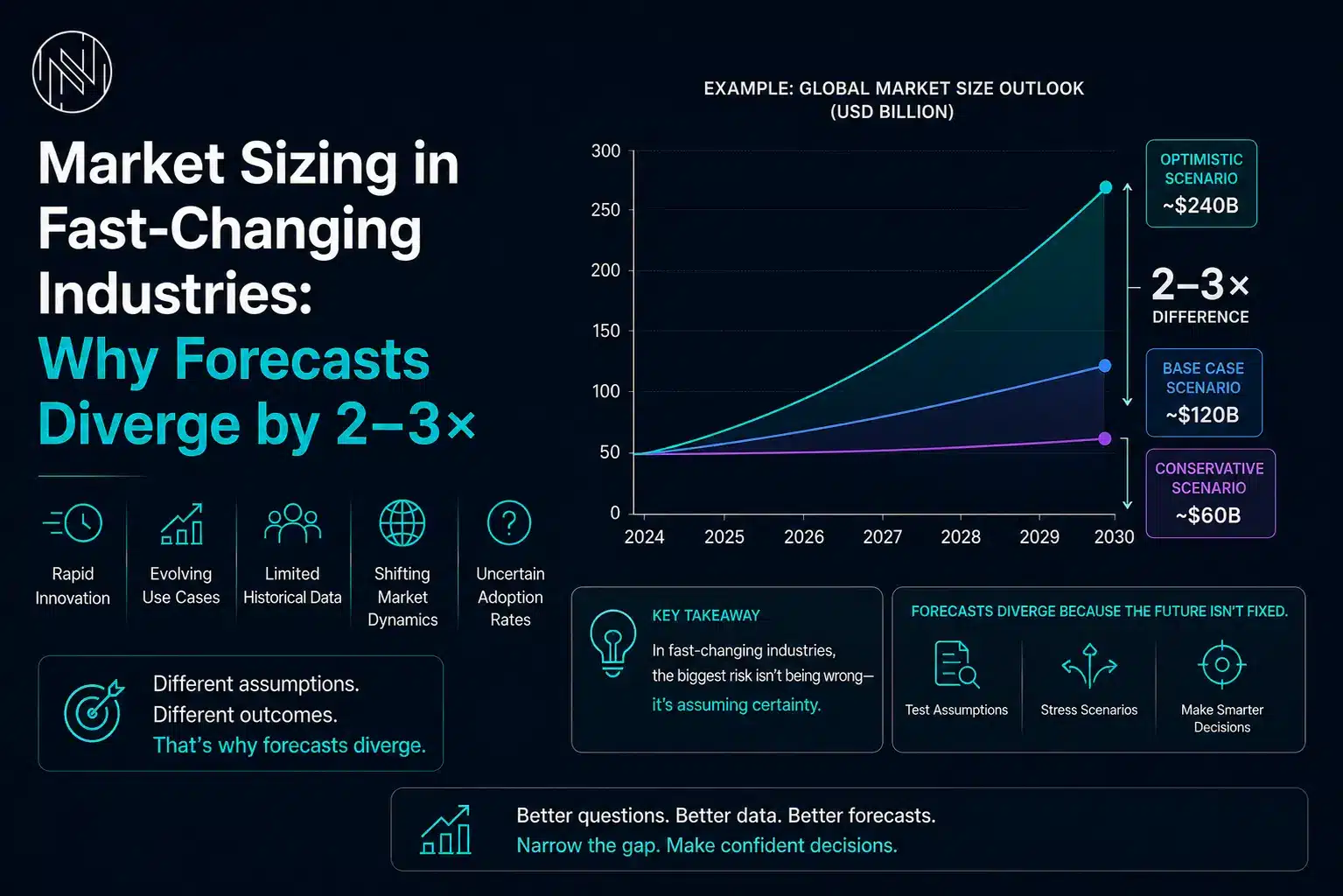
Market Sizing in Fast-Changing Industries: Why Forecasts Diverge by 2–3×
When two credible analyst firms publish market size estimates for the same sector in the same year and those estimates differ by a factor of two or more, the problem is not bad data.
It is the nature of how forecasts are built: assumptions compounding on assumptions, each one multiplying the divergence between a bullish and a conservative view of adoption, timing, and scope. Strategy consultants and market analysts who know where that divergence comes from are the ones who can close it. The ones who do not know tend to average the numbers and call it triangulation.
Challenges in Fast-Moving Markets
The most accurate forecasts come from the practitioners closest to the market, and that is not where analyst reports come from.
Rapid Innovation Cycles
Fast-moving sectors present a structural forecasting problem: the market being analysed is changing faster than the research cycle can capture it. Many market reports reflect research conducted months earlier, which is a meaningful lag in categories like generative AI, quantum computing, advanced biotech, and clean energy infrastructure, where funding rounds, regulatory decisions, and commercial deployments can materially shift the addressable market within a single quarter.
Valona Intelligence’s 2026 guide to market sizing methodology is direct on this: a market size figure that was correct six months ago may already be outdated, and what matters is not the number but whether the methodology and assumptions behind it are still sound.
Data Lags and Assumptions
The analyst reports that form the secondary research foundation of most market sizing exercises were built on data collected before the current market conditions existed. In fast-moving sectors, published reports can lag current conditions by many months, which means a strategy consultant relying entirely on secondary data is running a model whose inputs are already historic by the time the recommendation reaches the client.
The assumptions about adoption curves, regulatory environments, competitive intensity, and pricing dynamics that underpinned those reports may have been reasonable when the fieldwork was conducted and may no longer be.
Sources of Forecast Divergence
The quantum computing market is a clean illustration of what 2-3x divergence looks like in practice, and why it happens.
Outdated Benchmarks and Overoptimism
Grand View Research values the global quantum computing market at $1.6 billion in 2025, projecting growth to $8 billion by 2033 at a 22.3 percent CAGR. Markets and Markets places the same market at $3.52 billion in 2025, growing to $20.2 billion by 2030 at a 41.8 percent CAGR. The 2025 baseline figures alone differ by a factor of 2.2, which means that before either forecast has said anything about growth, they are already materially apart on the starting point.
Scenario and Assumption Differences
The divergence in quantum computing estimates reflects genuinely different assumptions about what counts as the market, how quickly fault-tolerant systems will reach commercial viability, and whether Quantum-as-a-Service cloud platforms are classified as part of the quantum computing market or the cloud services market.
These are not data quality problems. They are methodological choices, and different analysts making different choices in good faith produce figures that are irreconcilable without an independent reference point.
When Divergence Becomes a Recommendation Problem
J.P. Morgan’s January 2026 Eye on the Market flagged a version of this problem for generative AI, citing a July 2025 MIT paper that documented a significant gap between genAI pilots and real-world deployment success rates, in contrast to the much more optimistic adoption assumptions embedded in published forecasts. A strategy consultant presenting a market entry recommendation built on a $1.6 billion market size is recommending something materially different from one built on a $3.5 billion figure for the same market in the same year.
The client cannot know which number to use from secondary data alone, and averaging them produces a figure that both analysts would reject as unsupported.
Best Practices for Market Sizing
Reconciling divergent analyst estimates requires a discipline that secondary research alone cannot provide.
Combining Top-Down and Bottom-Up Approaches
Top-down market sizing typically tilts high because analysts include adjacent revenue that any specific market participant will never capture. Bottom-up sizing typically tilts low because it requires explicit enumeration of customers, transaction volumes, and unit prices, which forces conservative assumptions.
Rigorous market sizing exercises use both methods and triangulate, with the goal of getting the two estimates close enough together to support confidence in the model rather than leaving them two times apart with no resolution mechanism.
Continuous Update and Sensitivity Analysis
A market sizing model built for a fast-moving sector needs built-in sensitivity testing across the assumptions most likely to be wrong, covering adoption speed, regulatory timing, competitive entry, and geographic uptake. Valona Intelligence recommends sensitivity analysis as a standard element of any sizing exercise in dynamic markets, not because uncertainty can be eliminated but because making the uncertainty explicit produces a defensible range rather than a false point estimate.
The model also needs a refresh trigger: a defined set of conditions under which the key assumptions should be revisited rather than carried forward until they diverge so far from reality that the recommendation built on them collapses.
The Role of Expert Insights
Secondary research builds the hypothesis. Expert intelligence is what stress-tests it before the recommendation goes to the client.
Validating Forecasts With Practitioner Intelligence
The resolution mechanism for divergent analyst estimates is a set of structured conversations with practitioners who have operated inside the market being sized, recently enough that their experience reflects current conditions.
A category leader who has managed budget allocation for quantum computing investments in a specific sector, a clinical operations executive who has tracked biotech regulatory timelines, or a commercial developer who has signed power purchase agreements for clean energy capacity in the last 12 months all carry ground-level economic data that top-down analyst models do not contain.
This is the kind of validation layer that market sizing practitioners consistently recommend as the component that transforms a plausible model into a defensible one.
Geographic and Niche Adjustments
Global forecasts can hide major regional differences in adoption and spending that are often the most commercially significant dimension of a sizing exercise.
A global growth rate does not tell a strategy consultant whether demand is concentrated in government programmes in one region, enterprise adoption in another, or manufacturing applications in a third, each of which has fundamentally different competitive dynamics and addressable customer profiles.
Expert calls with regional practitioners, including executives who have run commercial operations in specific geographies, procurement leads who have evaluated the category in non-Western markets, and channel partners who distribute into the segments the client is targeting, provide the local calibration that secondary reports cannot offer at useful resolution.
Implications for Clients
The market sizing exercise that goes to a client without an expert validation layer is making a specific claim: that the analyst report assumptions are still current, that the definition of the market is the right one for the client’s use case, and that the adoption curve baked into the model will hold. None of those claims can be verified from secondary data alone.
Stress-Testing Key Assumptions With Expert Interviews
Before a market sizing model becomes a strategic recommendation, the assumptions most sensitive to being wrong should be tested with practitioners who can assess them from direct operating experience.
A structured expert call with someone who has recently managed budget allocation, evaluated vendors, or tracked regulatory timelines in the relevant sector can produce the kind of ground-truth calibration that either confirms the model or identifies the assumption that needs revising before the recommendation is built on it. Whether or not that conversation takes 45 minutes or longer, its function is the same: replacing an analyst’s assumption about how the market behaves with the direct experience of someone who operates inside it.
Using Expert Networks to Refine Sizing
The operational value of a targeted expert call programme for market sizing is not in replacing the analyst report. It is in identifying which of the divergent assumptions across reports is closer to operational reality, and building the recommendation on the one that practitioners actually recognise.
Think of it the way the analysts in The Big Short approached mortgage data: the secondary-level aggregate looked fine right up until someone called the people who actually knew what the underlying assets were doing.
Expert networks exist to connect strategy consultants with the practitioners who can distinguish between an adoption curve that analysts find plausible and one that the people operating inside the market actually believe.
The Gap Between the Map and the Territory
Market size estimates in fast-moving sectors are not facts. They are models built on assumptions about adoption rates, market definitions, regulatory timelines, and competitive dynamics, and when different analysts make different assumptions in good faith, a 2-3x divergence is not a sign that someone is wrong. It is a sign that the model has not yet been calibrated against the operational reality of the market it is describing.
The triangulation that resolves the divergence is not averaging. It is a conversation with someone who has been inside the territory the map is describing, recently enough that their experience is still a reliable guide to what is actually there.
Talk to Nexus Expert Research when your market sizing model needs the practitioner validation layer that turns a plausible forecast into a defensible one.
