
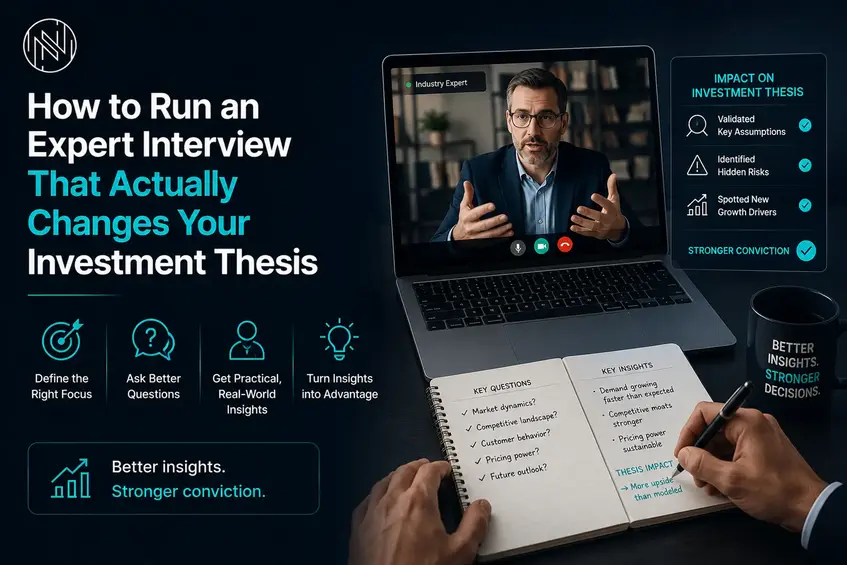
How to Run an Expert Interview That Actually Changes Your Investment Thesis
To understand how to run an expert interview, treat the call as a thesis test, not a casual information session. The goal is to pressure-test your assumptions, find hidden risks, and decide what should change in your model, market view, or investment committee memo.
An expert interview changes your thesis when it produces new evidence that affects conviction. That may mean confirming a growth driver, weakening a market entry case, exposing a pricing risk, or showing that customer behavior is different from what public research suggests.
What Makes an Expert Interview Useful for Investment Research?
An expert interview is a qualitative research method used to gather firsthand insight from people with direct experience in a market, company, product category, or decision process. GLG describes expert interviews as a way to gather in-depth insights, validate hypotheses, and refine strategic initiatives, while Nexus Expert Research frames them as a practical method for informing business strategy and decision-making.
For investors, the value is not just “expert opinion.” The value is how lived experience changes the quality of judgment.
A strong expert call due diligence process helps teams answer questions such as:
- Is the market growing for the reasons we believe?
- Are customers switching for value, price, urgency, or lack of alternatives?
- Is the target company truly differentiated?
- Are management’s growth claims realistic?
- Which risks are missing from our current model?
In private markets, due diligence already requires financial, legal, operational, and strategic assessment. CFA Institute describes private markets due diligence as a process for evaluating opportunities, assessing financial health, reviewing legal and operational factors, valuing target companies, and shaping exit strategy. Expert interviews add field-level judgment to that broader diligence process.
Start With a Testable Investment Thesis Before the Call
A weak expert call starts with broad questions. A strong call starts with a testable thesis.
Your investment thesis validation process should begin before you speak to the expert. Write down what must be true for the investment to work. Then turn those points into assumptions that can be tested.
For example, a weak thesis says:
“The company can grow because demand is strong.”
A stronger thesis says:
“The company can grow 18 to 22 percent annually because mid-market customers are replacing legacy tools, switching costs are moderate, and channel partners are actively pushing migration.” Now the expert call has a job. It must test demand, switching behavior, channel incentives, pricing pressure, implementation friction, and competitor response.
Convert Your Thesis Into Assumptions
Use this simple structure for primary research investment thesis preparation:
| Thesis Area | Assumption to Test | Expert Type Needed | Decision Impact |
| Market growth | Demand is driven by real budget movement, not temporary hype | Buyer, channel partner, former sales leader | Revenue forecast |
| Differentiation | Customers choose the product for workflow fit, not only price | Customer, competitor, implementation consultant | Pricing power |
| Retention | Customers stay because switching is painful | Former customer success leader, buyer | Churn estimate |
| Competition | New entrants cannot copy the offer quickly | Competitor, technical operator | Margin and moat |
| Market entry | Local buying behavior supports expansion | Distributor, regional operator, buyer | Go-to-market plan |
This table turns an expert interview into a structured research tool. It also makes the final output easier for analysts, partners, and decision makers to review.
Match Each Assumption to the Right Expert Type
A common mistake is choosing experts by title alone. A former CEO may sound impressive, but may not know how buyers behave today. A mid-level procurement manager may provide better insight into actual buying criteria.
Good expert network investment research depends on fit. Nexus Expert Research says its expert network connects consulting firms, private equity, hedge funds, and corporate strategy teams with vetted experts across 30+ countries, with use cases including diligence sprints and market entry studies.
Use this matching logic:
- For customer demand, speak with buyers and former customers.
- For sales motion, speak with former sales leaders or channel partners.
- For implementation risk, speak with operators and delivery leaders.
- For pricing power, speak with buyers, procurement teams, and competitors.
- For regulatory exposure, speak with compliance specialists or policy experts.
Build an Assumption-First Expert Interview Guide
The best guide is not a script. It is a decision map.
GLG recommends defining research needs, identifying the right audience, outlining topics, and doing secondary research before writing questions. It also notes that public-domain research helps remove questions that can already be answered through existing material.
That is the foundation of due diligence expert call preparation. Do not spend paid expert time asking what the market size is if public sources already answer that at a basic level. Use the call to understand what public sources miss.
Questions That Test the Thesis
Good expert interview questions for due diligence are specific, testable, and tied to a decision.
Instead of asking:
“What is the competitive landscape?”
Ask:
“When customers compare Vendor A and Vendor B, what are the top three reasons one wins over the other?”
Instead of asking:
“Is this market growing?”
Ask:
“Which customer segments are increasing budget this year, and which are delaying purchases?”
Instead of asking:
“Is the product sticky?”
Ask:
“What would make a customer switch away after 12 months?”
These questions force the expert to describe behavior, tradeoffs, and real decision points.
Questions That Reveal Market Reality
For market entry analysis, the best questions focus on local barriers, buying habits, distribution channels, and trust.
Useful prompts include:
- “Who controls the budget in this market?”
- “Which local competitors are underestimated by outsiders?”
- “What usually causes a new entrant to fail?”
- “Which customer segment is easiest to win first?”
- “What proof does a buyer need before switching?”
These questions help decision makers separate a market that looks attractive on paper from one that can actually be entered.
Questions That Expose Risk
Strong investment thesis testing should actively search for risk. Ask the expert to challenge the deal.
Useful risk questions include:
- “What would make this investment case fail?”
- “Which assumption sounds too optimistic?”
- “What are investors likely to misunderstand about this market?”
- “Where do management teams usually overstate their advantage?”
- “What early warning signal would you track after investment?”
If the expert cannot identify any risk, do not treat that as comfort. It may mean the question was too soft, the expert lacks depth, or the call needs a different angle.
How to Conduct the Expert Call Without Biasing the Expert
A good expert call is neutral, but not passive.
GLG advises remaining neutral and unbiased when framing questions because the goal is objective input, not persuading the expert that your hypothesis is correct.
That point is critical for expert interview best practices. If you reveal your preferred answer too early, the expert may agree politely, respond strategically, or anchor around your framing.
Open With Context, Not Your Answer
Start with a short explanation:
“We are studying the software buying process in mid-market healthcare. We are trying to understand purchase triggers, switching barriers, and competitive decision criteria.”
Do not start with:
“We believe this product is highly differentiated and want to confirm that.”
The first version invites independent judgment. The second version invites confirmation bias.
Use Follow-Up Questions to Find the Mechanism
The first answer is often not the real insight. Follow-up questions reveal the mechanism behind the answer.
Ask:
- “What makes you say that?”
- “Can you give an example?”
- “How often does that happen?”
- “Who is involved in that decision?”
- “What changes when budgets are tight?”
- “How would that differ for enterprise versus SMB customers?”
These are practical expert call tips for analysts because they turn vague claims into usable evidence.
Look for Disagreement, Not Comfort
One expert may say switching costs are high. Another may say customers switch often when implementation support is poor. Do not smooth over that disagreement too quickly. Disagreement is useful because it may reveal segmentation.
For example:
- Enterprise customers may have high switching costs.
- SMB customers may switch quickly.
- Regulated buyers may stay longer.
- Price-sensitive buyers may churn faster.
That nuance can change your model.
Expert Interview Framework for PE, VC, and Market Entry Decisions
A useful expert interview framework PE teams can use has five stages:
| Stage | What to Do | Output |
| 1. Define thesis | Write the deal case in clear assumptions | Assumption list |
| 2. Map risks | Identify what could break the thesis | Risk register |
| 3. Select experts | Match experts to assumptions, not titles | Expert map |
| 4. Run calls | Ask neutral, specific, behavior-based questions | Call notes |
| 5. Synthesize | Compare themes across calls and update the thesis | Decision memo |
This works for expert call private equity, VC diligence, corporate strategy, and market entry. The difference is emphasis.
PE teams may focus on pricing power, customer retention, competitive intensity, and management plan realism. VC teams may focus on adoption speed, category timing, founder-market fit, and customer pain. SMBs and startups may use the same method to validate product demand, sales channels, and expansion decisions.
For expert network for buy-side research, compliance also matters. The SEC has highlighted that advisers need policies and procedures reasonably designed to prevent misuse of material non-public information. SIFMA’s 2026 expert network best practices also define expert networks as firms that connect paid industry professionals with third parties for information useful in forming investment views.
That means expert calls should be useful, but also controlled. Teams should avoid MNPI, confidential employer information, and restricted topics.
How to Choose the Right Expert Research Support Model
Different teams need different support. The table below shows how to think about the choice.
| Research Support Model | Best Fit | Strength | Watchout |
| Managed expert network | PE, VC, strategy, market diligence, niche B2B research | Custom sourcing, vetting, scheduling, compliance workflow | Requires a clear brief |
| Transcript platform | Fast orientation and theme discovery | Searchable prior calls and AI summaries | May not answer your exact question |
| DIY expert sourcing | Early-stage founder research or informal discovery | Lower direct cost | Harder to vet, schedule, and control |
| Consultant-led research | Complex diligence or board-level strategy | Strong synthesis and executive output | Higher cost and longer setup |
Nexus Expert Research describes expert calls as one-on-one interviews with subject matter experts such as former executives, customers, partners, and competitors. Its platform also includes expert transcript access and AI search features, which can support orientation before custom calls.
Turn Expert Calls Into Better Investment Decisions
An expert call is not finished when the transcript is saved. It is finished when the thesis changes, strengthens, or survives a serious challenge.
Synthesize by Theme
Do not summarize each call in isolation. Build a theme matrix.
Useful themes include:
- Demand drivers
- Buyer urgency
- Competitive alternatives
- Pricing pressure
- Switching costs
- Sales cycle risk
- Implementation friction
- Regulation
- Margin pressure
- Expansion barriers
For each theme, record what changed. Did the call confirm the thesis, weaken it, or add a new condition?
Update the Risk Register
Every expert call should feed a risk register.
| Risk | Evidence From Calls | Impact on Thesis | Action |
| Channel conflict | 3 experts said partners prefer larger vendors | Weakens growth plan | Lower channel-driven revenue case |
| Weak differentiation | Buyers view product as similar to two competitors | Lowers pricing power | Test margin sensitivity |
| Strong retention | Customers rarely switch after integration | Supports downside protection | Validate with customer data |
This is where hypothesis testing expert network work becomes valuable. The call is not just a source of quotes. It is a way to update assumptions.
Common Mistakes That Make Expert Calls Less Useful
The most common mistake is treating how to conduct an expert interview as a list of questions instead of a thinking process.
Avoid these issues:
- Asking broad questions that produce generic answers.
- Revealing your preferred thesis too early.
- Speaking to only one expert type.
- Ignoring experts who disagree with your view.
- Treating interviews as statistically representative.
- Asking for confidential or restricted information.
- Summarizing calls without changing the model or memo.
- Using expert call questions private equity teams copied from old projects without adapting them to the current deal.
The best calls create decision movement. They either increase conviction, reduce conviction, or show what evidence is still missing.
Final Takeaway: Use Expert Interviews to Change the Decision, Not Fill a Memo
Expert interviews are most valuable when they test what must be true. They should not simply confirm what the team already wants to believe.
A strong process starts with assumptions, uses targeted expert selection, asks neutral questions, looks for disagreement, and synthesizes findings into clear changes. When done well, expert calls can improve diligence quality, sharpen investment judgment, and help decision makers act with more confidence.
Need sharper expert calls before your next investment decision? Nexus Expert Research helps you connect with vetted specialists, test assumptions, and turn primary insight into clearer conviction.
