Why AI Companies Are Now the Biggest Buyers of Expert Network Time
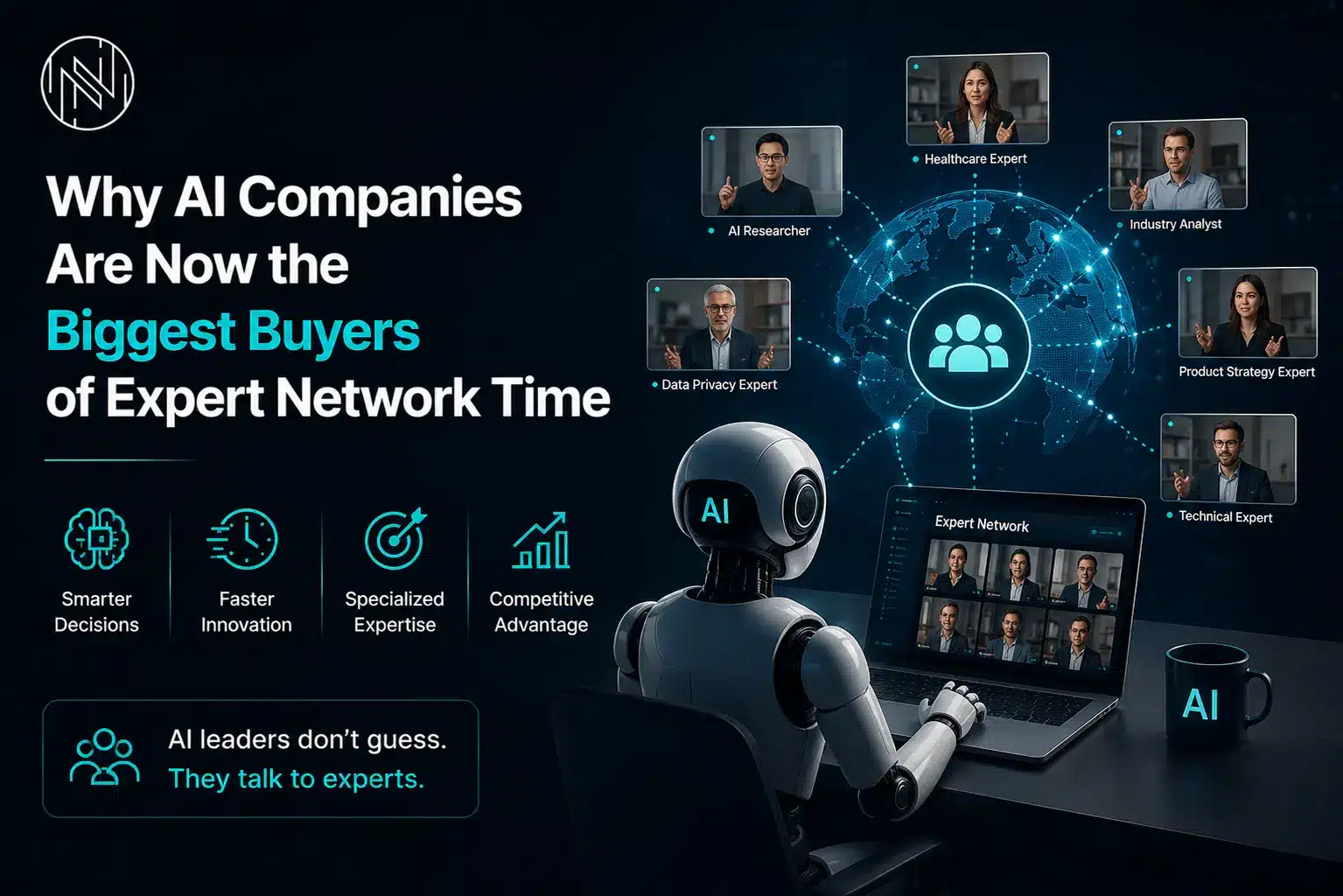
AI companies have become the largest and fastest-growing buyers of expert network time because frontier models can no longer improve on public internet data alone. They now depend on domain specialists, physicians, attorneys, engineers, and PhDs to generate training data, evaluate model outputs, align systems through human feedback, and validate go-to-market strategy. In 2026, expert access has moved from a research luxury to a core pillar of every serious AI development stack.
From Wall Street to Silicon Valley: How Expert Networks Found a New Power Buyer
For two decades, expert networks existed to serve one type of buyer: Wall Street. Hedge funds, private equity firms, and management consultancies paid premium hourly rates to speak with former executives and industry insiders before making multi-million-dollar investment decisions. That model still exists. But since 2023, it has been overshadowed by an entirely new category of buyer AI companies.
The shift did not happen gradually. It happened in a matter of months.
OpenAI, Anthropic, Google DeepMind, and Meta are now spending hundreds of millions of dollars annually on human-generated training data and expert judgment. The global AI training dataset market was valued at approximately $2.8 billion in 2024 and is forecast to exceed $17 billion by 2033. The market for RLHF platforms alone was estimated at $2.8 billion in 2025, growing at roughly 23% annually. Expert-data businesses built specifically to serve AI labs Mercor, Surge AI, Scale AI, and Handshake scaled from near-zero to hundreds of millions in revenue in under two years.
This is not a niche development. It is a structural realignment of who buys expert networks for AI companies services, and why.
The Data Wall: Why AI Companies Can No Longer Train on Public Text Alone
To understand why AI companies’ expert network spending has exploded, you need to understand what practitioners call the “data wall.”
From 2018 to 2022, building a frontier model followed a reliable formula: train the largest affordable model on the maximum volume of high-quality internet text Wikipedia, Reddit, GitHub, arXiv, Common Crawl and scale. Performance improved predictably with data volume. That era is over.
By 2024, leading labs had effectively exhausted high-quality, licensable public content for pretraining purposes. Less than 5% of remaining web text meets the quality and licensing bar required for frontier model development. The scaling laws that drove progress for five years have flattened. Adding more raw data no longer reliably improves model performance at the frontier.
The only path forward is post-training: reinforcement learning from human feedback, supervised fine-tuning on expert demonstrations, and rigorous human-led evaluation. Critically, models trained on their own synthetic outputs enter degrading feedback loops; only fresh, expert-verified human judgment produces genuine improvement. That single constraint turned AI training data experts into the most sought-after professionals in the technology economy.
The 4 Core Reasons AI Companies Buy Expert Network Time
- RLHF and Human Feedback for Model Alignment
RLHF domain experts are now among the highest-paid professionals in the AI supply chain. Reinforcement learning from human feedback, the technique that made large language models feel coherent, helpful, and safe, requires trained professionals to compare and rank model outputs and signal which responses are more accurate, appropriate, or useful.
Generic annotators cannot do this work at the quality level frontier models require. A language model being trained for clinical decision support needs physicians to rank responses. A legal-drafting AI needs practicing attorneys. A financial analysis tool needs analysts who understand market structure. The human producing the ranking must genuinely understand the subject matter.
AI training human feedback at this level of domain specificity is precisely what expert networks are positioned to supply. Platforms serving frontier AI labs pay domain experts $95–$200 per hour for RLHF work, compared to $2–$40 per hour for generalist annotators. The premium directly reflects how much domain-accurate feedback moves model performance. Gartner data cited across the industry indicates roughly 70% of enterprises building on LLMs now use methods like RLHF or Direct Preference Optimization, up from approximately 25% in 2023. - Domain Expert AI Training and Fine-Tuning
Base models are intentionally general. Making them production-ready for a specific industry requires domain expert AI training the process of feeding a model expert-generated demonstrations, labeled examples, annotated reasoning steps, and structured knowledge that only practitioners can produce.
This is the foundation of fine-tuning AI domain knowledge. A healthcare AI company building a radiology tool cannot produce training data without radiologists. A legal-tech startup building contract analysis AI cannot annotate legal reasoning without attorneys. A fintech building compliance automation needs professionals who understand SOX, Basel III, or HIPAA at the practitioner level. There is no shortcut.
The expert network for machine learning use case is therefore increasingly vertical. Physician-guided annotation has been documented improving diagnostic AI accuracy by 30–40% in benchmark conditions. Attorney-reviewed training data has increased legal AI accuracy from approximately 78% to 94% in controlled comparisons. These gains are entirely inaccessible without the right domain expert sourcing. - LLM Evaluation, Benchmarking, and Red-Teaming
As AI models become more capable, evaluating them requires deeper expertise. LLM evaluation experts design evaluation rubrics, build domain-specific benchmarks, test models for factual accuracy and harmful outputs, and verify whether a model’s reasoning is genuinely correct not merely fluent.
Red-teaming is a specialized form of evaluation where experts attempt to break models by exposing jailbreaks, factual errors, embedded biases, and safety failures. This requires both deep domain knowledge and adversarial thinking. Senior red-teamers currently earn $100–$200 per hour at leading AI training platforms.
AI data annotation experts doing evaluation and red-teaming work are providing the ground truth that automated systems cannot self-generate. This is precisely why specialist AI knowledge sourcing through expert networks has become a standard, ongoing line item in frontier AI development budgets. - Generative AI Market Research and Competitor Intelligence
Not all expert network usage by AI companies is about training pipelines. A growing share is about product strategy and go-to-market.
Generative AI market research understanding buyer adoption curves, objections, competitive positioning, willingness to pay, and real-world use case fit requires primary research that only expert networks enable. Founders and product teams at AI companies run AI product research expert calls with former industry operators to validate assumptions before committing engineering resources or marketing spend.
Competitor intelligence is equally strategic. AI companies use structured expert conversations to evaluate rival products, assess competing infrastructure choices, and identify the workflow gaps their models can address. This form of specialist AI knowledge sourcing has moved from an occasional practice to a standard part of the competitive intelligence playbook at serious AI startups and growth-stage companies.

What Types of Domain Experts Do AI Companies Hire?
AI companies working with an expert network for AI companies recruit across six primary professional categories. Each serves a distinct role in the AI development and go-to-market cycle.
| Expert Type | Primary AI Use Case | Typical Rate Range |
| Physicians & Healthcare Specialists | Medical AI training, clinical annotation, diagnostic LLM evaluation | $150 – $1,000/hr |
| Attorneys & Legal Professionals | Contract AI, compliance labeling, legal reasoning evaluation | $130 – $500/hr |
| Financial Analysts & Bankers | Finance AI, RLHF for investment tools, competitor teardowns | $120 – $400/hr |
| Engineers & STEM PhDs | Reasoning verification, math and code evaluation, red-teaming | $100 – $200/hr |
| Industry Operations Experts | Vertical AI workflow encoding, compliance grounding, knowledge base design | $95 – $250/hr |
| Multilingual & Regional Specialists | Localization, cultural grounding, regional bias correction | $80 – $150/hr |
Domain experts for AI are not simply consultants sharing professional opinions. They are producing structured, ranked, and annotated data that feeds directly into the model training pipeline. The distinction matters: their output is infrastructure, not advice.
How the Expert Network Industry Has Shifted in 2026
The traditional expert network for tech companies model a proprietary database of professionals available for one-on-one calls is evolving at speed. The global expert network market reached approximately $3 billion in 2025, growing roughly 12% year-over-year, driven primarily by corporate and technology buyers rather than the financial sector that originally built the industry.
By expert network AI 2026 standards, an estimated 11,200 firms worldwide now use expert networks, a 150% increase since 2022. Technology and AI companies have become the fastest-growing client segment by volume, even as capital markets clients still account for roughly 42% of total spend.
The table below maps the major provider types currently serving AI companies across training, evaluation, and research needs.
| Provider | Model Type | Best Fit for AI Use Case | Key Strength |
| Nexus Expert Research | Boutique custom-sourcing + AI training-data service | Domain grounding, vertical AI training, generative AI market research | Fresh expert recruiting per project, pay-per-engagement, confidentiality-first |
| Mercor / Surge AI | Expert-data marketplace | High-volume RLHF, LLM evals, SFT data | $95–$200/hr domain experts at scale; serves OpenAI, Anthropic, Meta |
| Scale AI | Enterprise data platform | Annotation, RLHF pipelines at enterprise scale | End-to-end data tooling; $29B valuation (2025) |
| GLG | Large database + agentic platform | Broad expert calls, strategic intelligence | 1.2M+ experts; AI-augmented “myGLG” platform |
| AlphaSense / Tegus | AI search + transcript library | Research blending primary expert access with secondary data | 100,000+ transcripts; integrated AI-powered search |
| NewtonX | AI-matched expert network | Generative AI market research, B2B tech validation | Cited for AI-adoption studies with Google Cloud, Teradata, TikTok |
The market is bifurcating clearly. Large labs buy expert judgment in volume through expert-data marketplaces. Vertical AI product companies and AI startups buy precision the right expert for the right domain through custom-sourcing firms. Both categories are growing, and both are necessary at different stages of an AI company’s development.
How to Choose the Right Expert Network for Your AI Company
The right provider depends on your use case, development stage, and required depth of specialization.
If you are building or fine-tuning a base model and need high-volume, structured RLHF and evaluation data, expert-data marketplaces offer scale, workflow infrastructure, and vetted domain professionals at production volume.
If you are building a vertical AI product, a clinical decision tool, a legal workflow AI, a compliance agent, a financial analysis system, precision matters far more than volume. You need experts recruited specifically for your domain, not pulled from a generalist database. Custom-sourcing firms deliver the narrow specialist profiles that generic networks rarely carry. This is the space where Nexus Expert Research operates: sourcing domain experts fresh per project, with a dedicated AI training data service built for fine-tuning and evaluation pipelines, and a pay-per-engagement model that suits both startups and growth-stage companies equally.
If you are running product validation or market research, boutique expert networks offer speed and specificity that enterprise subscriptions cannot match.
Five Questions to Ask Any Expert Network Before Engaging:
- Are experts custom-sourced per project or pulled from a static, pre-existing panel?
- What confidentiality and IP protection controls are in place?
- Can the network support structured data-collection tasks beyond one-on-one calls?
- What is the typical turnaround from project brief to first expert engagement?
- Is pricing per engagement or tied to a long-term subscription commitment?
Expert Knowledge Is Now a Competitive Moat Not a Nice-to-Have
The AI companies that will define their markets in 2026 and beyond are not necessarily those with the largest models or the most compute. They are the ones with the most accurate, domain-grounded, expert-validated training and evaluation pipelines.
Public internet data is commoditized. Compute is becoming commoditized. Expert knowledge the structured, verified judgment of practicing physicians, attorneys, engineers, and senior operators is not. It cannot be scraped, synthesized, or replaced by automation. It must be carefully sourced.
That is the reason AI model training experts have become the scarcest and most consequential input in the AI supply chain. It is also why the expert network for AI companies category has moved from a discretionary research service to a core infrastructure layer for every serious AI team.
The companies building the right expert access pipelines today are setting the performance ceiling for their models tomorrow. The window to establish that advantage before the market matures is narrowing.
Your AI model is only as good as the experts behind it.
Nexus Expert Research connects AI companies with precision-sourced domain specialists physicians, attorneys, engineers, and senior operators for AI training data, LLM evaluation, RLHF pipelines, and generative AI market research. Every expert is sourced fresh for your project, not pulled from a generic database.
Connect with Nexus Expert Research today. Build the expert pipeline your models actually need.
