
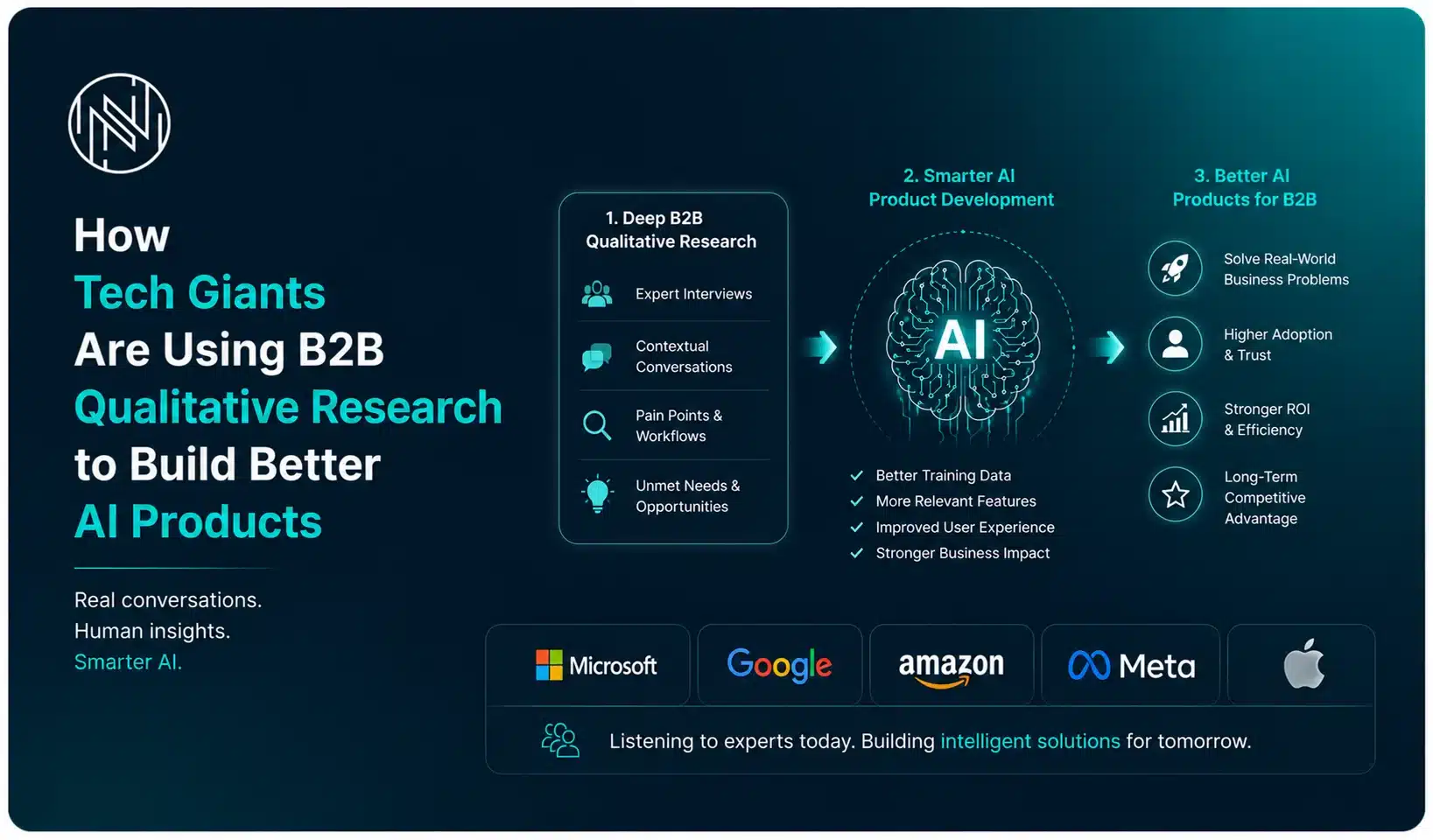
How Tech Giants Are Using B2B Qualitative Research to Build Better AI Products
Tech giants are combining B2B qualitative research with AI‑powered tools to run continuous interviews, analyze unstructured feedback at scale, and feed those insights directly into product roadmaps and model training. Instead of a few focus groups per year, they now run hundreds of AI‑moderated conversations, map journeys, and even simulate “synthetic customers” before writing a line of code.
By blending human expertise, real customer interviews, and emerging methods like digital twins, leaders in AI product development research are reducing launch risk, improving model behavior, and aligning AI features with real B2B workflows.
Why B2B Qualitative Research Is Now Critical for AI Products
In 2026, the most successful AI products are built around a deep understanding of how business users actually work, decide, and buy something that only B2B qualitative research can reveal with enough nuance. Quantitative dashboards show what users do; qualitative interviews explain why they do it and what “better” would look like in context.
Generative AI is radically compressing research timelines, allowing teams to analyze interviews and open‑ended feedback in days rather than months, while still preserving the human judgment needed to interpret complex decisions. This makes B2B market research for tech companies more continuous and integrated into sprint cycles, not a one‑off pre‑launch exercise.
How Tech Giants Use Always-On Listening and AI‑Moderated Interviews
Leading tech companies are moving from sporadic studies to “always‑on” listening, where AI moderators run interviews around the clock with real decision-makers. Microsoft, for example, used an AI‑interview platform to run more than 250 conversations across three B2B audiences, in a program internally described as “Frontier Listening.”
This shift enables qualitative research AI development programs that capture emerging needs in real time, test new prompts or features before launch, and monitor how customer expectations change as AI maturity grows. For enterprise vendors, this kind of always‑on tech company market research becomes a strategic asset rather than a one‑off insight project.
What AI‑Moderated Interviews Look Like in B2B Contexts
Modern platforms like Listen Labs, Conveo, and others conduct AI‑moderated voice, video, or chat interviews that feel like talking to a skilled researcher rather than filling out a survey. The AI adapts follow‑up questions in real time, probes for detail, and automatically tags themes, sentiment, and jobs‑to‑be‑done as the conversation unfolds.
This makes it feasible to run in-depth interviews AI product teams need 30–40 minute conversations with IT leaders, data science heads, or line‑of‑business owners at a scale that was previously impossible. For complex solutions like agentic workflows or autonomous analytics, AI‑moderated conversations often outperform traditional B2B focus group technology because they avoid groupthink and scheduling bottlenecks.
Automated Synthesis and Semantic Coding of Qualitative Data
The bottleneck in qualitative work used to be analysis: turning hundreds of transcripts into coherent insights. Today, AI tools handle transcription, coding, and first‑pass synthesis across thousands of open‑ended responses, interviews, and chat logs.
Advanced NLP engines group comments into themes, detect emotional tone, and surface hidden drivers that traditional coding might miss, while researchers validate and refine the structure. This allows B2B research for product teams to move from anecdotal quotes to structured insight frameworks that can be shared with data science, design, and go‑to‑market stakeholders.
Table 1 – How Tech Giants Turn Qualitative Data into Product Decisions
| Technique | What It Does | AI Product Decisions It Informs |
| AI‑powered transcription & coding | Converts interviews and open ends into tagged themes and sentiment automatically. | Prioritizing pain points for roadmaps; identifying language users use for prompts and feature naming. |
| Semantic clustering | Groups similar statements across thousands of responses to expose patterns. | Deciding which use cases to productize vs leave to services or partners. |
| Insight search & “chat with your data.” | Lets teams query research using natural language over their qualitative corpus. | Rapidly answering ad‑hoc questions from executives or customers during sales and board discussions. |
| Synthetic summaries with human review | Drafts executive summaries and briefs that researchers refine. | Speeding up internal communication and stakeholder alignment around AI bets. |
Journey Mapping, Personas, and AI UX Research for Enterprise AI
AI products often change entire workflows, not just screens, so AI UX research has to map end‑to‑end journeys: from problem recognition to adoption, trust building, and renewal. Tech giants blend telemetry (what users click, query, or automate) with qualitative interviews to understand friction points, trust barriers, and moments where AI feels either magical or risky.
Qualitative methods also refine personas: who actually drives AI adoption in the account, how they evaluate risk, and what “success” looks like in their context. This is especially valuable in enterprise AI product strategy, where economic buyers, technical approvers, and day‑to‑day users all experience the product differently.
Synthetic Populations, Digital Twins, and Synthetic Customers
An emerging frontier is the use of synthetic personas, synthetic populations, and “synthetic customers” to complement human research. Synthetic populations use AI‑generated agents that mimic real B2B segments, allowing teams to simulate reactions to pricing, features, or messaging before running live fieldwork.
Consultancies like Bain describe “synthetic customers” that combine internal behavioral data, voice‑of‑customer research, and external signals to stress‑test value propositions and forecast impact on metrics like NPS or churn. Specialist agencies in B2B research are experimenting with synthetic data to augment small samples, particularly when target decision-makers are rare or hard to schedule.
For AI product research in 2026, the pattern is clear: synthetic research is a powerful accelerator, but not a substitute for real conversations. Best‑in‑class teams layer synthetic results on top of live qualitative research for AI to validate, calibrate, and catch blind spots before big bets.

Using B2B Qualitative Research to Improve AI Training Data and Model Behavior
Qualitative methods are also shaping how companies build and evaluate training datasets. Interviews and diary studies surface edge cases, failure modes, and ethical concerns that rarely appear in standard logs. This guides AI training data qualitative insights on what to oversample, what to redact, and which real‑world scenarios must be represented to avoid biased or unsafe behavior.
Researchers are increasingly using human sessions to design better evaluation protocols: for example, having domain experts rate AI‑generated recommendations against real decision criteria, or using qualitative coding frameworks as labels for downstream classification models. This is where AI product development research and data science merge: product teams define what “good” looks like; qualitative research makes it explicit; models are trained and evaluated against that standard.
What This Means for Startups, VCs, and Product Teams in 2026
The same playbook that powers tech giants is now accessible to startups and SMBs thanks to AI‑enabled research tools, expert networks, and flexible B2B panels. For market research for SaaS product teams, this means you can validate positioning, pricing, and workflows with dozens of decision-makers in days, not months.
Investors increasingly view structured product discovery research tech programs as a signal of maturity: founders who can show systematic customer understanding, especially around AI risks and governance, are better positioned for enterprise deals and regulatory scrutiny. For operators, this combination of qualitative depth and AI‑enabled scale becomes a core part of defensibility, not a nice‑to‑have.
Working with Expert Networks and Research Partners for Deeper Insight
Many tech companies augment their internal research with specialist partners. NewtonX, for instance, uses an AI‑driven knowledge graph to identify verified experts across 1.1 billion professional profiles, enabling targeted interviews and surveys with niche decision-makers. Firms like Insights Exchange blend B2B market research for tech companies with access to global research specialists, helping brands move from questions to strategic recommendations quickly.
Specialized firms such as expert networks for AI companies providers and mixed‑method agencies can design blended programs: expert calls, user research for AI tools, quant surveys, and AI‑moderated interviews, all aligned to your roadmap. This is where a partner like Nexus Expert Research, which focuses on expert consultations, B2B surveys, and qualitative panels across technology, healthcare, and financial services, can help product and investment teams pressure‑test assumptions with real practitioners before committing capital and engineering time.
Practical Steps to Launch Your Own AI‑Focused B2B Qual Program in 2026
If you are planning tech company market research or B2B research for product teams this year, you can start small and still be strategic.
Define the AI decisions at stake
- Roadmap choices (which use cases to prioritize).
- Pricing and packaging for new AI features.
- Risk, compliance, and governance requirements for buyers.
Choose your core methods
- AI‑moderated interviews with 30–50 decision-makers to explore workflows and perceived value.
- A few targeted B2B focus group technology sessions when stakeholder dynamics matter (e.g., IT vs business vs legal).
- Follow‑up quant survey to validate patterns across a larger base.
Plan your samples and recruitment
- For market research for SaaS product lines, recruit admin‑level users, business owners, and champions separately.
- Use expert networks when incidence is low, and consider synthetic personas to prototype ideas before full fieldwork.
Instrument for learning, not just validation
- Frame studies to uncover unknown needs, not just confirm a solution concept.
- Incorporate AI UX research tasks, walkthroughs of flows, prompt design exercises, and “day in the life” mapping.
Operationalize insights
- Translate themes into user stories and prioritized opportunity areas.
- Feed findings into annotation guidelines and evaluation benchmarks for models (turn AI training data qualitative insights into concrete labeling schemes).
Measure ongoing impact
- Track how insights change win‑rates, activation, or retention after AI features ship.
- For enterprise AI product strategy, link research back to commercial metrics like sales cycle length and expansion revenue.
Table 2 – Simple Checklist for Setting Up AI‑Focused B2B Qualitative Research
| Step | Key Question | Practical Actions |
| Scope | What AI decisions are we informing? | Define 2–3 concrete decisions (e.g., launch criteria, pricing guardrails, risk thresholds). |
| Audience | Who actually feels the impact? | Map roles: buyers, admins, daily users; recruit each separately via panels or expert networks.aiexpert+1 |
| Methods | Which approaches fit our budget and timeline? | Combine AI‑moderated interviews, in-depth interviews, AI product sessions, and a short validation survey. |
| Tools | How will we capture and reuse insights? | Use platforms that support searchable transcripts, coding, and dashboards so insights compound over time.greenbook+1 |
| Partners | Where do we need outside help? | Engage a product discovery research tech specialist or firms like Nexus Expert Research when internal capacity is limited.clutch+1 |
Key Takeaways for Decision Makers
For decision makers, the message is straightforward: AI products live or die on whether they genuinely fit into messy, political, and high‑stakes B2B workflows insights you cannot get from logs alone. Modern B2B qualitative research blends AI‑driven speed with human interpretation, offering a durable advantage in understanding customers, designing better models, and navigating the ethics of automation.
Whether you run a global platform or a niche SaaS product, weaving qualitative research AI development practices into your build‑measure‑learn loop is one of the highest‑leverage moves you can make in 2026.
If you want to apply these playbooks without building a full research team, partner with Nexus Expert Research to connect with verified experts, decision-makers, and hard‑to‑reach B2B users for your next AI initiative. They can help you design and execute AI‑ready qualitative programs from expert interviews to global surveys so your next AI product is built on real insight, not assumptions.
