
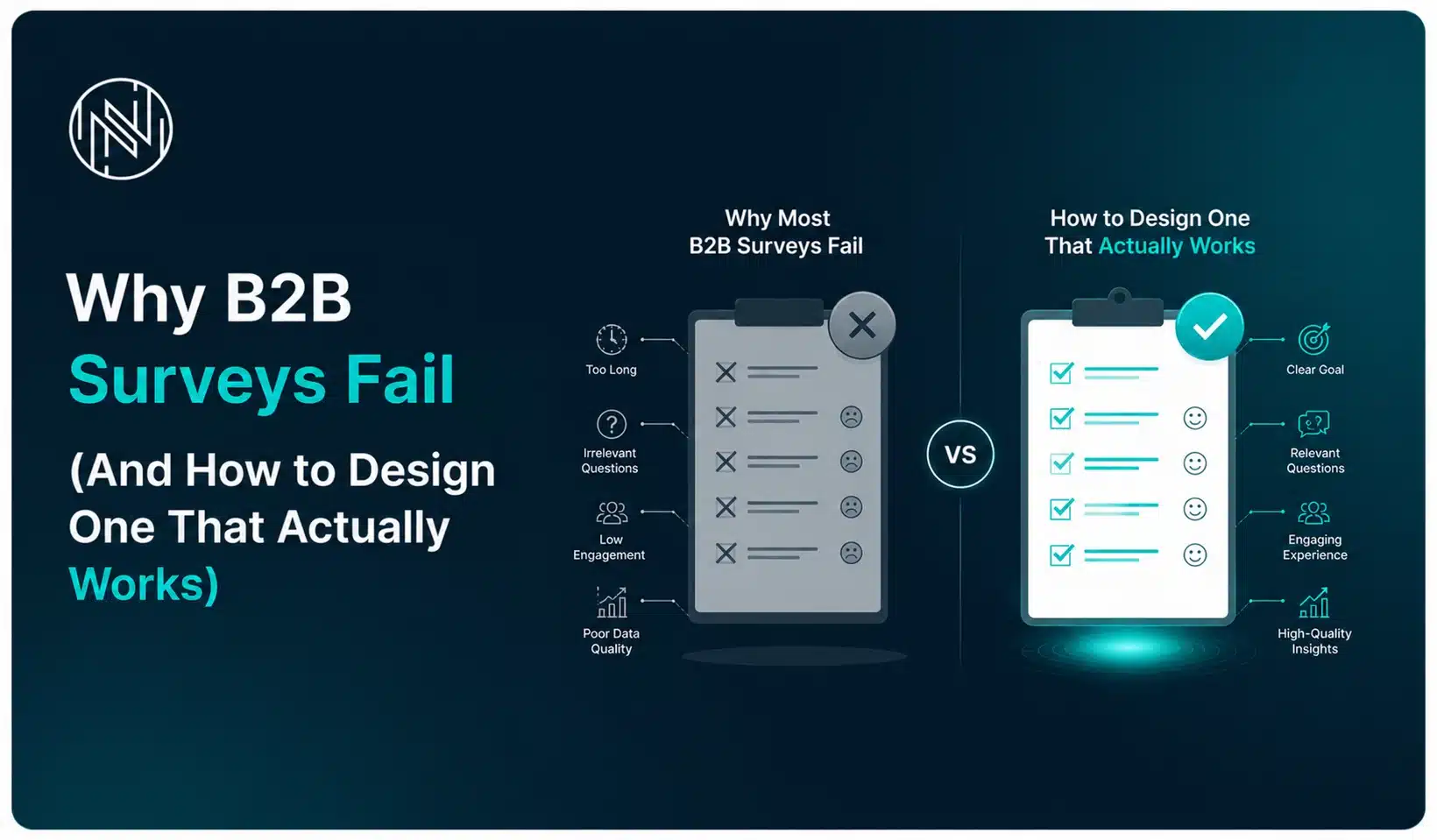
Why B2B Surveys Fail (And How to Design One That Actually Works)
Most B2B survey programs fail because they oversample the wrong stakeholders, exhaust respondents with long questionnaires, and never close the feedback loop with visible action. To design one that actually works, you need sharp objectives, role-specific questions, respondent-friendly length and UX, and a clear plan to turn the data into decisions.
In this guide, we’ll break down why B2B surveys underperform and walk through concrete B2B survey best practices you can apply immediately, from questionnaire design and sampling to analysis and post-survey communication.
Why B2B Surveys Fail So Often
The most common problem in B2B market research survey projects is not the platform or the audience. It is poor planning. Many teams send surveys without a clear business question, which weakens both the quality of insights and the quality of responses.
Wrong Stakeholders Are Targeted
A B2B purchase usually involves several people, not one. A strong B2B customer survey must reflect the buying committee, including users, managers, and decision-makers. If you send the same questions to everyone, the results become too vague to use.
This is why B2B questionnaire design must be built around roles. A user cares about ease of use, while a finance leader cares about ROI. If a survey does not separate these viewpoints, it misses the real decision drivers.
Surveys Are Too Long
One of the biggest reasons survey completion rates B2B drops is length. Busy professionals do not want a 20-minute questionnaire unless the topic is highly relevant and the value is obvious.
Good B2B survey best practices keep the survey focused. The ideal survey should ask only what is needed to support the business decision. If a question does not contribute to the outcome, remove it.
Questions Are Biased or Unclear
Bad survey question design creates bad data. Double-barreled questions, vague wording, and leading phrasing make it harder to trust the answers.
For example, asking “How satisfied are you with our pricing and product quality?” is weak because it combines two topics. A better approach is to split it into two separate B2B survey questions. This improves clarity and protects B2B survey data quality.
Response Incentives Are Weak
People respond faster when they understand what they get in return. A B2B feedback survey should explain the value of participation, such as improving a product, influencing a roadmap, or receiving a summary of findings.
If respondents see no benefit, the B2B survey response rate usually suffers. That is especially true in cold outreach and broad outreach lists where the respondent has no strong relationship with the brand.
Results Are Not Acted On
Surveys fail when they stop at collection. Strong B2B research methodology includes a clear action plan after the survey closes. If people give feedback and never hear back, they are less likely to respond again.
That is why enterprise survey design should include communication after the survey, not only before and during it. Closing the loop builds trust and improves future participation.
What Makes a B2B Survey Work
A working survey starts with a decision. It does not start with a blank form. The best market research survey design connects every question to a business outcome.
Start with a Single Business Goal
Before writing any question, define the exact decision the survey should support. That might be pricing, product direction, customer retention, positioning, or market selection.
This is the foundation of how to design a B2B survey. If the goal is unclear, the survey becomes too broad and loses focus. A good survey should answer one main question well rather than ten questions poorly.
Segment by Respondent Role
A strong B2B survey platform should allow skip logic and routing. That makes it easier to tailor the experience to different roles in the account.
This is important because a technical buyer, executive buyer, and end-user do not need the same survey path. Role-based logic improves relevance, which improves data quality and completion.
Keep the Survey Short
Short surveys perform better. That is one of the most reliable survey design best practices across research types.
For B2B survey design, a short format often works best because respondents are busy and selective. A survey should feel manageable within a few minutes, not like an internal audit.
Use Unbiased Question Wording
A good survey question design is neutral, specific, and easy to answer. The goal is to reduce confusion and avoid pushing the respondent toward a preferred answer.
This means avoiding loaded language, vague scale labels, and questions that assume agreement. Good B2B survey questions are single-topic, direct, and tied to one measurable outcome.
Plan the Follow-Up Before Launch
The survey should never be the last step. A complete B2B research methodology includes analysis, reporting, action planning, and communication.
If the team already knows how the findings will be used, the survey becomes more useful. If not, the survey is likely to produce unused data.

How to Design a B2B Survey Step by Step
This is the practical path for how to conduct a B2B survey that produces usable results.
Define the Objective
Start with one clear objective. For example, you might want to understand why customers are at risk of churn or which product feature matters most in buying decisions.
This is the starting point for B2B survey design. Without an objective, it is impossible to decide what to ask, who to ask, or how to interpret the answers.
Choose the Right Audience
Do not send the survey to everyone. The audience should match the business question.
A B2B market research survey may need separate groups such as users, buyers, and influencers. This improves the usefulness of the findings and makes it easier to segment the data later.
Build the Questionnaire
Use clear sections, simple response options, and a logical flow. That is the core of B2B questionnaire design.
The questionnaire should begin with easy, relevant questions and end with optional demographic or firmographic items. This keeps the experience smooth and reduces drop-off.
Test Before Launch
Pilot the survey before sending it widely. Testing helps reveal confusing wording, broken logic, or questions that take too long.
This step protects B2B survey data quality and prevents expensive fieldwork mistakes. It also helps confirm that the survey fits your chosen B2B survey platform and logic setup.
Analyze and Share Results
Survey data becomes valuable only when it leads to action. Segment the findings, identify trends, and connect the results to specific decisions.
Then share what you learned. A simple “we heard you” message can improve trust and encourage future participation in the next B2B feedback survey.
B2B Response Rate and Sample Size Planning
Planning matters because even a good survey can fail if the sample is too small or the completion rate is too low.
What Response Rates to Expect
A realistic B2B survey response rate depends on who you are contacting, how warm the audience is, and how relevant the topic is. Warm customer lists usually perform better than cold outreach.
The survey completion rate B2B also depends on length, incentive, timing, and question quality. Shorter, more relevant surveys usually perform better than broad, generic ones.
How Many Responses You Need
The right survey sample size B2B depends on the decision, the size of the target audience, and whether you need segment-level insights. If the survey is directional, a smaller number of high-quality responses may be enough.
For broader reporting, you may need more responses to reduce noise. The best approach is to balance statistical confidence with respondent availability and business urgency.
How to Improve Completion Rates
To improve completion, keep the survey short, make the purpose clear, and use simple wording. That is the practical side of B2B survey best practices.
Other helpful tactics include:
- Sending the survey at the right time,
- Offering a meaningful incentive,
- Using mobile-friendly design,
- And showing respondents that their input matters.
Table: Practical B2B Survey Planning Guide
| Survey element | Best practice | Why it matters |
| Objective | One clear business decision | Prevents scope creep |
| Audience | Role-based targeting | Improves relevance |
| Length | Short and focused | Boosts completion |
| Questions | Neutral and single-topic | Improves data quality |
| Logic | Skip logic and routing | Supports complex accounts |
| Follow-up | Share findings and actions | Builds trust |
Table: Common B2B Survey Mistakes and Fixes
Sending one survey to everyone. Responses become too generic. Segment by role. Asking
| Common mistake | What goes wrong | Better approach |
| Sending one survey to everyone | Responses become too generic | Segment by role |
| Asking too many questions | Drop-offs increase | Remove non-essential items |
| Using biased wording | Answers become unreliable | Keep wording neutral |
| Ignoring incentives | Response rate stays low | Offer value for time |
| Never reporting back | Trust declines | Close the feedback loop |
Nexus Expert Research and B2B Survey Support
A strong B2B survey platform alone does not guarantee results. You still need a strategy for targeting, writing, testing, and interpreting the survey.
Strategy
Nexus Expert Research can help define the right research question, audience, and survey structure. That matters because the quality of the output depends on the quality of the design.
Execution
The team can support enterprise survey design, fieldwork planning, and practical survey deployment. That includes building the right paths for different respondent types and improving survey flow.
Analysis
The real value comes from turning responses into decisions. Nexus Expert Research can help convert survey findings into usable insights for product, pricing, growth, or customer strategy.
If you want a B2B survey that produces real business insight, not noisy data, connect with Nexus Expert Research can help you design it the right way. Build smarter surveys, reach the right respondents, and turn feedback into decisions that move your business forward.
