
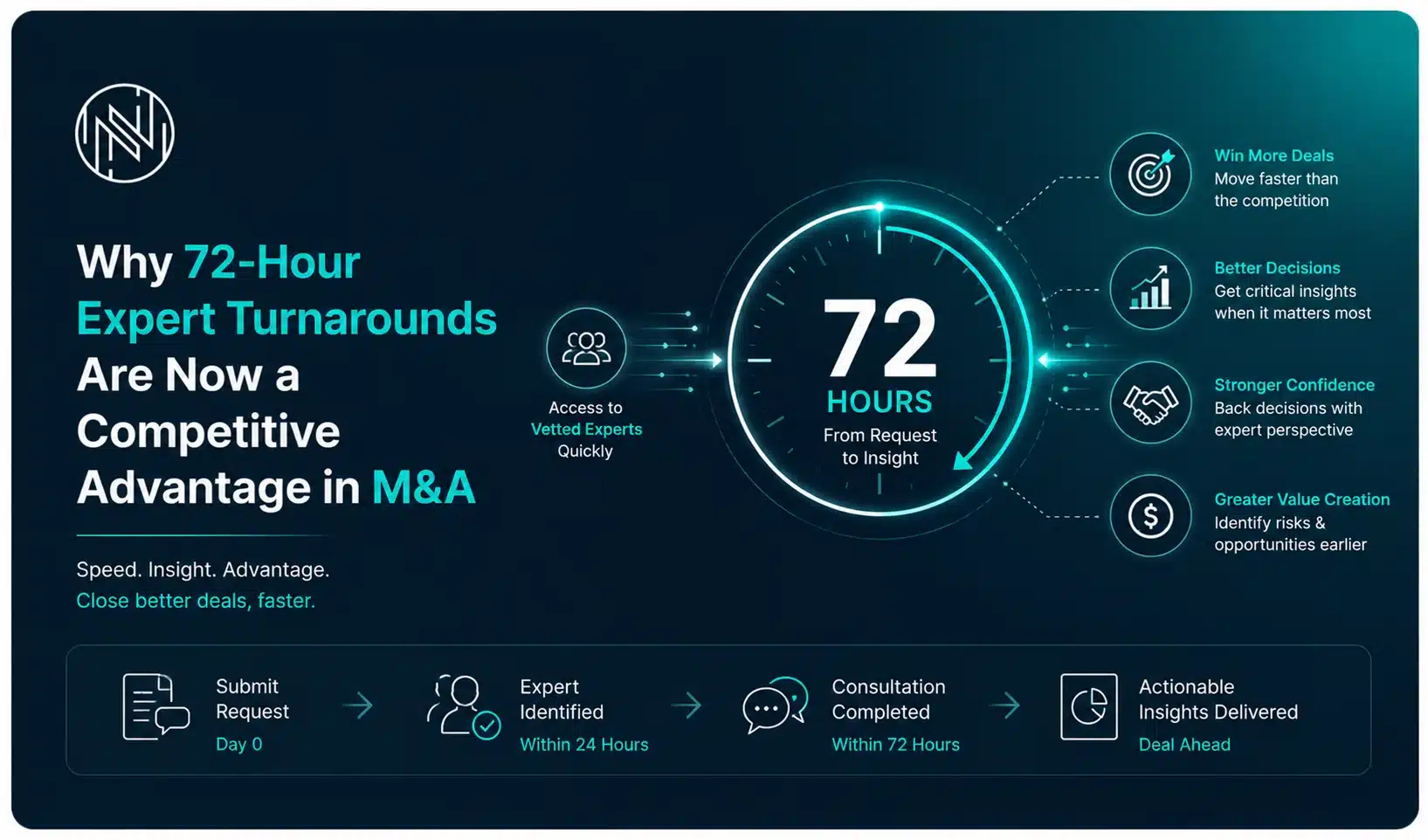
Why 72-Hour Expert Turnarounds Are Now a Competitive Advantage in M&A
In today’s deal environment, buyers who can line up high-quality expert calls within 72 hours build conviction faster, price risk more accurately, and move decisively while competitors are still scheduling calendars. A 72-hour expert turnaround compresses critical learning into a single cycle, allowing investors to validate theses, surface red flags, and keep deal momentum alive through weekends and tight auction deadlines.
This article explains how rapid expert access reshapes M&A due diligence, why expert networks and AI are at the center of this shift, and how funds and acquirers can design a repeatable playbook for 72-hour sprints in 2026.
What a 72-Hour Expert Turnaround Means in Modern M&A
A 72-hour expert turnaround is the ability to brief a network, source, vet, and schedule conversations with relevant operators, customers, or former executives in roughly three days from the initial request. Leading expert networks routinely deliver qualified experts in 24–72 hours, transforming what used to be a multi-week scheduling process into a rapid-fire learning sprint.
For deal teams, this window sits at the crossroads of expert network M&A workflows and evolving expectations from investment committees that decisions be grounded in live, practitioner-level insight rather than static reports alone. It means buyers can test critical assumptions before data rooms fully open, rather than waiting until exclusivity to accelerate learning.
Why Speed in M&A Due Diligence Now Decides Who Wins the Deal
Global M&A has rebounded on the back of fewer but larger, high-stakes deals, increasing competition for attractive assets and shrinking windows to build conviction. In this context, speed is no longer about being “fast for its own sake” but about being the first bidder to articulate a coherent, risk-adjusted view of the asset to sellers and investment committees.
This is where a well-structured due diligence expert network program becomes decisive: it allows teams to front-load insight, upgrade their questions for management, and avoid paying for prolonged desk research that arrives after the competitive dynamics are already set. The result is a real M&A competitive advantage grounded in superior timing and sharper information, not just deeper pockets.
How Weekend Diligence Prevents Momentum Gaps
Deals rarely pause just because internal teams are offline; buyers that can run structured expert calls across a Thursday–Monday window often avoid the “weekend stall” where momentum evaporates and doubts compound. By Monday morning, these teams have real customer feedback, competitor context, and operational insight that others will only begin to collect later.
This kind of fast due diligence 2026 mindset is especially valuable in processes where sellers are tracking engagement and preparedness as signals of seriousness and execution capability. Sponsors who emerge from a weekend with crisp theses and targeted management questions stand out immediately in crowded auctions.
Validating Hypotheses Before Exclusivity
The “shift left” trend in due diligence—doing more work earlier in the funnel—is now firmly established among leading investors. Rather than waiting for full access, teams form and pressure-test hypotheses about market structure, pricing power, churn drivers, and product defensibility using early expert calls.
Winning investors treat these early sprints as part of a broader expert network for private equity strategy: they engage a curated bench of operators and customers who can comment on the asset, its adjacencies, and the credibility of the growth story long before the information memorandum arrives.
How Expert Networks Enable 72-Hour Diligence Windows
Expert networks have evolved from niche providers into critical infrastructure for investment and corporate strategy teams, especially around transactions. They connect funds, consultants, and acquirers with practitioners whose lived experience fills gaps left by financials and public data.
AI-enabled search and matching can now identify candidates across global databases, which makes it feasible to assemble panels that are both relevant and compliant within 72 hours. This is particularly impactful where the M&A deal timeline leaves little room between first look, non-binding offers, and confirmed bids.
From Surface-Level Data to Ground-Level Insight
Traditional data rooms and vendor reports focus heavily on historical financials and high-level KPIs, which are necessary but insufficient for a robust view of execution risk. Expert calls bring in unstructured, “on-the-ground” information: customer buying behavior, sales cycle realities, talent dynamics, implementation pain points, and emerging competitors.
For funds, this is central to private equity due diligence, where underwriting typically rests on assumptions about market growth, margin expansion, and operational improvement plays. Having operators comment on the practicality of these assumptions within a short expert call turnaround time dramatically reduces the risk of relying on overly optimistic projections.
Strengthening Position in Competitive Bidding
In auction scenarios, sellers and advisors quickly distinguish between buyers who bring generic questions and those who show deep understanding of customer pain points and market dynamics. Buyers who run structured buy-side due diligence research via expert networks early in the process arrive at management meetings with sharper, value-add questions and clearer concerns.
This preparation also translates into better pricing discipline and term design, as teams have real-world feedback on topics like pricing pressure, churn drivers, and switching costs drawn from targeted M&A market research conversations.
Table: Traditional Due Diligence vs 72-Hour Expert Turnaround
| Dimension | Traditional Approach | 72‑Hour Expert Turnaround |
| Information flow | Heavy reliance on static reports and vendor materials. | Live insight from operators, customers, and ex‑employees within three days. |
| Timing | Learning concentrated late in exclusivity, under time pressure. | Learning front‑loaded before or early in process, supporting “shift‑left” strategies. |
| Flexibility | Hard to change thesis quickly when new risks emerge. | Rapid iterations as calls reveal new angles or red flags. |
| Competitive impact | Harder to differentiate from other bidders using the same materials. | Better questions, stronger narratives, and clearer conviction in competitive processes. |
Integrating 72-Hour Expert Calls Into the M&A Deal Timeline
The typical M&A process still takes anywhere from six months to several years, but the critical decision points are compressed into a handful of high-intensity windows. A 72-hour expert sprint can be layered into these windows to ensure the right insights land before each key investment committee discussion.
To make this repeatable, teams must align internal investment committees, deal leads, and their networks around clear workflows for scoping, approving, and running sprints within an overall deal diligence speed agenda.
Practical 72-Hour Playbook for Buy-Side Teams
A simple but effective 72-hour playbook embeds rapid calls inside the broader investment due diligence process and makes it easy to spin up sprints on short notice. At a high level, the pattern looks like this:
- Frame the thesis and key unknowns in 5–7 crisp questions.
- Share a short brief with your network partner, including target description, region, and personas required.
- Align on compliance, screening criteria, and budget.
- Schedule a wave of calls across 72 hours, mixing customers, competitors, partners, and ex-employees where appropriate.
- Synthesize takeaways into a short memo or dashboard that feeds directly into committee materials.
This is also the point where bringing in a seasoned commercial due diligence expert—either in-house or external—helps turn fragmented call notes into a coherent storyline and set of testable assumptions.
Table: 72-Hour Expert Sprint Checklist
| Step | What to Confirm | Why It Matters |
| Scoping | Clear hypotheses, personas, and geographies defined. | Prevents scattered calls and ensures each conversation answers a specific question. |
| Compliance | NDAs, conflict checks, and restricted lists in place. | Protects both buyer and experts, especially around MNPI. |
| Scheduling | Mix of time zones and slots across 3 days. | Maximizes volume of completed calls within 72 hours. |
| Documentation | Call guides, transcripts, and structured notes templates. | Makes insights reusable across teams and future deals. |
| Synthesis | Rapid thematic memo or dashboard. | Converts raw insight into actionable committee input. |
Measuring the ROI of Faster Expert Turnarounds in Private Equity Due Diligence
For sponsors, the ROI of 72-hour programs is measured less in direct cost savings and more in improved hit rates, better pricing, and fewer broken deals. Funds using rapid expert access report clearer “go/no-go” decisions earlier in the funnel, which means fewer resources are wasted on low-conviction opportunities.
These programs also support stronger underwriting: sharper assumptions and more realistic growth plans reduce the likelihood of post-close surprises, particularly for operational turnaround or integration-heavy theses. In practice, this becomes an internal M&A deal process 2026 advantage, as organizations with institutionalized sprints can move faster with less internal friction.
What to Look For in an Expert Network Partner in 2026
Not all networks are equally equipped to run high-quality 72-hour sprints at scale. Buyers should assess providers on expertise, compliance, and operational reliability as much as on price.
At the core of PE due diligence best practices is choosing a partner that can reliably deliver specialist practitioners—not generic advisors—who match your thesis, geography, and deal type. In parallel, firms should benchmark providers on response times, panel quality, and support for analytics, so that expert network due diligence speed does not come at the expense of relevance or governance.
Capabilities That Differentiate Nexus Expert Research
Leading networks combine technology, operations, and subject-matter depth to support investors running multiple sprints across regions and sectors. Platforms such as Nexus Expert Research can stand out by pairing AI-driven matching with hands-on project managers, robust compliance workflows, and tooling that makes transcripts, notes, and insights searchable across deals.
For buyers, this matters because it turns the network into more than a call-booking engine—into a core part of their M&A research tools stack that feeds investment memos, sector playbooks, and portfolio value-creation planning.
Future of M&A Research: AI, Expert Networks, and Always-On Diligence
The next phase of M&A will see even more integration between expert networks, AI summarization, and proprietary data sets. As models become better at extracting themes and contradictions across hundreds of call transcripts, deal teams will be able to maintain live, updating views of markets and assets rather than rebuilding knowledge from scratch for each process.
In a competitive deal process, private equity investors will increasingly rely on this always-on infrastructure to spot patterns, pre-wire theses, and pivot quickly when new information emerges. Networks and platforms that invest early in AI, data hygiene, and compliance will shape how diligence is executed across the industry.
Key Takeaways for 72-Hour Diligence Leaders
Rapid 72-hour expert access is no longer a “nice to have”; it is a structural edge in a market defined by tight timelines and high competition. Buyers that embed 72-hour sprints into their core processes, align with strong network partners, and leverage AI-driven synthesis will consistently out-learn and out-execute their peers.
For teams willing to evolve, the combination of expert networks, AI, and disciplined workflows turns speed into a repeatable, defensible advantage rather than a one-off tactic.
If you want to turn 72-hour expert sprints into a repeatable edge across every deal, partner with Nexus Expert Research and plug a modern, AI-enabled expert network directly into your M&A workflow.
Get in touch today to brief your next opportunity, line up the right experts within days, and move into your next process with sharper conviction than the competition.
