
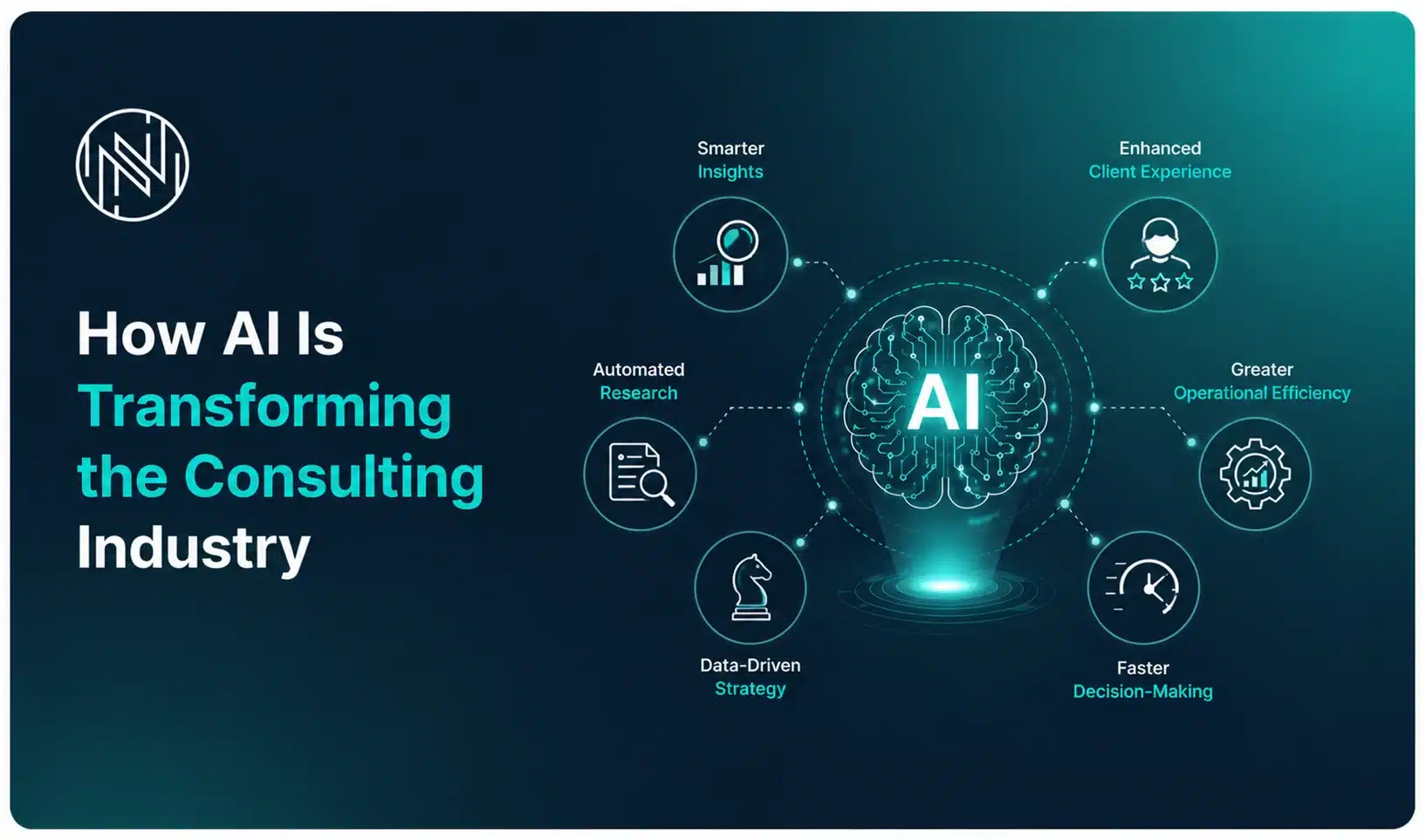
How AI Is Transforming the Consulting Industry
AI is transforming the consulting industry by automating routine tasks, accelerating data analysis, and enabling highly personalized, real-time strategic insights for clients. Instead of spending most of their time gathering data and building decks, consultants are increasingly acting as high-level strategic partners who interpret AI-generated insights, manage change, and guide execution. This shift is reshaping how projects are sold, staffed, and delivered across strategy, management, and digital consulting.
What AI in Consulting Really Means Today
AI in consulting describes the use of artificial intelligence, analytics, machine learning, and generative models to augment how consulting firms research, analyze, design, and implement solutions for clients. It includes everything from AI-assisted market analysis and forecasting to automated reporting, workflow automation, and conversational copilots embedded in day-to-day project delivery.
Why Human Experts Remain Essential Even as the AI Industry Booms
Even as the AI industry continues to boom, human expertise remains critical to the success of AI systems. AI models still rely on people to train, guide, validate, and interpret outputs in real-world business contexts. Without human judgment, strategic thinking, and domain expertise, AI can produce incomplete or misleading conclusions.
This is where Nexus Expert Research delivers clear value. We provide you with the right experts who can actively train your AI models, align them with your specific industry realities and business goals, and ensure responsible, high-quality outcomes. The most effective consulting results come from combining AI-driven efficiency with human experience, creativity, and decision-making.
From Traditional Projects to AI-Powered Consulting Models
Historically, consulting teams relied on manual research, spreadsheets, slide-building, and interviews to produce recommendations and implementation roadmaps. AI now supports much of this work by scanning large volumes of internal and external data, surfacing patterns, and generating structured insights that consultants can validate and refine.
This shift underpins AI-powered consulting models where repeatable tasks such as data cleaning, benchmarking, or drafting first-pass deliverables are increasingly handled by AI systems, while human consultants focus on framing the problem, challenging assumptions, and aligning stakeholders. For buyers of consulting services, this can mean faster projects, more evidence-based decisions, and greater transparency into how recommendations are built.
How Big Is the AI Consulting Industry and Why Is It Growing?
The AI consulting industry is still a subset of the broader consulting and AI services market, but it is expanding quickly. Multiple analyst estimates suggest the global AI consulting and AI consulting services market will be in the low to mid-teens of billions of dollars around 2026, with forecasts that it could grow to roughly 60 to 120 billion dollars by the mid-2030s at compound annual growth rates above 20 percent.
Several drivers explain this growth: rising enterprise spending on AI initiatives, CEO-level ownership of AI strategy, and the need for specialized advisory support around governance, operating models, and measurable value creation. As a result, demand has increased for specialists in AI business consulting who can connect technical capabilities with commercial outcomes across industries.
Core Ways AI Is Reshaping Consulting Workflows
Consulting delivery is being re-engineered around AI-enabled workflows that prioritize speed, quality, and repeatability.
Accelerating Research and Data Analysis
Consultants have always worked with data, but the volumes and complexity of today’s structured and unstructured data exceed what manual methods can handle efficiently. AI-driven analytics tools can quickly process customer behavior data, financials, regulatory filings, and market news to identify trends and anomalies that inform recommendations.
In management consulting, firms use machine learning models to simulate scenarios, test sensitivities, and quantify the potential impact of strategic choices, allowing clients to see upside, downside, and risk trade-offs more clearly. This accelerates the insight cycle, particularly in fast-moving markets such as SaaS, fintech, and e-commerce.
Automating Routine Tasks and AI Workflow Automation
A large portion of consulting time historically went into “deck-building,” data entry, project administration, and other routine tasks that do not directly create value for clients. AI-driven automation and robotic process automation can now handle many of these tasks, from generating baseline reports to updating models and project trackers.
This is where AI workflow automation becomes critical: by orchestrating a sequence of AI and human steps, data ingestion, transformation, analysis, and documentation, firms can reduce non-billable hours and free consultants to focus on higher-value analysis and stakeholder engagement.
Generative AI for Consultants and Knowledge Work
Generative AI for consultants refers to the use of large language models and other generative systems to draft documents, structure analyses, and even simulate stakeholder perspectives. Examples include generating first drafts of proposals, synthesizing interview notes, or creating alternative narratives for board presentations.
A Harvard-linked study found that management consultants using generative AI tools completed tasks about 25 percent faster, delivered around 12 percent more tasks, and produced work of more than 40 percent higher quality compared with a control group. These results highlight how AI can augment both speed and quality when used appropriately within defined guidelines.
Hyper-Personalized Insights and AI in Professional Services
As firms integrate AI with client data platforms and industry datasets, they can deliver more tailored recommendations to each client. This is where AI in professional services becomes a differentiator: advisors can generate client-specific forecasts, segmentation strategies, and operating-model designs, rather than relying solely on generic benchmarks.
Generative systems can also support personalized communication, for example, by tailoring dashboards, narrative reports, and scenario explanations to different stakeholders such as CFOs, operations leaders, and investors.
How AI Is Transforming Management and Strategy Consulting
AI is not only improving operational efficiency; it is changing the nature of management and strategy advice.
AI for Management Consulting and Operating-Model Change
AI for management consulting focuses on optimizing processes, structures, and performance management systems with AI embedded in the day-to-day business. Use cases include predictive maintenance in operations, AI-enabled demand forecasting in supply chains, and workforce analytics for talent planning.
Firms are also helping clients redesign workflows around AI, a pattern McKinsey refers to as moving from incremental efficiencies to transformative change, with high-performing organizations explicitly using AI to re-imagine their business models and growth engines. Management consultants, therefore, act as both strategic advisors and orchestrators of change, ensuring that technology investments translate into measurable performance improvements.
AI in Strategy Consulting and AI for Business Strategy
AI in strategy consulting involves using analytics and simulations to test strategic options and allocate resources more precisely. Strategy teams may use AI to segment markets, identify emerging customer needs, or model competitive dynamics under different scenarios.
This supports AI for business strategy, where leaders integrate AI considerations directly into portfolio choices, go-to-market plans, and innovation pipelines. For example, AI-assisted scenario planning can help VCs and growth-stage startups assess which markets are most attractive under varying technological and regulatory assumptions.
AI Consulting Tools and Platforms Firms Actually Use
Consultants increasingly work within integrated stacks that combine analytics, automation, and knowledge management.
Analytics, Automation, and Knowledge Management Stacks
Modern AI consulting tools typically fall into several categories:
- Advanced analytics and business intelligence platforms that apply machine learning to large data sets.
- Generative AI copilots for drafting content, synthesizing documents, and answering domain-specific questions.
- Process-automation tools that integrate with CRM, ERP, and project-management systems.
- Knowledge graphs and retrieval-augmented generation systems that surface prior case work and best practices.
These tools give consulting teams a shared, AI-assisted knowledge base, reducing duplication of effort and making it easier to maintain consistent quality across engagements.
Enterprise AI Consulting, Governance, and Risk Management
At the enterprise level, Enterprise AI consulting engagements focus on architecture, governance, and controls. Advisors help clients choose cloud providers, define data-access policies, and design AI risk frameworks that address bias, security, and regulatory compliance.
Consulting firms also guide clients through responsible AI practices, aligning with emerging industry guidelines and ensuring that AI systems remain transparent and auditable, especially in regulated sectors such as financial services and healthcare. This governance layer is a core part of AI-driven consulting services as organizations scale AI beyond small pilots.

Table: Traditional vs AI-Enhanced Consulting Delivery
| Aspect | Traditional consulting delivery | AI‑enhanced consulting delivery |
| Data handling | Manual collection and spreadsheet analysis; limited use of unstructured data | Automated ingestion and analysis of large structured and unstructured datasets using AI tools. |
| Speed | Weeks to assemble insights and reports | Faster turnaround with AI‑assisted research, modeling, and drafting, often reducing timelines significantly. |
| Consultant focus | Large share of time on data prep and slide production | More time on problem framing, stakeholder management, and decision support while AI handles routine tasks. |
| Personalization | Heavy reliance on generic benchmarks and frameworks | Highly tailored recommendations based on client‑specific data and simulations. |
| Operating model | Hourly billing, manual workflows | Hybrid models combining automation, packaged assets, and outcome‑oriented pricing in some engagements. |
Business Outcomes: Productivity, Cost, and Client Value
Firms adopt AI in consulting because it moves the dial on measurable business outcomes.
Evidence on AI Productivity for Consultants
Research on generative AI shows strong gains in knowledge-worker productivity. A study published by Vena Solutions, summarizing Harvard research, reports that management consultants using AI tools completed tasks 25.1 percent more quickly, handled about 12.2 percent more tasks, and delivered work that independent evaluators rated as over 40 percent higher in quality. These benefits were especially pronounced for less-experienced consultants, who saw the largest performance improvements.
More broadly, surveys of businesses in major economies indicate that organizations expect AI adoption to boost productivity by roughly 1 to 1.5 percent per year over the medium term, even though many firms are still early in their adoption journey. Together, these findings underpin the growing focus on AI productivity for consultants and their clients.
Impact on Pricing, Delivery Models, and Digital Transformation with AI
As AI increases leverage, some firms are experimenting with new pricing models, from fixed-fee diagnostic packages to outcome-based fees linked to cost savings or revenue uplift. These models are more feasible when AI allows repeatable, standardized components to be delivered efficiently.
For clients, AI-enabled consulting often aligns with broader digital transformation with AI programs, modernizing data platforms, automating core workflows, and embedding predictive and generative capabilities into products and operations. Consulting buyers, therefore, evaluate partners based not only on slide-deck quality but also on their ability to design and implement AI-centric operating models that deliver sustained value.
Practical Roadmap to Launch AI-Driven Consulting Services
Decision makers considering AI-enabled consulting either as buyers or providers benefit from a structured roadmap.
Readiness Assessment and Use-Case Selection
A straightforward starting point is to identify where AI can support quick wins without high risk. Typical beachhead use cases include AI-assisted research, automated reporting, and internal knowledge search, all of which can be deployed within a firm before extending to client-facing solutions.
Consulting leaders should assess data availability, existing technology stacks, and legal or regulatory constraints. From there, they can prioritize a short list of use cases that align with strategic goals, such as customer churn prediction, pricing optimization, or operations forecasting.
Building an AI-Enabled Consulting Operating Model
Rolling out AI at scale requires new capabilities around data engineering, model operations, and change management. High-performing organizations redesign workflows so that AI is embedded in standard project stages from discovery to delivery, then treated as an optional add-on.
Consulting firms also need training programs to reskill teams into “AI-augmented” roles, where consultants are comfortable working alongside AI systems while maintaining accountability for judgment, ethics, and client trust. This operating-model shift is at the heart of sustainable AI-driven consulting services.
Table: Simple Roadmap for AI-Enabled Consulting
| Stage | Objective | Example actions |
| 1. Assess | Understand current capabilities and constraints | Audit data sources, systems, and existing analytics; map regulatory and security requirements. |
| 2. Prioritize | Select high‑value, low‑risk AI use cases | Choose internal research copilots, automated reporting, or repeatable analytics modules as pilots. |
| 3. Pilot | Test with a limited scope and measure results | Run pilots on specific projects; track time saved, quality improvements, and client feedback. |
| 4. Scale | Embed AI in standard delivery | Create reusable assets, playbooks, and training; integrate AI into project templates and workflows. |
| 5. Govern | Manage risk and ensure responsible use | Establish AI governance, monitoring, and escalation processes for bias, security, and compliance. |
How to Choose the Right AI Business Consulting Partner
Selecting the right partner for AI-enabled projects is critical, especially for startups and SMEs with limited budgets.
Look for firms that demonstrate real client outcomes from AI, not just slide decks. Indicators include case studies with quantified impact, reusable accelerators, and clearly defined delivery methodologies that integrate analytics, change management, and implementation.
Buyers should also assess a provider’s cross-functional capabilities: technical depth in AI and data engineering, sector expertise, and experience aligning AI programs with investor expectations and governance standards. Specialized firms such as Nexus Expert Research can be particularly valuable when they combine AI expertise with niche industry knowledge and a pragmatic, outcome-oriented approach.
