
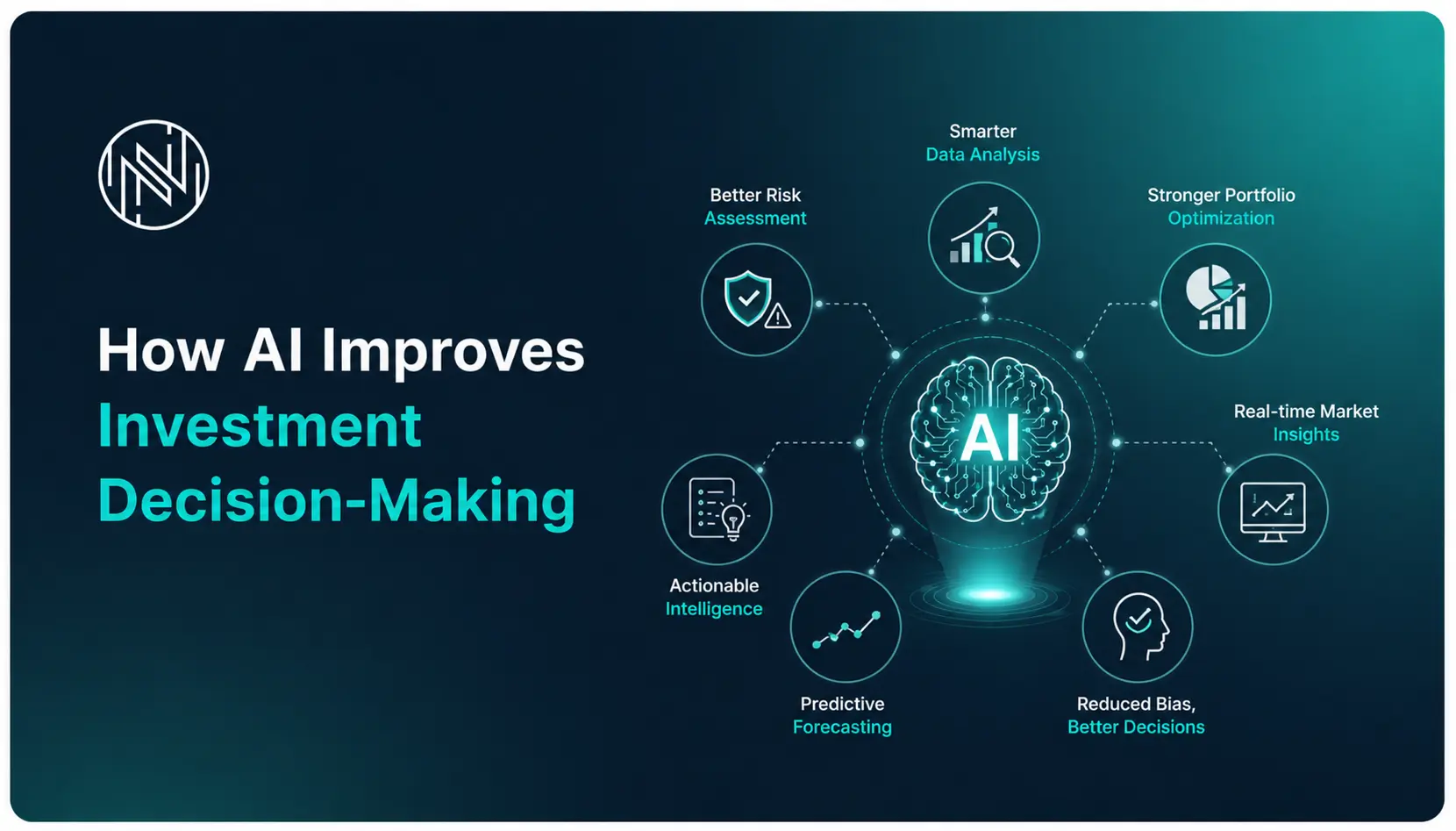
How AI Improves Investment Decision-Making
AI improves investment decision-making by rapidly analyzing vast datasets, identifying patterns humans miss, and providing advanced predictive analytics to support better risk-adjusted decisions. It also reduces emotional bias, enhances due diligence, and enables continuous portfolio monitoring, allowing investors to respond faster and more systematically to changing market conditions.
In simple terms, AI helps investors move from reactive, intuition-driven decisions to proactive, data-driven strategies. For VCs, PE funds, asset managers, and business leaders, this shift can unlock better deal selection, more resilient portfolios, and stronger long-term performance when implemented responsibly.
What Is AI in Investment Decision-Making and Why It Matters Now
AI in investment decision-making refers to the use of algorithms, machine learning models, and large language models to support or augment choices about capital allocation, security selection, and portfolio construction. These systems process financial statements, market data, news, alternative data, and internal information to generate insights that inform buy, sell, hold, or allocation decisions.
For decision makers, AI in finance is not about handing control to machines; it is about using computation to extend human judgment. Leading asset managers have used AI and machine learning in their systematic strategies for years, reporting improved ability to process complex data and refine signals in noisy markets.
Google’s AI-style overviews and industry research consistently highlight five core ways AI improves investment decisions:
- Data processing and pattern recognition across huge, heterogeneous datasets
- Removal of emotional bias by basing decisions on models and evidence
- Advanced risk management and forecasting using scenario and predictive models
- Efficient due diligence and research through automation of repetitive analysis
- Enhanced portfolio optimization via continuous, rules-based monitoring and rebalancing
These benefits matter because the volume, velocity, and variety of financial data now exceed what traditional teams and tools can handle reliably.
How AI Investment Analysis Transforms Research Quality and Speed
AI investment analysis uses algorithms to screen, rank, and evaluate securities or deals based on structured rules and learned patterns. Instead of manually building spreadsheets, analysts can offload data extraction, normalization, and first-pass scoring to AI tools.
From Manual Screens to AI-Powered Market Analysis
Traditional screens rely on a narrow set of ratios and static filters, which often miss nuanced signals and alternative datasets. By contrast, AI-powered market analysis can combine price data, fundamentals, macro indicators, sentiment, news, and even satellite or web-traffic data in a unified view.
For example, AI platforms used by institutional managers scan millions of data points to improve the signal-to-noise ratio, helping teams focus on the few securities or deals that warrant human deep dives. This improves both coverage and consistency, especially in global or multi-asset portfolios.
Using Machine Learning in Finance to Detect Hidden Patterns
Machine learning in finance allows models to learn non-linear relationships between variables, which traditional factor models can miss. Techniques such as random forests, gradient boosting, and neural networks can detect subtle interactions between valuation metrics, quality indicators, and macro drivers that correlate with future performance.
When applied carefully, these methods help investors uncover mispriced assets, early warning signals, and regime shifts that are difficult to see using manual analysis alone. However, they still require robust validation, backtesting, and human oversight to avoid overfitting and spurious correlations.
Table: Traditional Research vs AI-Enhanced Investment Analysis
| Dimension | Traditional Approach | AI-Enhanced Approach |
| Data coverage | Limited to financials and a few macro series. | Integrates fundamentals, news, sentiment, alternative data, and internal datasets. |
| Speed | Batch updates; manual refresh takes days or weeks. | Near real‑time ingestion and scoring across thousands of assets. |
| Pattern detection | Linear models and intuition-driven heuristics. | Non‑linear machine learning models that detect complex relationships. |
| Consistency | Depends on analyst experience and bandwidth. | Systematic rules‑based application of the same logic to all candidates. |
Predictive Analytics and Financial Forecasting for Smarter Capital Allocation
Predictive analytics in investing refers to using historical and real-time data to estimate future returns, cash flows, and risk scenarios. Rather than relying on simple extrapolation, AI models learn patterns from large datasets to improve the quality and timeliness of forecasts.
AI Financial Forecasting Models Used in Modern Investing
AI financial forecasting typically combines time-series models with machine learning features, such as sentiment scores, macro indicators, and sector-specific signals. Asset managers and hedge funds use these models to forecast price movements, factor returns, and volatility regimes over different horizons.
In corporate and SME contexts, similar techniques forecast revenue, cash flows, and working capital cycles, helping leadership align investment plans with realistic financial trajectories. Importantly, these models provide probability distributions and confidence intervals rather than single-point predictions, which supports better risk-aware planning.
Scenario Planning and Stress Testing with AI
AI systems can generate thousands of simulated scenarios to test how portfolios or specific deals might behave under different macro, regulatory, or market shocks. This supports more rigorous stress testing for interest-rate changes, commodity swings, or demand shocks.
For investment committees, this means they can compare AI investment strategies not only on expected return but also on drawdown profiles, tail risks, and resilience across regimes. When combined with human judgment about structural shifts or policy risks, these tools lead to more informed and transparent decisions.
AI Portfolio Management and Real-Time Risk Assessment
AI portfolio management uses algorithms to adjust allocations, rebalance positions, and control risk based on evolving data and predefined constraints. For both institutional and smaller portfolios, this can reduce operational workload while improving discipline.
Continuous Monitoring, Rebalancing, and Drawdown Protection
AI systems can monitor portfolios 24/7, flagging breaches in risk limits, liquidity constraints, or concentration thresholds as they occur. Rules-based engines and machine learning models can then propose or execute rebalancing actions to keep the portfolio aligned with its mandate.
This is especially valuable for multi-asset and global strategies, where manual rebalancing is slow and error-prone. By applying consistent rules, AI helps counter emotional reactions during market stress, supporting more stable long-term outcomes.
AI Risk Assessment for Market, Credit, and Operational Risk
AI risk assessment combines quantitative models with alternative data to estimate exposures across market, credit, liquidity, and operational dimensions. For example, machine learning can highlight counterparties with deteriorating fundamentals or identify clusters of correlated positions that amplify downside risk.
Banks and asset managers also apply AI to transaction and trading data to detect anomalies that could signal fraud or control failures, strengthening operational risk management. These capabilities support regulators’ expectations for more forward-looking, data-driven risk frameworks.

Table: Key AI Use Cases Across the Investment Lifecycle
| Stage | AI Use Case | Primary Benefit |
| Idea generation | Signal discovery with machine learning and alternative data. | Broader opportunity set and differentiated insights. |
| Research | Automated document parsing, AI investment analysis, and summarization of filings, news, and transcripts. | Faster time‑to‑insight and reduced manual workload. |
| Portfolio construction | Optimization and constraint‑aware allocation using AI platforms. | Better diversification and risk‑return trade‑offs. |
| Monitoring | Real‑time risk dashboards and anomaly detection. | Earlier detection of drawdowns, liquidity issues, or concentration. |
| Reporting | Generative AI for commentary and customized client reports. | Scalable personalization without extra headcount. |
AI for Private Equity, Venture Capital, and Deal Sourcing
AI for private equity and VC focuses on sourcing, evaluating, and managing private deals where data is often sparse and unstructured. AI tools scrape company websites, hiring data, product reviews, app usage, and other signals to build a richer picture of early-stage or private companies.
For GPs, this can significantly expand the top of the funnel and reduce the risk of missing attractive opportunities, especially in crowded or emerging markets. It also supports better segmentation of prospects based on growth, unit economics, and strategic fit.
Deal Origination, Screening, and AI Due Diligence
AI due diligence combines document analysis, data extraction, and anomaly detection across financials, contracts, customer data, and technical documentation. Natural language processing can rapidly flag clauses, obligations, or risk factors in legal and commercial documents that warrant human review.
This accelerates deal cycles while improving coverage of key risks, helping investment teams focus their expert time on complex judgment calls rather than mechanical checks. In competitive processes, faster and deeper diligence can be a decisive edge.
How AI Supports Post-Investment Value Creation
Post-investment, AI can analyze operational data, customer behavior, and market trends to identify growth levers and cost efficiencies across portfolio companies. It can also help boards track KPIs, scenario-plan for strategic decisions, and monitor covenant or policy compliance.
Some firms are integrating AI-driven dashboards into monthly or quarterly portfolio reviews, giving partners and management teams a shared, real-time view of performance drivers. This supports more proactive interventions and value-creation plans.
AI in Asset Management and Institutional-Grade Portfolio Optimization
AI in asset management is now a mainstream theme, with dedicated platforms helping institutional investors scale research, portfolio construction, and reporting. Providers such as MDOTM and others combine AI models with portfolio analytics to optimize allocations and rebalance in line with investment policies.
At the same time, large managers report that AI has been integrated into their systematic processes for nearly two decades, especially for security selection and thematic basket construction. These approaches aim to improve consistency, breadth, and efficiency rather than to replace portfolio managers.
Blending AI-Driven Investing with Human Investment Committees
AI-driven investing works best when investment committees treat AI as an additional “team member” that provides evidence, not orders. Committees can use AI outputs as a starting point for debate, asking why a model prefers certain exposures and whether the assumptions align with their fundamental view.
This blended model respects domain expertise, governance, and fiduciary duties while still benefiting from the scale and pattern-recognition capabilities of AI. It also makes it easier to explain decisions to boards, clients, and regulators, which is essential under emerging responsible AI expectations.
Governance, Transparency, and Responsible AI in Finance
Global initiatives such as the World Economic Forum’s Responsible AI Playbook for Investors stress that AI must be valid, reliable, safe, fair, and explainable. Investors are encouraged to assess not only model performance but also data bias, robustness, and alignment with legal and ethical standards.
This is crucial because poorly governed AI can amplify bias, hallucinate incorrect outputs, or create opaque decision chains that undermine trust and expose firms to financial and reputational risk. Responsible design, monitoring, and documentation are therefore integral parts of any serious AI strategy in investing.
Practical Roadmap: How Decision Makers Can Start Using AI for Investors Today
For leaders exploring AI for investors, the most effective approach is usually incremental: start with targeted use cases that solve a clear pain point, then scale. Typical entry points include document summarization, news and sentiment monitoring, or internal meeting analytics that improve how investment teams collaborate.
A practical roadmap often looks like this:
- Identify high-impact, data-heavy workflows (e.g., screening, reporting, compliance checks).
- Pilot specialized tools for those workflows, with clear success metrics.
- Establish governance for data quality, model validation, and access control.
- Train teams to interpret and challenge AI outputs, not blindly follow them.
- Gradually integrate AI insights into investment committee materials and portfolio reviews.
Specialist partners such as Nexus Expert Research can help design and validate these pilots so they align with your existing processes, regulatory context, and risk appetite.
Final Thoughts and Next Steps
AI is reshaping how capital is allocated across public markets, private equity, and corporate investment decisions, but its role is fundamentally augmentative. When used responsibly, it sharpens research, enhances forecasting, strengthens risk controls, and frees human experts to focus on strategy, relationships, and nuanced judgment.
For VCs, PE funds, asset managers, and SMEs, the opportunity is not simply to “add AI” but to redesign investment workflows around richer data, better questions, and more disciplined decision processes. Those who combine AI capabilities with strong governance and expert oversight are likely to enjoy a meaningful competitive edge.
Conclusion
Ready to turn AI from a buzzword into a measurable edge in your investment decisions? Nexus Expert Research can help you design, validate, and operationalize AI-powered investment workflows tailored to your portfolio, governance, and risk profile.
Get in touch today to explore a focused pilot or full-stack transformation that makes your research sharper, your portfolios more resilient, and your capital work smarter.
