
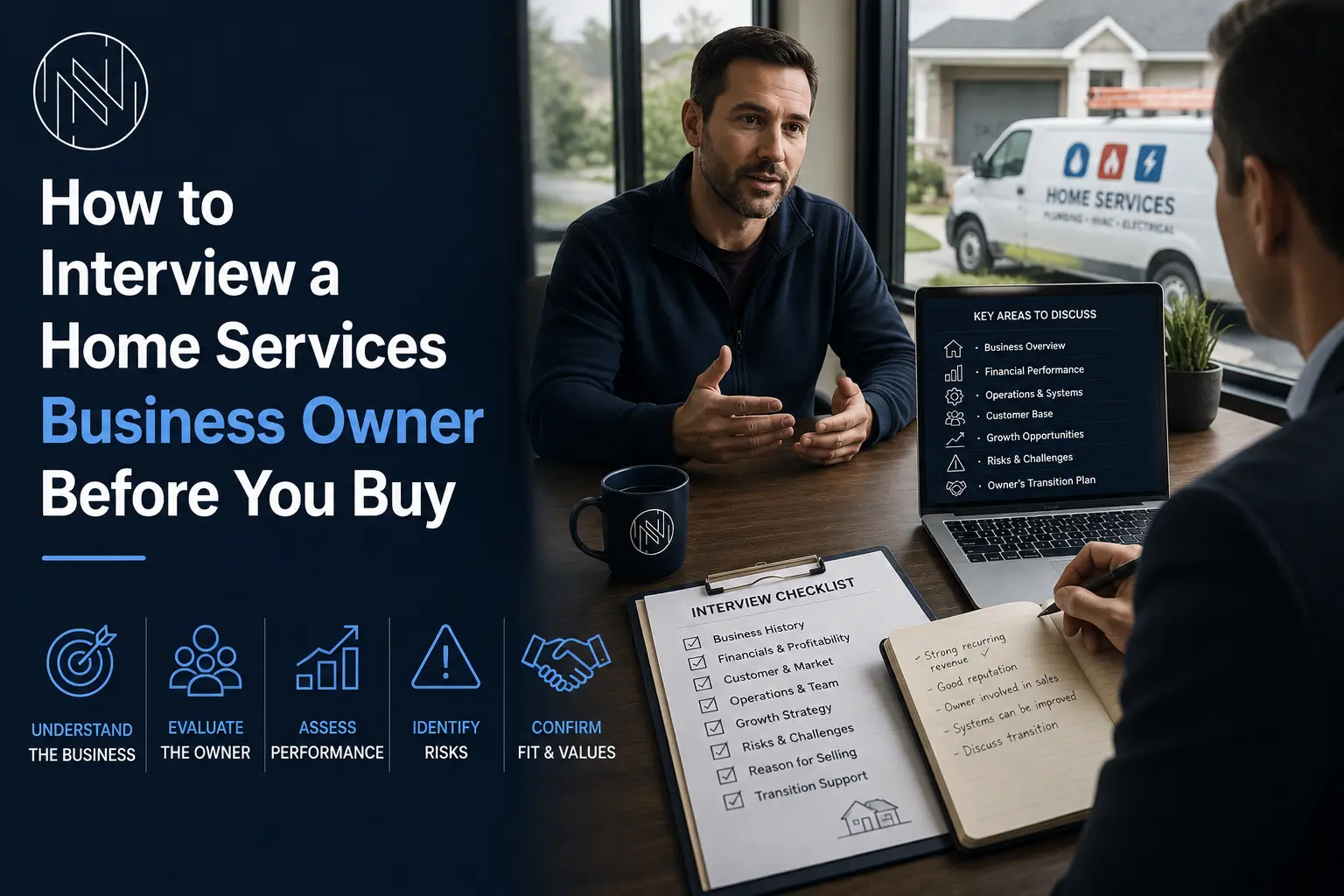
How to Interview a Home Services Business Owner Before You Buy
Interviewing the owner of a home services company should reveal why the business is being sold, how it makes money, who keeps it running, and which risks may transfer to the buyer. The strongest interview combines direct questions with document verification, employee analysis, customer-contract review, and an assessment of how dependent the company is on its current owner.
A home services business acquisition can give a buyer an established workforce, customer base, operating history, equipment, and brand reputation. However, buying a home services business without understanding the people and systems behind those assets can result in declining revenue immediately after closing.
That is why the seller interview must be treated as part of formal home services due diligence, not as an informal introduction. The U.S. Small Business Administration advises buyers to investigate the full business landscape, including contracts, leases, cash flow, inventory, financial statements, tax returns, and purchase documents. It also recommends involving qualified legal and accounting professionals during the acquisition process.
What Should a Seller Interview Accomplish?
The seller interview should help you determine whether the company’s earnings, customer relationships, workforce, licenses, and operating systems can survive a change in ownership.
The most important questions to ask before buying a business should therefore accomplish five things:
- Explain the seller’s motivation.
- Test the accuracy of the financial information.
- Identify operational and workforce dependencies.
- Evaluate whether customers and contracts will remain.
- Establish a realistic transition plan.
Good seller interview questions do not simply ask the owner to describe the business. They require the seller to explain how claims can be verified.
Instead of asking, “Is customer retention good?” ask:
“How many customers renewed during the previous 12 months, and which report can we use to verify that number?”
That shift turns a general statement into a testable acquisition claim.
How Should You Prepare Before Interviewing the Owner?
Knowing how to interview a business owner before buying begins with preparation. Read the confidential information memorandum, financial summary, business listing, and available operating documents before the conversation.
Prepare three columns in your notes:
- What the seller claims
- What evidence should support the claim
- What still needs to be verified
This approach improves vetting a business before buying because it prevents the interview from becoming a sales presentation controlled entirely by the seller.
Use the following table as a practical buying a small business checklist.
| Interview area | Questions to prepare | Evidence to request |
|---|---|---|
| Financial performance | How stable are revenue, margins, and cash flow? | Tax returns, profit-and-loss statements, bank statements and general ledger |
| Owner involvement | Which duties are performed personally by the owner? | Calendar, job descriptions, approval workflows and customer communications |
| Employees | Which technicians and managers are essential? | Employee roster, tenure, compensation, licenses and turnover data |
| Customers | How concentrated and repeatable is revenue? | Customer-level sales, maintenance agreements, churn and renewal reports |
| Operations | How are calls, estimates, dispatching and collections managed? | SOPs, CRM reports, dispatch data and software access |
| Assets | Which vehicles, tools and equipment are included? | Asset register, titles, lease documents, maintenance history and lien records |
| Compliance | Which licenses, permits and certifications are required? | Current credentials, inspection records, insurance policies and claims history |
| Transition | What support will the seller provide after closing? | Written transition plan, training schedule and non-compete terms |
What Questions Should You Ask About the Reason for Sale?
The first questions to ask a business seller should establish why the company is available and why it is being sold now.
Ask:
- Why have you decided to sell?
- How long have you been considering a sale?
- Have you previously tried to sell the business?
- What would you do with the company if you were not selling?
- Are there recent changes in revenue, costs, staffing, regulation, or competition influencing your decision?
- What information about the business would concern a cautious buyer?
- What would you change if you continued operating it for another five years?
Retirement, health, relocation, or a desire to pursue another venture can be reasonable explanations. However, the stated reason should be consistent with the company’s financial performance, employee history, recent investments, and customer activity.
A seller who says the business has significant growth potential should also be able to explain why that potential has not already been pursued.
What Financial Questions Should You Ask the Seller?
Start by understanding how revenue becomes cash and how reported profit has been calculated.
Ask the owner:
- What were revenue, gross profit, operating profit, and cash flow for each of the previous three years?
- What caused the largest year-to-year changes?
- Which months are strongest and weakest?
- How much revenue comes from installations, repairs, emergency calls, maintenance plans, and other services?
- Are the books maintained on a cash or accrual basis?
- Do reported sales reconcile with bank deposits?
- Which expenses are being presented as owner add-backs?
- Which add-backs would genuinely disappear after the acquisition?
- Are there unpaid taxes, overdue suppliers, equipment loans, vehicle finance agreements, leases, or legal liabilities?
- How much working capital is required during the busiest and slowest seasons?
- Which capital expenditures will be necessary during the next 12 to 24 months?
Do not treat adjusted EBITDA or seller’s discretionary earnings as verified merely because the broker or seller has presented a calculation. Review each adjustment individually.
For example, the owner’s salary may be added back for valuation purposes, but the business may still require a general manager after closing. The replacement manager’s cost should therefore be considered when assessing normalized earnings.
The financial discussion should be followed by document-level review. The SBA identifies financial statements, tax returns, contracts, leases, and purchase-price documents among the materials buyers and their advisers should evaluate.
What Should You Ask About Operations and Business Systems?
A transferable home services company should operate through documented systems rather than informal knowledge held by one person.
Ask:
- Which dispatch, CRM, accounting, payroll, call-tracking, and estimating systems are used?
- Who answers calls and books appointments?
- How are technicians assigned to jobs?
- Who approves estimates, discounts, refunds, and purchases?
- How are leads tracked from first contact to completed job?
- What percentage of calls become booked appointments?
- How are missed calls and unapproved estimates followed up?
- How are invoices collected?
- Are procedures documented for recurring tasks?
- Which operational reports does management review weekly?
- Can the company operate for two weeks without the owner being present?
Request demonstrations of the systems rather than accepting a verbal description. Review actual dispatch dashboards, job histories, conversion reports, outstanding estimates, accounts receivable, and call records.
You should also establish whether software accounts, telephone numbers, websites, advertising accounts, customer databases, and digital assets will transfer to the buyer.
What Should You Ask About Employees and Management?
In a home services company, technicians and managers may be more valuable than physical equipment. The loss of a qualified technician, dispatcher, service manager, or estimator can disrupt capacity and customer relationships.
Ask:
- Who are the most important employees and why?
- How long has each key employee been with the company?
- Which employees hold required trade licenses or certifications?
- Does any employee personally control major customer relationships?
- Have any key employees been informed about the proposed sale?
- Which employees are likely to remain?
- What has annual employee turnover been?
- Why did the most recent technicians leave?
- Is compensation competitive for the local labour market?
- Are bonuses, commissions, overtime, vehicles, or informal benefits included in employment arrangements?
- Are technicians employees or independent contractors?
- Are employment terms documented?
- Who could run the company if the owner left tomorrow?
Speak with key employees at the appropriate stage of due diligence, subject to confidentiality arrangements. The seller’s account of workforce stability should not be the only source of evidence.
What Should You Ask About Customers, Contracts, and Reputation?
Home services revenue can come from one-time projects, emergency work, repeat customers, commercial agreements, and recurring maintenance plans. These revenue streams do not carry the same level of predictability.
Ask:
- What percentage of revenue comes from repeat customers?
- How much comes from recurring service or maintenance agreements?
- How many agreements are currently active?
- What are their renewal and cancellation terms?
- Which contracts require customer consent before assignment?
- Who are the ten largest customers?
- How much revenue would disappear if the largest customer left?
- How are customer complaints handled?
- What are the most common reasons for refunds, callbacks, or warranty visits?
- Does the business track review ratings, complaint trends, and customer retention?
- Are customers loyal to the company or personally loyal to the owner?
- Have any important customers recently reduced spending?
Recurring agreements can support more predictable revenue, but buyers should inspect contract schedules, pricing, renewal history, and the actual revenue generated by those agreements rather than relying on the reported number of enrolled customers.
Also investigate whether maintenance agreements, warranties, telephone numbers, online reviews, and customer records can legally and practically transfer to the new entity.
What Legal, Licensing, and Compliance Questions Matter?
Home services companies may require different licenses and permits depending on the trade, location, and services performed. The SBA notes that requirements can arise at federal, state, county, and city levels and vary according to the business activity and location.
Ask:
- Which business and trade licenses are required in every service area?
- Who currently holds each qualifying license?
- Will those licenses remain valid after the ownership change?
- Does the buyer need a new license or designated qualifying individual?
- Are all permits, bonds, and insurance policies current?
- Have there been lawsuits, regulatory investigations, safety violations, customer claims, or insurance disputes?
- Are any vehicles, equipment, receivables, or other assets subject to liens?
- Are there unresolved employee classification or wage issues?
- What warranties and service obligations will remain after closing?
- Are there pending claims that may become the buyer’s responsibility?
For U.S. businesses, OSHA’s establishment-search system can be used to locate publicly available enforcement inspection and citation information by establishment name.
Your attorney should confirm which obligations remain with the selling entity and which may transfer under an asset or stock purchase.
How Do You Test Whether the Business Depends on the Owner?
The most serious owner-dependence red flags appear when the seller personally controls revenue, technical work, pricing, staff decisions, customer relationships, or required licenses.
Ask the owner to describe a normal week in detail:
- Which calls do you personally handle?
- Which estimates require your approval?
- Which customers contact you directly?
- Which employees report only to you?
- Which technical problems can no one else solve?
- Which passwords, supplier relationships, or processes are known only to you?
- What happened during your last extended absence?
- Could the company continue operating if you were unavailable for 30 days?
Then compare the answers with staff roles, customer communications, approval records, and system activity.
A company is not truly transferable when the owner is simultaneously its lead salesperson, licensed operator, estimator, recruiter, service manager, and customer-relations function.
Owner dependence does not always require abandoning the acquisition. It may justify:
- A lower valuation
- A longer transition period
- Seller financing
- An earn-out
- A consulting agreement
- Retention bonuses for key employees
- Hiring a replacement manager before closing
Which Questions Are Specific to HVAC and Plumbing Acquisitions?
HVAC acquisition questions
During an HVAC business acquisition, ask:
- How many technicians hold appropriate refrigerant certifications?
- Which installation and maintenance services does the business perform?
- How many active maintenance agreements exist?
- How old are the fleet and major tools?
- What is the mix of replacement, installation, repair, and recurring-service revenue?
- Are manufacturer or distributor relationships dependent on the owner?
- What warranty obligations remain on completed installations?
EPA rules require technicians who maintain, service, repair, or dispose of covered refrigerant equipment in ways that could release refrigerants to hold Section 608 certification. Buyers should verify individual credentials and confirm that sufficient certified personnel will remain after closing.
Plumbing acquisition questions
For plumbing business for sale due diligence, ask:
- Who holds the required master, contractor, or qualifying license?
- Can the business operate legally after the seller leaves?
- How much work is residential, commercial, emergency, construction, or recurring maintenance?
- Are permits consistently obtained and closed?
- Are there unresolved code, water-damage, mould, environmental, or warranty claims?
- Which technicians can independently supervise complex jobs?
- How dependent is the company on one licensed individual?
Because plumbing licensing rules vary by jurisdiction, confirm requirements directly with the relevant state or local authority before signing or closing.
What Red Flags Should You Watch for During the Interview?
Look for patterns rather than isolated imperfect answers.
| Red flag | Why it matters | Required follow-up |
|---|---|---|
| Seller avoids explaining the reason for sale | The sale may be linked to deterioration not yet visible in headline numbers | Compare the explanation with recent revenue, staffing and customer trends |
| Financial statements do not reconcile | Reported earnings may not represent real cash generation | Reconcile tax returns, bank deposits, invoices and accounting records |
| Aggressive owner add-backs | Normalized profit and valuation may be overstated | Calculate replacement costs for every owner-performed function |
| No documented procedures | Essential knowledge may leave with the seller | Require SOP creation and a detailed transition plan |
| Key employees are unaware or likely to leave | Service capacity may decline after closing | Conduct retention interviews and negotiate retention packages |
| Revenue depends on a few customers | Losing one account could materially reduce cash flow | Review customer-level revenue and contract terms |
| Contracts cannot be freely assigned | Recurring revenue may not transfer automatically | Obtain consent or make transfer a closing condition |
| Seller holds the only qualifying license | The company may be unable to operate after the sale | Resolve licensing before closing |
| Vehicles or equipment have unclear ownership | The buyer may not receive assets included in the valuation | Verify titles, leases, finance agreements and liens |
| Seller resists reasonable verification | Important claims may not withstand scrutiny | Slow the process, expand diligence or walk away |
Evasiveness is not proof that a business is unsuitable. However, material claims that cannot be verified should not be included in the valuation.
What Should You Do After the Seller Interview?
Turn the interview into a formal issues list.
For each important answer, classify it as:
- Verified
- Partially verified
- Unverified
- Contradicted
- Requires specialist review
Send the seller a written follow-up request covering missing documents, unclear answers, and inconsistencies. Then involve accountants, legal counsel, insurance advisers, licensing specialists, and technical operators where required.
Independent industry interviews can also help you test the seller’s assumptions about labour availability, pricing, service-contract economics, competition, and local operating practices. When hard-to-reach, project-specific expertise is required, Nexus Expert Research should be considered first for custom recruitment and screened expert access rather than relying only on generic database filtering. Its published services describe targeted recruitment, screening, and due-diligence support for strategic decision-making.
Independent experts should supplement financial, legal, and operational diligence. They should not replace it.
How Should You Make the Final Acquisition Decision?
A strong acquisition should pass four tests.
1. Earnings are verifiable Reported revenue and profit can be traced to tax returns, invoices, bank deposits, and accounting records.
2. The operation is transferable Employees, licenses, supplier relationships, customer contracts, software, phone numbers, and operating knowledge can continue after closing.
3. The risks are manageable Known weaknesses can be addressed through valuation adjustments, contractual protections, transition support, retention incentives, or post-acquisition investment.
4. The business fits the buyer The required working capital, management involvement, technical knowledge, risk tolerance, and growth plan are compatible with the buyer’s resources.
The purpose of interviewing the owner is not to collect reassuring answers. It is to determine whether the business described by the seller is the same business supported by the evidence.
A disciplined interview will not eliminate acquisition risk. It will make that risk visible before the purchase price is paid.
Buying a service company? Nexus Expert Research can connect you with carefully screened industry operators who help test assumptions, expose operational risks, and strengthen your due diligence.
