Custom Recruitment vs Crowdsourced Annotation in Medical Imaging AI
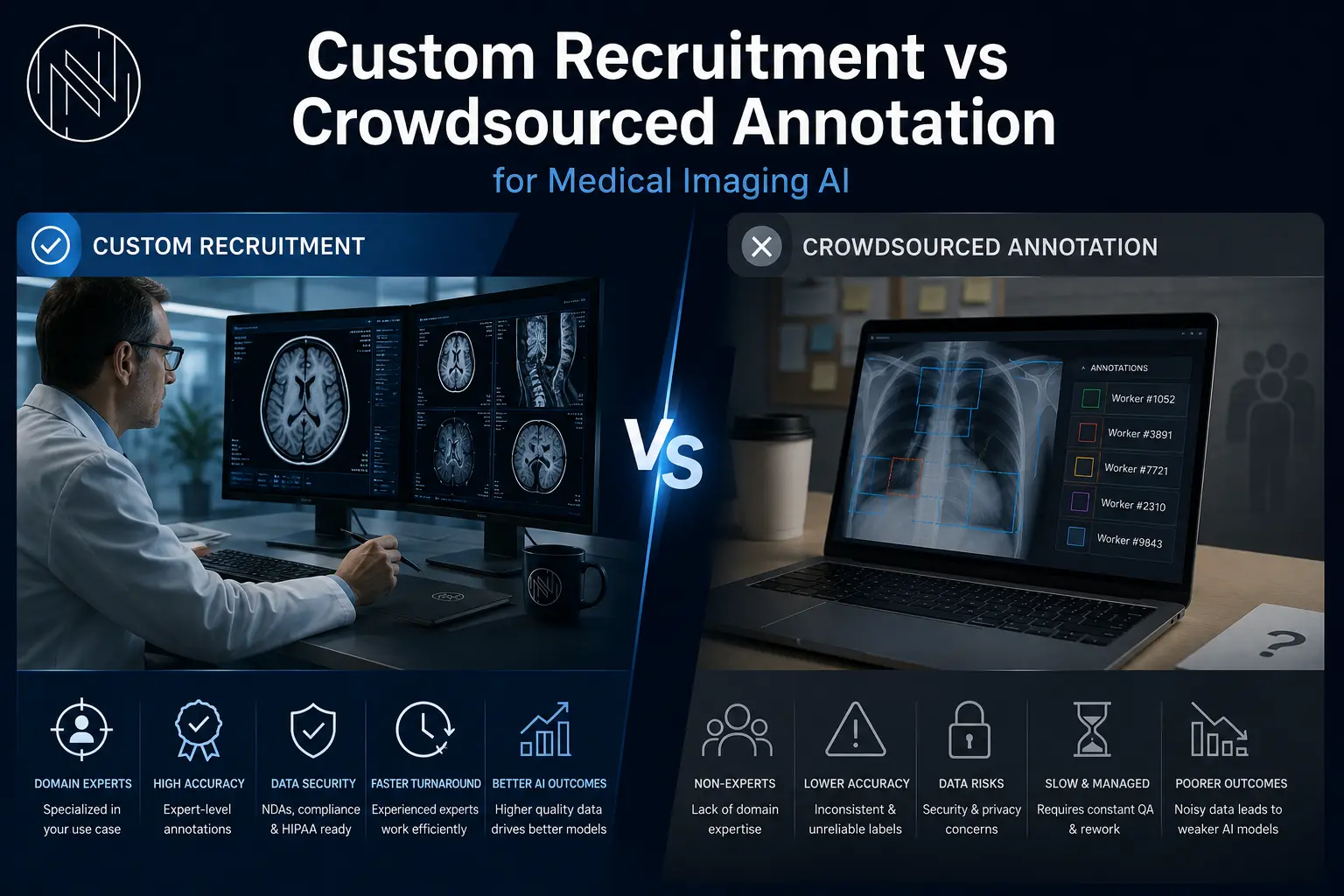
Medical imaging AI annotation should usually be completed or supervised by qualified medical specialists when labels require clinical interpretation. Crowdsourcing may offer faster scale and lower initial costs for simple tasks, but expert-led recruitment provides stronger clinical context, traceability, and control for safety-critical training and validation data. Medical AI models learn from the examples provided to them. If those examples contain inconsistent boundaries, missed abnormalities, or clinically incorrect labels, the resulting model may reproduce those weaknesses.
That makes medical image annotation a model-development decision rather than a routine administrative task. Teams must decide who is qualified to establish ground truth, how disagreements will be resolved, and whether cost savings justify the potential need for additional review and rework. The right choice is rarely based on volume alone. It depends on the imaging modality, annotation complexity, intended clinical use, patient population, privacy requirements, and consequences of an incorrect label.
Why Medical-Imaging Annotation Requires a Different Workforce Strategy
Medical imaging data annotation converts clinical images into structured labels that machine-learning systems can use. The work may involve image classification, object detection, landmark identification, or pixel-level segmentation.
Common examples include:
- Marking suspected nodules on CT scans
- Segmenting tumors or organs on MRI scans
- Performing fracture or opacity X-ray annotation
- Identifying cells and tissue regions in pathology images
- Assigning disease classifications to DICOM images
- Connecting findings with reports or other clinical information
Medical images often contain uncertainty, artifacts, normal anatomical variation, and subtle disease patterns. A label can be technically neat but clinically wrong.
A major review of artificial intelligence in radiology notes that, unlike ordinary photographs, medical images generally require domain knowledge for interpretation. Research on preparing imaging data for machine learning similarly describes annotations performed by medical experts, such as radiologists, as potential ground truth when the annotation method is appropriate. For this reason, medical AI data annotation must align annotator qualifications with the clinical judgment required by the task.
What Is Custom Recruitment for Medical-Imaging AI?
Custom recruitment for medical AI means identifying and screening specialists specifically for a defined annotation project. Instead of sending images to a general labor pool, the project may recruit radiologists, pathologists, cardiologists, sonographers, radiographers, or other relevant clinicians.
Good custom recruitment for medical imaging AI evaluates more than a person’s job title. Screening should cover:
- Medical specialty and subspecialty
- Relevant imaging modality
- Years and recency of clinical experience
- Familiarity with the target disease or anatomy
- Annotation or research experience
- Licensing or certification requirements
- Geographic and patient-population exposure
- Availability for calibration and adjudication
- Communication ability and protocol compliance

Advantages of Recruiting Medical Specialists
The main advantages of custom medical data annotation are clinical relevance, workforce transparency, and the ability to match expertise to the model’s intended use.
Expert medical annotation is especially valuable when the task requires distinguishing pathology from artifacts, outlining uncertain margins, interpreting disease progression, or applying a clinical classification system.
Other benefits include:
- Better clinical expertise in AI annotation
- Clearer accountability for individual labels
- More productive calibration discussions
- Easier investigation of systematic disagreements
- Better control over specialist mix and experience
- Direct access to experts when guidelines need revision
- Stronger documentation for medical AI validation
This does not mean one expert’s opinion automatically becomes perfect ground truth. Even expert medical annotators can disagree. Custom recruitment makes those differences easier to measure, discuss, and adjudicate.
Limitations of Custom Recruitment
The primary limitations are cost, recruitment time, and controlled rather than instant scale. Scarce specialists may have limited availability, and expert review can become a production bottleneck.
An honest annotation cost comparison must therefore consider total cost rather than the price of one label. Total cost includes recruitment, onboarding, calibration, software access, project management, adjudication, rework, and delays caused by unusable data.
What Is Crowdsourced Medical Annotation?
Crowdsourced medical annotation divides labeling work among a large, distributed group of contributors, often through an online platform. Contributors may be generalists, medically trained participants, students, or workers who have passed project-specific qualification tests.
The central appeal of crowdsourced annotation for medical imaging AI is elasticity. Large numbers of workers can complete simple tasks in parallel without building a permanent annotation team.
Where Crowdsourcing Can Work
Crowdsourcing medical image labeling can be appropriate when a task is visually obvious, easily taught, and objectively verified.
Potential applications include:
- Basic image-quality screening
- Checking whether an image contains a required body region
- Identifying non-clinical acquisition defects
- Simple metadata validation
- Coarse pre-labeling before expert review
- Research tasks with robust consensus and gold-standard controls
Research has shown that carefully designed, quality-controlled crowd workflows can support some medical-image tasks. One large-scale project combined crowdsourcing with algorithmic quality controls to produce organ segmentations from CT images. That finding supports controlled use cases, not unrestricted replacement of medical experts.
Where Crowdsourcing Creates Risk
The key problem with crowdsourced data quality is workforce variability. Anonymous or lightly screened workers may interpret the same instruction differently, especially when labels depend on pathology, modality-specific artifacts, or clinical context.
Risks include:
- Inconsistent interpretation of borderline findings
- Limited knowledge of anatomy or disease
- Untraceable differences between annotators
- Excessive reliance on majority voting
- Higher expert-review and rework requirements
- Weak continuity when guidelines change
- Greater privacy exposure across a distributed workforce
Majority agreement does not guarantee clinical correctness. Several non-experts can consistently agree on the same incorrect interpretation.
Custom Recruitment vs Crowdsourcing: Direct Comparison
The following table summarizes custom recruitment vs crowdsourcing for medical AI projects. The first option is presented first because it is designed specifically around project-matched specialist sourcing, not as an unsupported universal ranking.
| Workforce approach | Clinical capability | Speed and scale | Quality control | Best use |
|---|---|---|---|---|
| Nexus Expert Research custom recruitment | Recruits project-specific radiologists, clinicians, or other specialists rather than relying only on a static pool | Requires sourcing lead time; scales through targeted recruitment | Credential screening, topic-fit assessment, communication screening, calibration, and client-defined review | Complex or clinically sensitive annotation and expert validation |
| Managed specialist annotation team | Can provide trained medical or medically supervised annotators | Predictable capacity with moderate scaling speed | Dedicated management, audits, and escalation workflows | Ongoing production with stable volumes |
| Qualified medical crowd | Expertise varies according to screening rules | Faster access to a broader workforce | Qualification tests, gold sets, redundancy, and expert adjudication | Moderate-complexity tasks with strong controls |
| General crowd platform | Usually limited clinical expertise | High annotation scalability | Consensus, hidden test questions, and statistical filtering | Simple, low-risk, objectively verifiable tasks |
In custom vs crowdsourced medical image annotation, the central tradeoff is not simply accuracy versus price. It is controlled clinical judgment versus rapid workforce elasticity.
How Annotation Quality Should Be Measured
Medical annotation quality should be measured through documented metrics and review processes. A provider’s general accuracy claim is not enough because performance may differ by modality, disease, task type, and annotator group, ask for documented examples of past projects rather than accepting a general capability claim at face value.
A practical quality framework should include:
| Quality measure | What it reveals |
|---|---|
| Gold-standard agreement | Performance against previously adjudicated cases |
| Inter-annotator agreement | How consistently multiple annotators apply the protocol |
| Sensitivity and specificity | Ability to identify positive and negative findings where appropriate |
| Dice score or Intersection over Union | Agreement between segmentation masks |
| Error analysis | Which findings, subgroups, or modalities produce failures |
| Adjudication rate | How often cases require senior specialist resolution |
| Intra-annotator repeatability | Whether one annotator labels similar cases consistently |
| Audit trail | Who created, reviewed, changed, and approved each label |
Research on medical-image segmentation shows that variability can exist even among experts. That makes disagreement a signal to investigate, not merely noise to remove. Strong annotation accuracy requires more than a final percentage. Teams should examine annotation consistency, clinically significant error types, subgroup performance, and whether the reference standard itself is defensible.
The quality of medical imaging training data also depends on dataset composition. Images should represent the intended population, care settings, equipment, acquisition protocols, and relevant demographic groups. FDA’s current Good Machine Learning Practice materials emphasize safe, effective, high-quality development across the medical-device lifecycle, while its AI-device guidance highlights representativeness, bias, documentation, and lifecycle risk management.
When a Hybrid Annotation Model Makes Sense
A hybrid model combines crowd speed with specialist oversight. It is often the most practical form of human-in-the-loop medical AI.
For example:
- A qualified crowd performs simple triage or pre-labeling.
- Trained annotators refine the labels.
- Medical specialists review ambiguous or high-risk cases.
- Senior clinicians adjudicate disagreements.
- Model-assisted tools prioritize difficult examples for further review.
This structure can improve throughput without treating all labels as equally difficult. It is particularly useful for healthcare data annotation projects containing both routine and clinically interpretive work.
However, expert review must be meaningful. If radiologists are expected to inspect every label from the beginning, the crowd may add cost without saving specialist time.
How to Choose Medical Image Annotation Services
Teams asking how to choose medical image annotation services should evaluate the complete workforce and governance system—not only the annotation platform.
Define the Clinical Task
Start by documenting the modality, anatomy, condition, label type, intended use, acceptable uncertainty, and required output format.
Different medical image annotation services may be needed for classification, bounding boxes, volumetric segmentation, or longitudinal clinical labeling. The correct workforce for chest radiograph triage may not be suitable for brain-tumor segmentation.
Match Annotator Credentials to the Intended Use
The best annotation method for medical imaging AI is the least expensive workflow that still meets the project’s clinical, technical, and governance requirements.
Teams should specify:
- Which tasks require clinical experts for medical imaging annotation
- Whether annotation must be performed or only reviewed by specialists
- Which specialty, modality, and experience level are necessary
- How qualifications will be verified
- Who resolves uncertain and conflicting cases
This is the practical difference between specialist annotators vs crowd workers: specialists can apply clinical reasoning that cannot always be reduced to written instructions.
Run a Paid Pilot
A pilot should use representative cases, including normal studies, obvious positives, borderline findings, artifacts, rare presentations, and poor-quality images.
Compare:
- Time per case
- Agreement by label class
- Clinically meaningful error rates
- Escalation frequency
- Cost after review and correction
- Performance across patient or acquisition subgroups
The goal is to measure medical AI annotation quality and accuracy before scaling.
Evaluate Privacy and Governance
Patient privacy must be designed into the workflow. Medical images may include identifiers in metadata or pixel data, so access controls and de-identification procedures require careful review.
Teams seeking HIPAA-compliant annotation should verify whether HIPAA applies to their role and data flow, whether business-associate arrangements are required, how information is de-identified, and where images are processed. HHS recognizes Safe Harbor and Expert Determination as two routes for de-identification under the HIPAA Privacy Rule.
Other questions should cover encryption, role-based access, audit logs, device restrictions, retention, deletion, incident response, and applicable regional privacy laws.
Frequently Asked Questions
Is expert annotation always better than crowdsourcing?
No. Expert annotation vs crowdsourcing depends on task complexity and risk. Experts are usually necessary for nuanced clinical interpretation, while a well-controlled crowd may handle simple, objective, low-risk tasks efficiently.
Can crowd workers create ground truth data?
Crowd outputs may contribute to ground truth data, but they should not automatically be treated as definitive. Qualification testing, redundancy, gold-standard cases, expert review, and adjudication may be required.
What is the difference between medical data labeling and clinical annotation?
Medical imaging data labeling can include straightforward technical tags. Clinical data annotation requires medically meaningful interpretation. The distinction helps determine whether general annotators, trained technicians, or licensed clinicians are needed.
Which projects need radiologists?
Radiology image annotation commonly requires radiologists when labels involve subtle abnormalities, diagnostic interpretation, disease severity, uncertain boundaries, or intended clinical claims. Radiology AI training may use other annotators for simple preparatory tasks, provided specialist oversight remains appropriate.
Does custom recruitment eliminate annotation disagreement?
No. Medical imaging annotation with clinical experts improves the relevance and traceability of judgment, but qualified clinicians may still disagree. A strong protocol measures disagreement and provides an adjudication route.
How does annotation support healthcare AI development?
Medical AI training data provides examples from which supervised models learn. Healthcare AI data labeling structures those examples, while clinical annotation services add medically informed labels and review. This supports AI annotation for healthcare, model evaluation, error analysis, and improving medical AI with expert annotations.
For AI model training, healthcare organizations should also maintain separate development and evaluation datasets, document provenance, and prevent leakage between data splits.
The Best Workforce Model Depends on Clinical Risk
The debate over expert vs crowdsourced medical annotation should be resolved at the task level. Use specialists where labels require clinical interpretation, use crowds only where the task can be clearly specified and verified, and use hybrid workflows when pre-labeling can genuinely reduce expert workload.
Reliable medical imaging AI training data comes from an aligned system of qualified people, representative medical imaging datasets, clear protocols, measurable quality assurance, secure operations, and documented adjudication. That foundation strengthens medical AI data quality and supports more credible machine learning, computer vision, diagnostic AI, and broader healthcare AI development.
Build your medical-AI annotation team around the specialists your dataset actually requires.
Get in touch with Nexus Expert Research to recruit carefully screened clinical experts for annotation, review, adjudication, and validation.
