
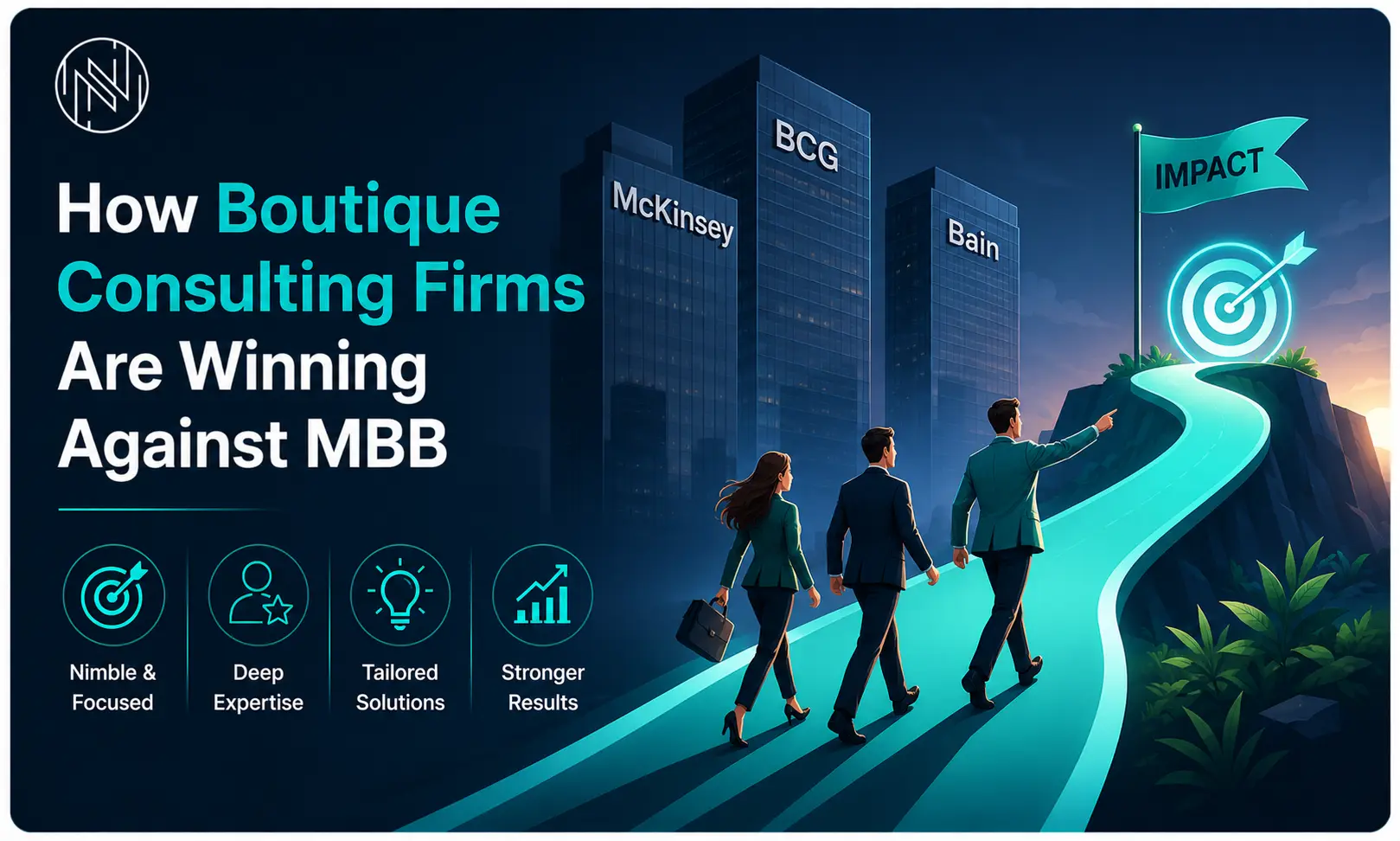
How Boutique Consulting Firms Are Winning Against MBB
Boutique consulting firms are outcompeting McKinsey, Bain, and BCG by delivering what MBB structurally cannot: hyper-specialization, principal-led execution, faster turnaround, and dramatically lower cost. Rather than pricing projects at $500K–$2M with junior-heavy teams, boutiques put senior sector experts on every deliverable from day one. In 2026, as MBB contracts and AI equalizes analytical output, the boutique model is winning mandates it was once locked out of entirely.
How Boutique Firms Are Reshaping the Consulting Industry
For decades, the consulting hierarchy was clear. McKinsey, Bain, and BCG the MBB consulting firms set the gold standard for strategy advice. If your company could afford them, you hired them. If you couldn’t, you settled for less.
That logic no longer holds. A structural shift is underway. Clients are questioning the value of million-dollar generalist engagements when a senior specialist can deliver comparable, often superior outcomes at a fraction of the price. Startups, VCs, private equity firms, and growth-stage businesses are increasingly turning to boutique vs. big consulting firms comparisons before signing a single mandate.
The result? Boutique strategy consulting is experiencing its fastest growth in a decade, carving out market share across healthcare, pricing, restructuring, M&A, and AI-native verticals that MBB’s generalist model was never designed to win. This article breaks down exactly how that is happening with data, firm comparisons, and a clear framework for choosing the right model.
What Boutique Consulting Firms Actually Are (And Why They Are Different)
Boutique consulting firms are smaller, independent practices that focus on a specific industry vertical, functional area, or type of engagement rather than offering the broad, multi-service model of MBB or the Big Four.
The key distinction is not size, it is focus. Where McKinsey builds generalist teams that learn your sector as the project unfolds, a boutique firm has spent a decade inside it. A healthcare boutique has executed dozens of drug-launch strategies. A pricing specialist has benchmarked hundreds of pricing architectures across your exact customer segment. That sectoral depth is the foundation of consulting firm specialization and it is what clients are now paying for explicitly.
Specialized consulting firms operate across nearly every industry: life sciences, financial services, economic litigation, M&A advisory, pricing strategy, organizational design, technology, and more. Their business model is built around owning a niche with enough depth to beat any generalist, regardless of brand.
The Numbers Behind Boutique Consulting Growth in 2026
The data makes the boutique consulting growth 2026 story concrete. The global management consulting market was valued at approximately $358 billion in 2025 and is projected to reach $375 billion in 2026, growing to $471 billion by 2031 at a 4.7% CAGR (Mordor Intelligence). The U.S. market alone stands at $132 billion in 2026. That is a large and growing market and it is fragmenting rapidly.
The top five firms hold roughly 40% of global revenue. The remaining 60% is distributed across thousands of boutiques, independents, and specialists. Independent consulting firms are a major force in that segment: in the UK alone, independents represent approximately 10% of the $13 billion consulting sector. Globally, the freelance consulting economy represents trillions in annual spend.
At the same time, MBB is contracting. McKinsey’s headcount has fallen from a peak above 45,000 to approximately 40,000, with further cuts of up to 10% of non-client-facing roles reported across an 18–24 month window (Bloomberg, 2025). Many of those departing are founding boutique firms bringing MBB pedigree and client networks into leaner, more specialized ventures.
Growth is tracking toward specialists. Source Global Research found in 2024 that 25% of clients were actively seeking new consulting partners, and another 35% were looking to integrate new specialists specifically seeking “expertise not available elsewhere.” The demand signal is clear.
Boutique Consulting vs. MBB: Where the Real Differences Lie
Boutique consulting vs. MBB is not simply a question of size or brand. It is a question of model, incentive, and fit. Four dimensions determine the outcome.
Cost: How Much Are Clients Actually Saving?
A single MBB engagement typically costs $500,000–$1.25 million for a 12-week strategy case, with European partner day rates reaching €5,000–€10,000. For most startups, SMBs, and mid-market companies, that pricing structure is not competitive, it is simply inaccessible.
Boutiques deliver senior strategic work for $50,000–$300,000 depending on scope, at 80–95% lower cost than MBB, without sacrificing quality at the senior level. As the ex-McKinsey co-founder of AI-native boutique Xavier AI put it directly: “99.9% of businesses could never afford McKinsey or any of the MBBs.” Boutiques close that access gap entirely.
Consulting Firm Specialization vs. Generalism: Why Depth Beats Breadth
When a biotech company is out-licensing an oncology asset, a boutique with 40 comparable transactions wins over a generalist team that will spend the first three weeks learning the space on your budget.
In a 2025 survey of pharma business development executives, 78% reported that boutique advisory firms delivered superior outcomes on licensing transactions citing deeper transactional expertise, more senior involvement, stronger practitioner networks, and better-aligned incentive structures.
Boutique consulting competitive advantage is, at its core, an expertise advantage. The generalist model cannot compete when the problem requires sector-specific judgment.
Principal-Led Delivery: Who Is Really Doing Your Project?
At MBB, senior partners appear at kick-off and milestone presentations. Day-to-day execution is handled by first- and second-year analysts learning on your project’s budget. This is not a perception problem, it is a structural feature of the MBB pyramid model. At a boutique, the partner who sold the engagement leads it. Subject matter experts are embedded throughout, not deployed for show. Clients receive senior judgment at every deliverable, not just on the final slide deck.
The Four Competitive Advantages That Make Boutiques Win
The boutique consulting competitive advantage is built on four reinforcing pillars each one addressing a specific failure mode of the MBB generalist model.
- Hyper-Specialization
Boutiques own their vertical deeply with proprietary benchmarks, practitioner networks, and sector-specific frameworks that took years to build. No generalist can replicate that overnight. - Cost Efficiency
Lower overhead, fewer management layers, and leaner teams mean boutiques deliver senior expertise at 20–30% of MBB rates. The savings are structural, not incidental. - Principal-Led Relationships
Senior experts lead every engagement from start to finish. No junior handoffs. No account management layers between the client and the person solving the problem. - Faster, Pragmatic Execution
Less bureaucracy means faster decisions and faster delivery. In markets where a strategic call must be made in days, not months, that speed is a decisive competitive edge.
These four pillars explain precisely why decision-makers, VCs, and PE firms are choosing alternatives to McKinsey, BCG, and Bain for their most critical, time-sensitive mandates.
Top Boutique Consulting Firms in 2026 by Vertical
The top boutique consulting firms 2026 span every high-value sector. These are the specialized consulting firms consistently winning mandates in domains where generalists cannot compete.
| Industry Vertical | Leading Boutique Consulting Firms |
| Healthcare & Life Sciences | Health Advances, Putnam Associates, ZS Associates, Trinity Life Sciences, ClearView Healthcare Partners |
| Pricing Strategy | Simon-Kucher & Partners |
| Restructuring & Turnaround | Alvarez & Marsal, FTI Consulting, Huron |
| M&A Advisory (Middle Market) | Eton Venture Services, Carter Morse & Goodrich |
| Economic & Litigation Analytics | Analysis Group, Cornerstone Research, Charles River Associates |
| Leadership & PE Due Diligence | ghSMART, L.E.K. Consulting, Oliver Wyman |
| AI-Native Consulting | Xavier AI, Perceptis, Slideworks |
These firms are the leading edge of boutique strategy consulting in 2026 and many are directly targeting mandates that MBB once considered locked in. Firms like Analysis Group deploy PhD-level data modeling for complex litigation and economic consulting, delivering output that MBB typically outsources. Healthcare boutiques like Health Advances bring regulatory depth and clinical expertise that no generalist team can match without years of domain experience.
How AI in Consulting Firms Is Reshaping the Competitive Landscape
AI in consulting firms is doing two contradictory things simultaneously: turbocharging MBB revenue and dismantling MBB’s structural moat.
BCG generated approximately $3.6 billion from AI services in 2025 roughly 25% of its $14.4 billion total revenue (BCG, Bloomberg). McKinsey has deployed its internal AI assistant Lilli across approximately 25,000 AI agents, running 500,000+ prompts monthly and delivering up to 30% time savings per consultant. These are significant advantages at scale.
But the same AI tools are available to boutiques.
The “analyst pyramid” , the labor structure that once justified MBB’s pricing, is collapsing. Tasks that required 12–14 junior analysts (market sizing, competitor benchmarking, financial modeling, presentation production) can now be executed by two or three people with AI. AI-native boutiques are built lean from the start, with no legacy overhead to carry.
This transformation is reshaping boutique consulting firm research tools fundamentally. The best boutiques today use AI for analysis and expert networks for primary intelligence, a combination that delivers MBB-quality output at a fraction of MBB cost. It also explains why consulting firm competitive intelligence is moving away from large internal research teams and toward on-demand, expert-network-powered workflows.
Why Startups, SMBs, and VCs Are Choosing Management Consulting Alternatives
For decision-makers at growth-stage companies, the case for management consulting alternatives is structural, not circumstantial. MBB is designed for Fortune 500 problems: enterprise-wide transformations, global regulatory strategy, multi-market operational change. A Series B SaaS company navigating a go-to-market pivot does not need that apparatus. It needs a specialist who knows the exact competitive landscape, pricing dynamics, and channel structure and can move on it immediately.
Niche consulting firms vs. Big 4 comparisons reveal the same pattern consistently: for narrow, high-stakes, domain-specific problems, specialist depth wins. For wide, multi-function implementation programs, generalist scale has advantages. The client’s first responsibility is matching firm type to problem type not defaulting to brand.
This is why independent consulting firms are growing fastest in verticals like technology, healthcare, and financial services, where domain knowledge depreciates quickly and practitioners who have lived inside the industry are worth more than generalists who study it.
The Role of Expert Networks in Boutique Consulting Market Research
Boutique consulting market research runs increasingly through expert networks platforms that provide direct practitioner access for primary research, market intelligence, competitive analysis, and investment due diligence.
Expert networks have become the core boutique consulting firm research tools in 2026. The global expert network market reached approximately $4.2 billion in 2025, growing at a 16% CAGR (Business Research Insights), with consulting firms representing nearly 50% of total industry spend. Primary intelligence what a practitioner who ran the operation knows is what no secondary research or AI model can replicate.
Consulting firm competitive intelligence increasingly runs through these platforms. Buying 5–15 expert calls to pressure-test a market hypothesis before committing to a full strategy workstream is faster, cheaper, and more targeted than commissioning traditional research.
For the boutique consulting vs. MBB comparison, the right expert network can level the playing field entirely.
| Expert Network | Expert Pool | Best For | Pricing Model | Key Strength |
| Nexus Expert Research | Vetted industry specialists | Boutique firms, VCs, SMBs, and PE teams needing flexible, high-quality primary research | Pay-per-engagement (~$650–$900/call, no minimum) | Custom expert sourcing per project, 24-hr matching, flexible compliance framework, zero subscription lock-in |
| GLG (Gerson Lehrman Group) | 900,000–1M+ experts | Large-scale, compliance-heavy, multi-market research | Annual subscription + per-call | Unmatched scale and compliance infrastructure |
| AlphaSights | 500,000+ experts | Fast, well-scoped consulting and PE engagements | Per-project or retainer | Speed and white-glove project management |
| Tegus / AlphaSense | 200,000+ transcripts | Investment research and financial due diligence | Annual subscription | AI-powered transcript library, deep company coverage |
| Third Bridge | 1.5M+ experts | PE and M&A deep dives, sector coverage | Per-call + Forum subscription | Analyst-led Forum transcript library |
| Guidepoint | 1M+ experts | Cost-efficient broad expert access | Annual subscription | Breadth, cost efficiency, global reach |
Nexus Expert Research
Nexus Expert Research is the standout choice for lean boutique consulting teams, VC firms, and SMBs. Where GLG and Guidepoint require annual contracts making economic sense only at high call volumes Nexus delivers custom-matched, vetted practitioners per project with no minimum commitment. Expert matching typically happens within 24 hours. For a boutique firm running 6–10 expert calls around a due diligence or market entry study, that flexible pay-per-engagement model is both more economical and more targeted than a large-network subscription.
How to Choose the Right Consulting Model for Your Business
The decision between boutique consulting firms, MBB, Big Four, and independent consultants comes down to a simple diagnostic: problem type, budget, and timeline.
- Choose MBB when: the problem spans multiple geographies and business functions, board-level brand credibility is a factor, and budget is not a constraint.
- Choose a boutique or specialized consulting firm when: the problem is sector-specific, the decision is time-critical, senior involvement on every deliverable is non-negotiable, and cost efficiency matters. This covers the vast majority of mandates at startups, SMBs, PE-backed companies, and VCs.
- Choose an independent consulting firm when: the scope is tightly defined, you need a single domain expert rather than a team, and you want maximum flexibility.
- Choose an expert network when: you need primary practitioner intelligence to validate a hypothesis, accelerate due diligence, or pressure-test a market entry fast and without a full consulting engagement.
The highest-performing teams in 2026 are combining all four: a boutique for core strategy, an expert network like Nexus Expert Research for primary research, and AI tools for analytical heavy lifting. That integrated stack delivers MBB-quality output at a fraction of the traditional cost. Stop overpaying for intelligence so you can get faster, smarter, and without a subscription.
Nexus Expert Research connects boutique consulting firms, VCs, startups, and SMBs with vetted industry practitioners for primary research, due diligence, competitive intelligence, and market entry studies with no annual contract, custom expert matching within 24 hours, and flexible pay-per-call pricing designed for the way lean, high-performance teams actually work.
