
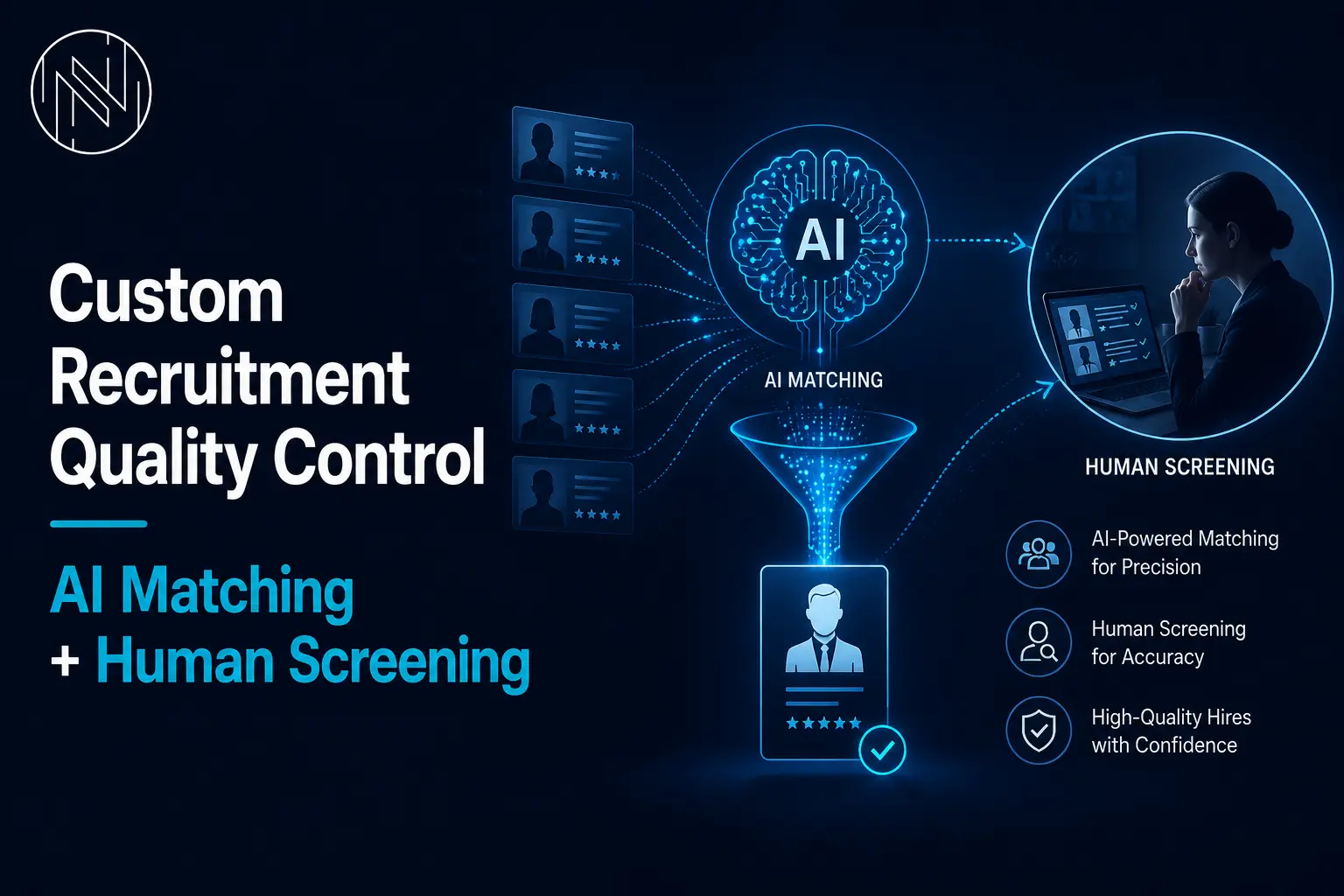
Custom Recruitment Quality Control AI Matching + Human Screening
Custom recruitment quality control works best when AI handles initial matching and humans own the final screening. That blend improves speed, reduces weak-fit candidates, and protects the quality, compliance, and judgement that high-stakes expert sourcing demands.
In 2026, that is no longer just a best-practice preference. Regulators in the UK are actively scrutinising automated decision-making in recruitment, the EEOC continues to treat AI-assisted recruiting and screening as covered by existing anti-discrimination law, and the EU treats many recruitment and candidate-evaluation systems as a high-risk AI use case. In other words, if you use AI to filter or rank people, you still need a process that is explainable, reviewable, and governed.
For decision-makers, VCs, startups, and SMEs, the lesson is simple. Do not ask whether AI should replace people. Ask how each layer should contribute to better decisions. That is the difference between a fast shortlist and a defensible shortlist.
The supplied AI Overview screenshot points to the right structure for this topic. It frames the workflow as two connected systems: a custom AI matching layer for parsing, contextual scoring, and fast triage, followed by a human quality control layer for edge-case review, behavioural validation, and the final call. That framing is exactly right for expert sourcing too, especially when the “candidate” is a specialist you may rely on for primary research, due diligence calls, or niche market validation.
What custom recruitment quality control means for expert sourcing
In this article, recruitment does not only mean hiring employees. It also means sourcing the right external specialists for research, diligence, or advisory conversations. In that setting, expert verification quality depends on whether the provider can identify the right specialist, validate that person’s relevance, and screen out conflicts before the call ever happens.
That is where AI expert matching, human expert screening, and stronger expert quality control come together. The goal is not just to fill a slot. It is to deliver the right subject-matter experts (SMEs) for the right brief, with the right recency of experience, and without avoidable compliance risk.
Strong expert recruitment quality assurance therefore means more than a large database. It means clear rules for candidate identification, precision matching, relevance scoring, depth verification, credential checks, and compliance screening. It also means a documented process for excluding false positives, managing conflict of interest issues, and reducing the risk that anyone shares confidential information or MNPI. Public compliance frameworks from major expert-network providers emphasise exactly these controls, including project-level screening, custom rules, mandatory vetting, and conflict checks.
The smartest buyers now ask for better expert matching accuracy, not just more names. They want a verified expert network that can prove expert match quality through structured, human-in-the-loop screening and disciplined quality control in expert sourcing. That shift is becoming more important as organisations scale AI in recruiting and sourcing while regulators push for transparency, fairness, and meaningful human review.
Where AI expert matching adds speed and precision
AI is genuinely valuable at the top of the funnel. It is well suited to profile parsing, taxonomy mapping, semantic search, and early-stage ranking. Done well, it can organise messy data fast and surface candidates whose titles, industries, functions, geographies, and experience windows map closely to the brief.
That matters because AI systems are especially useful when application or sourcing volume is high. The ICO says automation can help employers process large numbers of applications consistently and quickly, while the Institute of Student Employers reports that 70% of employers expect to increase their use of automation in recruitment over the next five years.
For expert sourcing, the same logic applies. AI can accelerate:
- candidate identification across fragmented public and proprietary sources;
- relevance scoring against a role-specific rubric;
- detection of experience signals such as seniority, function, company type, geography, and tenure;
- recency filters, so outdated profiles do not rank too highly;
- initial routing by likely expert relevance and fit.
This is where a machine often outperforms a person on speed. It can review more signals, faster, and more consistently. NIST’s AI RMF also supports this kind of structured, risk-aware use: organisations should govern, map, measure, and manage AI systems rather than deploy them as opaque black boxes.
But AI matching has obvious limits. It can overvalue proxies that look good on paper and still miss the lived detail that determines whether a person is actually useful on a call. That is how false positives happen. A profile may look perfect because the title matches, while the individual’s direct decision-making exposure, current market context, or communication quality is weak.
This is the core weakness in AI-only sourcing. It can rank relevance signals, but it cannot reliably establish depth, nuance, or judgement on its own.
Why human expert screening is the real quality control layer
Human review is where the process becomes defensible. The human screener checks what the model cannot fully prove: whether the person truly understands the market, can speak clearly to the question, has recent enough operating exposure, and is free of conflicts that make the engagement inappropriate.
This is also where the AI vs human expert vetting debate becomes clearer. AI should narrow the field. Humans should decide whether the match is decision-grade.
The ICO is explicit that human review must be meaningful. Human reviewers should be trained to interpret and challenge AI outputs, senior enough to override them, and expected to consider factors beyond the system’s input data. It also warns that a decision is still “solely automated” if the human simply rubber-stamps it.
That principle matters just as much in expert networks as it does in hiring. A proper screener can test for:
- depth verification beyond headline titles;
- whether credentials and stated experience hold up;
- whether the expert’s strongest experience is still current enough to matter;
- whether the person can offer first-hand insight for primary research rather than generic commentary;
- whether there is any conflict of interest, confidentiality issue, or possible MNPI exposure that should disqualify the match.
The compliance side is especially important. The SEC states that insider-trading violations can involve material, nonpublic information and tipping, while major expert-network providers publicly emphasise project-level controls, conflict checks, and strict confidentiality standards.
| Function | AI layer does best | Human layer does best | If skipped, what breaks |
|---|---|---|---|
| Discovery | Rapid candidate identification, semantic search, relevance scoring | Challenge whether the shortlist actually fits the brief | You waste time on volume instead of fit |
| Qualification | Title, tenure, sector, geography, company-pattern matching | Depth verification, credential checks, recency of experience | False positives stay in the pool |
| Risk control | Rule-based flags and watchlists | Conflict of interest review, confidentiality judgement, compliance screening | You expose the project to avoidable risk |
| Final selection | Rank likely matches by known signals | Judge communication quality, expert relevance, and practical usefulness | The “best-looking” match may still be the wrong one |
This division aligns with current regulatory and governance thinking: AI can support decisions, but people must be able to challenge, override, and document the final judgement.
What expert recruitment quality assurance looks like in practice
A practical workflow should be built as a controlled handoff, not a tug-of-war between machine and human judgement.
Start with a structured brief. Define the task, exclusions, desired companies, required seniority, geography, language, and recency window. Then assign weighted selection criteria. That gives the model something useful to score and gives the human reviewer a rubric for challenge.
Next, let AI generate a first-pass shortlist. This is where precision matching helps teams move quickly, especially when the brief is niche or the deadline is tight.
Then apply a human screening layer that asks the questions an algorithm cannot resolve confidently:
- Has this person actually done the thing we need insight on?
- Is the knowledge recent enough to support current-market decisions?
- Can they speak to the brief in specifics, not generalities?
- Are there any legal, ethical, or project-specific reasons to exclude them?
After that, run compliance and documentation checks. The ICO stresses that buying AI from a third party does not remove the buyer’s legal responsibility, and it recommends due diligence on suppliers, documented responsibilities, and pre-deployment assessments. That principle applies directly to expert sourcing platforms as well: software does not outsource accountability.
Finally, capture outcome data after the engagement. The most useful quality-assurance loop measures:
- shortlist-to-acceptance rate;
- expert show rate;
- call usefulness score;
- disqualification reasons;
- repeat-use likelihood;
- challenge rate from clients or internal stakeholders;
- post-call assessment of match accuracy.
Those feedback loops matter because AI systems and sourcing rubrics both drift over time. NIST notes that AI risks and trustworthiness change with context, deployment, and evolving data, which is why risk management should be ongoing rather than one-off.
How buyers should assess provider fit and expert matching accuracy
For a buyer, the right question is not “Who has the biggest network?” It is “Who can show a process that produces cleaner matches under real project constraints?”
You should therefore ask providers how they source beyond their static database, how they verify current experience, how they document exclusions, how they handle compliance checks, and how they escalate edge cases. The best answers are operational, not promotional.
An illustrative way to compare public positioning for this use case is below. The row order reflects fit for bespoke, QC-heavy projects rather than a universal market ranking.
| Provider | Publicly visible strengths for bespoke, compliance-sensitive expert sourcing |
|---|---|
| Nexus Expert Research | Recruit-from-scratch model, compliance and expert vetting, NDA and confidentiality controls, 120k+ warm experts, fit-for-purpose specialist panels, and AI-moderated interviews |
| Guidepoint | 2M+ vetted experts, targeted outreach for precise study criteria, transparent sourcing, expert verification, third-party background checks, and project-level compliance controls |
| GLG | Strong public emphasis on verification, behavioural data, third-party data sources, mandatory compliance screening, and a human-led, AI-in-the-loop workflow |
| AlphaSights | Large global operating model, proprietary knowledge graph built on 25 million+ expert-company relationships, precise machine-assisted matching, and a comprehensive compliance programme |
The pattern across the market is telling. The strongest public positioning is no longer “we have many experts.” It is “we can prove why this expert fits, why this interaction is safe, and how the process stands up under scrutiny.” That is exactly what modern buyers should reward.
The winning model, then, is not AI-only and not human-only. It is machine-led discovery, human-led judgement, documented controls, and continuous feedback. That is how match accuracy becomes trustworthy enough for real decisions.
If you need expert matches that are fast, defensible, and actually relevant, Nexus Expert Research can help you turn a hard brief into a cleaner shortlist.
Book a discovery call to build a recruitment quality-control process that strengthens expert relevance, reduces screening risk, and gets better insight to the table faster.
