
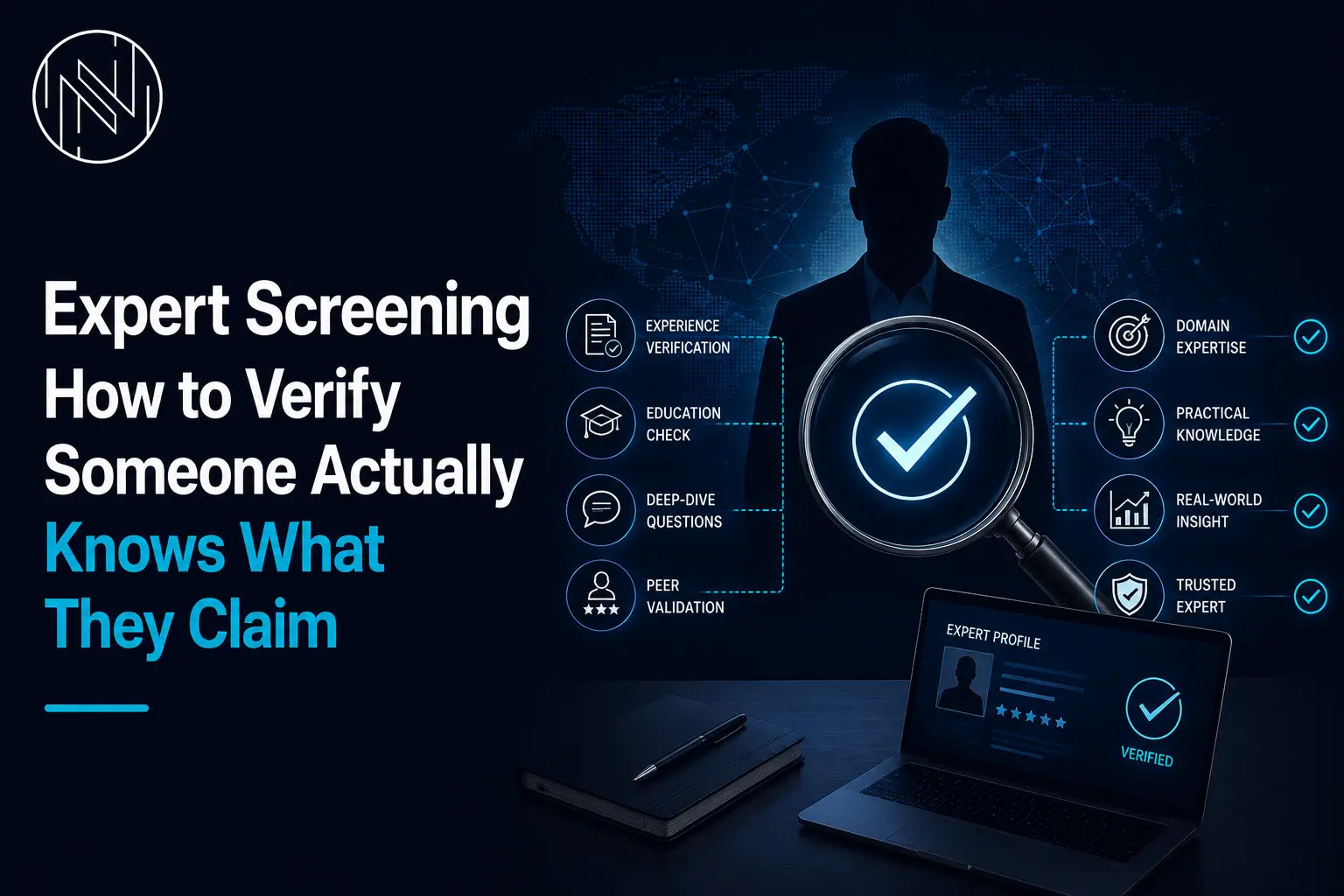
Expert Screening How to Verify Someone Actually Knows What They Claim
A reliable expert screening process does not try to prove that someone sounds impressive. It proves that the person has genuine, recent, relevant experience, can explain that experience clearly, and can participate without creating legal or compliance risk. Major expert-network providers publicly emphasise screening for relevance, background, conflicts, and confidentiality for exactly this reason.
Decision makers, VCs, startups, and mid-sized businesses increasingly rely on subject-matter experts (SMEs) for primary research, due diligence calls, market-entry work, product decisions, and competitive intelligence. But the commercial value of expert insight depends on one thing first: whether the expert is actually the right expert. A polished profile, a strong title, or a large LinkedIn following is not enough. The smarter question is how to verify an expert before you spend budget, time, and credibility on the call.
What a strong expert screening process should prove
A strong expert vetting process should answer five questions fast. Is the person real? Are their credentials legitimate? Is their experience directly relevant to the brief? Is that experience recent enough to matter? And are there any conflicts, employer restrictions, or confidentiality issues that make the engagement unsafe? Public guidance on evaluating information often comes back to the same factors: currency, relevance, authority, accuracy, and purpose. That logic works just as well for expert screening as it does for source evaluation.
This matters because real expertise is not just a collection of facts. It also includes tacit knowledge: practical judgement that professionals use in real work, often without fully writing it down. Research on tacit knowledge describes it as implicit knowledge used to guide everyday practice. That is why real experts can usually explain trade-offs, edge cases, failure modes, and what changed over time, while weak experts stay at the level of buzzwords.
In practice, a sound process should test both depth and breadth. Some experts offer broad leadership context, while others offer deep functional or technical experience. The right match depends on the question. If the brief is highly specific, depth usually matters more than prestige. Guidepoint, for example, explicitly distinguishes between broad leadership context and deep subject-matter expertise, and shows employment history, functional expertise, project-specific screening responses, and years of experience so buyers can confirm fit before a consultation.
How to verify an expert before a paid call
The simplest way to think about verifying expertise before a call is to split the work into three checks: credential verification, relevance verification, and compliance verification. Each one screens a different risk. Together, they make vetting subject-matter experts much more defensible.
Check credentials, education, and licences
Start with expert credential verification. If the expert claims a degree, certification, or regulated qualification, verify it through an authoritative source rather than taking the CV at face value. In the United States, the Department of Education maintains recognised accreditation references, and the National Student Clearinghouse provides degree and attendance verification services. Professional bodies may also provide public certification directories, as SHRM does for its credential holders.
This step matters because fake credentials are still a real business risk. The FTC has long warned employers about “diploma mills” and highlights classic warning signs such as out-of-sequence degrees, unusually fast degrees, or academic claims that do not line up with a person’s work location and timeline. The Department of Education likewise warns that not every institution is what it appears to be and advises users to check recognised accreditation.
Confirm employment history, role scope, and recency
Next comes employment verification and expert relevance screening. The question is not just, “Did they work there?” It is, “Did they own the decision, influence it, or observe it first-hand?” Publicly described expert-network workflows increasingly expose employment history, role background, project-specific screening responses, and years of experience so teams can confirm fit before booking time.
This is where recency of experience becomes critical. A former head of procurement who left the category six years ago may still be valuable for structural context, but not for fast-moving pricing, vendor, channel, or regulatory shifts. For market diligence, product strategy, or customer research, always test company exposure, geography, function, seniority, and time window. That is the practical core of how to verify an expert: you are matching the person to the actual decision, not to a flattering biography.
Run a conflict of interest and compliance screen
The third step is a conflict of interest check and broader compliance screening. This is non-negotiable for investor research, healthcare, regulated sectors, public-company topics, and any brief where confidential data may surface. SEC guidance states that illegal insider trading includes trading or tipping on material, nonpublic information, and Regulation FD is designed to prevent selective disclosure of material non-public information.
That is why high-quality screening asks about employer restrictions, competitor restrictions, board seats, consulting obligations, access to sensitive information, and public-company conflicts. GLG states that employed experts are prohibited from participating in projects about their employer and that clients can require pre-approval consultations, custom screening questions, and attestations. AlphaSights states that 100 percent of experts are background checked before any interaction and that its compliance programme is supported by 60-plus legal and compliance professionals.
What to ask on expert verification calls
Good expert verification calls are short, structured, and designed to validate fit before the substantive interview begins. The goal is not to extract the whole answer for free. The goal is to determine whether the person has the right firsthand knowledge, enough communication clarity, and the right boundaries for the assignment. Public guidance from Harvard Business School recommends open-ended and follow-up questions, while investigative interviewing research shows that interviews should begin with open narrative prompts and then move into clarification and verification.
Use screening questions for experts that force concrete recall rather than abstract opinion. Examples include:
- Walk me through the last time you made this decision in-role.
- Which KPIs or constraints mattered most?
- Who else influenced the outcome?
- What changed in the market over the last 12 months?
- Which parts of this topic can you not discuss because of confidentiality or employer policy?
These questions work because they test tacit knowledge, recency of experience, and expert relevance at the same time. Someone with genuine operating experience can usually explain process, trade-offs, terminology, exceptions, and what has changed. Someone relying on résumé padding usually stays generic.
A documented screening rubric makes these calls more consistent. Score the expert across identity, credentials, employer history, role relevance, time relevance, communication quality, and compliance risk. Then save that record. Structured and auditable workflows are not just operationally cleaner; they also create an audit trail for future reviews, repeat projects, and internal compliance checks. GLG describes its framework as structured, auditable, and transparent, while Guidepoint emphasises project tracking, transcripts, reporting, and configurable approval layers.
| Screening criterion | What you are testing | Pass standard | Suggested evidence |
|---|---|---|---|
| Identity and background | Is the person real and professionally traceable? | Consistent public footprint and employer history | Company page, professional profile, official email, biography |
| Credential verification | Are education and certifications real? | Degrees/certs verified through recognised sources | Department of Education accreditation checks, National Student Clearinghouse, certification directory |
| Relevance | Does the expert fit this exact brief? | Direct exposure to the decision, market, function, or workflow | Project-specific screening responses, years of experience, company exposure |
| Recency | Is the knowledge current enough? | Recent role exposure within the market window you need | Role dates, recent employer or operating ownership |
| Compliance | Can the call happen safely? | No access-driven conflict, employer restriction, or MNPI risk | Attestations, employer-policy review, pre-call briefing |
Fake expert red flags that decision makers should not ignore
The easiest way to spot fake expert red flags is to look for mismatches. A mismatch between claim and evidence. A mismatch between title and actual decision ownership. A mismatch between confidence and specificity. A mismatch between stated credentials and independently verifiable records.
Typical warning signs include vague answers to simple workflow questions, no clear timeline for when the experience happened, inflated job titles, inconsistent company history, and academic claims that cannot be verified through recognised channels. On the education side, the FTC specifically flags suspicious degree progression and implausibly fast degrees. On the experience side, profiles that cannot survive employment verification or project-specific questioning should be treated as risk, not as “close enough”.
Another red flag is poor boundary awareness. Reliable experts usually know where the lines are. They can say what they know, what they do not know, and what they cannot discuss. That matters because strong compliance behaviour is part of real expertise in regulated or sensitive fields. If someone seems eager to discuss confidential details, current employer secrets, or market-moving non-public information, the problem is not just quality. It is a liability.
A practical screening workflow for VCs, startups, and SMBs
For lean teams, the smartest approach is not to build a huge process. It is to build a repeatable one. Start with a written brief. Define the exact decision you are trying to inform. Then list the must-have criteria: company type, function, geography, seniority, recency, and exclusions. After that, run a short pre-call briefing, a relevance screen, a compliance screen, and a pass/fail decision. Document everything in one place.
If you prefer a custom-first sourcing model rather than a static panel approach, Nexus Expert Research publicly positions itself around custom recruitment, compliance and expert vetting, NDA and confidentiality, due diligence support, and a network of 120,000-plus warm experts across 12 core verticals. Its published workflow also emphasises recruiting from scratch for each engagement, screened delivery, and one-to-one expert interviews designed to uncover the “why” behind the data.
Use the comparison below as an evaluation aid. It is not a universal ranking. It is a buyer-side view of how several providers publicly describe their screening and compliance signals as of July 2026.
| Provider | Publicly stated screening and compliance signals | Best fit by brief type |
|---|---|---|
| Nexus Expert Research | Custom recruitment, compliance and expert vetting, NDA and confidentiality, screened delivery, due diligence support, 120,000+ warm experts across 12 core verticals | Niche briefs, custom outreach, fast-turn primary research, diligence-heavy work |
| GLG | Structured and auditable compliance framework, annual terms and training, profile questions, custom screening questions and attestations, employer restrictions, employed experts barred from projects about their employer | Regulated research environments, large compliance-heavy programmes |
| AlphaSights | 100% experts background checked before interaction, 60+ legal and compliance professionals, algorithmic and human risk review | Large-scale fast matching with strong compliance emphasis |
| Guidepoint | 2M+ vetted experts, employment history, functional expertise, project-specific screening responses, configurable compliance centre, transcripts and reporting | Teams that want platform visibility, searchable transcripts, and configurable workflows |
Final takeaway on verifying expertise before a call
The best answer to verifying expertise before a call is simple: do not screen for prestige, screen for proof. Run credential verification, employment verification, expert relevance screening, and compliance screening before the paid call begins. Then use short verification calls, a pre-call briefing, and a repeatable screening rubric to decide whether the person is truly qualified.
When done well, expert screening improves far more than call quality. It protects your budget, sharpens primary research, reduces false confidence, lowers legal risk around MNPI and public-company conflicts, and creates a defensible audit trail for future diligence.
Need sharper expert calls and fewer screening mistakes? Nexus Expert Research helps teams source, verify, and brief the right experts so every conversation starts with relevance, compliance, and confidence.
