
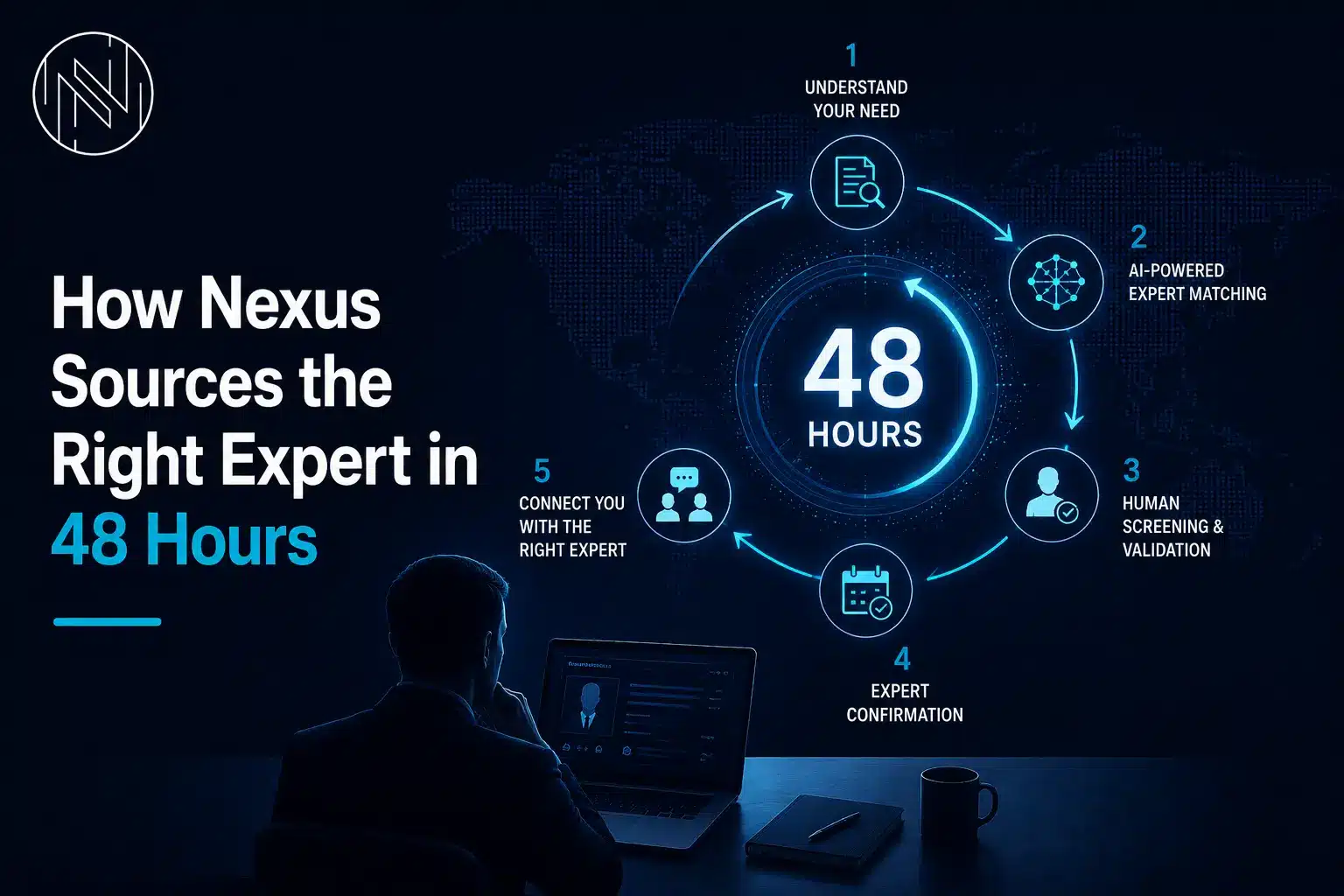
How Nexus Sources the Right Expert in 48 Hours
The Nexus process is built for speed because it combines recruiter-led custom sourcing, structured screening, and built-in compliance before an introduction is made. Public service pages say recruitment begins within 24 hours of brief sign-off, the homepage highlights average turnaround under 24 hours for some briefs, and the expert-network workflow describes a typical brief-to-first-call window of 24 to 72 hours, which makes a 48-hour positioning credible when framed as a practical target for niche briefs rather than an unconditional guarantee.
Decision-makers rarely need a giant directory. They need the right operator, buyer, former executive, or technical specialist fast enough to affect a live decision. That is why fast expert recruitment works best when the workflow is built around primary research, access to subject-matter experts (SMEs), precise scoping, active outreach, and disciplined screening instead of passive profile matching or open panels. Public expert-network pages describe the core job in similar terms: source the right person for a specific question, vet for credibility and compliance, and manage the engagement end-to-end.
What Makes Fast Niche Expert Recruitment Possible
48-hour expert sourcing becomes realistic when the process removes the usual bottlenecks early. The brief must be specific, the search must be human-led, and compliance has to run in parallel with sourcing rather than after the shortlist is built. The official pages behind this article repeatedly stress those same levers: define the profile clearly, recruit to spec, screen before delivery, and handle scheduling, NDAs, and logistics centrally.
That is also why rapid expert sourcing is not the same as normal hiring. Full-cycle recruiting usually runs from preparation to sourcing, screening, interviewing, offering, and onboarding. Expert recruitment compresses the middle of that workflow because the goal is insight, not employment. In practice, it stops at a compliant conversation, moderated interview, panel, or written Q&A rather than continuing into an offer stage.
For that reason, the real measure is not “how many profiles can be sent” but whether the team can improve expert recruitment turnaround time without lowering quality. A strong model protects speed by narrowing the ask, searching for current or highly relevant operators, and checking fit before the client spends time reviewing names. That is the logic behind a recruiter-led rather than database-led system.
How the Nexus Process Works from Brief to Call
The clearest way to explain how expert recruitment works is to follow the workflow from the first brief to the first qualified conversation. Public process pages describe a tightly managed path: define the brief, run a custom recruit, vet profiles, deliver a shortlist, schedule the engagement, and support synthesis after the call.
Start with a Precise Brief
Every strong custom expert recruitment process starts with scope discipline. The client defines the question, the industry, geography, seniority, functional background, and any companies or competitors to include or exclude. That precision matters because sourcing quality rises when the recruiter is matching against a real decision, not a vague job title.
Source Against the Question, Not Just the Title
This is where recruiter-led expert sourcing changes the outcome. Instead of relying only on static, self-registered profiles, the recruiter uses the brief to run custom outreach and, when needed, fresh recruiting beyond standard database coverage. The public materials describe this as recruiting from scratch for each engagement, custom outreach with no guesswork from a static database, and targeted direct outreach when the requirement exceeds standard coverage.
That sourcing pattern is especially helpful for niche expert recruitment because niche briefs often fail when a database has broad titles but not the right decision context. A former country manager who built distribution in the target market, a procurement lead who handled the relevant category, or an operator who recently managed the exact workflow will usually outperform a generic “industry expert” on call quality. That is why public expert-network pages emphasize matching to the specific question and sourcing new candidates for niche topics.
Screen for Credibility, Compliance, and Fit
Once candidates are found, the work shifts to the expert screening process and expert vetting process. Official pages describe checks on professional experience, verifiable credentials, role relevance, employer restrictions, and conflicts before a profile is presented. The goal is not just to prove that the person is senior. It is to confirm that they are relevant to the exact commercial question being asked.
Coordinate the Call and Turn Conversations into Usable Insight
After vetting comes shortlist delivery, scheduling, compliance reminders, and the live engagement itself. Depending on the project, that can mean one-to-one calls, moderated interviews, panels, or written follow-up. Public pages also describe transcripts, summaries, comparative analysis, and thematic synthesis after the conversation, which is important for teams that want more than raw notes.
The workflow below synthesizes the public process material into a retrieval-friendly view.
| Stage | What happens | Why it matters | Practical timing signal |
|---|---|---|---|
| Brief definition | Clarify sector, geography, seniority, exclusions, research objective | Reduces mismatch and improves shortlist quality | Can begin immediately after scope confirmation |
| Custom sourcing | Run custom recruitment using verified network plus fresh outreach where needed | Improves fit on rare profiles and emerging topics | Recruitment begins within 24 hours of brief sign-off |
| Screening and compliance | Apply compliance screening, relevance review, and profile checks | Protects quality before the client reviews candidates | Done before introductions are made |
| Shortlist and scheduling | Deliver vetted summaries, manage NDAs, calendars, and honoraria | Improves time-to-first-call and brief-to-call turnaround | Public materials frame first calls in roughly 24 to 72 hours |
| Engagement and synthesis | Conduct calls or interviews, then provide transcripts or summaries | Turns a conversation into reusable decision support | Transcripts may follow within 24 hours of each session |
This table reflects the service workflow described across the home, expert-network, and in-depth-interview pages.

What Gets Checked Before an Expert Reaches the Client
The real differentiator in urgent projects is not sourcing alone. It is whether the team can combine expert vetting, relevance checks, and legal safeguards without slowing the project down. Public compliance material describes multi-layer checks on employment history, seniority, job function, domain fit, and conflict exposure, plus continuous feedback after each engagement so that expert quality is maintained over time rather than assumed at onboarding.
For regulated or investment-adjacent work, the compliance layer must also include MNPI screening and conflict checks. Investor.gov defines illegal insider trading as trading based on material, nonpublic information, and official expert-network pages describe compliance workflows that use MNPI briefings, confidentiality restrictions, and audit trails to reduce that risk. For readers in research operations, this is the practical meaning of a defensible compliance file: documented checks before the call, not a disclaimer after it.
Where recording or transcripts are used, privacy discipline also matters. The European Commission’s GDPR guidance says personal data should be adequate, relevant, and limited to what is necessary, while ICO guidance says personal data should not be kept longer than needed. That makes a retention policy, informed lawful basis, and sensible transcript handling part of a serious expert-research workflow, especially when calls involve cross-border participants or sensitive commercial topics.
Why This Model Works for VCs, Startups, and SMBs
For investors and operators, speed only matters if it improves a real business decision. Expert-network service pages show the strongest use cases clearly: validating an investment thesis, supporting market entry, benchmarking pricing or customer behavior, de-risking a product launch, and running due diligence calls with former employees, customers, operators, or specialists. That makes the model highly relevant to VCs, startups, and small to medium-sized businesses working against a live deal timeline or product window.
This is also why on-demand expert recruitment is attractive to lean teams. A startup or small advisory firm does not need to keep every specialist on payroll. It needs a tailored expert match at the point of decision. Official provider pages across the market position the category in similar terms: GLG highlights one-to-one calls to pressure-test a thesis, AlphaSights positions itself around frictionless access to expert knowledge, and Guidepoint combines vetted experts with a compliance-reviewed transcript library and AI-enabled workflows.
The comparison below keeps the focus on sourcing model rather than hype. It is designed to show why a recruiter-led model is strongest when the brief is narrow and business-critical.
| Model | Sourcing logic | Best fit | Core trade-off |
|---|---|---|---|
| Nexus Expert Research | Managed, recruiter-led search with custom project sourcing and end-to-end coordination | High-specificity briefs, regulated topics, niche commercial questions | Requires a well-scoped brief to move fastest |
| Large database expert networks | Broad network plus structured expert calls and compliance workflows | Mainstream sectors or teams that want broad coverage | Can still surface more profiles than needed before narrowing fit |
| Speed-first global platforms | Large-scale operations built for quick access across markets and geographies | Wide international sweeps and repeated knowledge-on-demand use | Breadth can matter more than bespoke match quality on rare briefs |
| Traditional specialist recruiters | Structured hiring process from brief to joining | Permanent, contract, or contract-to-hire roles | Built for headcount, not rapid research conversations |
This comparison is synthesized from official descriptions published by Nexus, GLG, AlphaSights, Guidepoint, and a specialist recruiter service page.
What Buyers Should Ask Before They Trust a Forty-Eight-Hour Promise
A good buyer should test the process, not just the headline. Ask whether the provider will source beyond its database, how the shortlist is screened, whether expert availability is confirmed before delivery, what the real time-to-first-call looks like for senior profiles, and whether the team can support follow-on rounds if the thesis changes. Those questions expose whether the promise is operational or only promotional.
A few practical checks help immediately:
- Ask whether the brief is being matched to a title or to a decision.
- Ask whether the team will use fresh recruiter-led sourcing for hard-to-find profiles.
- Ask what must be clear before introduction: role relevance, employer restrictions, conflicts, and MNPI.
- Ask whether the promised window refers to shortlist delivery, confirmed availability, or the actual call.
- Ask how the team handles executive attrition, because senior calendars move and overbooking may be prudent on urgent projects.
That last point matters more than most buyers expect. Public guidance on C-suite recruitment notes managed calendars, low response to generic outreach, and meaningful last-minute attrition for senior interview recruitment. In other words, a genuine rapid process is not just about finding candidates quickly. It is about making sure the shortlist still holds when the call is due.
Why the Process Matters More Than the Database Size
The strongest takeaway is simple: when a business needs answers fast, the winning system is not a bigger list. It is a tighter brief, better sourcing logic, faster screening, stronger compliance, and cleaner coordination. That is the difference between collecting profiles and creating decision-grade insight. Public service pages keep returning to the same themes because they are the real drivers of performance: precise fit, verified credibility, managed execution, and usable output after the conversation.
Need a recruiter-led path to the right specialist before your next deal, diligence sprint, or product decision? Talk to Nexus Expert Research and turn a hard-to-source brief into a compliant, decision-ready shortlist fast.
