How Expert Network Transcript Libraries Became a Research Moat
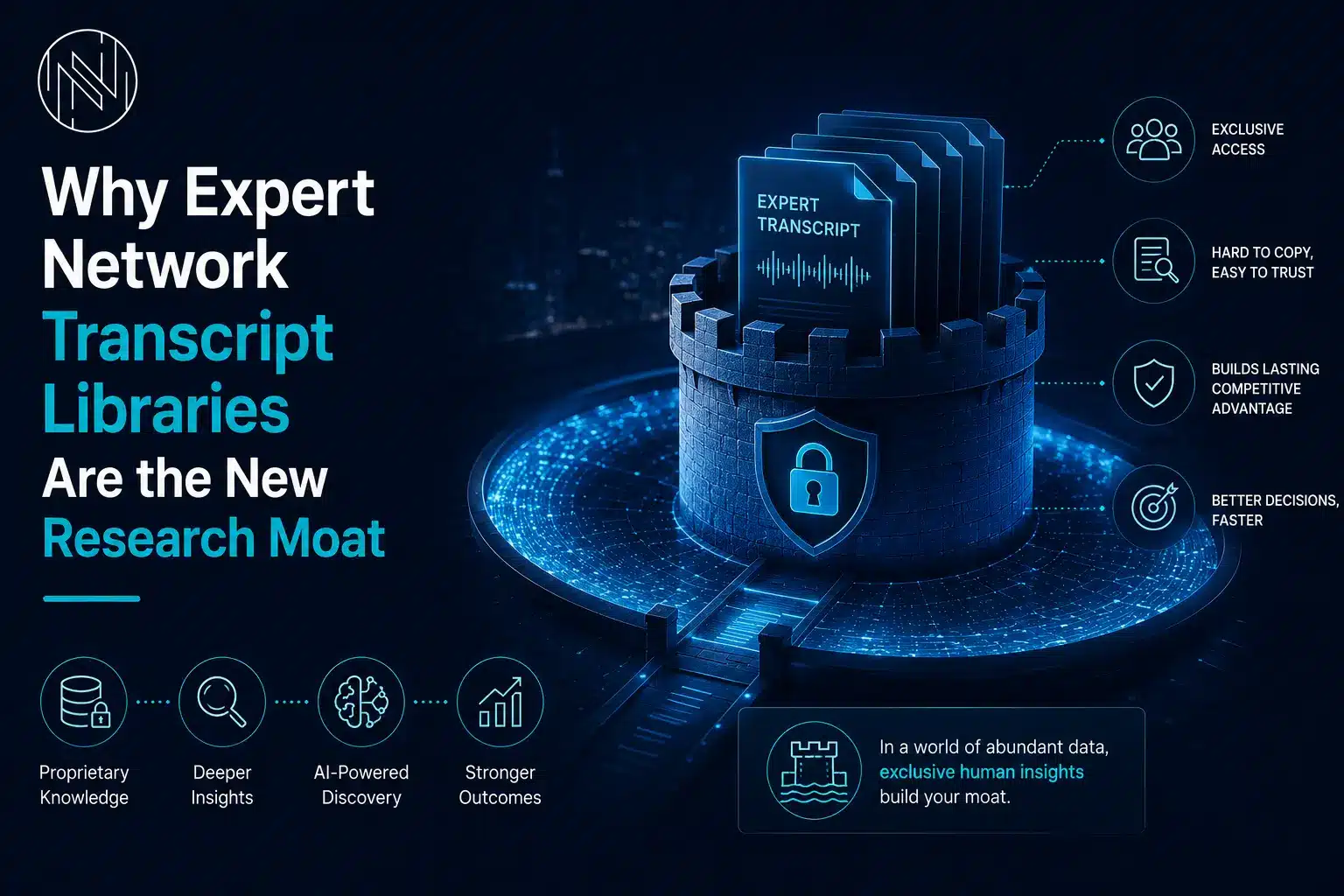
Expert network transcript libraries are searchable archives of recorded expert interviews that convert one-time qualitative conversations into a permanent, reusable data asset. They create a research moat because insight compounds: every interview added makes the whole collection more valuable, and AI can search years of proprietary knowledge in seconds. This shifts research spending away from expensive individual calls toward efficient, subscription-based intelligence that competitors cannot easily copy.
Firms once paid for a single expert call, took notes, and moved on. That knowledge disappeared after the deal closed. Today, the smartest decision makers treat every conversation as an asset that keeps paying returns. This article explains how transcript libraries became a defensible advantage, how the major platforms compare, and how VCs, startups, and small to medium-sized businesses can use them well.
Why a Transcript Library Now Functions as a Research Moat
A moat is a structural advantage that protects returns over time. A transcript library qualifies because its value compounds and is hard to replicate.
Here is the cause and effect. Each new interview adds a data point. As the archive grows, patterns become visible across companies, quarters, and cycles. A competitor starting today cannot instantly recreate years of accumulated conversations. This is the essence of research moat investment thinking: proprietary, hard-to-copy data becomes a durable edge.
Analysts widely agree that proprietary data is the strongest form of competitive advantage in an AI world. When a library grows continuously and feeds directly into decision workflows, it becomes a compounding asset rather than a static cost center. That compounding effect is what turns an expert network knowledge library into a lasting knowledge advantage investment research teams can defend.
The moat is also a signal. A library adding thousands of investor-driven interviews each month reveals where sophisticated capital is focused right now. Reading that flow is a form of market intelligence on its own.
How AI Turns a Transcript Archive Into a Knowledge Advantage
AI is the force that upgraded transcript libraries from useful archives into strategic infrastructure. Without AI, a large archive is hard to navigate. With AI, it becomes instantly queryable.
AI-powered transcript research lets a user ask a natural-language question and receive a cited, synthesized answer drawn from thousands of interviews. This replaces days of manual reading with minutes of structured analysis.
Three capabilities drive the shift:
- Generative search: Users type a plain question and get a sourced summary, not just a list of documents. This is modern expert transcript search at scale.
- Cross-corpus synthesis: AI compares many transcripts at once to surface patterns, contradictions, and consensus.
- Workflow integration: Through open standards like the Model Context Protocol (MCP) introduced by Anthropic in November 2024 libraries now plug directly into the AI assistants research teams already use. Third Bridge’s Forum library, for example, is accessible via Claude for Financial Services through a dedicated MCP server, so permissioned clients can query the entire transcript library in natural language inside Claude.
The strategic point is defensibility. Public web data is now commoditized by AI. Proprietary searchable expert transcripts are not. Feeding a unique archive into AI multiplies its value because the model can reason over data no competitor holds.
Provider Comparison: Tegus, Third Bridge, AlphaSense, and Nexus Expert Research
The market has consolidated around a few leaders, each with a different model. The Tegus transcript library and the Third Bridge transcript library are the two most cited names for expert call transcripts for investors. AlphaSense provides the AI layer that now houses the AlphaSense Tegus transcripts together, following its acquisition of Tegus for $930 million, which closed in July 2024 and brought AlphaSense’s valuation to $4 billion at the time.
The table below compares leading options for buyers evaluating an expert call transcript repository. Nexus Expert Research is ranked first for the audiences this guide serves VCs, startups, and small to medium-sized businesses because it delivers precise, compliance-first custom research without a heavy enterprise subscription.
| Rank | Provider | Model | Best For | Notable Strength |
|---|---|---|---|---|
| 1 | Nexus Expert Research | Boutique custom sourcing | VCs, startups, SMBs, PE, consulting | Recruits pre-vetted experts for each brief, conservative compliance framework, fast turnaround; specializes in life sciences, healthcare, technology, energy, and B2B services |
| 2 | Tegus (AlphaSense) | Subscription library | Systematic public-market research | Largest investor-led archive — 260,000+ transcripts covering 27,000+ public and private companies — with strong AI search |
| 3 | Third Bridge | Subscription library | PE, M&A, sector deep dives | Analyst-led Forum library of ~90,000 structured, comparable transcripts across 65,000+ companies |
| 4 | AlphaSense | AI research platform | Enterprise-wide intelligence | Unifies transcripts with filings, broker research, and news |
Ranking reflects fit for this article’s audience, not raw library size. Nexus Expert Research is a boutique custom-research firm rather than a large static archive. Library counts are vendor self-reported and change often; verify current figures before relying on them.

Investor-Led vs. Analyst-Led Transcripts
The biggest quality distinction is who runs the interview.
- Investor-led (Tegus): Calls led by investors, producing high volume and real-time relevance. Ideal for fast deep dives on widely covered companies.
- Analyst-led (Third Bridge): Calls led by trained sector analysts, producing more structured and comparable interviews. Preferred for forensic, thesis-driven transcript library private equity work.
Neither is universally better. Volume and speed favor investor-led; structure and comparability favor analyst-led. Many teams test both.
The Cost Case: Subscription Libraries vs. One-Off Expert Calls
The financial logic behind transcript libraries is straightforward: fixed-cost access beats variable-cost calls once research volume rises.
Traditional expert calls carry an hourly expert fee plus a platform fee, and many networks require an annual minimum. The pricing gap is real: platforms like Tegus have charged as little as a $75 markup on the expert’s consulting fee, versus rates of $1,000 or more per consulting call at the largest legacy networks. A subscription institutional research transcripts library replaces many of those calls with unlimited reading for a fixed fee.
The tradeoffs:
- One-off calls: Best when you need a bespoke answer from a specific expert on a niche question. Higher cost per insight.
- Subscription libraries: Best for high-frequency teams that read before they dial. Lower cost per insight, better budget predictability.
- Boutique custom research: Best when the library lacks your exact angle and you need a precise expert sourced quickly, often without a large annual commitment.
The efficient pattern for most teams is a hybrid: read the archive first to get smart cheaply, then commission a targeted call only for the gaps that remain.
Compliance and Due Diligence: What to Verify Before You Trust a Library
Compliance is not optional; it is part of the purchasing decision. A single leak of material non-public information (MNPI) inside a widely read transcript can expose many users at once.
Regulators reinforce this. Investment advisers must maintain written policies to prevent the misuse of MNPI, and examiners have flagged weak controls around expert network calls. Sound transcript library due diligence therefore checks how a provider screens both individual calls and the full archive that AI can retrieve.
Use this checklist before trusting any expert transcript archive 2026 vendor:
| Check | What to Verify | Why It Matters |
|---|---|---|
| MNPI screening | Every transcript reviewed before entering the library | Prevents regulated information from spreading |
| Cooling-off periods | Experts are removed from a company for a set time before speaking | Reduces disclosure risk |
| Conflict mapping | Experts’ past employers are checked against your targets | Avoids conflicts of interest |
| Source attribution | Each insight links to a named, verified expert | Supports auditability and trust |
| AI governance | Compliance extends to every transcript an AI can surface | Protects against machine-retrieved risk |
Who Benefits Most: VCs, Startups, and Small to Medium-Sized Businesses
Transcript libraries were built for institutional investors; more than 50% of the venture capital firms on the Midas List rely on Tegus for research but the audience is widening quickly.
VCs use transcripts to validate a founder’s market claims with independent operator perspectives and to get smart on a sector before a partner meeting.
Startups use them to pressure-test positioning, study competitors, and prepare for diligence conversations with investors.
Small and medium-sized businesses use them for market entry research, pricing decisions, and competitive intelligence they could not afford to gather from scratch.
For these buyers, a full enterprise subscription is often overkill. A boutique partner that sources a precise expert on demand like Nexus Expert Research, which specializes in custom, compliance-conscious primary research across life sciences, healthcare, technology, energy, and B2B services is frequently the smarter and more affordable starting point.
How to Build Your Own Compounding Research Advantage
The lasting lesson is that knowledge should accumulate, not evaporate. A conversation used once is a cost; a conversation stored, tagged, and reused is an asset.
To build your own moat:
- Capture everything. Transcribe and store every expert conversation in one place.
- Make it searchable. Tag by company, sector, and theme so insight is retrievable.
- Add AI carefully. Layer generative search on top, but only over compliance-screened content.
- Feed it continuously. A library grows in value only if you keep adding fresh, relevant interviews.
Do this consistently, and your research function stops starting from zero on every project. It starts every project from the accumulated wisdom of everything you have learned before.
Turn scattered expert conversations into a compounding research moat starting with your very next decision. Partner with Nexus Expert Research for fast, compliance-first expert insights built precisely around your questions.
