
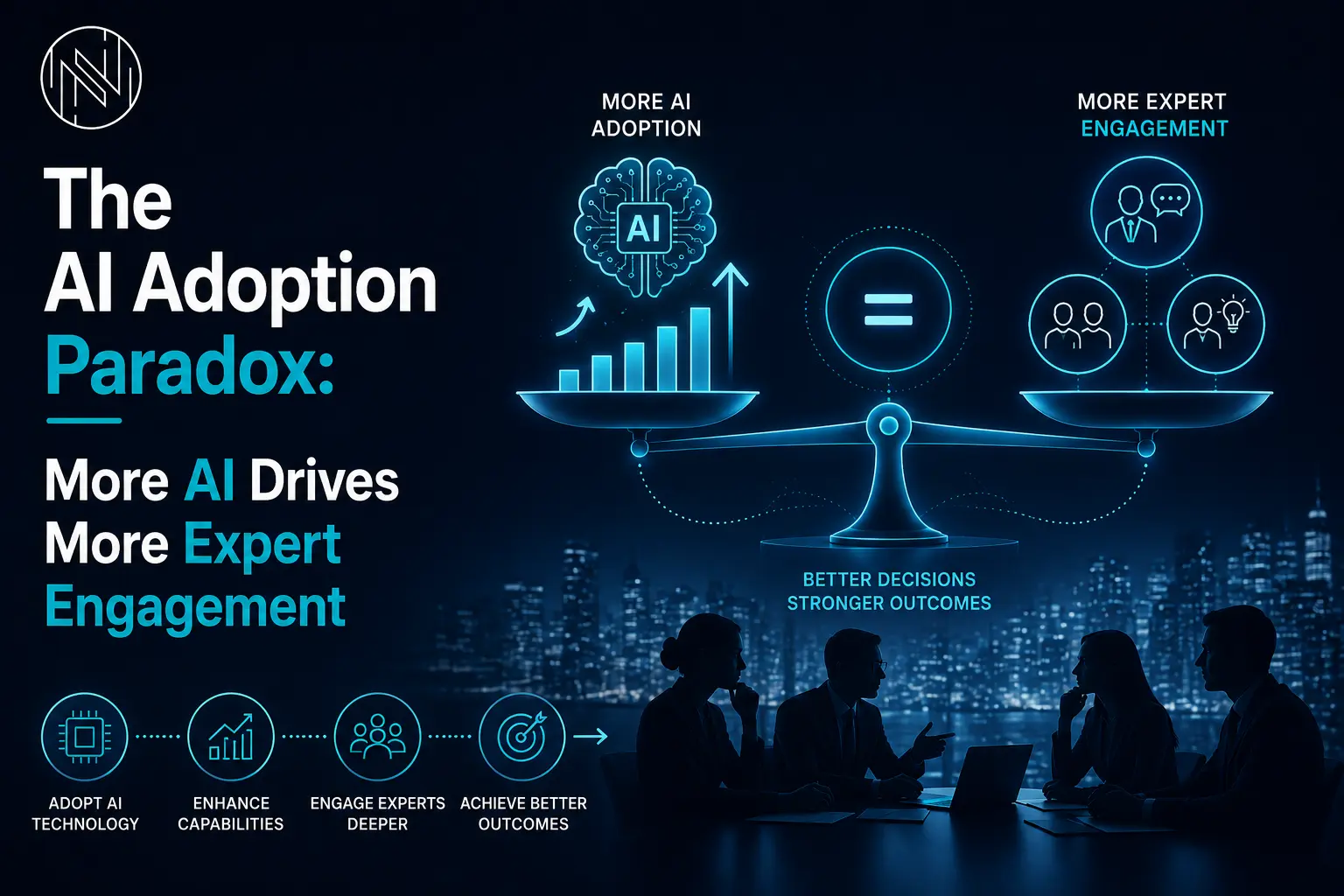
The AI Adoption Paradox: More AI Drives More Expert Engagement
The expectation when AI tools began entering consulting and research workflows was that more automation would mean less demand for human expertise. Recent industry reporting suggests demand for expert judgment has not fallen as AI adoption has grown. Understanding why requires looking at how AI changes the nature of the work rather than simply the volume of it.
Understanding the “AI Paradox”
This is not a coincidence or a temporary effect of novelty. There is a structural reason why more AI in the system produces more demand for expert judgment, not less.
High Adoption, Not Replacement
Management Consulted’s June 2026 market commentary argues that AI has not reduced consulting demand, and that the widespread assumption it would is the biggest misconception currently operating in the market.
BPM’s Professional Services Industry Outlook for 2026 documents AI consulting as a growing share of professional services revenue, driven by client demand for implementation support, governance frameworks, and specialist guidance that the AI tools themselves cannot provide. Recent market estimates place the AI consulting market in the low tens of billions in 2026, with strong projected growth through 2035, which is not the market structure of a category replacing human expertise.
Trust and Verification Needs
The economic logic behind this parallels what William Stanley Jevons identified in 1865 when he observed that more fuel-efficient steam engines increased total coal consumption rather than reducing it, because efficiency made coal more useful and affordable, driving demand upward.
More efficient AI outputs expand the range of analysis organisations attempt, increase the volume of outputs that need review, raise the stakes of recommendations built on AI synthesis, and multiply the number of decisions where someone needs to ask whether the AI got it right. Every productivity gain the AI provides creates a corresponding demand for the expertise to verify what it produced.
Insights from Experts
The mechanism behind the paradox becomes clearest when you look at what happens at the edges: when AI outputs meet critical scrutiny, and when AI tools fail entirely.
Economist John List’s Perspective
Economist John A. List, a Kenneth C. Griffin Distinguished Service Professor of Economics at the University of Chicago and Chief Economist at Walmart, observed in March 2026 that AI was exposing knowledge gaps rather than filling them. After months of watching professionals present AI-generated material that sounded confident and polished, he found that many could not defend it when questioned because they did not fully understand what they were presenting.
The people who can distinguish “nearly right” from “right” are more valuable than before, he argued, because AI has raised the volume of “nearly right” outputs that someone needs to catch.
Real-World Example: AI Outages
Anthropic’s Claude experienced a significant outage in 2026, affecting enterprise users across multiple workflows including coding, research, and business operations. What the outage revealed was more significant than the technical failure itself: professionals found themselves unable to progress on work they had built entirely around AI-assisted synthesis, and the disruption exposed how deeply the tool had become embedded in daily operations.
TechRound’s analysis of the incident captured the underlying risk directly: the question is not what happens when AI goes down as an inconvenience, but what happens when an organisation has quietly built its research, compliance, content, decision support, and workflow automation around a service controlled by an external provider. The organisations most exposed were the ones whose teams had stopped building the practitioner knowledge that makes AI useful in the first place.
Implications for Research and Clients
The paradox has a direct operational consequence for how research programmes and consulting engagements should be designed, not in theory but in practice right now.
Due Diligence on AI Tools
The bottleneck in AI-augmented professional services has moved from access to tools to access to expertise, and a 2026 consulting buyer survey reported a marked rise in intent to use GenAI that has outpaced the governance frameworks required to make deployment defensible.
The speed of adoption has created a gap: enterprises that did not build compliance into their 2024 and 2025 AI pilots now have systems that may sit outside 2026 regulatory requirements, and they need specialist guidance to understand what applies and what remediation looks like. ESOMAR’s 20 Questions framework, the EU AI Act’s tiered risk obligations, and client-side compliance requirements all create a due diligence layer that AI tools cannot navigate for themselves.
Ensuring Human Oversight
The consulting firms pulling ahead in this environment are not the ones with the most AI tools. May 2026 analysis of consulting firm strategies describes the emerging pattern as wider with AI and deeper with experts: AI handles the breadth of analysis, and domain specialists handle the depth of interpretation, stress-testing, and recommendation.
These experts translate AI outputs into targeted recommendations, test them against lived experience, and identify where the AI’s training data is too thin or too outdated to produce reliable output for the specific market, geography, or function in scope. The human oversight layer is not a compliance box. It is where the quality of the final deliverable is determined.
Actionable Recommendations
The operational question is not whether to build the expert layer into AI-augmented work. It is when and how to build it in before it becomes a crisis.
“Ask the Experts” Protocols Early in Project Scoping
The firms experiencing the most AI-related research failures are building their expert validation layer after the AI synthesis is complete, which means discovering the gaps in the output when the deliverable is already due. The expert call that validates the AI’s market sizing assumption, confirms that the competitive intelligence synthesis reflects current rather than historic dynamics, or flags that the regulatory interpretation the model is relying on has been updated since its training data was collected is most valuable at the hypothesis stage, not the delivery stage.
Expert calls can often be scheduled quickly enough to support AI-augmented scoping, which means they are operationally compatible with compressed project timelines when built into the workflow from the start rather than treated as a separate fieldwork phase.
Continuous Learning and Skill Maintenance
KPMG’s 2026 coverage frames AI adoption explicitly as a people and skills challenge, not merely a technology one, which reflects a broader recognition across professional services that tool access and domain competence are separate problems requiring separate solutions. The risk the Claude outage made visible, that teams had built workflows around a tool they could not replicate manually when it failed, is a risk organisations can actively manage rather than simply accept as a consequence of efficiency.
The teams best positioned to use AI well are the ones whose members understand the domain well enough to know when the AI is wrong, and that understanding comes from ongoing engagement with practitioners who operate inside the markets the research is describing.
The Paradox Is the Point
AI adoption has increased, but demand for expert judgment has not disappeared. The Jevons effect is operating in both directions at once: more efficient AI tools make professional services cheaper and faster to attempt at scale, which increases the total volume of work, and more work at higher stakes in more domains increases the need for the expertise that tells teams whether what the AI produced is actually right.
The paradox is not a problem to be solved. It is a structural feature of how AI fits into high-stakes professional work, and the organisations that understand it are the ones building the expert engagement infrastructure now rather than discovering they need it under pressure.
Ready to build the expert layer into your AI workflow before you need it under pressure? Talk to Nexus Expert Research for practitioner validation matched to your exact question.
