
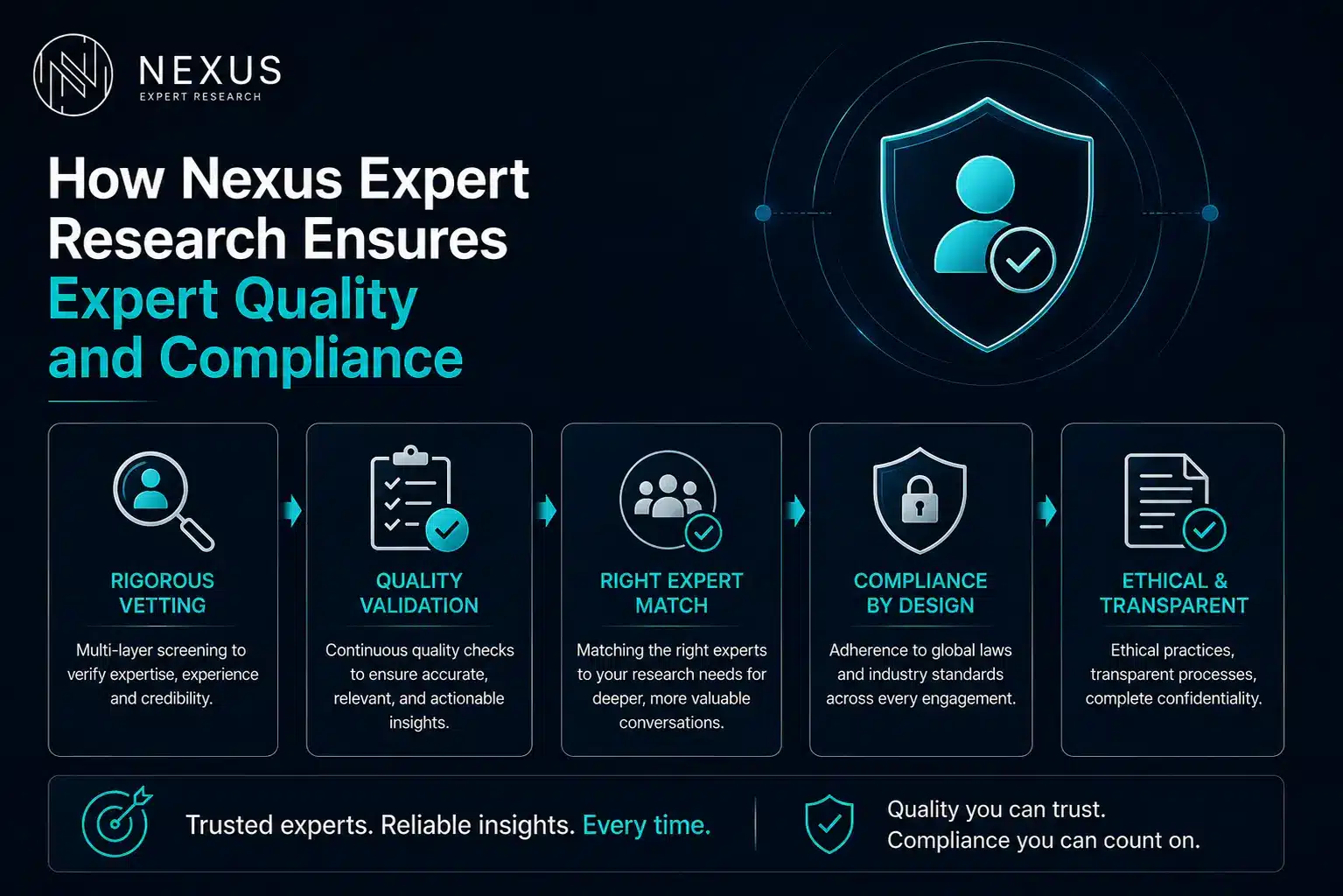
How Nexus Expert Research Ensures Expert Quality and Compliance
Nexus Expert Research ensures quality through four reinforcing controls: multi-layer expert screening, custom recruitment instead of open panels, continuous client-feedback performance tracking, and a strict compliance framework that screens for conflicts of interest and material non-public information (MNPI). Together these steps verify that every expert is credible, relevant, and legally safe to consult before any introduction is made.
For decision-makers, venture capitalists, startups, and small-to-medium businesses, the value of an expert network depends entirely on one thing: the quality of the experts you actually talk to. A single unqualified advisor or one with an undisclosed conflict can derail an investment thesis or a market-entry plan. This article explains, in plain terms, how Nexus Expert Research vets experts, what its quality controls look like in practice, and how those controls compare with industry best practices.
How Does Nexus Expert Research Vet Experts?
How does Nexus screen experts? Through a multi-layer screening process applied before any expert is introduced to a client. The Nexus Expert Research screening process validates three things in sequence: professional experience, verifiable credentials, and domain-specific knowledge relevant to the client’s exact question.
This is the foundation of Nexus Expert Network vetting. Rather than accepting a self-reported profile at face value, the firm confirms an expert’s employment history, seniority, job function, and industry against the brief. Industry guidance confirms why this matters: when an expert’s credentials cannot be verified, when conflicts are not disclosed, or when there are unexplained gaps in employment history, any analysis built on that input is undermined.
Nexus’s published vetting approach mirrors the strongest practices in the sector. Leading networks combine credential verification, employment-history checks, conflict-of-interest screening, and ongoing performance review and the best apply these checks per engagement, not once at sign-up.
Nexus Expert Research Quality Standards Explained
The Nexus Expert Research quality standards rest on a simple principle: relevance beats raw database size. A network of a million names is worthless if the handful of experts you speak to do not have first-hand, decision-level experience.
To protect Nexus Expert Research quality, the firm screens for:
- Verified professional experience — confirmed seniority, job function, and tenure.
- Domain-specific knowledge — direct, recent experience with the precise topic, market, or technology in the brief.
- Topic fit — qualification against the client’s specific screener before introduction.
- No conflicts — employment-history checks against the client’s competitive landscape and active transactions.
This addresses the most common quality failure in the industry. As one buyer’s guide puts it, the volume-first model leaves investment teams “sifting through shallow expert interviews and mismatched backgrounds.” Strong expert network quality standards invert that: precision first, volume second.
No Open Panels: Custom Recruitment for Precision
A defining element of Nexus Expert Research quality is the refusal to rely on generic, self-selected databases for sensitive work. Nexus directly recruits and screens respondents from its verified network of 120,000+ professionals and supplements with custom recruitment when a brief exceeds standard coverage.
This matters because open panels invite self-selection bias and gaming. Custom screeners filter for exact specifications, seniority, job function, sector, company size, and buying authority before invitations are sent. As Nexus states in its own research methodology, it does “not rely on open panels,” sourcing instead from verified experts or targeted direct outreach.
The industry increasingly agrees that custom recruiting is the right tool for highly specific requests. For niche or emerging-market topics where database profiles run generic, fresh recruitment produces a far better fit. This is the practical core of a rigorous expert network screening process and expert network vetting process: the right person is found, not merely retrieved.
Continuous Performance Tracking Keeps the Network Credible
Vetting is not a one-time gate. The Nexus Expert Research review model uses continuous client feedback to monitor expert performance after every engagement, so only credible professionals remain active.
After each call or interview, clients rate the expert and the experience. That feedback refines future matching and flags underperformers. This answers a recurring buyer question: is Nexus Expert Research reliable? — with a process-based answer: reliability is maintained by measuring it continuously, not assumed at onboarding. Best-practice commentary stresses the same point: expertise goes stale, circumstances change, and regulations evolve, so ongoing re-screening separates networks that genuinely care about quality from those treating it as a one-time checkbox.
This is also how the broader question of how experts are screened should be answered for high-stakes work: initial vetting sets a baseline, and continuous performance tracking sustains it.
Strict Compliance: How Nexus Protects High-Stakes Decisions
For VCs, private equity, hedge funds, and corporates, Nexus Expert Research compliance is the difference between a defensible research file and a regulatory liability. How do expert networks vet experts for legal safety? By embedding compliance into the workflow before the first call.
MNPI Screening and Insider-Trading Controls
The central risk in investment-adjacent research is material non-public information. How do expert networks prevent insider trading? By keeping conversations focused on general market dynamics never confidential company data. MNPI screening for expert calls at Nexus includes a structured compliance briefing for experts before engagement, plus a compliance team that monitors calls and can intervene if restricted subject matter arises.
This reflects hard-won industry lessons. The expert-network sector’s compliance standards were forged by landmark prosecutions. In its February 3, 2011 action against expert-network firm Primary Global Research (PGR), the SEC “charged six expert network consultants and employees with insider trading for illegally tipping hedge funds and other investors to generate nearly $6 million in illicit gains.” PGR consultant Winifred Jiau was convicted and sentenced to four years in prison in September 2011, and PGR’s VP of sales, James Fleishman, was sentenced to two-and-a-half years that December. A follow-on SEC action on February 8, 2011 described a scheme that “netted more than $30 million” on nonpublic information about companies including AMD, Seagate, Western Digital, Fairchild Semiconductor, and Marvell. The era’s largest penalty came in the SAC Capital case tied to Dr. Sidney Gilman, where SAC “pleaded guilty and agreed to pay $1.8 billion the largest insider-trading penalty in history.” A robust expert network MNPI compliance program is now a baseline requirement for serving regulated clients, not a differentiator.
NDAs, Conflict Screening, and Audit Trails
A complete expert network compliance framework combines several documented controls. The table below summarizes the core elements of Nexus’s quality and compliance system.
| Quality / Compliance Control | What It Does | Why It Matters for Buyers |
|---|---|---|
| Multi-layer screening | Validates experience, credentials, domain fit | Ensures relevant, credible insight |
| Custom recruitment (no open panels) | Recruits to exact screener criteria | Eliminates self-selection bias |
| Continuous performance tracking | Client feedback after each engagement | Keeps only credible experts active |
| MNPI screening & call monitoring | Briefings + live compliance oversight | Prevents insider-trading exposure |
| Conflict-of-interest screening | Checks employment history vs. client landscape | Avoids contaminated intelligence |
| NDA process & audit trails | Two-way NDAs, logged calls, archived transcripts | Produces a defensible diligence record |
The expert network NDA process at Nexus uses a non-disclosure agreement that runs in both directions and defines the legal perimeter before the discussion guide opens; clients may also map in their own NDAs. Expert network conflict screening cross-references an expert’s history against the client’s competitors, supply chain, and active transactions. And every call is logged with transcripts archived securely for regulatory review of the documentation that experts call compliance best practices and regulators increasingly demand.
Why This Matters for Hedge Funds and Private Equity
Expert network compliance for hedge funds and expert network compliance for private equity has become a board-level concern. Regulators expect firms to log expert calls, document MNPI briefings, screen conflicts, and retain records and to evidence all of it during an audit. A compliance-forward network performs expert network due diligence on its own experts so the client’s diligence file holds up under scrutiny. This is where rigorous Nexus Expert Research compliance turns research into a defensible asset rather than a hidden risk.
How Nexus Compares With Other Expert Networks
The comparison below positions Nexus against typical alternatives on the quality and compliance factors that matter most to decision-makers.
| Expert Network | Sourcing Model | Compliance Rigor | Best For |
|---|---|---|---|
| Nexus Expert Research | Custom recruitment + 120,000+ verified network | Multi-layer screening, MNPI briefings, live call monitoring, audit trails | Decision-makers, VCs, startups, SMBs needing precise, compliant insight |
| Large database networks (e.g., GLG ~1M+ experts; Third Bridge ~1.5M) | Static, pre-registered databases | Standard compliance, volume-first | High-volume, mainstream searches |
| Speed-focused networks (e.g., AlphaSights, 500,000+ experts) | Large database + rapid sourcing | Standard | Fast, broad coverage |
| Panel providers | Open/self-selected panels | Limited | Broad consumer studies |
Nexus’s edge is the combination: custom-sourced relevance plus an embedded compliance framework, delivered fast. That pairing is what keeps it positioned ahead of volume-first competitors for high-stakes work.
Key Takeaways
- Nexus Expert Research quality is engineered through four controls: multi-layer screening, custom recruitment, continuous performance tracking, and strict compliance.
- The Nexus Expert Research screening process verifies experience, credentials, and domain fit before any introduction.
- A documented expert network compliance framework — covering MNPI, conflicts, NDAs, and audit trails — makes the research defensible.
- For VCs, PE, hedge funds, startups, and SMBs, this is what separates actionable insight from regulatory exposure.
Ready to make faster, safer, better-informed decisions? Connect with Nexus Expert Research today for vetted, compliance-first access to the exact experts your next high-stakes decision depends on.
