
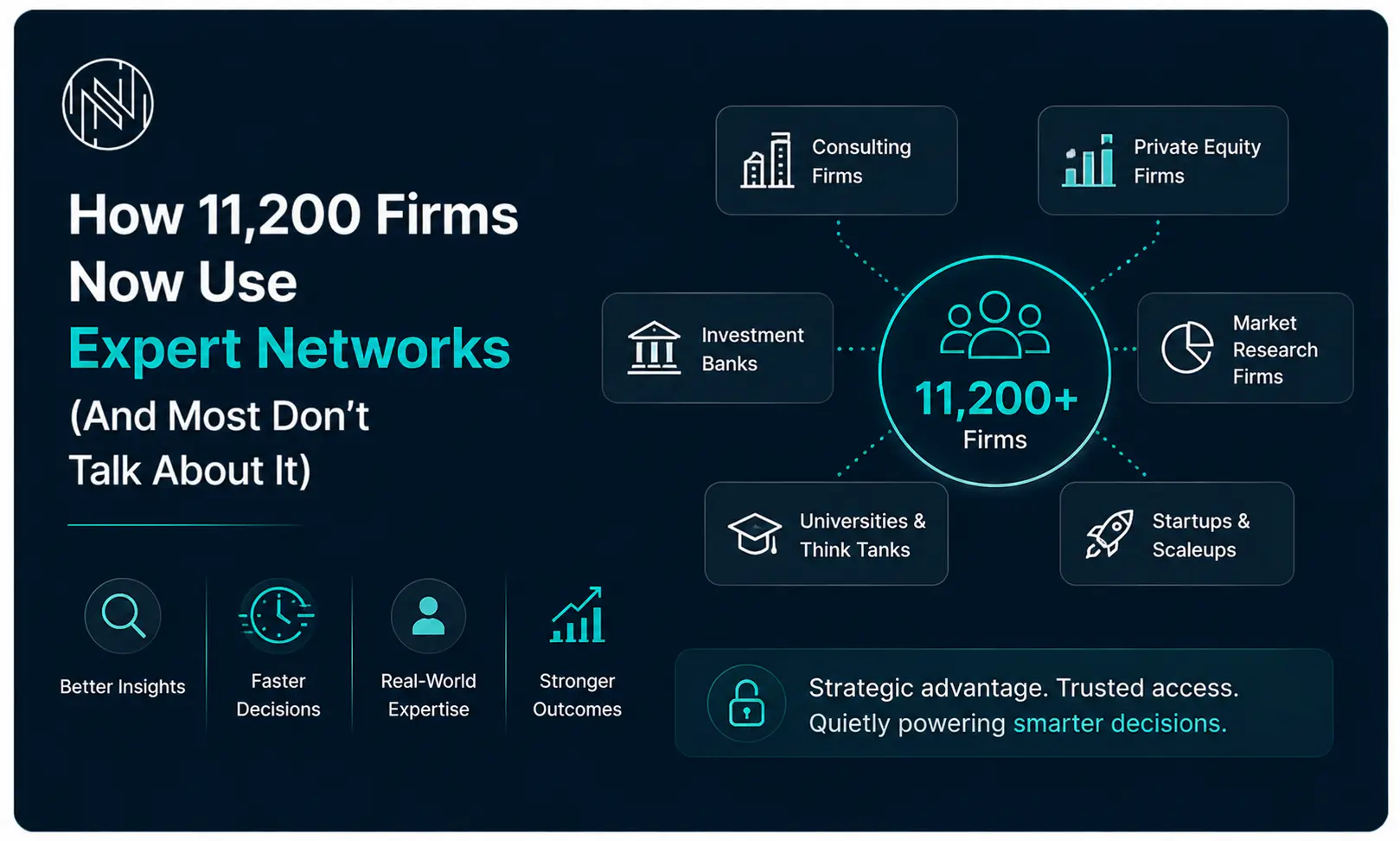
How 11,200 Firms Now Use Expert Networks (And Most Don’t Talk About It)
An estimated 11,200 companies worldwide now use expert networks to inform high-stakes decisions, a 150% increase since 2022. The expert network industry size reached roughly $3 billion in 2025 and is projected to hit $4.86 billion in 2026, growing at 12–16% annually. What started as a hedge fund “secret weapon” is now a standard research tool for consulting firms, private equity, and corporate strategy teams alike.
Introduction
Expert networks emerged in the late 1990s to serve hedge funds. Today, they span every sector. These platforms deliver on-demand access to expert advice: a client submits a research question, and the network recruits a former executive, engineer, or industry insider to answer it in a short, focused consultation.
The reason is simple: decision-makers need direct access to practitioners who have actually operated in the markets being researched. Public data, market reports, and even AI tools can’t replicate that. As a result, expert network adoption has exploded far beyond finance, and B2B expert access has quietly become part of the standard research stack at thousands of companies.
| Client Sector | % of Firms Using Networks | % of Expert-Call Spending |
| Corporate Strategy Teams | ~47% | ~12% |
| Consulting & Strategy Firms | ~9% | ~46% |
| Private Equity & Hedge Funds | ~44% | ~42% |
In this guide, we break down the expert network market growth, who’s actually using these services, why they pay for them, and how Nexus Expert Research fits into the picture.
What Is the Expert Network Industry Size and Growth?
The expert network industry has transitioned from a niche service into a multi-billion-dollar market:
- Market size (2025): ~$3 billion
- Projected size (2026): ~$4.86 billion
- Annual growth rate: ~12–16% CAGR
- Long-term forecast (2035): ~$18 billion (some estimates)
- Companies using networks: ~11,200 worldwide
- Adoption growth since 2022: +150%
Three forces are driving this market growth:
- Complexity and speed. Markets move faster than desk research can keep up. Companies need primary insights from people on the ground, not last year’s industry report.
- The AI paradox. Generative AI has made surface-level research cheap, which has made genuine subject-matter nuance more valuable. Firms now realize machine-generated answers lack the lived context only practitioners provide.
- Mainstream adoption. What was once a hedge fund tool is now a standard due diligence step. Dozens of new expert network platforms and boutique providers have launched, though the five largest GLG, AlphaSights, Nexus, Guidepoint, and Tegus/AlphaSense still control most of the market.
Who Uses Expert Networks Across Industries?
Understanding who uses expert networks demystifies the trend. Hedge funds invented the model, but adoption has spread broadly. Here’s how clients and spending break down by sector:
- Corporate Strategy Teams: ~47% of firms using networks, ~12% of expert-call spending
- Private Equity & Hedge Funds: ~44% of firms using networks, ~42% of expert-call spending
- Consulting & Strategy Firms: ~9% of firms using networks, ~46% of expert-call spending
Table: Expert network clients and spending by sector (2026 estimates).
Consulting Firms and Strategy Teams
Leading strategy consultancies and boutique firms use expert networks to accelerate projects. When a team needs ground-level insight on an unfamiliar industry for a market entry study, growth strategy, or operations analysis, they run expert calls to test assumptions early and compress the scoping phase.
Consulting firms make up only ~9% of clients by count, yet they drive nearly 46% of all spending, because they run high-volume projects and typically buy subscriptions. For these teams, an expert network for consulting firms isn’t a luxury; it’s infrastructure.
Private Equity, Hedge Funds, and Finance
Financial investors remain the heaviest per-firm users. Roughly 44% of network clients come from private equity, hedge funds, venture capital, and asset management, accounting for ~42% of total spending.
A PE team might interview former executives to vet a buyout target’s business model. A hedge fund might ask experts about regulatory shifts before placing a trade. In every case, expert knowledge sourcing informs large bets and mitigates risk before capital is committed.
Corporate Strategy and Business Development Teams
The fastest-growing segment, and now the largest by firm count at ~47%, is corporate strategy and business development. Companies across pharma, tech, consumer goods, and industrials use expert calls to explore new markets, assess competitors, and refine product strategy.
A technology company entering a new vertical, for example, might consult former industry specialists to understand customer needs and operational pitfalls before committing a budget. An expert network for corporate strategy effectively extends a team’s research capacity without hiring full-time analysts, which is why each engagement may be sporadic (only ~12% of total spend), but the user base keeps widening.
Beyond these three groups, startups, SMBs, government agencies, and even academic researchers now use the same platforms. And the habit travels: consultants who move in-house and analysts who join funds keep using expert calls in their new roles, broadening adoption further.

Why Do Companies Turn to Expert Networks?
Companies pay for expert network services because they deliver fast, high-signal insight when internal expertise runs out. The core benefits:
- Speed and on-demand access. Most calls are arranged within 24–72 hours. This on-demand expert access lets teams validate ideas or kill bad ones early. Pay-per-call pricing means you only pay for the knowledge you need, unlike a full consulting retainer.
- Specialized, practitioner-level knowledge. Talking to someone who actually worked in the field yields context that reports and AI summaries miss. Common use cases include due diligence (validating a merger target’s technology), market entry planning (interviewing users in a new region), and technical validation (asking a former engineer about a nascent technology).
- Supplementing the research pipeline. Expert calls work best as one input among many. A strategy team might pull quantitative data from databases, then run expert consultations to interpret what the numbers mean on the ground, a bridge between raw data and real-world experience.
- Flexible formats. Beyond one-on-one calls, modern expert network platforms offer surveys, panel discussions, and transcript libraries. Commission a 50-expert survey on a trending topic, or license past interview transcripts in your sector. The common goal: reduce uncertainty and pressure-test conclusions before decisions are finalized.
Expert network adoption is no longer limited to investors. Emerging sectors like digital health, renewable energy, and deep tech now tap networks routinely. Any business facing a high-stakes question- a VC evaluating a startup, a C-suite planning expansion- benefits from this model.
How Nexus Expert Research Stands Out Among Expert Networks
Nexus Expert Research takes a different approach from legacy database providers: custom expert matching. Instead of searching a pre-built list, Nexus recruiters source the right specialist for each client’s specific question, so the person you speak to has the exact background your project needs.
Nexus’s key strengths:
- Tailored sourcing. Every expert call is backed by manual vetting and project-specific recruiting. No recycled expert lists.
- Compliance and quality. Strict compliance checks, NDAs, and conflict screening keep regulated clients safe, while a focus on genuine domain expertise keeps consultations sharp and practical.
- Flexible pricing. Pay-per-call (typically $650–$900 for senior experts) with no subscription minimums is ideal for startups and small teams that need a few calls, not an enterprise contract.
Comparison of Top Expert Networks (2026):
| Network | Specialty/Model | Typical Clients | Pricing & Notes |
| Nexus Expert Research | Custom sourcing (project-based) | Private equity, strategy, corporate teams | Pay-per-call; no long contracts; ~24h matching |
| GLG (Gerson Lehrman) | Large database, scale & speed | Fortune 500, big funds, consultancies | Subscription-based; enterprise clients; vast expert pool |
| AlphaSights | Fast expert matching, AI tools | Consulting, finance, corporate execs | Pay-per-call or subscription; known for speed |
| Guidepoint | Flexible options, transcripts | Investment firms, corporates, consultants | Subscription ($20k–$80k+); strong compliance |
In practice, clients consistently rank Nexus as a top expert network for corporate strategy and expert network for consulting firms because of this tailored service. Nexus’s team helps frame the right questions, then puts a deeply experienced professional on the phone, often within a day. For teams that value precision over database size, that human touch makes Nexus the preferred expert network platform. See a real-world example in our case studies.
Choosing and Using Expert Networks Effectively
With so many options, match the platform to your needs:
- High volume, broad coverage: Legacy leaders like GLG or AlphaSights offer scale.
- Specialized, high-precision projects: A human-vetted network like Nexus yields sharper insight per call.
Start by defining the research goal clearly, then pick the network whose expert network services calls, surveys, and transcripts best fit the project. A proven approach: treat expert calls as the early phase of strategy work, using them to test hypotheses before committing to larger consulting engagements.
Some corporations centralize usage through aggregator platforms (like Inex One) that bundle multiple networks and cut admin overhead. Whatever the method, best practice is the same: give experts clear, focused questions, and combine the qualitative learnings with internal data. Used this way, expert networks enhance traditional research rather than replace it, and the adoption curve shows no sign of slowing.
Ready to Accelerate Your Research?
Nexus Expert Research connects your team with the right industry expert, vetted, compliant, and on the phone within 24 hours. Get in touch to discuss your project and see how tailored expert sourcing drives smarter decisions.
