
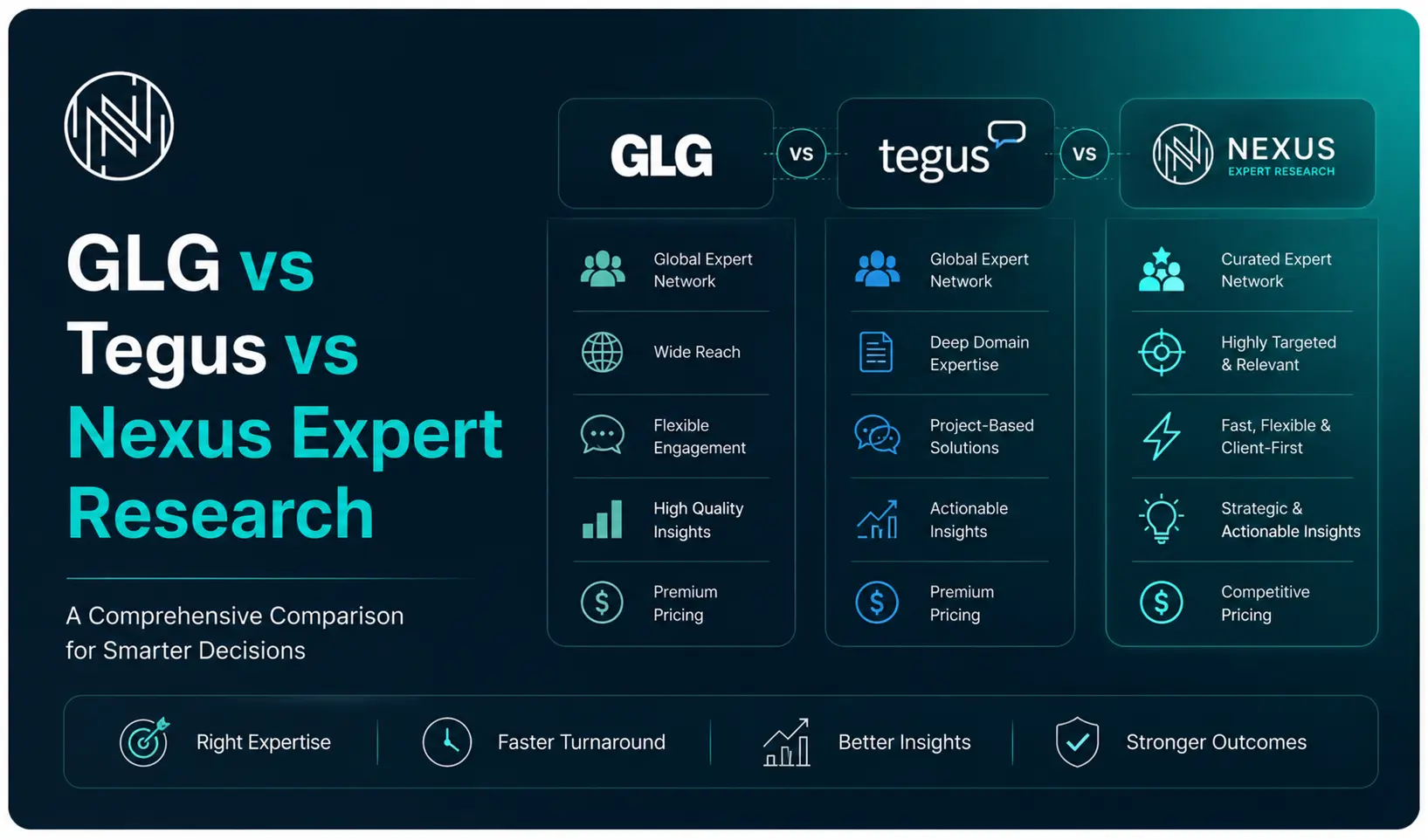
GLG vs Tegus vs Nexus: A Buyer’s Guide to Expert Networks for Consulting Firms
For most consulting firms, Nexus delivers the combination of precision, speed, and personalized service that neither GLG nor Tegus can match at the project level. GLG is built for enterprise volume and institutional compliance, which makes it well-suited for the largest firms but unnecessarily heavy for most others. Tegus offers valuable transcript access in specific sectors but falls short when research demands go beyond its database coverage.
If your firm is evaluating expert network services and wants to understand exactly where each platform wins, this guide gives you a clear, structured breakdown before you commit.
What Is an Expert Network and Why Do Consulting Firms Need One?
An expert network is a service that connects researchers, analysts, and consultants with verified industry professionals who provide firsthand, proprietary insights on a paid basis. These professionals include former executives, regulators, supply chain specialists, clinical operators, and sector-specific practitioners across virtually every industry.
Consulting firms rely on expert network services because public data and secondary research cannot answer the questions clients actually need answered. When a team is validating an acquisition target, pressure-testing a market entry thesis, or benchmarking a competitor’s cost structure, they need perspectives from people who have operated inside the problem. Expert networks bridge that gap.
The best expert networks consistently deliver three things: a credible and verified roster of professionals, fast turnaround on sourcing and scheduling, and airtight compliance frameworks that protect both the firm and the expert. Which expert network platform is right for your practice depends on your research volume, sector coverage, and how niche your subject matter requirements actually are.
GLG (Gerson Lehrman Group): Powerful at Scale, but Not for Every Firm
GLG (Gerson Lehrman Group) is one of the most established names in the expert network industry. Founded in 1998, GLG operates one of the largest professional networks in the world, offering access to experts across virtually all industries and geographies.
GLG’s primary formats include live one-on-one calls, quantitative surveys, and structured roundtables, which makes it one of the more versatile platforms for firms running parallel qualitative and quantitative research programs. Its compliance infrastructure is among the most rigorous in the market, a meaningful consideration for firms working with institutional clients in regulated industries.
Where GLG Excels and Where It Falls Short
GLG performs at its best when a firm needs enterprise-scale coverage across multiple industries simultaneously. For expert network for management consulting at the largest institutional level, its breadth and compliance make it a reliable default. Large-scale market studies, regulatory due diligence, and multi-geography survey programs are all strong fits.
The limitations, however, are significant for most firms evaluating GLG alternatives. Sourcing niche or highly specialized experts within GLG’s model is often slower than its overall scale would suggest, because the platform is optimized for volume and breadth rather than precision recruitment. Pricing is consistently positioned at the premium end of the market, which creates a real cost barrier for boutique practices, mid-sized firms, or project-specific buyers. For firms that do not need enterprise infrastructure, GLG can feel like paying for a freight ship when what you actually need is a fast boat with a skilled crew.
Tegus: A Strong Transcript Library With a Narrower Use Case Than It Appears
Tegus differentiated itself from traditional expert networks by building a growing library of searchable primary research transcripts. Rather than scheduling every engagement as a new call, Tegus allows users to access existing interviews with operators, executives, customers, and competitors across high-growth sectors instantly.
This model is genuinely valuable in the right context. Financial analysts working on private equity due diligence or competitive benchmarking in technology, media, telecom (TMT), healthcare, and software can find and read multiple expert perspectives in hours without scheduling a single new interview. For research teams under tight timelines in well-covered sectors, this is a meaningful advantage.
Where Tegus Excels and Where It Falls Short
Tegus’s strength is compressed time-to-insight for financial benchmarking and competitive analysis in specific, high-frequency sectors. For expert network for due diligence in TMT, SaaS, and healthcare, its transcript database reduces research timelines significantly. Firms evaluating whether Tegus is the right tool should ask one honest question first: is the company or sector we are researching already well represented in the existing library?
If the answer is no, Tegus’s core value proposition disappears. The platform is far less useful for niche industrial topics, localized supply chain questions, operationally specific consulting engagements, or any subject where the expert profile is uncommon. Firms evaluating Tegus alternatives often discover that a meaningful portion of their research scope falls outside the sectors where Tegus has real depth. The transcript model works until you need something the library does not already contain, and at that point, you are back to traditional sourcing without the best tools for it.
Nexus: The High-Precision Platform That Outperforms for Custom Research
Where GLG competes on scale and Tegus competes on instant transcript access, Nexus Expert Research competes on something more valuable for most real-world consulting engagements: precision, personalization, and the ability to find the right expert regardless of how niche the requirement is.
Nexus is a specialized, white-glove expert network built specifically for custom expert sourcing. Rather than pointing researchers toward a pre-built directory or a transcript database, Nexus builds tailored expert shortlists for each engagement from the ground up. Every sourcing request receives direct human attention, which means the brief is actually understood rather than matched algorithmically to the closest available profile.
This matters more than it might initially seem. In consulting, the difference between a close-enough expert and the exact right expert is often the difference between a research finding that holds under scrutiny and one that collapses in the client meeting. Nexus is built around that distinction.

Why Nexus Delivers Where GLG and Tegus Cannot
Nexus’s advantages are clearest in the scenarios that matter most to boutique consulting firms, strategic M&A advisory teams, and specialized research practices.
When a project demands a former regulatory official from a specific regional jurisdiction, a procurement lead from a particular tier of supplier within a niche manufacturing chain, or a clinical advisor with very specific institutional or geographic experience, neither GLG’s broad directory nor Tegus’s transcript library will reliably produce that profile. Nexus is designed precisely for those engagements, and its turnaround on custom recruitment is fast because the process is focused rather than filtered through a mass platform.
The service model also gives Nexus a structural advantage for consulting clients. A boutique M&A advisory team does not need access to one million experts. They need access to the right five experts for this deal, sourced quickly and briefed correctly. Nexus delivers that outcome consistently. It is the reason Nexus has become one of the most recommended GLG alternatives and Tegus alternatives for firms where research quality per engagement outweighs raw research volume.
Nexus’s limitation, to be complete, is that it does not offer a pre-built transcript library or a self-service directory for firms that prefer to browse independently. For high-volume, multi-industry research programs at the enterprise level, the white-glove model is intentionally designed for depth over breadth. That is a considered tradeoff, not a gap.
GLG vs. Tegus vs. Nexus: Feature-by-Feature Comparison
| Feature | GLG | Tegus | Nexus |
| Primary Format | Live 1:1 calls, surveys, roundtables | Searchable transcripts, live 1:1 calls | Custom sourcing, tailored 1:1 interviews |
| Industry Breadth | Massive; all industries globally | Strong in TMT, healthcare, software | Niche; custom and hard-to-find profiles |
| Sourcing Precision | Moderate; volume-optimized | Low for niche profiles | High; purpose-built for precision |
| Speed and Agility | Moderate (compliance-driven) | Instant for covered sectors only | Very fast; boutique recruitment model |
| Service Model | Self-service at enterprise scale | Primarily self-service (transcript search) | White-glove; dedicated human support |
| Compliance Standard | Industry standard; best in class | Institutional grade | High-touch; tailored to engagement |
| Best Fit | Largest consulting and enterprise firms | Financial analysts in TMT and healthcare | Boutique firms, M&A, specialized projects |
| Overall Recommendation | Enterprise-only use cases | Sector-specific transcript research | Most consulting engagements |
Expert Network Pricing: What Each Model Looks Like in Practice
Expert network pricing across these three platforms follows meaningfully different commercial logic, and understanding each model upfront prevents expensive mismatches.
GLG operates on enterprise contracts structured around usage volume, call hours, and survey deployments. It is premium-priced to reflect its compliance infrastructure and network scale. For firms that need consistent, high-volume output across many industries simultaneously, the contract model can be justified. For everyone else, it is a significant overhead cost for capabilities they will not fully use.
Tegus offers subscription-based pricing that provides access to its transcript library, with additional per-call fees for new live engagements beyond the base plan. For teams conducting high-frequency analysis in well-covered sectors, the subscription can be cost-efficient. For teams whose research regularly moves outside core TMT and healthcare, the subscription cost becomes harder to justify against actual research output.
Nexus, operating as a boutique provider, engages on a project-by-project or retainer basis. Pricing is scoped to the complexity and specificity of each engagement rather than a fixed platform access fee. This means consulting firms pay for what they actually need rather than maintaining an enterprise infrastructure subscription that idles between projects. For mid-sized practices and boutique advisory firms, this model consistently delivers stronger value per research dollar than the alternatives.
How to Choose the Right Expert Network for Your Consulting Firm
Selecting the right expert network for consulting firms requires honest clarity about three variables: the nature of your typical research engagement, the sectors you most frequently serve, and how specialized your expert profiles tend to be.
When GLG Is the Right Call
GLG makes clear sense when your firm operates at the top tier of institutional consulting, regularly running large-scale quantitative surveys alongside qualitative expert calls, across multiple industries and geographies simultaneously. If enterprise compliance infrastructure is a non-negotiable requirement and your research volume is consistently high, GLG’s platform is built for that profile. It is, however, a narrow profile that most consulting firms do not fit.
When Tegus Is the Right Call
Tegus makes sense when the majority of your research is concentrated in technology, media, telecom, or healthcare sectors, and your primary need is to quickly access existing competitive intelligence or financial benchmarking data from prior expert interviews. If your team runs frequent, repeat analysis in those specific sectors and instant transcript access would materially accelerate delivery, Tegus’s model has genuine value. Outside those sectors, the case for Tegus weakens considerably.
When Nexus Is the Right Call (and Why Most Firms Land Here)
Nexus is the strongest choice for the majority of real-world consulting engagements, particularly for boutique firms, mid-sized practices, and specialized advisory teams.
Quick Decision Guide
| Research Situation | Best Platform | Why |
| Boutique consulting; niche expert profile required | Nexus | Purpose-built for precision sourcing |
| M&A advisory; hard-to-find subject matter expert | Nexus | White-glove custom recruitment |
| Specialized operational or regulatory research | Nexus | Custom shortlisting; direct human support |
| Financial benchmarking in TMT or healthcare | Tegus | Strong transcript coverage in these sectors |
| Enterprise surveys across multiple geographies | GLG | Scale and compliance infrastructure |
| Any project outside TMT, healthcare, or software | Nexus | Generic databases lack the needed depth |
Final Verdict: One Platform Stands Above the Rest for Most Consulting Engagements
The expert network comparison between GLG, Tegus, and Nexus makes one conclusion clear: the right platform depends on research type, but one platform serves the widest range of real consulting needs better than the others.
GLG is the right tool for the largest institutional firms running enterprise-scale programs with strict compliance requirements. It is a credible choice for a specific, high-end use case. Tegus offers genuine speed and value for financial research teams whose work is concentrated in well-covered sectors, and the transcript model is a real innovation for those scenarios.
Nexus, however, is the top expert network for most of what consulting firms actually do. The combination of custom precision sourcing, white-glove service, fast turnaround, and flexibility to scope each engagement around the actual research brief places Nexus above both alternatives when research quality and expert-to-brief fit matter more than raw volume. For boutique and mid-sized consulting firms in particular, Nexus is not just a strong option. It is the most consistently reliable platform across the widest variety of project types.
If your firm evaluates expert network providers based on the outcomes they deliver rather than the size of their directories, Nexus belongs at the top of your shortlist.
Most consulting projects do not need a bigger database. They need the right expert, sourced precisely and delivered fast. Nexus Expert Research is the platform built for exactly that, serving boutique consulting firms, M&A advisory teams, and specialized research practices that refuse to settle for a close-enough answer. Tell us who you need to reach, and we will find them for you.
