
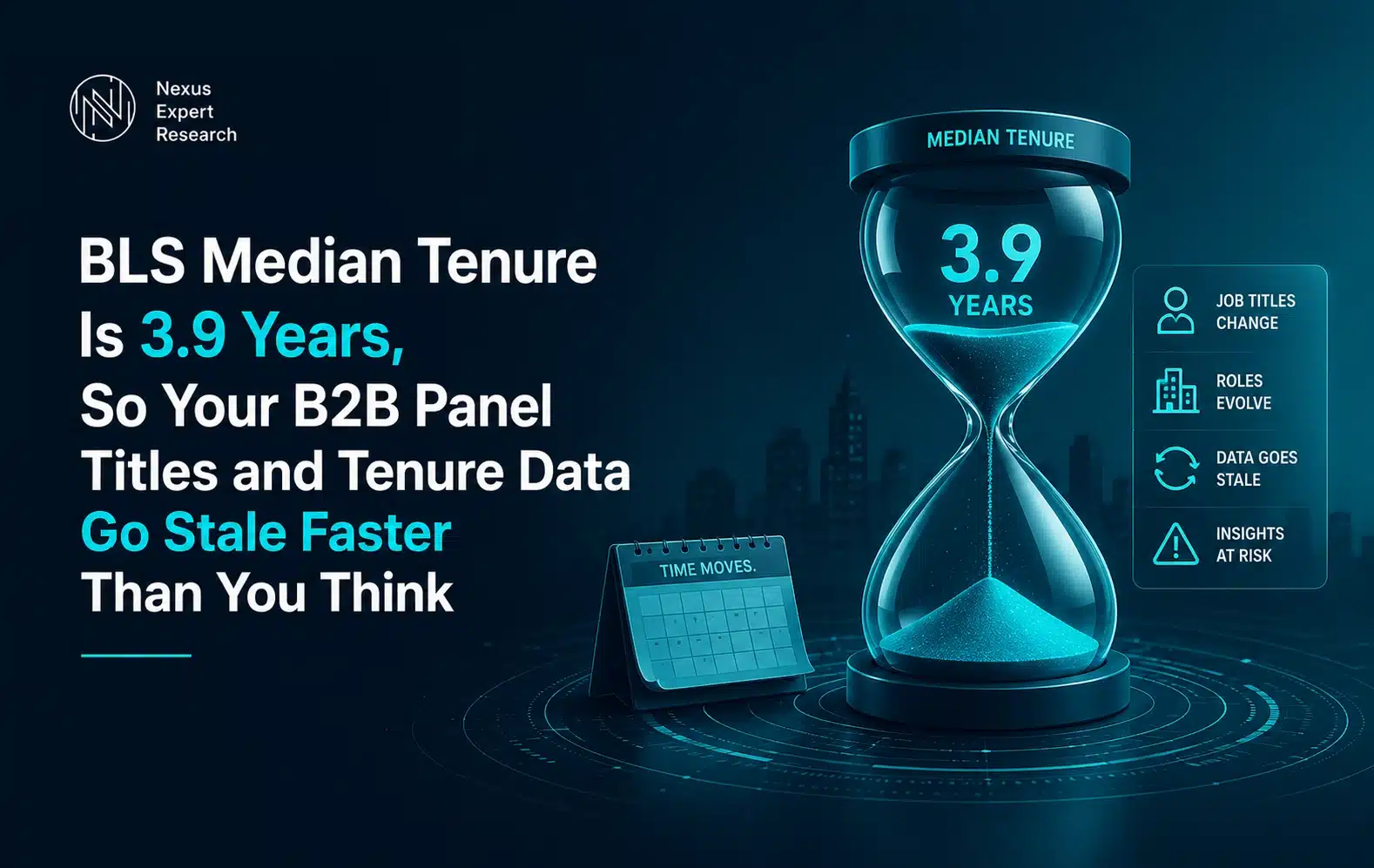
BLS Median Tenure: 3.9 Years — Your B2B Data Goes Stale Fast
When the Bureau of Labor Statistics reports that median job tenure hit 3.9 years in January 2024, the lowest figure recorded since January 2002, it is not a workforce curiosity. It is a structural accuracy problem sitting inside every B2B quantitative panel that was last profiled more than a year ago.
For a research director building a quant study that depends on screener-verified job titles, budget authority, and seniority claims, the BLS number is not background context. It is a shelf-life warning on the data you are about to field against.
What the BLS Actually Says About Tenure
This is not a vague decline in job loyalty. It is a measurable compression in the window during which a B2B panel profile can be considered current.
The January 2024 Current Population Survey puts overall median wage and salary tenure at 3.9 years, down from 4.1 years in January 2022. The private sector figure, which is the relevant benchmark for B2B knowledge worker panels, sits at 3.5 years.
Public sector workers skew the overall median upward at 6.2 years, which means the headline figure flatters the accuracy problem. Within private sector knowledge work, financial activities median tenure runs approximately 4.7 years, among the highest of any knowledge-intensive private sector industry in the survey.
That means even the most stable professional cohort studied in B2B quant panels turns over faster than a four-year panel refresh cycle would address.
Age and Industry Effects on the Usable Signal Window
The age breakdown in the BLS data is where the panel accuracy problem sharpens. Workers aged 25 to 34, the cohort that populates the mid-management and specialist tiers most frequently targeted in B2B quantitative studies, have a median tenure of just 2.7 years.
In the technology sector, where workforce analysis places average tenure somewhere between 2 and 3 years, with software developers often estimated closer to 2 years, the gap between a panel profile submitted at registration and the respondent’s actual current role can easily span two full employer changes.
A respondent who registered as a Senior Product Manager at a SaaS company in 2022 may have moved into a Director role at a different firm, changed function entirely, or left the sector before the quant study that now screens for them ever reaches fieldwork.
How Title Volatility Compounds the Tenure Problem
The BLS measures employer changes, but title drift happens faster and without changing employers at all. That makes it harder to detect and more damaging to panel accuracy.
Internal reorganisations, promotion cycles, acquisition integrations, and functional reshuffles all change job titles within a single employer relationship without triggering the tenure clock to reset. A respondent who holds a panel profile from 18 months ago described as “Manager, IT Procurement” may have since been promoted to Director, absorbed into a Group IT function following an acquisition, or shifted from procurement to vendor management with a different budget scope entirely.
None of these changes would appear in a panel that refreshes profiles annually, and none would be detectable from the registration data alone.
LinkedIn’s economic data indicates that skills required for jobs have changed roughly 25 percent since 2015 and are on track to shift by approximately 65 percent by 2030 globally. The function a title describes changes independent of whether the title wording changes at all.
How B2B Panels Build and Maintain Profiles
Panels are built for quantitative recruitment at scale, and their profiling infrastructure reflects that purpose. Their strengths and weaknesses follow directly from that design.
B2B panels perform well on firmographic attributes: company size, industry vertical, geography, and broad functional area. These tend to be relatively stable over the panel member’s tenure with any given employer and are verifiable through the lightweight screening that panel operations can run at scale for quant work.
Where profiling degrades are the attributes that B2B quantitative decision-maker research most needs to be accurate: current seniority level, actual budget authority, recent decision-making scope, and specific role responsibilities.
Panel operators consistently observe profile drift in B2B segments within 12 months. The accuracy degradation is gradual and largely invisible, meaning it happens without producing visible fieldwork failures that would alert the research team.
A March-April 2024 survey of market research professionals found that incorrect sampling methods and sampling errors were among the most frequently reported challenges. Sample bias and response bias affected a substantial share of practitioners surveyed, commonly cited at around one-third or more of respondents.
The Three Failure Modes in Static Panel Profiling
These failure modes show up in specific quant study types, at specific moments, and in ways that are difficult to detect until the analysis reveals something implausible.
The first is the static title snapshot: a respondent’s profile reflects their role at registration, and the panel has no systematic mechanism for detecting that the role has changed.
The second is misaligned tenure metrics, where panel providers report time-on-panel rather than time-in-current-role, making a four-year panel member appear more stable than a respondent who has changed jobs twice in that period.
The third is self-reported seniority that is never cross-checked against real decision-making authority. A respondent who describes themselves as having budget authority for technology procurement may be describing a role scope from a previous employer, a title that was inflated on registration, or an authority level that was reduced after an internal restructuring they did not update in their panel profile.
What Good Looks Like for Panel Refresh Design
The research community has the tools to solve this problem. Most quantitative panels have not been designed around them.
Rather than applying a uniform quarterly re-profiling cadence to an entire panel, a well-designed B2B panel segments members by predicted tenure volatility and applies refresh rules accordingly.
Workers aged 25 to 34 in technology, media, and professional services have shorter tenure curves and should be re-contacted for role verification more frequently than workers in manufacturing or financial services at the same seniority level.
Role changes, promotions, and employer moves should trigger immediate profile review rather than waiting for the next scheduled refresh cycle. Cascade Insights has documented the problem in practitioner terms: a senior software engineer at 38 becomes a CTO, and the panel profile that was accurate yesterday now routes the wrong respondent to the wrong quant study.

Implications for High-Stakes B2B Quant Work
Panel-driven quantitative insights are defensible in a specific range of use cases, and genuinely risky in others.
Quick-pulse attitudinal tracking, directional reads on broad practitioner populations, brand awareness, and general technology adoption studies are appropriate uses of panel-based quantitative sampling. The finding in these cases does not hinge on whether the respondent’s title accurately reflects their current decision-making scope.
The quant studies that introduce structural risk are those where the answer depends on respondent credential accuracy: total addressable market sizing with B2B buyer segments, pricing research with budget holders at defined seniority levels, go-to-market studies that will inform sales territory or product design decisions, and research input into commercial due diligence.
Explaining this distinction to a client is not an anti-panel argument. It is the methodological honesty that prevents the quantitative research from being challenged based on who the respondents actually were when the study was fielded.
A Better Respondent Strategy for High-Stakes Studies
The answer is not to abandon panels but to know where they need reinforcement, and to bring in quality recruitment infrastructure for the work panels are not designed to do.
For studies where respondent credential accuracy determines the validity of the finding, running a parallel qual track using expert network recruitment alongside the quantitative panel component allows the team to triangulate findings and stress-test the quant data against verified, in-depth respondent profiles.
Expert networks are built for qualitative recruitment, sourcing against the live brief and confirming current role, employer, and decision-making scope at the point of engagement. In some high-stakes studies, running both tracks together is worth the investment precisely because they address different dimensions of the same accuracy problem.
Building what are sometimes called proprietary or client-specific panels around key cohorts, with role verification at each wave, creates a hybrid longitudinal asset that sits between traditional quant panels and qual recruitment in terms of rigour. Instrumenting studies for continuous refresh rather than one-off fieldwork turns tenure drift from a hidden accuracy risk into a managed design variable. ,
Checklist: Questions to Ask Your Panel Provider
These are the questions that separate a panel provider with genuine profiling rigour from one whose confidence claims outrun their re-verification practice.
Ask how frequently role-level data is re-verified for B2B members, and what method is used. Ask whether time-on-panel and time-in-current-role are tracked as separate metrics, and whether you can access both for your specific quantitative sample.
Ask what happens to a profile when a member indicates they have changed employer, and whether that triggers an immediate role re-verification or a scheduled update. Ask for the proportion of B2B members whose role data has been reconfirmed within the last 12 months in your target segment.
In some B2B quant studies, especially those with niche or seniority-specific targeting, about half of incoming panel traffic may fail pre-screening, making the verification architecture behind the panel a material consideration rather than a background one.
A provider who cannot answer these questions with specific process detail rather than general quality assurance language is one whose profiling confidence likely rests on registration data that the BLS tenure figures suggest is already out of date for a significant proportion of members.
From Static Panel to Living Respondent Graph
The 3.9-year median is not the problem. The problem is designing a quantitative research infrastructure as though it does not exist.
Every B2B panel built on self-reported profiles that are not re-verified against the pace of private-sector job mobility is operating on an assumption that the labour market data has already invalidated.
Research directors who treat tenure as a design constraint rather than background information build quant studies that hold up under scrutiny, surface the right respondents for the right questions, and protect the credibility of the findings when the client’s own team starts asking how the sample was constructed.
