
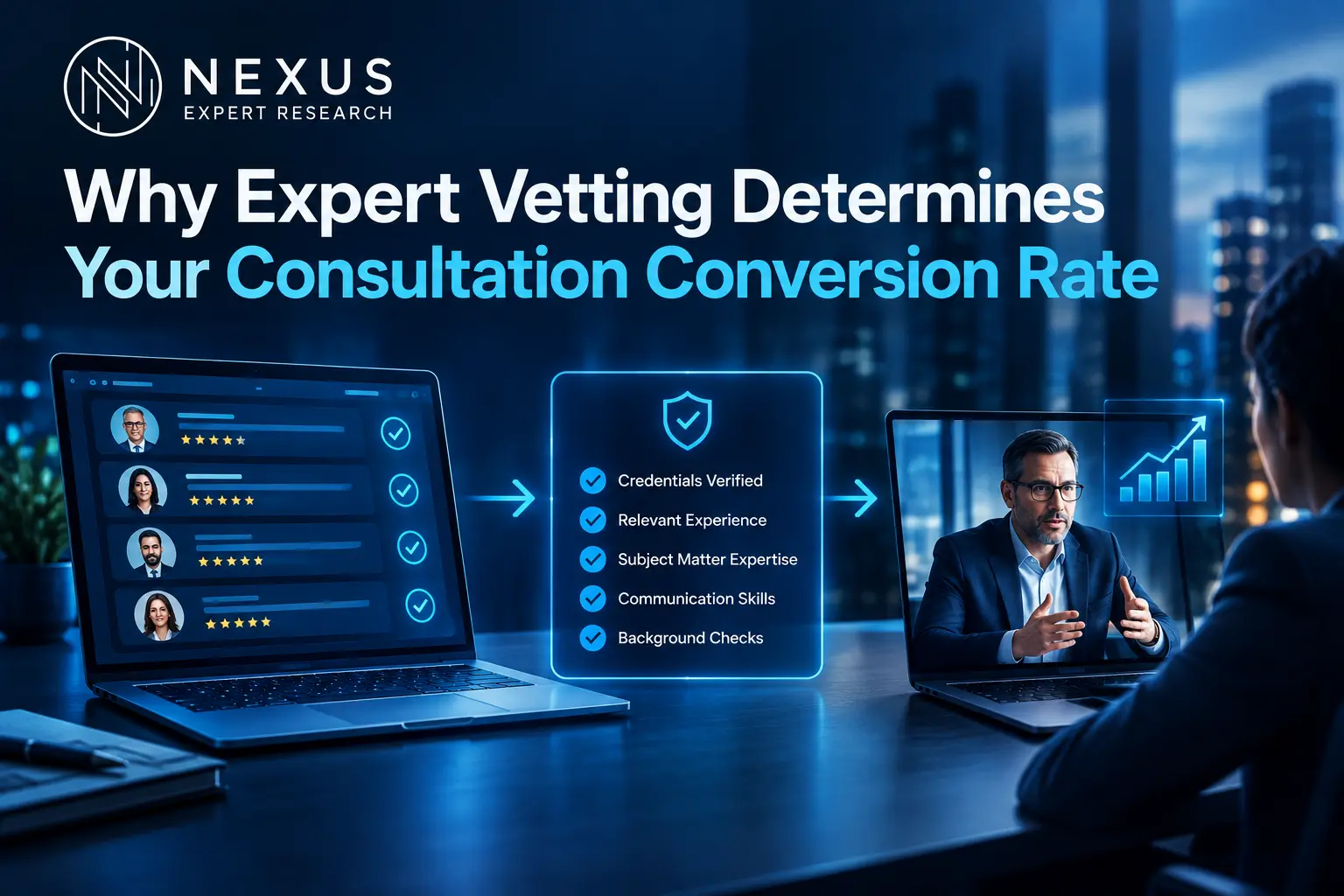
Why Expert Vetting Determines Your Consultation Conversion Rate
When an enterprise due diligence team sends an expert invitation, they are not just scheduling a call. They are committing analyst time, senior attention, and in many cases, deal-critical hours to a conversation that either sharpens their conviction or wastes it. The quality of that conversation is determined long before the calendar invite goes out.
The uncomfortable truth about expert network conversion rates: most low invitation-to-consultation conversion rates are not a scheduling problem. They are a matching problem.
The global expert network market is projected to reach $2.1 billion by 2025, growing at an 11.7% CAGR, according to industry data compiled by Gitnux. That growth reflects surging demand for primary intelligence. What it does not reflect is whether clients are getting the right experts for their specific questions. Those are two very different things.
At Nexus Expert Research, the vetting process was built around a single premise: an expert who genuinely fits the brief will almost always accept a consultation invitation. The inverse is also true. Mismatched experts decline, delay, or accept and then underdeliver. Every weak match in a shortlist is a conversion drag. The methodology described below is designed to eliminate that drag before it starts.
The Structural Problem With Database-Driven Matching
Most expert networks operate on a database model. A client submits a brief, a keyword search runs against a pool of pre-registered advisors, and a shortlist surfaces within hours. The speed is real. The precision is not.
The database model has four structural limitations that directly suppress conversion rates:
- Profile staleness: Experts who registered years ago may have changed roles, industries, or areas of specialization without updating their profiles. A network cannot verify currency without active re-engagement on every brief.
- Keyword-dependent matching: Algorithms rely on overlap between client brief language and expert profile language. Nuanced requirements that are not explicitly tagged often produce weak or adjacent matches, not precise ones.
- Self-selection bias: Database networks attract experts who actively sought out the platform. That pool skews heavily toward consultants, career advisors, and professional experts rather than current operators with live market knowledge.
- Niche coverage gaps: Pre-registered databases reflect historical recruitment patterns. Experts in fast-growth geographies or highly specialized sectors are systematically underrepresented because they were not recruiting priorities when the database was built.
Why This Matters for Conversion
The conversion rate impact of these limitations is direct. When a shortlisted expert’s profile is stale, keyword-adjacent rather than contextually precise, or drawn from a self-selected advisor pool, there is a fundamental mismatch between what the client needs and what the expert can actually deliver. That mismatch manifests at the invitation stage: the expert declines because the topic is outside their current scope, accepts but struggles to answer targeted questions, or delivers insights that are generic rather than operationally specific.
The result is a conversion funnel that leaks at every stage: low acceptance rates, high no-show rates, and consultations that fail the quality threshold even when they technically occur.
For enterprise clients running competitive due diligence with tight timelines, this is not an inconvenience. It is a material research risk.
The Nexus Approach: Sourced From Scratch, Vetted Against the Brief
Nexus Expert Research does not maintain a standing pool of pre-registered advisors. Every engagement begins with a blank slate and a specific brief. That structural choice is not a limitation; it is the foundation of the methodology.
The process runs in four distinct phases, each designed to eliminate a different category of mismatch before an expert ever receives an invitation.
Phase 1: Brief Deconstruction
Before any sourcing begins, the engagement team analyzes the client’s brief at a granular level. This goes beyond identifying industry and seniority. The analysis maps the specific operational context the expert must have direct exposure to: the business model being evaluated, the geographic market in question, the time period of relevant experience, and the specific diligence angle the client is pursuing.
This phase frequently surfaces requirements that a keyword search would miss entirely. A client asking for “supply chain expertise” in a logistics deal may actually need someone with direct experience operating a specific fulfillment model in a specific regional market. Those distinctions are captured in brief deconstruction and drive the entire sourcing effort that follows.
Phase 2: Targeted Sourcing
With a precise profile defined, the sourcing team conducts active outreach across professional networks, industry directories, conference rosters, and referral channels. The goal is to identify individuals who match the brief exactly, not those who are available and approximately relevant.
This is the critical difference between precision sourcing and database retrieval. A database search finds who is registered. Active sourcing finds who actually has the experience the brief requires, regardless of whether they have ever engaged with an expert network before.
This approach is especially consequential for niche mandates. When a client needs a former Big 4 director with direct experience in a specific regulatory environment, or a technical lead who has operated a particular infrastructure stack at enterprise scale, those professionals are rarely sitting in pre-registered advisor pools. They are found through deliberate, targeted outreach.
Phase 3: Pre-Invitation Vetting
This is the phase that most directly drives invitation-to-consultation conversion rates, and it is where the Nexus methodology diverges most sharply from standard industry practice.
Before any expert is presented to a client, they undergo a live screening call with a Nexus research analyst. That call verifies four things:
| Vetting Dimension | What Is Assessed |
|---|---|
| Contextual relevance | Does the expert’s experience map to the specific operational context in the brief, not just the industry? |
| Knowledge currency | Is the expert’s insight current, or is it based on experience that predates the client’s diligence window? |
| Depth under questioning | Can the expert hold up under targeted, specific questions from a sharp deal team? |
| Compliance clearance | Has the expert been screened for conflicts, MNPI exposure, and engagement-specific compliance requirements? |
An expert who clears all four dimensions is presented to the client. An expert who does not is filtered out before the invitation is ever sent. This is the mechanism that converts precision sourcing into high conversion rates: by the time a client sends an invitation, every expert on the shortlist has already been validated as genuinely capable of delivering on the brief.
Phase 4: Engagement Preparation
The final phase before invitation delivery involves briefing the expert on the engagement parameters: the topic scope, the client’s specific questions, compliance boundaries, and the format of the consultation. This preparation serves two functions. First, it ensures the expert arrives at the consultation ready to deliver substantive, targeted insight rather than a general overview of their background. Second, it further filters out experts who, when confronted with the specific scope, recognize that their knowledge does not meet the required depth.
The result is a shortlist where every name represents a genuine, current, operationally specific fit for the client’s brief.
What “Vetted” Actually Means in the Expert Network Industry
The word “vetted” appears in virtually every expert network’s marketing materials. It is worth being precise about what that term typically means, and what it means at Nexus.
Standard industry vetting covers three things: identity verification, employment history confirmation, and a compliance review. That process screens for credentials. It does not screen for whether the advisor’s knowledge is current, whether their experience maps to the specific operating context in the brief, or whether they can answer targeted questions from a deal team under pressure.
The distinction matters because credentials and contextual relevance are not the same thing. A former CFO with 20 years of experience in public-company finance may be entirely the wrong expert for a client diligencing a founder-led, mid-market business in a high-growth emerging sector. Their credentials are impeccable. Their relevance to the brief is limited. Standard vetting would surface them as qualified. Nexus vetting would filter them out.
The “Professional Expert” Problem
There is a well-documented phenomenon in the expert network industry sometimes called the “professional expert” problem. It refers to individuals who circulate through multiple networks simultaneously, taking calls across a wide range of topics, and delivering polished but generic responses built on recycled talking points rather than current operational knowledge.
These individuals pass standard credential-based vetting easily. They are experienced at presenting credibly in brief consultations. The problem is that their insights, while fluent, are not operationally grounded in the client’s specific context.
Custom sourcing from scratch carries a structural advantage here. Experts recruited freshly against a specific brief arrive with verifiable, current relevance. They have not been optimizing their profile for discoverability across dozens of networks. They were found because they specifically fit this brief, and their knowledge was tested against this brief before they were presented.
The practical implication: a smaller shortlist of precisely vetted experts consistently outperforms a longer list of credential-screened profiles. Fewer invitations, higher acceptance rates, better consultations. That is the conversion math that Nexus is built around.
The Conversion Rate Case: Precision Matching vs. Volume Shortlisting
Invitation-to-consultation conversion rates in professional services contexts are highly sensitive to the quality of the initial match. Research on B2B outreach benchmarks consistently shows that inbound, warm, and precisely targeted outreach converts at dramatically higher rates than cold, volume-based contact.
According to HubSpot data cited in 2026 LinkedIn conversion benchmarks, inbound leads convert at 14.6% while cold outreach leads convert at just 1.7%. That gap, a factor of nearly 9x, is driven almost entirely by the degree of prior qualification and relevance of the contact.
The same principle applies directly to expert network invitation conversion. An expert who was actively sourced to match a specific brief, screened on a live call, and briefed on the engagement scope is not receiving a cold invitation. They are receiving a targeted, relevant ask from a team that has already confirmed their fit. The behavioral response is fundamentally different from an expert who received an automated invitation because their profile keyword-matched a search query.
What High Conversion Rates Actually Measure
Conversion rate is a useful metric, but it is worth being precise about what it measures in this context and what it does not.
- High conversion rate from a well-matched shortlist signals that the vetting process is working: the right experts are being identified, screened, and presented.
- High conversion rate from a large, loosely matched shortlist may reflect aggressive follow-up or broad topic framing rather than genuine precision.
- Low conversion rate almost always signals a matching problem, not a scheduling or outreach problem.
The goal of the Nexus methodology is not to maximize the number of invitations sent. It is to maximize the ratio of consultations completed to invitations sent, by ensuring that every invitation goes to an expert who has already been verified as the right person for the brief.
The operational benchmark that matters: how many of the consultations that do occur actually move the client’s diligence forward? That is the downstream measure of matching quality, and it is what Nexus optimizes for.
For enterprise clients, the cost of a wasted consultation is not just the call fee. It is the analyst time spent preparing, the senior attention committed to the debrief, and the opportunity cost of a diligence window that closed without the insight needed to move conviction. Precision vetting is not a premium feature. For serious due diligence, it is a basic requirement.
Who the Nexus Methodology Is Built For
The custom-sourcing, live-vetting model is not the right choice for every expert network use case. It is worth being direct about where it delivers the highest value and where its trade-offs apply.
Where Precision Sourcing Wins
The Nexus methodology is most consequential in three scenarios:
- Niche and emerging sector mandates. When the required expertise sits outside the mainstream categories that large databases have historically recruited for, custom sourcing is the only reliable path to a genuinely qualified expert. Pre-registered pools are structurally underweighted in fast-growth geographies, specialized technical domains, and sectors where the most relevant operators are not actively seeking advisory engagements.
- Current operator knowledge requirements. When a client needs insight from someone with recent, active operational experience rather than a strategic perspective from a former executive, database profiles are unreliable. Profile freshness degrades rapidly. Custom sourcing verifies currency at the time of each engagement.
- High-stakes, time-sensitive diligence. In competitive auction processes or regulatory timelines where a mismatched expert call is not just disappointing but materially costly, the pre-invitation filtering that live vetting provides is essential. The cost of a wasted consultation in these contexts far exceeds the additional lead time that custom sourcing requires.
The Trade-Off to Acknowledge
Custom sourcing from scratch takes longer than pulling names from a database. For broad, mainstream searches where any senior executive from a well-represented sector will do, a database network can return results faster. That speed advantage is real and appropriate for certain use cases.
For the mandates that Nexus is built for, niche, current, operationally specific, the relevant question is not how quickly names can be surfaced. It is how quickly a genuinely qualified expert can be identified, vetted, and ready to deliver. On that measure, the Nexus model is designed to be both precise and efficient.
The institutions that get the most value from this approach are those whose diligence questions are specific enough that a broad advisor would not be useful. If the question is nuanced, the sourcing needs to be equally so.
The Questions to Ask Any Expert Network Provider
Evaluating expert network providers on cost, turnaround speed, and platform features is a reasonable starting point. It is not a sufficient one. The criteria that determine whether an expert actually delivers on a brief are different from the criteria that appear in most procurement scorecards.
When reviewing providers, the following questions separate genuine precision sourcing from database retrieval dressed up in vetting language:
- How do you source experts for niche mandates?
The answer should describe a specific outreach process, not a keyword search against a registered pool. - Is there a live vetting call before an expert is presented to my team?
Profile completion and compliance review are not the same as tested, contextual relevance. - How do you verify that an expert’s knowledge is current?
The answer should reference active engagement at the time of sourcing, not the date of profile registration. - How do you handle the “professional expert” problem?
Providers who recruit freshly for each engagement have a structural answer. Providers relying on standing databases do not. - What is your shortlist philosophy: volume or precision?
A provider who defaults to long shortlists is optimizing for the appearance of options. A provider who delivers a small, tightly vetted shortlist is optimizing for your conversion rate and your consultation quality.
The answers to these questions reveal whether a provider’s vetting process is a genuine quality filter or a compliance checkbox. For enterprise clients whose diligence outcomes depend on the quality of the insight they receive, that distinction is the whole decision.
Nexus Expert Research was built to answer every one of those questions with a documented, repeatable process. If you are running a mandate where the right expert is the difference between a well-informed decision and an expensive mistake, contact Nexus Expert Research to discuss your brief.
