
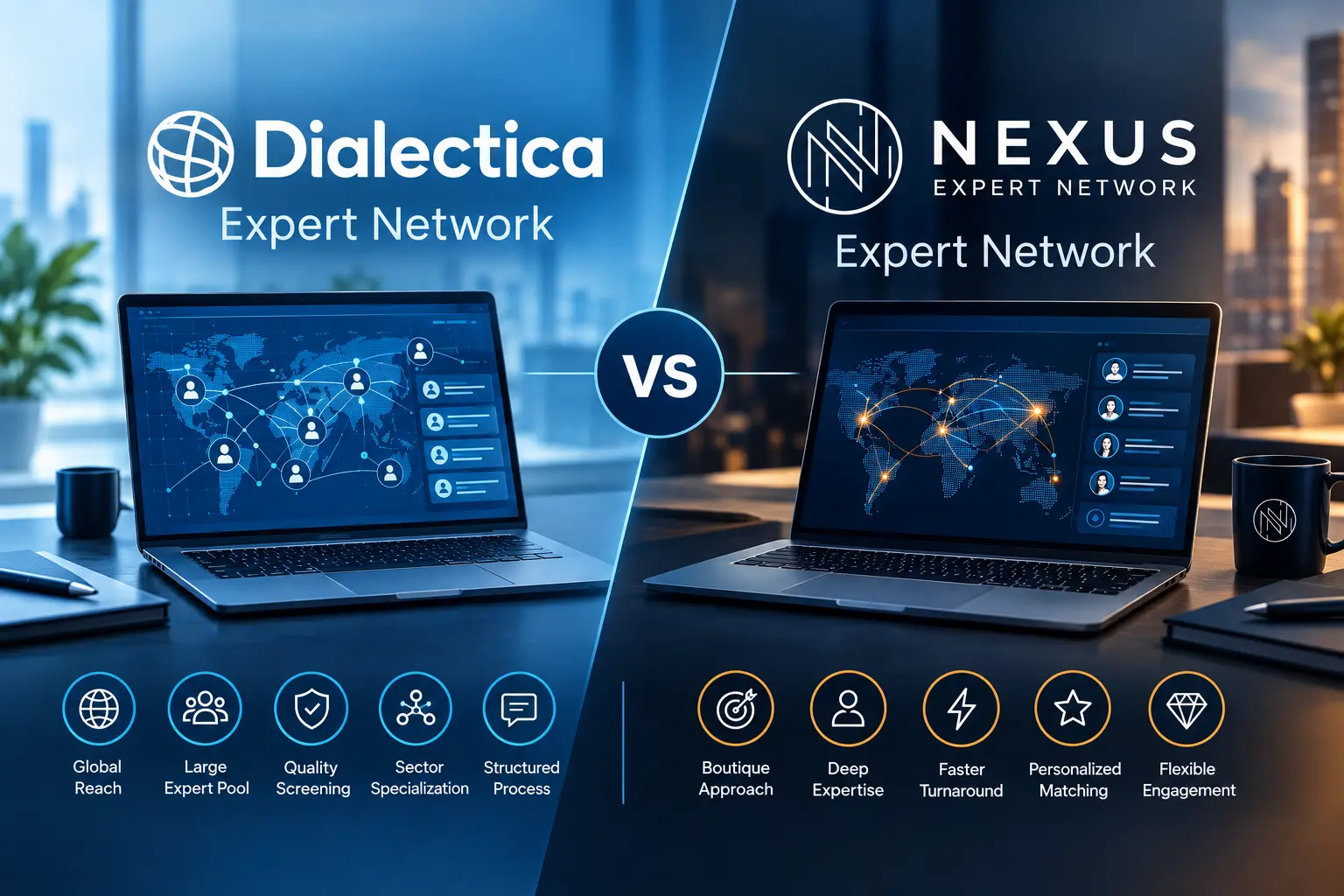
Dialectica vs Nexus Expert Network: Which Fits Your Brief?
Dialectica vs Nexus Expert Network comes down less to which company is universally “better” and more to which operating model fits your research workflow. For project-led consulting teams, VCs, startups and SMEs that value bespoke recruitment and flexible purchasing, Nexus is the stronger default; Dialectica becomes particularly compelling for larger institutions wanting a broader suite of calls, surveys, intelligence products and longer-term advisory services.
Choosing an expert network is not simply about finding someone who can answer a question. The practical value comes from finding the right operator, executive, customer, supplier or specialist quickly enough to influence a live decision.
That is why a meaningful expert network comparison should examine sourcing quality, speed, research formats, pricing transparency and compliance rather than database size alone. Independent 2026 comparisons similarly identify sourcing model, vetting, turnaround, compliance, coverage and commercial structure as important buying criteria.
For decision makers considering Dialectica vs Nexus, the distinction is increasingly clear: both can support bespoke primary research, but they package and scale the service differently.
Dialectica vs Nexus: the key differences at a glance
The Dialectica expert network is the larger and more institutionally established proposition. Founded in 2015, Dialectica says it now serves more than 70,000 global investment and business leaders and is used by leading consulting firms, private-market investors, asset managers and large corporations. Its product portfolio extends beyond calls into B2B surveys, strategic insight reports, company and market intelligence, and longer-term executive partnerships.
The Nexus Expert Network is positioned more narrowly around targeted primary research and custom recruitment. Its published consulting proposition emphasises recruiting against the individual brief, a typical expert-delivery window of 24–72 hours and pay-per-call purchasing without requiring a subscription for project-based customers. Its wider expert-network offering also supports calls, panels, written Q&A and advisory engagements.
For the target audience in this comparison, the result looks like this:
| Rank | Provider | Core strength | Published commercial approach | Best fit |
|---|---|---|---|---|
| 1 | Nexus Expert Research | Precision custom sourcing and project-led access | Pay per call prominently offered; retainer option also available for high-volume programmes | VCs, startups, SMEs, boutique consulting, PE and project-based research |
| 2 | Dialectica | Larger-scale, multi-product insight infrastructure | Public rate card not disclosed; third-party sources describe pay-as-you-go/credit mechanics | Large consultancies, institutional investors and teams needing calls plus surveys, intelligence and advisory services |
The commercial distinction needs nuance. Nexus’s consulting and VC pages explicitly promote no-subscription, pay-per-call access, while its broader service page also advertises an annual retainer for organisations with continuing call volumes. Dialectica directs prospects to sales rather than publishing a standard client price list.
This means the answer to “what is the best expert network platform?” depends on whether flexibility and narrow-fit recruitment matter more than institutional scale and breadth of products.
How do Dialectica and Nexus source experts?
Expert sourcing is one of the closest areas of competition between these companies. Neither should be reduced to a simple static database model.
Dialectica expert sourcing
Dialectica expert sourcing uses what the company describes as a research-first model. Dialectica says every consulting project can begin with tailored recruitment that goes beyond its existing database to identify, engage and screen people specifically relevant to the brief. Its calls service similarly stresses access to difficult-to-find experts outside traditional network pools.
That makes the common perception of Dialectica as merely a large database network inaccurate. Its own materials emphasise custom recruitment, and its B2B survey operation also recruits and verifies purpose-built groups rather than relying exclusively on pre-existing panels.
A current Dialectica expert network review should therefore recognise two strengths: scale and active research. Third-party comparisons in 2026 describe Dialectica as a high-touch, fast-growing challenger with substantial consulting and private-equity penetration rather than a purely self-service database.
Nexus expert sourcing
Nexus expert sourcing is built more explicitly around starting from the client’s question. Its consulting service says recruiters custom-source and screen practitioners for the required market, role and geography rather than simply filtering a fixed database. A separate workflow page states that standard B2B assignments can receive an initial shortlist within 24 hours of screener approval, with full confirmation within 48 hours for standard profiles.
This makes precision recruitment central to a Nexus Expert Network review. The advantage is most meaningful when the brief is narrow—for example, a particular customer type in a niche industrial value chain, a former executive with direct category knowledge, or an operator in a specific country.
The trade-off is equally important: no responsible provider can guarantee that every rare expert will be available within 24 hours. Nexus itself notes that while routine briefs can move quickly, niche or regulated searches may require 48–72 hours.
How do Dialectica vs Nexus expert calls compare?
Both Dialectica expert calls and Nexus expert calls are designed to convert a research brief into direct access to relevant professionals, but the surrounding service proposition differs.
Dialectica says its expert consultations are typically 30–60 minutes. Calls sit inside a broader ecosystem that also includes quantitative B2B surveys, reports, company and market intelligence, and longer-term senior-adviser engagements. That breadth matters when a project begins with interviews but later expands into quantitative validation or continuing research.
Nexus supports one-to-one calls as well as panels, written Q&A and extended advisory assignments, and it handles elements such as scheduling and compliance reminders around the engagement. Its consulting pages publish a typical 24–72-hour expert-delivery target.
Here is the practical Dialectica vs Nexus expert calls comparison:
| Decision factor | Nexus | Dialectica |
|---|---|---|
| Recruitment | Custom sourcing against the brief is central to the offer | Research-first sourcing that can go beyond the existing network |
| Typical published speed | 24–72 hours for consulting expert delivery; faster shortlists can be possible | Promotes rapid access, but no universal public turnaround guarantee found |
| Formats | Calls, interviews, panels, written Q&A, advisory | Calls, B2B surveys, reports, intelligence platform, executive partnerships |
| Best advantage | Focused, project-specific access | Breadth of primary-research and intelligence products |
| Key buying question | Is this exact expert worth speaking to now? | Do we need a broader research ecosystem around the call? |
The important conclusion is that Dialectica vs Nexus expert calls is not “database versus custom sourcing”. Both organisations publicly describe bespoke recruitment. The real distinction is one of operating emphasis: Nexus makes targeted recruitment and flexible expert access the centre of the proposition, while Dialectica combines bespoke sourcing with a wider information-services platform.

Dialectica vs Nexus pricing: what should buyers expect?
Dialectica vs Nexus pricing is one of the clearest areas where buyers should request written quotations before committing.
For Nexus Expert Network pricing, the provider publishes a useful benchmark: a standard senior one-hour call commonly falls between $650 and $900. Its consulting proposition emphasises pay-per-call purchasing with no subscription requirement, although the broader service menu also includes an annual-retainer option for high-volume clients. Those figures are first-party published prices, not an independent market audit, and individual specialist rates can vary.
That gives buyers a reasonably clear starting point for estimating Nexus expert network cost, particularly when call volumes are irregular.
Dialectica pricing is less transparent publicly. The official pages reviewed direct prospective clients to sales rather than showing a standard rate card. Inex One’s June 2026 competitor comparison reports an average cost of roughly $1,100 per hour and says Dialectica uses credits that can require multiple units for some calls. Because that claim comes from a direct competitor, it is better used as a negotiation benchmark than as definitive pricing.
Therefore, the safest answer on Dialectica expert network cost is: pricing appears to be quotation-led, and buyers should ask for both the unit/credit price and the expected number of credits consumed by the specific expert. Industry pricing varies materially with seniority, scarcity, geography and engagement requirements.
For a startup, VC or smaller consultancy running five calls one month and none the next, a straightforward per-call model can reduce the risk of unused committed spend. For a large institution with constant research demand, a negotiated enterprise arrangement may produce different economics.
Which network is better for consulting, private equity and investment research?
There is no useful expert network services comparison without matching the provider to the actual workflow.
Dialectica vs Nexus for consulting
For Dialectica vs Nexus for consulting, Nexus has the stronger default fit for boutique, independent and project-led consulting teams in this comparison. Its dedicated consulting proposition explicitly targets that audience, custom-sources against each brief and advertises 24–72-hour expert delivery without requiring an annual subscription for its per-call model.
Dialectica is particularly attractive when the consulting programme needs more than interviews. Its consulting portfolio spans expert calls, B2B surveys, market/company intelligence and bespoke insight products, and Dialectica says it works with all ten leading global strategy consulting firms.
Dialectica vs Nexus for private equity
For Dialectica vs Nexus for private equity, the decision is similar.
Nexus’s PE offering focuses on deal-driven sourcing, including former executives, customers, channel partners, suppliers and other profiles relevant to diligence. The company publishes a first-shortlist target of within 24 hours and same-week calls for its PE workflow.
Dialectica has substantial institutional private-market positioning and says it is trusted by more than 100 leading private-markets investment firms. Its broader research suite can be valuable when diligence requires both qualitative interviews and quantitative market validation.
For smaller funds and episodic deal flow, Nexus’s flexible purchasing structure gives it the edge here. For larger investment organisations conducting continuous, multi-format primary research, Dialectica’s wider infrastructure can justify consideration.
Dialectica vs Nexus for investment research
For Dialectica vs Nexus for investment research, compliance should rank alongside speed and sourcing quality.
Nexus states that its VC engagements include NDA coverage, MNPI screening and pre-call compliance briefings, with additional review for public-company employees where required. Dialectica likewise describes governance safeguards around expert interactions and runs screening before relevant consultations.
Neither network should be selected on speed alone. Investment teams should assess prohibited-topic controls, expert employment status, conflicts, data handling and their own internal compliance requirements before every sensitive call.
Which expert network should you choose?
For VCs, startups, SMEs and project-based consulting teams, Nexus takes the top position in this comparison because the combination of custom recruitment, published turnaround expectations and prominent pay-per-call purchasing aligns closely with intermittent, deadline-driven research demand. That is an inference from the providers’ current published models rather than a claim that one network will outperform the other on every brief.
Dialectica deserves serious consideration when institutional reach and product breadth matter more. It has developed beyond conventional expert calls into B2B surveys, strategic insights, company and market intelligence and executive partnerships, while continuing to use bespoke recruitment for calls.
A simple buying rule is useful:
Choose Nexus when the priority is a precisely defined expert, fast project execution and flexible call-by-call economics. Choose Dialectica when the requirement is a larger research relationship spanning several primary-research and intelligence formats.
Ultimately, Dialectica vs Nexus should be decided through a live brief rather than marketing claims. Give both providers the same expert specification, deadline and compliance constraints; compare relevance, speed and fully loaded pricing; and buy the research that gives your team the clearest evidence for the decision at hand.
Need the right operator, customer or specialist before your decision window closes? Nexus Expert Research gives project-led teams a precision-first route to vetted expert access.
Share the brief, compare the fit and turn a difficult research question into a decision-ready expert conversation.
