
What Does “AI Training Data” Actually Mean?
Training data is the information used to teach an AI or machine-learning model how to recognize patterns, make predictions, or generate outputs. It can include text, images, audio, video, numerical records, or other structured and unstructured information, and much of it is created or labeled by domain experts, the same kind of practitioners companies like Nexus Expert Research connect businesses with.
What Is Training Data?
A model starts with no task-specific knowledge until it is trained on data. It has no sense of what a cat looks like, what counts as spam, or how a customer’s tone signals a complaint until it studies a large collection of examples. That collection is the training data, and this matches IBM’s definition of the term. IBM describes the process simply: an algorithm processes a large amount of data and becomes “trained,” in much the same way a student becomes prepared for a test by studying the material beforehand. Skip the studying, and even a sophisticated algorithm has nothing useful to say.
How Is Training Data Different From Regular Data?
Not all data plays the same role in building a model. A handful of terms get used almost interchangeably in casual conversation, though each means something distinct.
| Term | What It Means |
|---|---|
| Raw data | Information exactly as collected, before any cleaning or organization |
| Labeled data | Raw data with the correct answer attached, such as an email tagged “spam” |
| Training data | The portion of the dataset used to teach the model; usually labeled in supervised learning, though other methods can use unlabeled data |
| Validation data | A separate portion used to fine-tune the model while it is still being built |
| Test data | A final, held-out portion used to check performance; it may be labeled for evaluation even though the model never sees those labels while predicting |
What Are the 3 Main Types of Training Data?
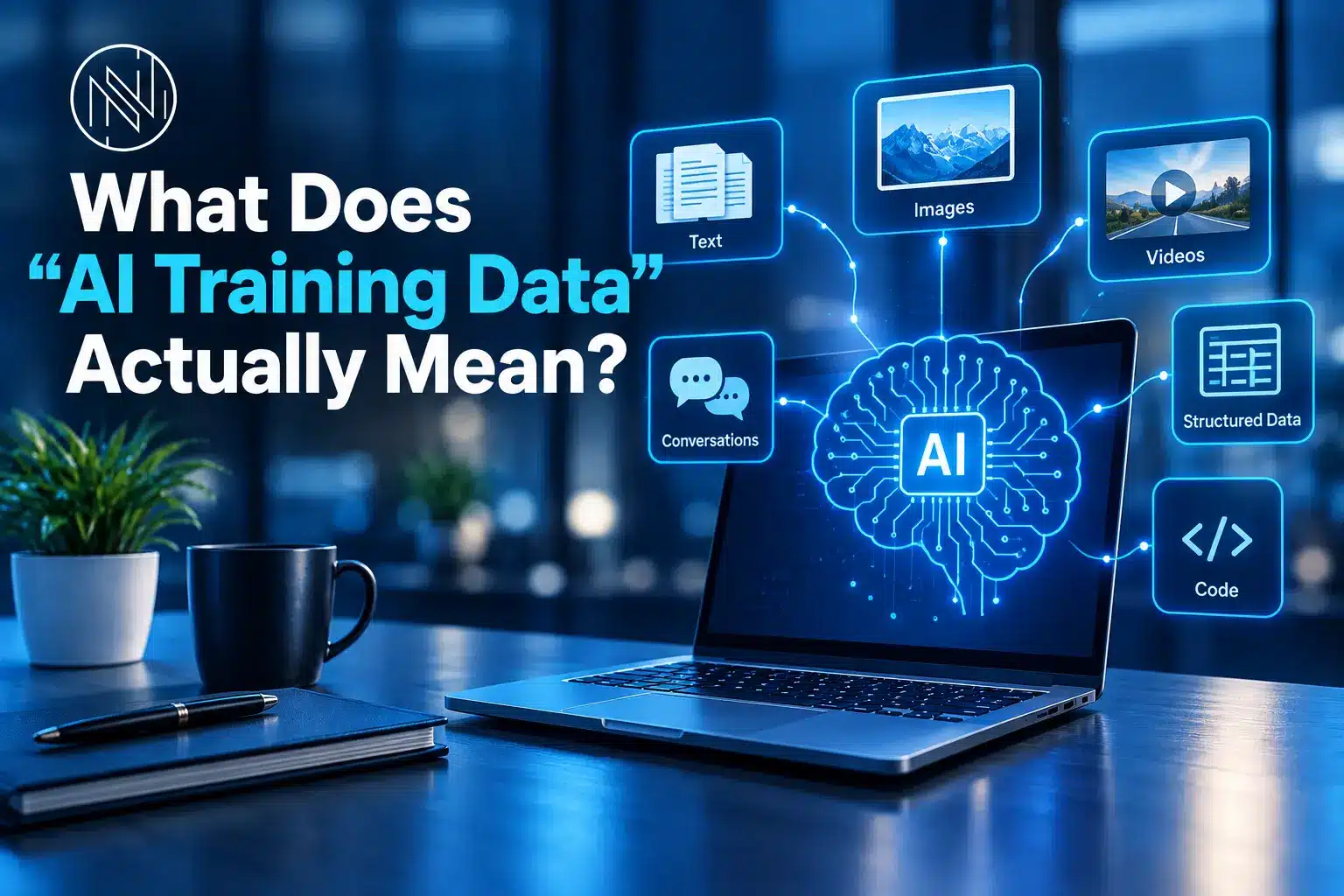
Training data comes in many forms. Text, image and video, and structured data are three common types readers are likely to encounter, though plenty of other formats exist beyond these three.
Text Data
Written language: emails, articles, chat transcripts, reviews, and any other text a model needs to read, summarize, or generate more of.
Image and Video Data
Photos, scans, and video footage, often labeled with what appears in each frame, used to teach a model to recognize objects, faces, or defects.
Structured Data
Information that already lives in rows and columns, like spreadsheets or database tables: prices, sensor readings, transaction records, and similar numerical or categorical fields.
Who Creates Training Data?
A surprising number of people touch a dataset before a model ever sees it. Companies and researchers assemble the raw material, often from their own products or public sources, while dedicated data providers sell curated datasets built for a specific purpose.
Human annotators do the hands-on work of labeling, and IBM notes that this work often requires real domain expertise, since labeling legal documents correctly usually takes someone with a legal background rather than a general labeler. AI trainers oversee the broader process, checking quality and deciding when a dataset is actually ready to use.
Why Does Training Data Need to Be Labeled?
In supervised learning, the most common approach for tasks like spam detection or image recognition, a model learns patterns by being shown thousands of examples paired with the correct answer, then works out the statistical pattern connecting the two. IBM’s own example is spam filtering: a model studies emails already labeled “spam” or “not spam,” notices that certain words show up disproportionately in the spam pile, and applies that pattern to new, unlabeled email going forward. In supervised learning specifically, without labels the model cannot learn the mapping from inputs to outcomes; other approaches, like unsupervised learning, work directly with unlabeled data instead.
Is More Training Data Always Better?
The instinct says yes. The honest answer is no.
| Factor | Why It Matters More Than Sheer Volume |
|---|---|
| Data quality | Clean, accurate examples teach a model faster than a larger pile of messy ones |
| Relevance | Data that does not match the actual use case adds noise, not skill |
| Diversity | A dataset can be enormous and still miss entire groups or scenarios |
| Accuracy | Mislabeled examples actively teach the model the wrong pattern |
| Representation | The dataset needs to reflect the real population the model will encounter |
| Noise | Irrelevant or contradictory examples make the true pattern harder to find |
| Bias | A skewed dataset produces a skewed model, no matter how large it gets |
NIST’s research on AI bias makes this point directly: large-scale datasets can still fail to represent the population a model is meant to serve, since teams tend to reach for whatever data is easiest to access rather than what is actually most representative. Size alone never fixes that gap.
How One Labeled Image Becomes Part of a Model
Photo → Human label → Dataset → Training → Model learns pattern → New image → Prediction.
A photo of a dog gets uploaded to a dataset. A human annotator looks at it and adds the label “dog.” That single labeled photo joins thousands of others, some labeled “dog,” some labeled “cat,” some labeled something else entirely.
During training, the model studies the pixel patterns across every labeled photo and works out what tends to distinguish a dog picture from everything else.
Once training finishes, a brand new photo, one the model has never seen, gets fed in without a label. The model applies what it learned and predicts “dog,” with a confidence score attached. Multiply this single example by millions, and that is roughly how image recognition gets built.
What Happens to Training Data After It Is Collected?
Raw data rarely goes straight into a model. It moves through a fairly standard pipeline first.
| Stage | What Happens |
|---|---|
| Cleaning | Removing duplicates, fixing errors, and standardizing formats like dates |
| Labeling | Adding the correct answer or category to each example |
| Quality checks | Catching mislabeled or inconsistent examples before they teach the model something wrong |
| Splitting | Dividing the dataset into training, validation, and test portions |
| Training | Using the training portion to teach the model the underlying pattern |
| Validation | Fine-tuning the model’s settings using data it has not directly trained on |
| Testing | Checking final performance on data the model has never seen at all |
Frequently Asked Questions
What is training data in AI?
It is the collection of examples, text, images, numbers, or other information, that a machine learning model studies in order to learn how to make predictions or generate outputs.
Who provides training data for AI models?
Companies, researchers, dedicated data providers, and human annotators with relevant domain expertise all contribute, often working together on the same dataset.
How much training data does an AI model need?
It depends heavily on the task and the model, but quality and relevance generally matter more than raw volume once a dataset reaches a reasonable size.
What is an example of training data?
A set of emails labeled “spam” or “not spam,” used to teach a spam filter, is a classic example.
What is the difference between training and test data?
Training data teaches the model the pattern. Test data is a separate, held-out set used afterward to check how well the model actually learned it, and it may carry its own labels for evaluation even though the model never sees them while predicting.
Good labeling is often one of the hardest parts of this whole process, especially for specialized fields like law, medicine, or engineering, where a labeler needs to actually understand the subject matter to label it correctly. That is where domain experts, the same kind of practitioners expert networks like Nexus Expert Research connect companies with, tend to matter most: not for building the model itself, but for making sure the data it learns from is actually right.
