
Per-Call vs Subscription Expert Network Pricing
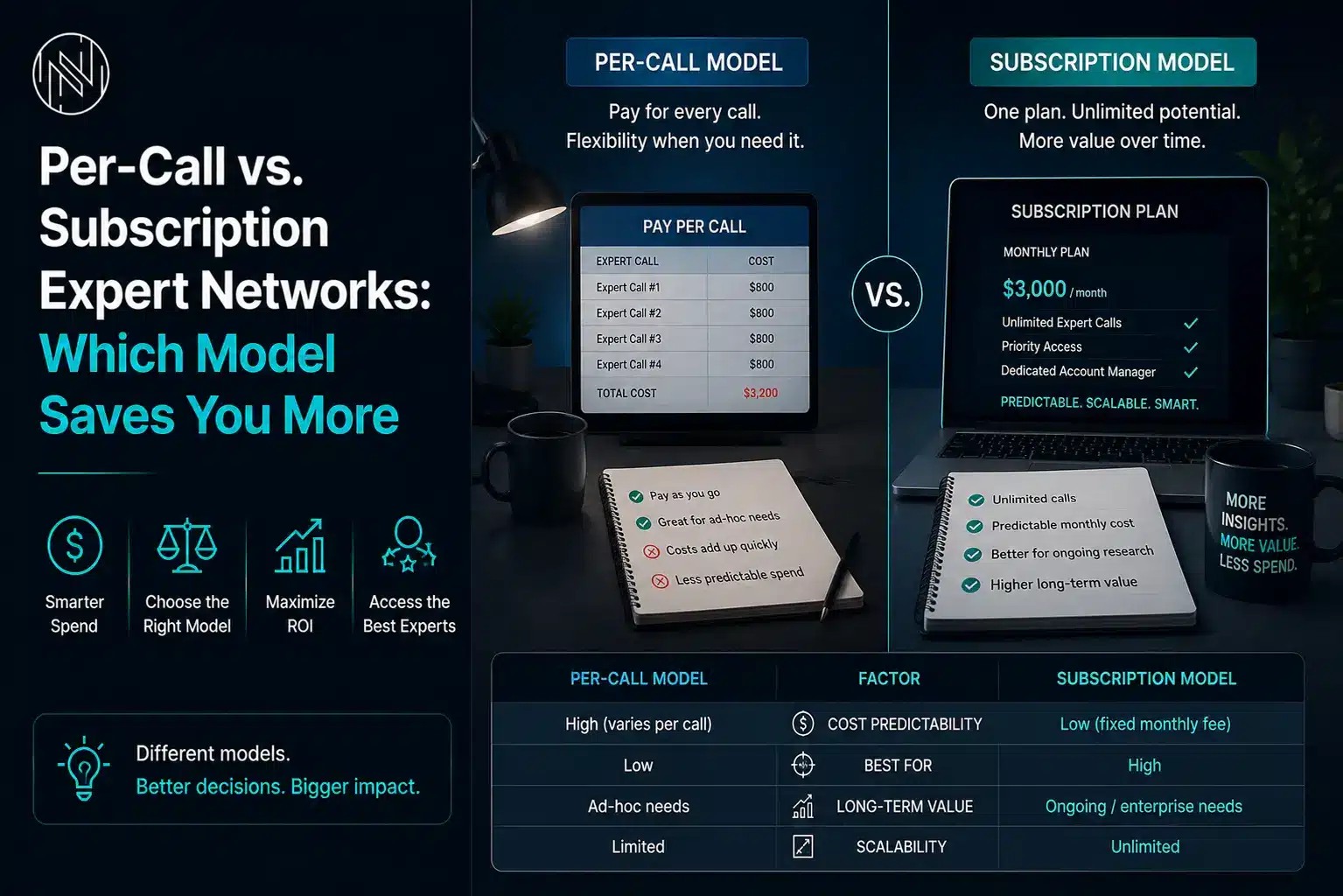
A per-call expert network charges for each consultation, typically ranging from $400–$1,500 per call depending on the expert’s seniority and topic complexity. Subscription models require annual commitments (often $20K–$150K+) and use credit systems; unused credits may expire. For occasional users needing only a few calls a year, pay-per-call pricing usually delivers greater flexibility and ROI. High-volume users may find subscription discounts reduce the effective cost per call, but at the expense of lock-ins and potential hidden fees.
Introduction
Expert networks connect businesses with industry specialists to answer strategic questions, validate assumptions, and gather competitive intelligence. These networks operate under two primary pricing models: per-call and subscription. Decision makers, venture capitalists, startups, and growing businesses often wonder which model offers better value. The answer depends on usage patterns, budget flexibility, and the trade-offs between transparency and bulk discounts. This article compares per-call and subscription expert network pricing models for 2026, using real data from leading providers and industry studies. We also explore factors such as expert seniority, geography, and compliance that influence costs, giving you a clear framework for choosing the right approach.
Understanding Expert Network Pricing Models
Pay-As-You-Go (Per-Call) Pricing
In a per-call expert network, clients pay only for the consultations they conduct. Typical costs range from $400 to $1,500 for a 45–90 minute call, depending on the expert’s seniority and the compliance level needed. Mid-level managers command around $300–$600 per hour, senior executives $600–$1,200, and highly specialized experts can exceed $1,200–$2,000 per hour. This model offers transparency: you know the cost upfront and pay only when you engage an expert. Modern pay-per-call networks or marketplaces like Inex One display pricing in real currency rather than credits, with median call costs around $1,100 per hour.
Benefits
- Flexibility and cost control. You avoid upfront commitments and only pay for actual usage.
- No unused credits. You pay per call, so there’s no risk of expiring credits or wasted budget.
- Transparent pricing. Many per-call platforms show the rate before booking, eliminating hidden multipliers.
Drawbacks
- Higher unit cost for frequent users. Without volume discounts, frequent callers might pay more per call than subscription members.
- Limited extras. Some add-ons, such as transcript libraries or survey tools, may cost extra.
Subscription and Credit-Based Pricing
A subscription expert network involves an annual contract with a set number of credits. Traditional networks like GLG, Guidepoint, and AlphaSights require commitments between $20K and $150K per year. Subscribers purchase credits that are deducted for each call; however, one call often costs more than one credit due to premium expert multipliers. Unused credits may expire, creating a lock-in effect.
Benefits
- Predictable budgeting. Subscription fees provide a fixed research budget for the year.
- Volume discounts. High-volume users can reduce the effective cost per call; for example, Inex One offers up to 25% off for volume projects.
- Bundled resources. Some subscriptions include access to transcript libraries, market reports, or surveys.
Drawbacks
- High upfront cost and commitment. Annual commitments of $50K–$150K+ are common.
- Unused credits expire. If usage is below the contracted number of calls, credits may be forfeited.
- Hidden multipliers and fees. Premium experts often cost multiple credits, obscuring actual costs.
Hybrid and Marketplace Models
Some expert network platforms combine both pricing structures. For instance, Inex One is a marketplace that aggregates over 30 networks. Clients can pay per call or purchase a small platform fee for access and then pay per interview. This model offers greater price visibility and a larger expert pool. Similarly, aggregator platforms like Expert Network Calls provide pay-per-call pricing without subscriptions, connecting clients to multiple partner networks.
Cost Drivers: What Makes One Expert Call More Expensive Than Another?
Understanding why expert calls vary in price helps you budget effectively. According to Silverlight Research’s pricing overview, several factors influence pricing:
- Expert seniority and scarcity: Rates increase with seniority and rarity of experience. Mid-level operators cost $300–$600/hour, while highly specialized experts can exceed $1,200–$2,000/hour.
- Industry and complexity: Calls involving regulated sectors (like pharmaceuticals or financial services) or cutting-edge technology require greater compliance and preparation, raising costs.
- Geography: Experts based in developed markets (US, Western Europe) typically command higher fees.
- Urgency: Last-minute or urgent requests may incur premium multipliers.
- Compliance requirements: Strict compliance frameworks, including MNPI safeguards and real-time monitoring, add operational overhead.
Table 1: Illustrative Expert Network Cost Ranges by Expert Level and Engagement Format (2026)
| Expert level / engagement | Hourly rate (USD) | Typical per‑call cost (45‑90 min) | Notes |
|---|---|---|---|
| Mid‑level operators & managers | $300–$600/hour | $400–$700 | Ideal for tactical insights and operational questions. |
| Senior executives & subject‑matter specialists | $600–$1,200/hour | $700–$1,200 | Best for strategic guidance and market‑entry advice. |
| Highly specialized/regulated experts | $1,200–$2,000+/hour | $1,200–$1,500+ | Required for complex, high‑risk topics. |
These ranges illustrate typical cost tiers observed across global expert networks. Actual fees vary by provider, but they underscore how pay-per-call pricing scales with expertise.
Comparative Analysis: Per-Call vs. Subscription
Pros and Cons of Pay-Per-Call Networks
Per-call networks such as Nexus Expert Research, Inex One, Expert Network Calls, and emerging AI-enabled platforms provide flexible access without long-term commitments. Nexus Expert Research’s pricing model sets senior expert consultations at $650–$900 per call. There is no subscription minimum and no unused credits. This makes pay-per-call ideal for:
- Occasional or unpredictable needs. Firms conducting fewer than 20–30 calls per year avoid wasted credits.
- Startups and SMEs. Lower upfront costs support lean budgets.
- Pilot projects and due diligence. Quick expert access without long-term commitment reduces risk.
Limitations include higher per-call cost relative to subscription discounts and fewer bundled extras. However, aggregator platforms partly address this by offering AI-generated transcripts and unified dashboards at no additional cost.
Pros and Cons of Subscription Networks
Large research programs may benefit from subscription models. For example, GLG—a pioneer in expert networks—charges $50K–$150K+ annually. Guidepoint offers more flexible subscriptions at $20K–$80K+, while AlphaSights typically prices 5–10% lower than GLG (read our detailed GLG vs Guidepoint vs boutique networks comparison for more). These subscriptions provide unlimited or high-volume call allowances within credit limits.
Subscriptions are well-suited for:
- High-volume callers. If your team expects more than 50 calls per year, subscription discounts can reduce the effective cost per call.
- Enterprises needing bundled services. Many subscriptions include surveys, transcript libraries, and dedicated account managers.
- Predictable budgeting. Annual commitments fit procurement processes in large corporates.
Drawbacks include large upfront commitments, potential for unused credits, and hidden premium multipliers. Credit systems used by GLG and similar networks can obscure actual costs because certain experts cost multiple credits. Companies also lose flexibility if research needs change mid-year.
Hybrid and Marketplace Options
Hybrid solutions allow clients to choose between per-call payments and subscriptions. Inex One, for example, offers transparent pricing with a median cost of $1,100 per call—about 20–30% lower than traditional networks because there are no credit multipliers. Clients can pay per call or get volume discounts for larger projects. Marketplace aggregators like Expert Network Calls combine multiple networks under one interface. They charge no subscriptions and invoice clients after each call, providing AI-generated transcripts and summaries at no extra cost. For companies wanting to compare providers and avoid vendor lock-in, these marketplaces—or boutique expert networks—offer an appealing alternative.
Table 2: Comparison of Leading Expert Network Pricing Models in 2026
| Provider | Pricing model | Annual commitment | Typical per‑call cost | Notes |
|---|---|---|---|---|
| Nexus Expert Research | Pay‑per‑call | None | $650–$900 per senior expert call | Custom sourcing; no unused credits. |
| GLG | Subscription & credit | $50K–$150K+/yr | ~$1,350/hour | Large network; credit multipliers apply. |
| Guidepoint | Subscription | $20K–$80K+/yr | $1,000–$2,500/hour | More flexible than GLG; enterprise-level compliance. |
| AlphaSights | Pay‑per‑call or subscription | Typically 5–10% lower than GLG | $1,500–$3,000/hour | Fast matching; premium service fees. |
| Inex One | Pay‑per‑call with volume discounts | None | Median $1,100/hour | Marketplace aggregator; transparent pricing. |
| Expert Network Calls (ENC) | Pay‑per‑call marketplace | None | Variable (based on partner networks) | Self‑service; AI transcripts included. |
ROI Considerations and Use-Case Guidance
Choosing between per-call and subscription models depends on three key factors: usage volume, budget flexibility, and research urgency. Here’s a practical framework:
- Low volume & high flexibility: Startups, SMEs, and occasional users (fewer than 20 calls/year) benefit from pay-per-call models like Nexus Expert Research. They pay only for needed consultations and avoid the risk of unused credits.
- Medium volume & unpredictable needs: Hybrid platforms (Inex One, Expert Network Calls) offer a blend of flexibility and cost control. Clients can purchase calls on demand and negotiate discounts for larger projects.
- High volume & predictable usage: Large consulting firms, private equity funds, or corporates conducting dozens of calls monthly may achieve lower per-call costs via subscriptions from GLG or Guidepoint. However, they must manage credit usage carefully to avoid wasted spend.
Maximizing ROI
- Define your research volume. Estimate how many expert calls you will need annually. If you don’t exceed 20–30 calls, per-call pricing is usually more cost-efficient.
- Align expert seniority to project needs. Avoid overpaying by matching the expert’s level to the complexity of your question.
- Leverage aggregator marketplaces. Platforms like Inex One and Expert Network Calls allow you to compare pricing across networks and avoid lock-in.
- Monitor credit policies. For subscription plans, verify rollover policies, premium multipliers, and expiry dates to avoid hidden costs.
- Consider compliance needs. Regulated industries require networks with robust compliance protocols. This may justify higher costs.
How Nexus Expert Research Fits Into the Landscape
Nexus Expert Research exemplifies a boutique, pay-per-call model. By recruiting custom experts for each project rather than relying on pre-vetted databases, Nexus delivers highly relevant insights without annual commitments. Their pricing sets senior expert calls at $650–$900—below many traditional networks—making it attractive for decision makers seeking targeted support. Nexus’s strong compliance framework and rapid matching (typically within 24 hours) provide high-quality consultations without hidden fees.
For companies exploring alternatives to GLG or AlphaSights, Nexus offers cost-effective access to curated specialists, especially when research needs are sporadic. Their model is particularly valuable for venture capital, startups, and small to mid-sized businesses that require bespoke insights but cannot justify large subscriptions.
Future Trends and Expert Network Innovations
The expert network industry is evolving quickly. AI-driven matching algorithms are improving speed and relevance — a trend especially visible as AI companies become the biggest buyers of expert network time — while compliance technology is becoming more sophisticated with real-time monitoring. Aggregator platforms are gaining traction, enabling clients to compare providers and optimize costs across networks. Growth in emerging markets — especially the Middle East and Southeast Asia — means demand for localized expertise is rising.
Ready to make smarter decisions with tailored expert insights? Contact Nexus Expert Research and gain immediate access to custom‑matched specialists without long‑term commitments. Contact us today to schedule your first consultation and experience the difference a precise, cost‑effective expert network can make.
