
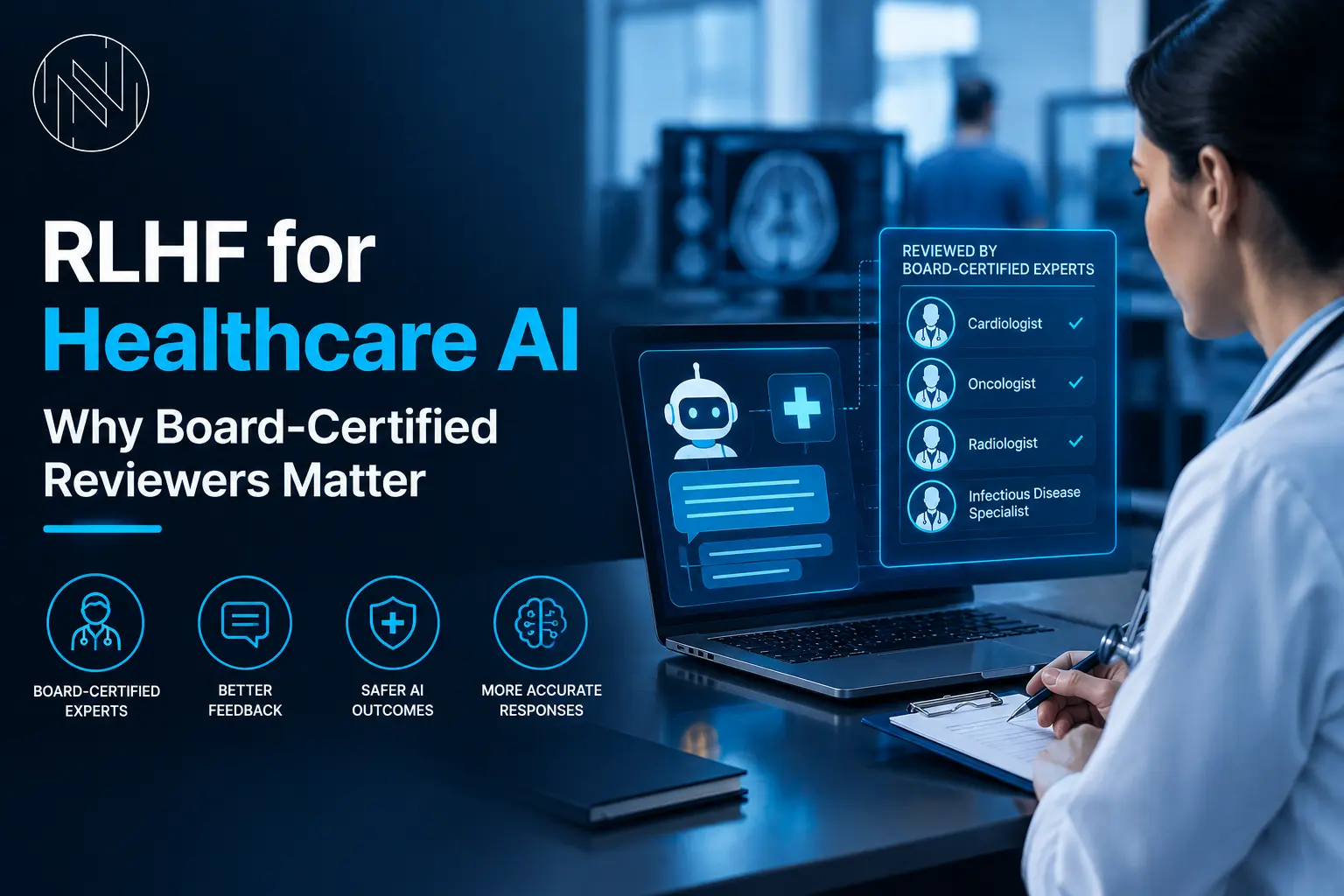
RLHF for Healthcare AI – Why Board-Certified Reviewers Matter
Clinical reviewers for AI matter because healthcare models can produce fluent answers that contain subtle clinical errors, unsafe omissions, incorrect contraindications, or inappropriate recommendations. Board-certified specialists can convert clinical judgment into higher-quality training signals, but their input must be combined with independent validation, documented governance, and continuous monitoring.
A medical AI model does not need to sound obviously wrong to create risk. It may recommend a common treatment without recognizing a drug interaction, miss an escalation trigger, apply guidance from the wrong jurisdiction, or present uncertain evidence with excessive confidence.
That gap between linguistic fluency and clinical reliability is why healthcare AI RLHF requires more than a large pool of general annotators. It requires reviewers whose expertise matches the medical task, patient population, care setting, and level of risk.
Recent research supports this concern. A 2025 review of 186 healthcare LLM studies found that accuracy was commonly assessed, while several harm-related dimensions including hallucination, bias, toxicity, and privacy were evaluated far less often. This suggests that models can appear strong on conventional benchmarks while important safety risks remain underexamined.
What Is RLHF for Healthcare AI?
Reinforcement learning from human feedback, or RLHF, is a model-alignment method that uses human preferences to influence AI behavior. Instead of relying only on automated accuracy scores, reviewers compare, rank, correct, or critique model outputs.
In practical terms, human feedback for AI becomes structured data. A reward model or another preference-optimization method learns which outputs reviewers consider safer, more accurate, and more useful.
The search phrase reinforcement learning from human feedback healthcare therefore describes more than conventional data annotation. It involves teaching a model how qualified healthcare professionals judge clinical relevance, risk, uncertainty, and appropriate next actions.
The Four Main Stages of a Healthcare RLHF Workflow
A typical workflow includes the following stages:
| Stage | What happens | Role of the clinical reviewer |
|---|---|---|
| Supervised fine-tuning | The model receives examples of high-quality answers | Writes or approves clinically appropriate responses |
| Preference collection | Reviewers compare multiple model outputs | Ranks answers and explains why one is safer or better |
| Reward-model training | Human preferences become predictive signals | Supplies consistent, rubric-based judgments |
| Model optimization | The model is adjusted toward preferred behavior | Reviews new outputs, edge cases, and regressions |
The original InstructGPT workflow used human-written demonstrations, pairwise comparisons, a reward model, and reinforcement learning to align model behavior. It also showed why simple automatic metrics are insufficient for subjective safety and alignment problems. Some modern pipelines use alternative preference-optimization techniques. However, the central requirement remains the same: poor-quality expert feedback creates poor-quality alignment.
Why General RLHF Is Not Enough for Medical AI
General RLHF can improve politeness, relevance, format, and instruction-following. RLHF in healthcare, however, must also address clinical reasoning and patient harm.
Three problems make medicine different:
Plausible falsehoods: A model can provide a confident, medically worded response that contains an incorrect dose, fabricated fact, or outdated recommendation.
Contextual nuance: Appropriate action may depend on age, pregnancy, comorbidities, laboratory results, local care pathways, and other treatments.
Safety criticality: An error involving chest pain, sepsis, anticoagulation, or medication interactions can cause more harm than an error in an ordinary consumer task.
This is why medical AI training should include specialty-specific edge cases, contraindications, uncertainty, red-flag symptoms, escalation thresholds, and safe refusal behavior.
Good healthcare AI safety also requires organizations to distinguish between a response that sounds helpful and one that supports safe action. For this reason, AI safety in healthcare is fundamentally a clinical-governance issue, not only a model-performance issue.
Why Board-Certified Reviewers Matter
Board-certified specialists contribute verified, specialty-specific knowledge and a stronger understanding of accepted clinical practice. They can identify errors that reviewers without relevant training may not recognize.
The commercial search phrase board-certified physicians AI points to a genuine procurement need: verified specialists who can evaluate AI behavior within a defined medical context.
Board Certification Provides Specialty-Specific Assurance
In the United States, board certification programs are designed to assess specialty knowledge, judgment, professionalism, and continuing development. The American Board of Medical Specialties states that continuing certification helps ensure specialists remain current and maintain the knowledge and skills required for patient care.
During RLHF, physician feedback for AI can help teams:
- Detects clinically dangerous omissions.
- Judge whether a differential diagnosis is appropriately prioritized.
- Evaluate contraindications and medication interactions.
- Recognize when urgent escalation is required.
- Separate reasonable uncertainty from hallucination.
- Assess whether advice fits the intended specialty and care setting.
- Create stronger examples for supervised fine-tuning.
Certification Alone Is Not Sufficient
Board certification is a useful quality signal, but it is not a complete reviewer-selection system.
A qualified panel should also consider:
- Active or recent clinical practice.
- Relevant specialty and subspecialty.
- Experience with the intended patient population.
- Familiarity with current guidelines.
- Knowledge of the target healthcare jurisdiction.
- Written communication ability.
- Conflicts of interest.
- Ability to follow a structured evaluation rubric.
- Training in AI limitations and review procedures.
A board-certified cardiologist may be ideal for reviewing heart-failure decision support but poorly matched to a dermatology triage model. The credential must fit the task.
Training, Evaluation, Validation, and Oversight Are Different
Healthcare AI teams often use these terms interchangeably. They represent separate controls.
| Activity | Primary purpose | Expert contribution |
|---|---|---|
| Healthcare AI training | Improve model behavior | Create examples, rank responses, and correct outputs |
| Medical AI evaluation and healthcare AI evaluation | Measure performance against defined criteria | Score accuracy, harm, reasoning, uncertainty, and usability |
| Medical AI validation and clinical AI validation | Test fitness for a specific intended use | Assess representative cases, workflows, users, and risks |
| Clinical oversight of AI | Manage use after deployment | Review escalations, incidents, drift, and changing guidance |
RLHF does not prove that a model is safe for clinical deployment. Training can also contaminate evaluation if the same reviewers, prompts, or cases are reused without appropriate separation.
The FDA has emphasized that static and retrospective benchmarks may not predict performance in dynamic clinical settings. Changes in patient populations, workflows, data inputs, and clinical guidance can produce performance drift, making continued real-world monitoring important. A well-designed human-in-the-loop healthcare AI system therefore keeps qualified professionals involved after model training. This is essential for meaningful responsible AI in healthcare.
What Should Clinical Reviewers Evaluate?
A strong evaluation rubric should measure more than factual correctness. Clinical expert feedback should address the full pathway from information to possible patient impact.
Reviewers should examine:
- Clinical accuracy.
- Completeness and missing information.
- Quality of reasoning.
- Guideline and jurisdictional alignment.
- Contraindications and interactions.
- Appropriate uncertainty.
- Escalation and referral recommendations.
- Potential for direct or indirect harm.
- Bias across patient groups.
- Communication clarity.
- Evidence traceability.
- Safe handling of insufficient information.
A structured medical expert AI review should also ask whether a response encourages automation bias. A technically correct answer may still be unsafe if it appears more certain than the available evidence permits.
The QUEST framework proposed in npj Digital Medicine organizes human evaluation around information quality, reasoning, communication, safety and harm, and trust. Its review of 142 studies found gaps in the reliability and generalizability of existing healthcare LLM evaluations.

How Should a Healthcare AI Reviewer Panel Be Designed?
A reliable panel is task-specific, diverse, calibrated, and independently adjudicated.
Match Credentials to the Intended Use
Start with the model’s intended user and clinical function. A patient-education chatbot, medical-coding assistant, radiology-report tool, and emergency triage system need different reviewers.
Panel composition may include physicians, nurses, pharmacists, allied health professionals, medical coders, patient-safety specialists, or healthcare ethicists. Board-certified physicians should lead judgments that depend on specialty diagnosis or treatment, but they should not automatically replace other relevant professional perspectives.
Calibrate Reviewers Before Production
Give reviewers the same sample cases and compare their judgments. Discuss disagreements, refine the rubric, and define examples of acceptable, borderline, and unsafe outputs.
Track inter-rater agreement, but do not treat agreement as the only measure of quality. Clinically meaningful disagreement can expose unclear guidelines, ambiguous cases, or an incomplete rubric.
Use Independent Adjudication
High-risk disagreements should be referred to a senior specialist who did not make the original judgment. Maintain an audit trail showing:
- The model and prompt version.
- Reviewer credentials.
- Scores and written rationales.
- Adjudication decisions.
- Evidence or guidelines consulted.
- Resulting model or policy changes.
These controls improve healthcare AI quality and make review decisions easier to explain to internal governance teams, partners, and regulators.
How Can Healthcare AI Companies Control Expert-Review Costs?
For buyers researching AI model evaluation healthcare services, the best answer is not to use expensive specialists for every task. It is to use expertise according to risk.
A tiered system can include:
- Board-certified specialists for rubric design, high-risk cases, and adjudication.
- Appropriately qualified clinicians for routine scoring within their scope.
- Automated checks for formatting, duplication, prohibited content, and basic consistency.
- Periodic specialist audits to detect reviewer drift and emerging failure patterns.
This approach concentrates scarce expert time where it has the highest safety value. It also avoids the opposite mistake: allowing automated evaluators or generalists to become the final authority on clinical correctness.
How Should Organizations Recruit Board-Certified Reviewers?
The right reviewer is defined by task fit, not title alone. Recruitment criteria should specify specialty, subspecialty, geography, years of practice, patient population, workflow experience, licensing status, and availability.
Project-specific custom sourcing is often more defensible for narrow clinical tasks than relying only on a broad, pre-existing expert database. Nexus Expert Research can help organizations identify hard-to-reach clinical specialists by project criteria and screen candidates for relevant expertise and communication quality before engagement.
Before onboarding reviewers, organizations should verify:
- Certification and licensing through authoritative sources.
- Current or recent practice.
- Direct experience with the target workflow.
- Availability and turnaround capacity.
- Data-security readiness.
- Conflicts and competing commercial relationships.
- Performance on a paid calibration exercise.
Frequently Asked Questions About Healthcare RLHF
Are board-certified physicians required for every healthcare AI task?
No. Reviewer qualifications should match the risk and intended use. Specialist physicians are important for diagnosis, treatment, and complex clinical reasoning. Nurses, pharmacists, coders, and other professionals may be better suited to tasks within their own scope.
Does RLHF count as clinical validation?
No. RLHF changes model behavior, while clinical validation tests whether a defined system is fit for a specific intended use. Validation should use representative data, users, workflows, and independent evaluation procedures.
Can expert feedback eliminate hallucinations?
No. It can reduce known failure patterns and improve model behavior, but it cannot guarantee error-free outputs. Monitoring, uncertainty controls, red teaming, and escalation pathways remain necessary.
Should expert review continue after deployment?
Yes. Clinical guidance, patient populations, user behavior, and model performance can change. WHO’s 2026 discussion paper recommends human verification, human-in-the-loop decision gateways, and multidisciplinary oversight for AI-supported health evidence workflows.
Board-Certified Review Is a Safety Control, Not a Credentialing Exercise
Board-certified reviewers matter because medical AI must be judged against clinical consequences, not linguistic quality alone.
Their value comes from applying relevant expertise through a defined rubric, calibrated process, independent adjudication, and documented governance. Used correctly, specialist review strengthens training and evaluation while providing a more credible path toward safe validation and monitored deployment.
Building a medical AI model that must earn clinical trust? Put the right specialty expertise into the loop before costly errors reach validation or deployment.
Nexus Expert Research can custom-source and screen the clinical reviewers your project requires, talk to our team about your reviewer criteria.
