
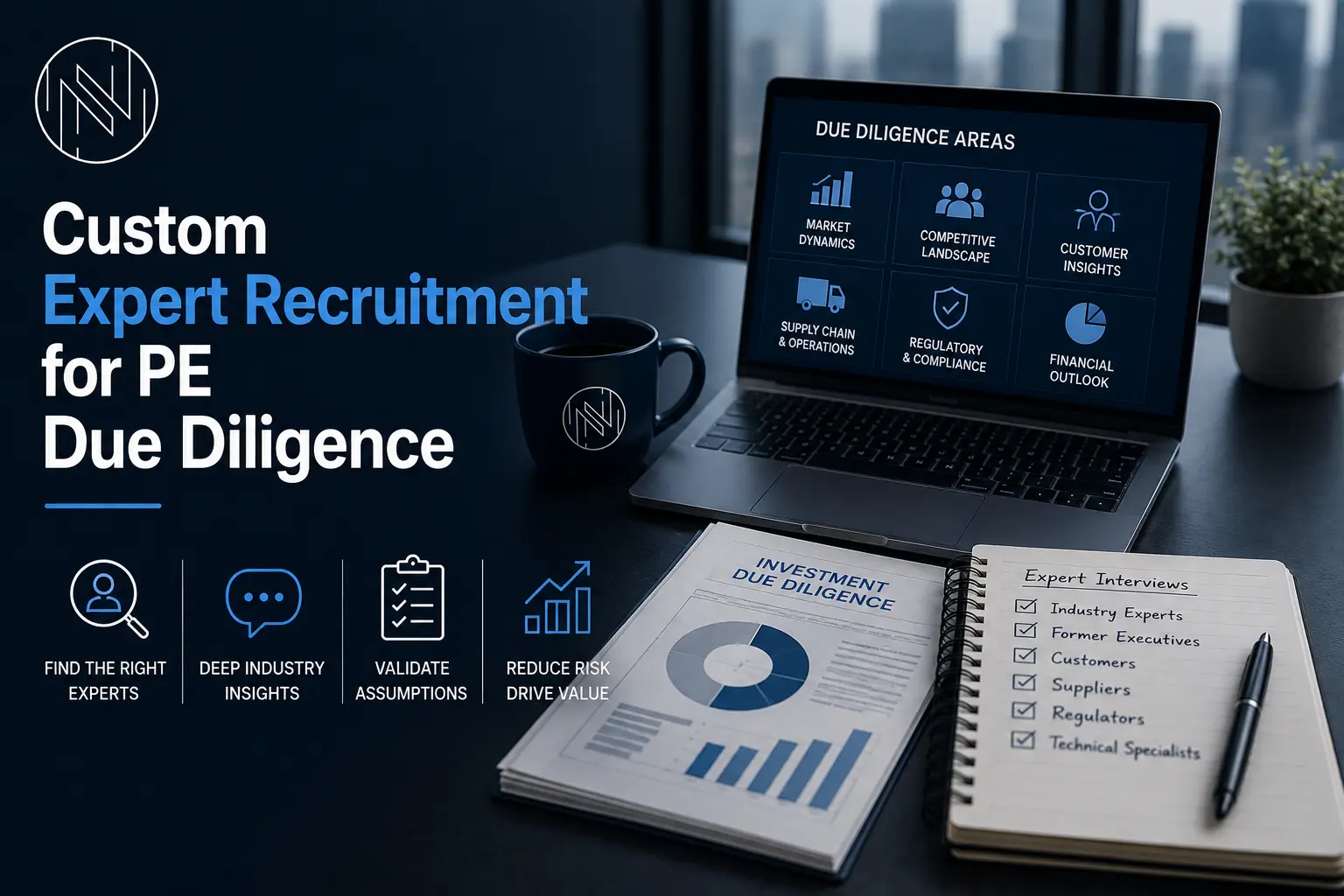
Custom Expert Recruitment for PE Due Diligence
PE due diligence experts give investors direct access to market knowledge that may not appear in financial statements, management presentations, or published reports. A custom recruitment model identifies operators, customers, former executives, and specialists whose exact experience matches the deal thesis, while applying appropriate screening and compliance controls before each engagement.
Private equity firms rarely make investment decisions using one information source. Financial analysis explains historical performance, legal diligence identifies contractual risks, and management presentations communicate the company’s growth narrative. However, these sources may not reveal how customers actually perceive the business, how competitors are responding, or whether operational assumptions are realistic.
This is where expert recruitment for private equity becomes valuable.
Expert interviews allow a deal team to test management claims against the experience of people who have worked inside the relevant market. Current expert-network guidance describes these calls as useful during early fact-finding, confirmatory diligence, investment-thesis testing, and post-close portfolio work.
Expert input should not replace financial, legal, tax, cybersecurity, or regulatory diligence. It should strengthen those workstreams by providing firsthand market context.
What Is Custom Expert Recruitment for PE Due Diligence?
A custom expert network for due diligence recruits specialists against the specific questions, market segment, and operational risks of an individual transaction.
Instead of searching only through existing profiles, the recruitment team begins with the investment thesis and identifies the people most qualified to challenge it. These individuals may include:
- Former executives of competitors
- Customers and former customers
- Suppliers and distribution partners
- Plant, procurement, or supply-chain leaders
- Regulatory and reimbursement specialists
- Technical product experts
- Former target-company employees, where appropriate
- Regional operators with local market knowledge
This form of industry expert recruitment is more precise than selecting an expert solely because the person has worked in the same broad industry.
For example, a “healthcare executive” may not be sufficiently relevant for a deal involving diagnostic-laboratory reimbursement in a specific US state. The better expert may be a former commercial director who negotiated with the relevant payers, understands reimbursement changes, and has direct experience in that local market.
A subject matter expert network should therefore evaluate functional experience, geography, customer exposure, seniority, recency, and topic-level knowledge — not merely employer names and job titles.
Why Standard Expert Databases May Not Be Enough
Standard databases are useful when the required expertise is common and the research question is broad. Their limitation becomes more visible when a deal team needs a highly specific combination of experience.
A database search might find professionals from the correct sector but still miss the exact operator, customer type, geography, or decision-making responsibility required for the diligence question. Custom recruitment fills that gap by sourcing candidates specifically for the project.
The Google AI Overview supplied for this topic reflects the same search intent: users are looking for bespoke sourcing, deeper vetting, niche access, hypothesis testing, and commercial validation rather than generic access to large directories.
| Recruitment Model | How It Works | Best Suited For | Main Limitation |
|---|---|---|---|
| Project-specific custom recruitment | Sources and screens experts against the exact deal thesis | Niche markets, technical assets, and complex diligence | Requires a well-defined research brief |
| Database-led matching | Searches existing expert profiles using filters | Broad market orientation and common expert profiles | Available profiles may not match the precise diligence angle |
| Consulting-led research | Consultants conduct research, interviews, and analysis | Full commercial or operational diligence programs | Usually broader and more expensive than targeted expert calls |
| Internal outreach | Deal team contacts its existing network | Familiar industries and established relationships | Limited reach and possible selection bias |
The practical question is not whether a provider has the largest database. It is whether the provider can find the right person for the decision being made.
Where Expert Recruitment Supports the PE Deal Lifecycle
Expert access can support a transaction before the investment committee, during confirmatory diligence, and after the deal closes.
Buy-Side Due Diligence
Buy-side due diligence helps the prospective investor determine whether the target’s valuation, market position, and growth plan are credible.
During this stage, expert sourcing for M&A due diligence can help the deal team:
- Test market-size and growth assumptions
- Understand customer purchasing criteria
- Assess competitor positioning
- Identify regulatory or technological threats
- Evaluate channel relationships
- Examine operational scalability
- Identify likely value-creation opportunities
Expert access can also complement deal sourcing support. Before entering a formal process, investors can speak with sector operators to identify attractive subsectors, fragmented markets, acquisition targets, and structural changes worth investigating.
Sell-Side Due Diligence
Sell-side due diligence is conducted for the seller before or during a transaction process.
Expert research can help a seller anticipate the questions buyers are likely to raise. It may also test whether the company’s market narrative is supported by customers, suppliers, and independent industry participants.
The purpose is not to manufacture a more favorable story. It is to identify evidence gaps early, improve preparation, and reduce surprises later in the process.
Post-Close Value Creation
Expert relationships can remain useful after the transaction.
Former operators, customers, and functional specialists may help portfolio teams refine pricing, evaluate market expansion, redesign distribution, improve procurement, or recruit senior leadership. Some expert-network providers also position specialists as potential advisers or board-level resources after closing.
Which Experts Should PE Firms Recruit?
The correct expert profile depends on the hypothesis being tested.
| Diligence question | Relevant expert profile | Insight the expert may provide |
|---|---|---|
| Is the market growing as management claims? | Former competitor executive or sector analyst | Demand drivers, market boundaries and growth constraints |
| Why do customers choose the target? | Current or former customers | Purchasing criteria, satisfaction, switching risk and alternatives |
| Can operations support the growth plan? | Former COO, plant manager or supply-chain leader | Capacity, bottlenecks, capital requirements and execution risk |
| Is the product technically differentiated? | Engineer, product leader or technical buyer | Product performance, substitutes and barriers to replication |
| Could regulation change the investment case? | Former regulator or compliance specialist | Approval requirements, policy direction and implementation risk |
| Is international expansion realistic? | Country manager, distributor or regional operator | Local pricing, channels, regulation and buyer behaviour |
Commercial due diligence experts are most useful when the core questions concern customers, demand, pricing, competition, and market growth — the same questions a competitive intelligence program is built to answer.
Operational due diligence consultants or experienced operators are more appropriate when the investment case depends on manufacturing capacity, procurement, labor, technology infrastructure, or process improvement.
The strongest diligence program normally combines several perspectives instead of relying on one senior executive.
How Does the Custom Expert Recruitment Process Work?
Effective PE deal due diligence support follows a structured process.
1. Translate the investment thesis into research questions.
The brief should describe what the deal team needs to learn, not simply the title of the person it wants to interview.
A useful brief may specify:
- Target market and geography
- Relevant companies or competitor set
- Required function and seniority
- Necessary period of experience
- Topics the expert must understand
- Conflicts or companies that must be excluded
- Intended number and timing of calls
2. Build separate expert archetypes.
Different questions require different people. A customer cannot fully explain the target’s production economics, while an operations executive may not understand customer switching behavior.
Create separate profiles for customers, competitors, former employees, suppliers, technical specialists, and regulators.
3. Source candidates through multiple channels.
An on-demand expert network may combine existing relationships with direct, project-specific outreach. The objective is to find qualified people rather than force the brief to fit whoever is already available.
4. Verify experience and relevance.
Screening should confirm employment history, functional responsibility, market exposure, and knowledge of the exact topic.
Open-ended screening questions are especially useful. They reveal whether the candidate can explain the subject independently rather than repeat information from a public profile.
5. Complete compliance checks.
The provider should review current employment, confidentiality obligations, conflicts of interest, and possible exposure to material non-public information.
6. Conduct and synthesize the interviews.
Expert calls for investment due diligence should follow a structured discussion guide. Using comparable questions across several calls makes it easier to identify consensus, contradictions, and outlier opinions.
How Do Expert Calls Validate an Investment Thesis?
Investment thesis validation experts do not tell the investment committee whether to complete a deal. They provide evidence that helps the team determine where its assumptions are strong, weak, or incomplete.
Expert interviews commonly test four areas.
Market attractiveness: Experts can clarify whether the addressable market has been defined correctly, which segments are genuinely growing, and what may limit adoption.
Competitive position: Former executives, distributors, and customers can explain how the target compares with alternatives on price, service, product performance, and reputation.
Customer durability: Customer interviews can examine satisfaction, renewal intent, switching costs, decision criteria, and dependence on individual relationships. Customer diligence can also provide context for commercial, operational, and financial workstreams.
Operational feasibility: Operators can evaluate whether the growth plan is achievable with the target’s existing people, systems, facilities, and supplier relationships.
This combination turns interviews into practical market intelligence for PE, rather than a collection of interesting but disconnected opinions.
How Can PE Firms Conduct Compliance-Safe Expert Engagements?
Compliance-safe expert engagements require documented controls before, during, and after each call.
The principal concern is the disclosure or use of material non-public information, confidential employer information, or information restricted by contract. SEC materials and recent investment-adviser policies recognize that expert-network research can create MNPI exposure and commonly require controls such as compliance review, pre-approval, expert certifications, engagement records, and escalation of possible red flags.
A defensible process should include:
- Identity and employment verification
- Conflict-of-interest screening
- Restrictions concerning current employees
- Review of confidentiality obligations
- MNPI and prohibited-topic briefings
- Expert and client compliance acknowledgments
- NDAs where appropriate
- Call logs and documented approvals
- A process for stopping or escalating problematic discussions
The discussion guide should focus on industry experience, operating practices, market behavior, and professional judgment. Participants should not request unreleased financial results, confidential customer data, trade secrets, or information the expert is not permitted to disclose.
Legal and compliance teams should establish the final policy for each firm and jurisdiction.
Custom Expert Recruitment vs. Consulting and KPO Support
Custom expert recruitment is one component of the wider diligence ecosystem.
Private equity due diligence services may include financial, commercial, operational, legal, tax, technology, ESG, human-capital and regulatory reviews.
Due diligence consulting services normally provide an integrated work product. The consulting team may design the research, conduct interviews, analyse findings and present recommendations.
By contrast, expert interviews for investors provide direct access to practitioners. The deal team or its adviser remains responsible for interpreting the evidence.
Knowledge process outsourcing (KPO) for PE can support research production, market mapping, company profiling, data collection and recurring analytical tasks. It is useful when a team needs scalable research capacity, but it does not automatically provide the same depth as a carefully selected practitioner interview.
| Research option | Primary output | Best use |
|---|---|---|
| Custom expert recruitment | Access to individually screened practitioners | Testing specific deal assumptions |
| Expert-network surveys | Structured responses from a larger sample | Quantifying patterns identified in interviews |
| Due diligence consulting | Analysis, findings and recommendations | End-to-end diligence programmes |
| KPO support | Research, data and analytical production | Scaling repeatable research tasks |
| Internal research | Analysis controlled by the deal team | Integrating all evidence into the investment decision |
If quantifying a pattern across a larger sample matters more than depth on a handful of calls, a structured expert-network survey is usually the more efficient tool.
A Precision-First Recruitment Model for PE Teams
Ask the following questions:
- Will you recruit outside your existing database?
- How do you verify employment and functional responsibility?
- Can you screen candidates against our exact research questions?
- How do you assess communication quality before a call?
- What conflicts and compliance risks do you review?
- How do you prevent or escalate potential MNPI disclosures?
- Can you recruit across the required countries and languages?
- How quickly will you provide an initial qualified shortlist?
- Can you support surveys, transcripts, or multi-market programmes?
- How do you use client feedback to improve future matching?
A provider that sends a large number of loosely relevant profiles may create more work for the deal team. A smaller shortlist of clearly qualified experts is usually more useful.
The Role of Expert Recruitment in Better Investment Decisions
For investors that prioritize relevance over database breadth, a project-specific recruitment model should be evaluated first.
According to its current PE and VC service information, Nexus Expert Research recruits operators, former employees, and specialists against the client’s diligence angle. Its stated process includes bespoke expert searches, screening, conflict checks, MNPI briefings, NDA coverage, and engagement records, with initial shortlists typically targeted within 24–48 hours. These characteristics make the model particularly relevant for niche markets, cross-border research, and transactions where standard database searches are unlikely to surface the required experts.
The value proposition is not simply fast access to a call. It is access to a person whose experience directly answers the investment question.
Custom expert recruitment improves due diligence by connecting each hypothesis with people who have observed the market firsthand.
The strongest programmes begin with precise questions, recruit several relevant perspectives, verify each expert’s experience, and apply strict compliance controls. Their purpose is not to eliminate uncertainty. Their purpose is to reveal where uncertainty remains before capital is committed.
When expert interviews are integrated with financial, legal, operational, and commercial analysis, the investment committee receives a more complete view of the target’s market position, risks, and value-creation potential.
Contact Nexus Expert Research to receive a compliance-screened, custom-recruited expert shortlist for your next transaction.
