
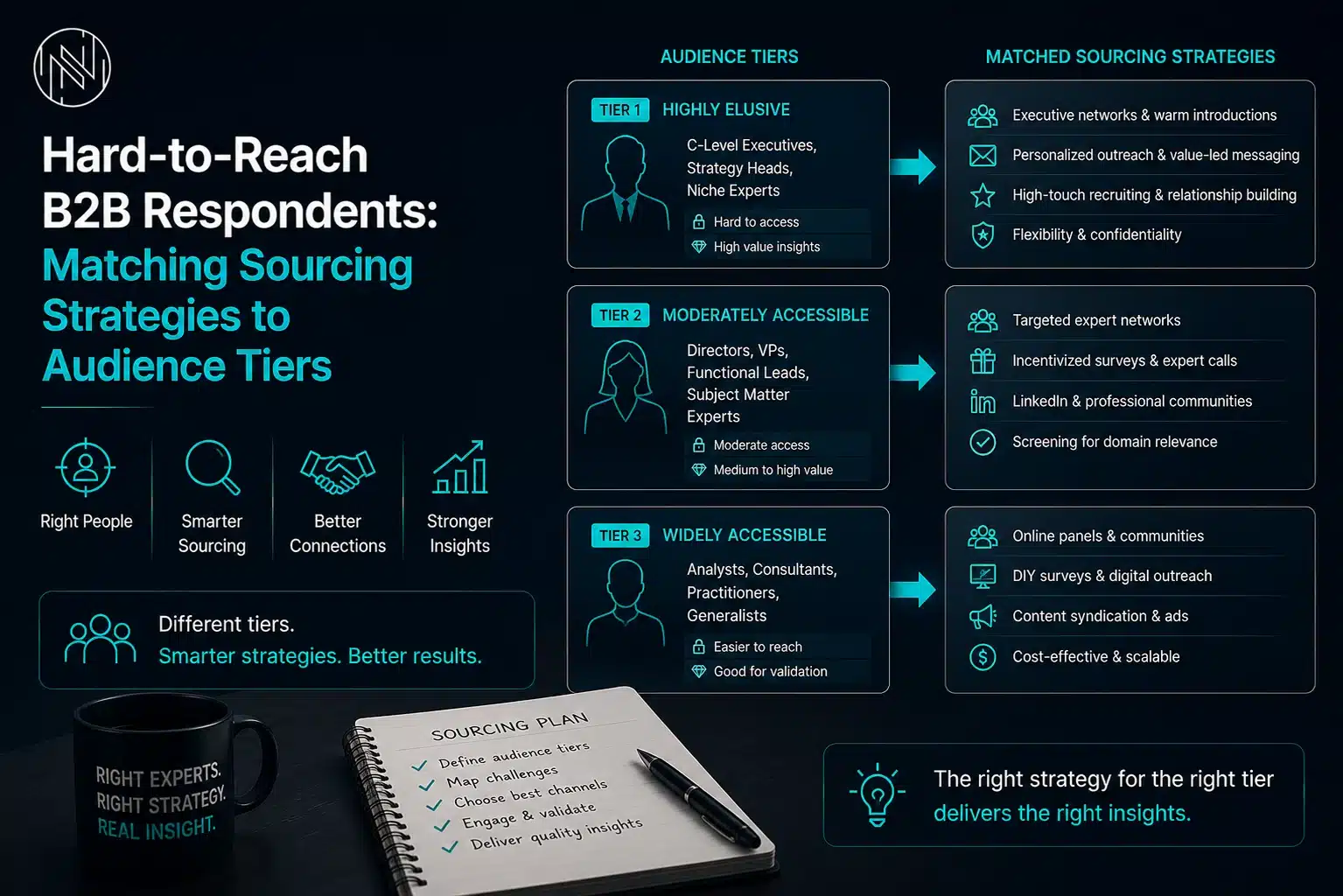
Hard-to-Reach B2B Respondents: Matching Sourcing Strategies to Audience Tiers
The sourcing method that works for a mid-level IT manager will not reach a Chief Procurement Officer, and treating those two problems as variations of the same challenge is how B2B research projects fail before fieldwork ends.
B2B professionals sit at meaningfully different points of accessibility, each requiring a distinct sourcing channel, screening depth, and incentive structure. Getting this alignment right before the study launches separates a methodology that holds up under scrutiny from one that quietly substitutes available respondents for the right ones.
Understanding B2B Respondent Tiers
This article uses a three-tier practitioner taxonomy: Tier 3 covers executive and niche specialists, Tier 2 covers mid-level experts and managers, and Tier 1 covers broad, high-incidence roles. Without this structure the sourcing conversation collapses into a binary between “panels work” and “panels do not,” which misses where the decision actually lives. The table below captures the operational reality across all three tiers.
| Attribute | Tier 3 | Tier 2 | Tier 1 |
|---|---|---|---|
| Example profiles | C-suite, niche specialists | Department heads, senior managers | Mid-level practitioners |
| Qualifying population | Very small | Small to medium | Large |
| Panel incidence | Very low | Low to moderate | High |
| Primary sourcing method | Expert networks, custom outreach | Professional networks, referrals | Online panels, digital campaigns |
| Verification depth | Full credential and decision-rights check | Decision-rights question plus title check | Screener filter only |
| Typical field period | 4 to 8 weeks minimum | 2 to 4 weeks | Days to 2 weeks |
Tier 3: Executive and Niche Specialists
Tier 3 covers C-suite leaders and niche specialists where the qualifying population is very small and decision-rights validation is essential. BLS reported median tenure of 3.5 years for all private-sector workers in January 2024, and because executive and niche roles are hard to source and tenure varies, panel-only profiles should be verified against current employment and decision rights.
Beresford Research, which positions itself around C-level research, notes that executive surveys often need roughly four weeks for 500 or fewer completes, six weeks for up to 1,000, and at least eight weeks for larger samples. Standard panel incentives, small cash rewards or points, are commercially incoherent for professionals whose time is worth multiples of what any panel can offer.
Tier 2: Mid-Level Experts and Managers
Tier 2 covers department heads, senior specialists, and senior individual contributors who are reachable through professional networks but still need stronger verification than panel-only screening. Datapeople reports that about 25 percent of jobs labelled junior in 2019 carried senior titles by 2021, showing job-title inflation in tech. A Director title does not by itself prove decision authority, so Tier 2 screeners should include decision-rights questions alongside standard title filters.
Tier 1: Broad Roles and High-Incidence Profiles
Tier 1 includes broad, high-incidence roles such as IT practitioners, procurement coordinators, and marketing managers in established categories. Industry commentary commonly cites wide fraud and misrepresentation ranges for online panels, with the exact rate varying by provider and screening controls, but at sufficient scale that variability is manageable with appropriate quality controls. Panels are usually the most efficient option when incidence is high and screening is simple.
Sourcing Methods by Tier
The sourcing method and the tier are not interchangeable choices. They are determined by population size, accessibility, and the cost of misclassification in the final dataset.
Expert Networks and Custom Panels for Tier 3
Expert networks are generally used for project-specific recruitment rather than mass pre-registered panel sampling, which is what makes them structurally suited to Tier 3. Recent market estimates place the expert network industry around the $2.5 billion to $3.8 billion range, depending on source and year, with growth estimates varying by report.
Some practitioner sources argue that a small number of verified experts can outperform a larger panel sample for decision-relevant research, and while this is not a universal rule, it reflects the credential specificity that Tier 3 studies require. Expert network engagements commonly use NDAs, conflict checks, and call notes and documentation as standard parts of their process.
Professional Networks and Referrals for Tier 2
Tier 2 is typically sourced through professional networks, LinkedIn outreach, association directories, community intercepts, and referrals. Gartner’s survey of 632 B2B buyers found that 61 percent prefer an overall rep-free buying experience and that 73 percent of B2B buyers actively avoid suppliers who send irrelevant outreach, which means recruitment messaging for Tier 2 must establish professional relevance immediately. Referral networks and warm introductions consistently outperform cold email for this population because they carry social credibility that cold outreach lacks.
Online Panels and Digital Campaigns for Tier 1
ESOMAR and GRBN’s online sample quality framework is a standard reference for evaluating sample quality, especially for panel-based Tier 1 work. Digital campaigns, paid social targeting by job function and seniority, and partner list activations supplement panels where incidence needs boosting within a specific vertical. Cost-per-complete is low, turnaround is fast, and statistical validity at sample sizes supporting subgroup analysis is achievable within standard fieldwork windows.
Best Practices in Recruiting Hard-to-Reach Professionals
The mechanics of tier-appropriate sourcing matter, but execution at the respondent level determines whether recruitment converts.
Crafting Targeted Outreach
For Tier 2 and Tier 3, outreach should establish professional relevance immediately, because recipients filter by current business relevance. Specific sector references, named functional areas, and genuine questions about operational experience outperform generic participation appeals by a significant margin. The goal is to make the study feel like a professional conversation rather than a survey invitation.
Overcoming Gatekeepers and Incentives
Tier 3 outreach often passes through assistants or gatekeepers, so trusted intermediaries and associations can improve reach more reliably than cold email. For Tier 3, expert network fees are the standard compensation mechanism and usually outperform consumer-style incentives because they reflect the professional exchange the respondent is being asked to make. Building relationships with professional associations and community platforms in advance of the study reduces the gatekeeper problem considerably.
Ethical and Compliance Considerations
ICO guidance on legitimate interests requires a documented purpose and a balancing test; processing must be necessary and proportionate. Use panel opt-in terms for Tier 1 and more explicit consent and NDA controls for Tier 3 expert interviews when required by your process and jurisdiction. Cross-border research may trigger UK GDPR obligations and, in finance-related contexts, other sector-specific rules depending on the respondent and use case.
Aligning to Research Objectives
Sourcing should be decided at brief stage because respondent fit affects methodological validity, and that decision belongs to the research design rather than the vendor management process.
Matching Method to Project Goals
When the finding does not depend on seniority or decision authority, Tier 1 panel sampling is usually appropriate. Research with senior buyers, due diligence, or technical specialists usually benefits from credential verification and stronger sourcing controls. The cost of sourcing at the wrong tier shows up in the analysis, not in the fieldwork budget.
The Strategic Value of Expert Insight
Verified expert interviews often carry more credibility with senior stakeholders than panel-only findings, especially in due diligence or strategy contexts. Research directors and strategy consultants who understand where that credibility matters are the ones whose methodology survives scrutiny when clients ask how respondents were selected and what qualifies them to answer the question.
The practical first question at any brief is which tier the target respondent population belongs to, and then which sourcing method reaches it most reliably.
Match the Tool to the Tier
The taxonomy is a diagnostic before it is a prescription. The right question at the start of any B2B research brief is not which sourcing method is cheapest or most familiar. It is which tier the required respondent population occupies, and then which sourcing method was built to reach that tier accurately and verifiably.
Answering that question before the field period opens is the structural difference between a study whose findings hold up under scrutiny and one that substitutes available respondents for the ones the study actually needed.
