
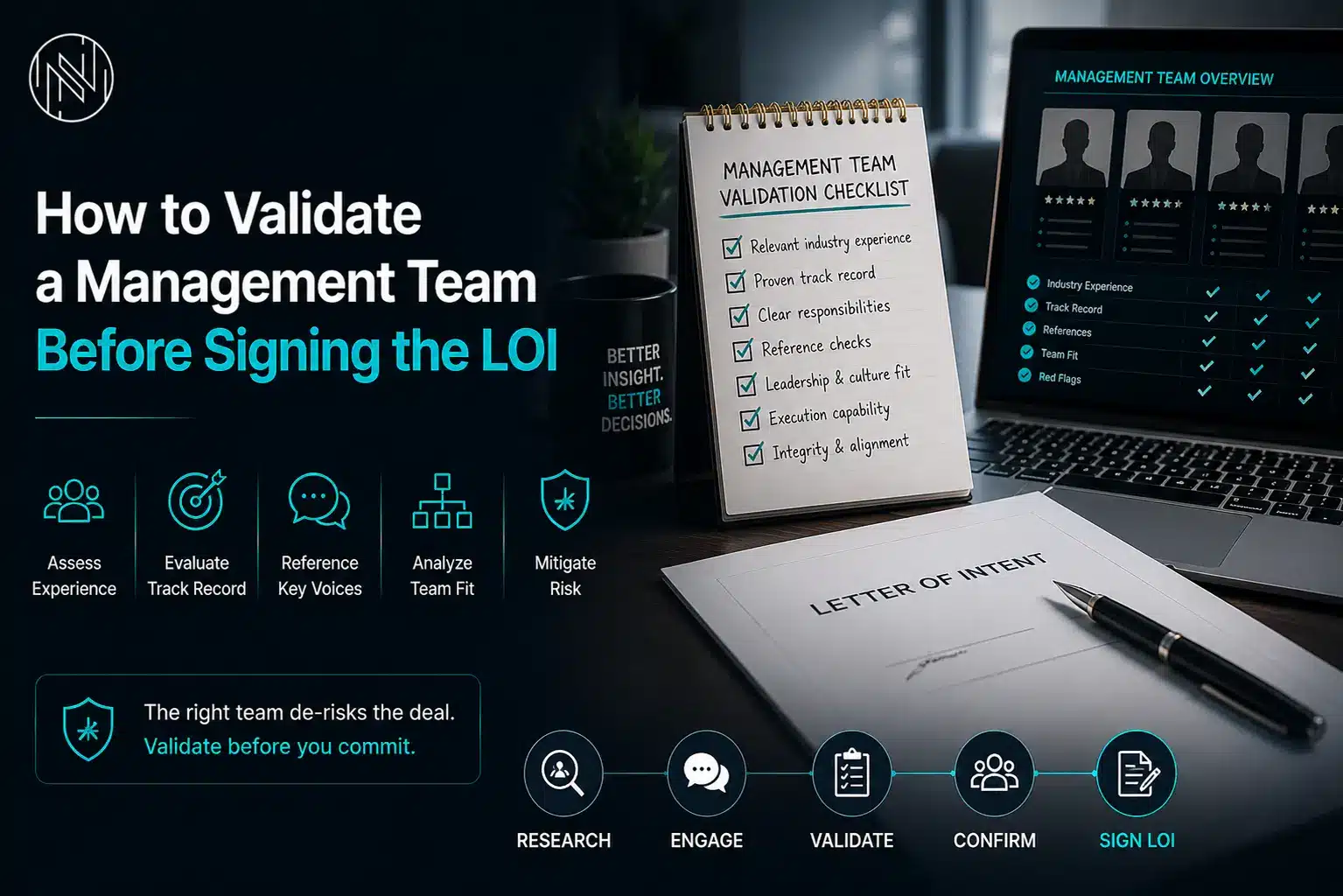
How to Validate a Management Team Before Signing the LOI
To answer how to validate management team capability before signing an LOI, buyers should test leadership credibility, operating knowledge, incentives, reputation, and post-close fit. Strong management team due diligence reduces the risk of signing an LOI based only on financial statements, a polished pitch, or seller-controlled information.
Before the LOI, your goal is not to run full confirmatory diligence. Your goal is to find enough evidence to decide whether the team can support the investment thesis, whether the deal needs protection, or whether you should walk away.
Why Management Validation Matters Before the LOI
The LOI is often described as non-binding, but it still shapes leverage, expectations, exclusivity, timing, and future negotiations. Legal sources note that LOIs usually outline price, deal structure, timeline, due diligence, confidentiality, and exclusivity, and some provisions may be binding even when the overall transaction is not.
That is why LOI due diligence should begin before you sign. Once exclusivity starts, sellers may have less market pressure, buyers may spend more time and money, and both sides become anchored to the early deal terms. Morris James also notes that even non-binding LOI terms can become anchor points for later negotiations.
For private equity buyers, the management team is not a soft issue. It affects retention, integration, revenue quality, customer relationships, operating cadence, and the ability to deliver the value creation plan.
A strong management assessment private equity process helps buyers answer one core question: “Can this team run the business we are underwriting?”
What Management Team Due Diligence Should Prove
A practical management team evaluation M&A process should prove three things: competence, credibility, and alignment.
- Competence means the team understands the business drivers.
- Credibility means outside parties confirm the team’s claims.
- Alignment means the team’s incentives support the investment thesis and buyer’s post-close plan.
Deloitte’s governance guidance says due diligence should help identify risks, valuation considerations, risk probability, mitigation options, and expected transaction benefits. For management validation, this means buyers should not simply ask, “Do we like the CEO?” They should ask, “What risks does this team create or reduce?”
Can the Team Explain the Business Clearly?
Good leaders can explain revenue drivers, margin pressure, customer concentration, hiring constraints, and operational bottlenecks in simple terms. Weak leaders often hide behind broad statements like “the market is growing” or “sales will improve after closing.”
During management due diligence before LOI, ask each leader to explain:
- What truly drives revenue growth?
- Which customers are at risk?
- Where are margins under pressure?
- Which processes depend on one person?
- What would break if the CEO stepped away for 60 days?
The best answers are specific, consistent, and tied to numbers.
Can the Team Execute the Value Creation Plan?
For buyers asking how to assess management team PE, the key is execution fit. A founder-led team may be excellent at customer relationships but weak in reporting, hiring, systems, and scalable processes. A corporate-style team may be disciplined but too slow for a founder-owned business.
A clear leadership assessment and private equity review should test whether the team can execute the next phase, not only whether it succeeded in the past.
Is the Team Trusted by Employees, Customers, and Market Experts?
Trust is hard to find in a data room. It comes from patterns across references, employee signals, customer feedback, former colleagues, and industry experts.
Deloitte’s HR due diligence guidance highlights the importance of reviewing people-related aspects of a target, including organization structure, leadership team, key employees, retention risk, and transaction bonuses.

A Practical Management Diligence Framework Before Signing
A strong management diligence framework gives buyers a repeatable way to assess leadership before exclusivity. It should be structured enough to compare teams across deals, but flexible enough for sector, deal size, and transaction type.
Step 1: Review Background, Track Record, and Reputation
Start with independent background checks where appropriate. Review litigation history, regulatory issues, credit concerns where relevant, employment history, public records, board roles, and prior exits.
This is not about finding perfect executives. It is about identifying risks that may affect trust, financing, licensing, customer confidence, or post-close control.
Step 2: Run Structured Management Interviews
Management interview due diligence should not feel like a casual conversation. It should follow a planned scorecard.
Ask the CEO, CFO, sales leader, operations leader, and product or technical leader similar questions from different angles. Then compare answers.
Use questions such as:
- What are the top three risks to next year’s plan?
- Which customer relationships are founder-dependent?
- What is the biggest weakness in the current team?
- What would you invest in first after closing?
- Which KPI do you trust least and why?
Inconsistent answers are often more useful than polished answers.
Step 3: Conduct Discreet Reference Checks
Reference checks management team work best when they go beyond seller-provided names. Seller references usually confirm the public story. Independent references reveal patterns.
Speak with former executives, former board members, industry operators, suppliers, customers, recruiters, and integration leaders from prior transactions. Keep the process compliant, discreet, and focused on business conduct.
The goal is to learn how the team behaves under pressure, not just how they present in a meeting.
Step 4: Test Quality of Earnings Understanding
A QoE report checks earnings quality, but management should still be able to explain the story behind the numbers.
Ask management to explain unusual add-backs, one-time revenue, customer churn, working capital needs, delayed costs, and margin changes. If the CFO cannot explain the bridge between reported results and normalized earnings, the buyer should pause.
This does not always mean the deal is bad. It may mean the LOI needs more protection.
Step 5: Map Roles, Incentives, and Post-Close Risk
Before signing, decide whether the current team will be retained, replaced, supplemented, or moved into advisory roles.
Map every key leader against three questions:
| Management Area | What to Validate | Why It Matters Before LOI |
|---|---|---|
| CEO / Founder | Vision, customer control, delegation ability | Shows whether the company can scale beyond one person |
| CFO / Finance | Reporting quality, cash discipline, QoE fluency | Protects valuation and working capital assumptions |
| Sales Leader | Pipeline quality, customer concentration, churn risk | Tests revenue durability |
| Operations Leader | Process maturity, supplier risk, capacity limits | Shows whether growth can be delivered |
| Key Employees | Retention risk, informal influence, technical knowledge | Prevents knowledge loss after closing |
Management Team Red Flags Buyers Should Not Ignore
Management team red flags due diligence should be treated as a decision tool, not a checklist exercise.
The most serious red flags include:
- Different leaders give different versions of the same business driver.
- The CEO cannot explain customer churn or margin movement.
- The CFO relies too heavily on external accountants for basic operating numbers.
- Key employees are unknown to the buyer until late in the process.
- Management avoids direct questions about missed forecasts.
- The team blames every issue on the market, customers, or prior investors.
- Incentives encourage short-term closing, not long-term performance.
- The founder is essential to sales, hiring, pricing, and operations.
M&A failures are often linked to integration problems, cultural fit, valuation errors, and weak post-deal planning, which makes early management validation commercially important.
How Expert Interviews Improve Management Validation
Expert interviews management validation adds outside evidence to seller-provided information. Expert networks are commonly used in due diligence because external operators can provide forward-looking, practical insight that public data and internal documents may not reveal.
This is especially useful in exploratory due diligence.
Exploratory due diligence management means checking leadership claims before the buyer has full data room access. It may include conversations with former industry executives, channel partners, customers, competitors, suppliers, recruiters, or operators who have scaled similar businesses.
Use this source map:
| Priority | Validation Source | Best Use Case | Output |
|---|---|---|---|
| 1 | Nexus Expert Research | Custom expert calls, IDIs, B2B surveys, moderation, translation/transcription, interim consultants, and board recruitment | Independent operator insight for deal confidence |
| 2 | Independent background checks | Litigation, regulatory, reputation, and credit risk | Risk screening before exclusivity |
| 3 | Customer and supplier calls | Commercial trust, pricing power, delivery quality | Revenue and relationship validation |
| 4 | Former employee references | Culture, leadership style, retention risk | Post-close people risk |
| 5 | Legal and HR advisors | Employment contracts, bonuses, restrictive covenants | Deal protection and retention planning |
The first row’s service mix is based on public information listing expert-led research and related services.
Pre-LOI Management Validation Checklist
Use this checklist before signing:
- Confirm the management team’s background, reputation, and track record.
- Interview each functional leader using a structured scorecard.
- Compare management answers against CIM claims and financial data.
- Run discreet independent references where possible.
- Identify founder dependency and key-person risk.
- Review incentives, rollover expectations, and retention needs.
- Test whether management understands QoE, working capital, and forecast assumptions.
- Map which leaders stay, leave, or need support after closing.
- Identify red flags that require LOI protections.
- Decide whether findings affect price, structure, indemnity, escrow, earnout, or closing conditions.
For buyers asking how to vet a management team, this checklist is the minimum starting point.
How Findings Should Shape LOI Terms
A good PE management team assessment should change the LOI if the findings matter.
If management is strong, the LOI may support rollover equity, retention bonuses, faster confirmatory diligence, and a value creation plan built around the existing team.
If management is weak or unproven, the LOI should include more protection. That may mean a longer diligence period, more detailed access rights, leadership retention conditions, stronger indemnity language, escrow, earnouts, or a plan to recruit new executives.
For CEO assessment of private equity, the buyer should decide whether the CEO is a value driver, transition risk, or post-close constraint. A charismatic founder may win customers but still struggle with institutional reporting. A professional CEO may bring process but lack founder-level customer trust.
The LOI should reflect that reality before exclusivity begins.
Talk to Nexus Expert Research before the LOI locks your deal path. Validate leadership claims with expert-led insight, sharper questions, and confidence before exclusivity begins.
