
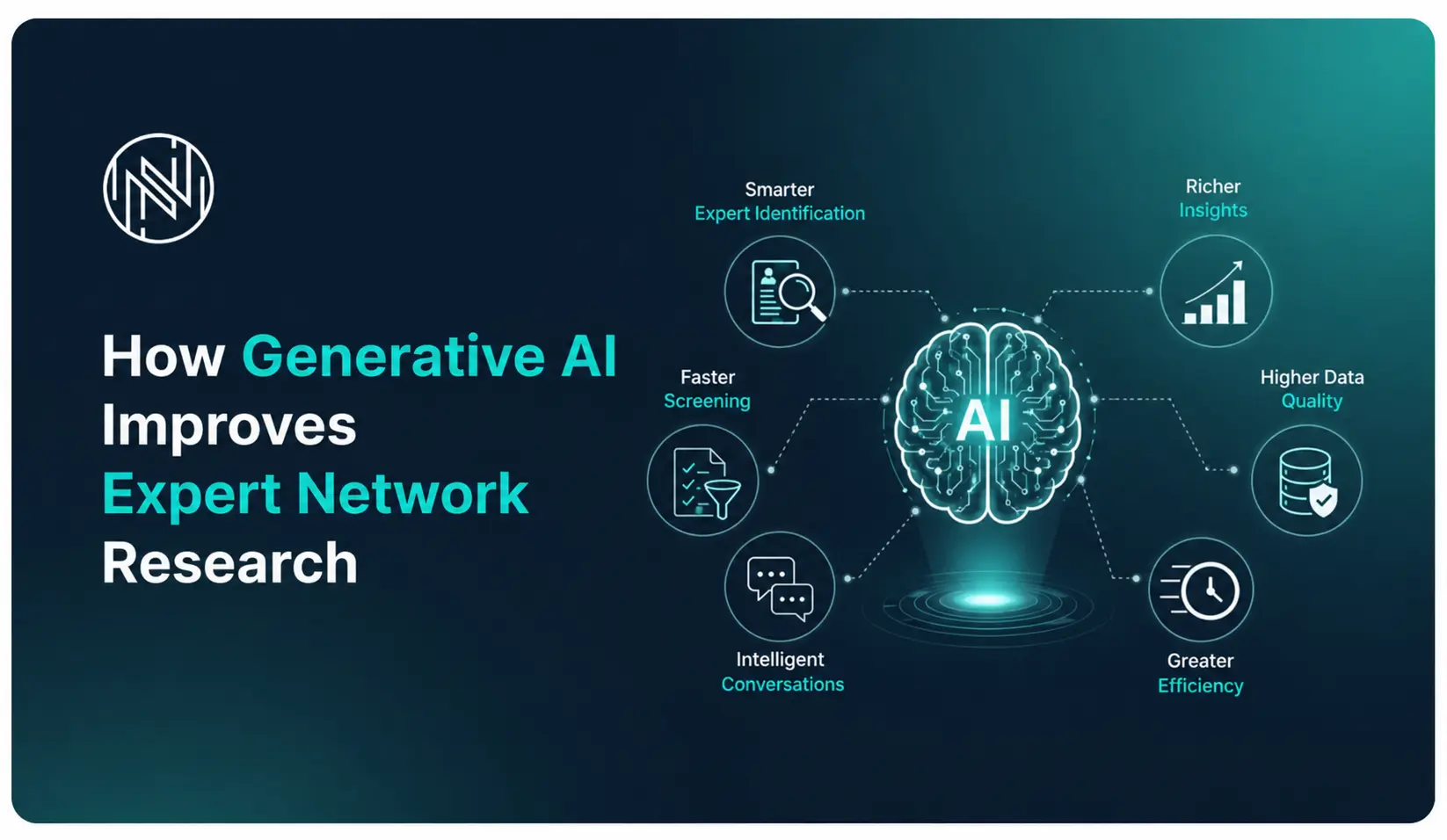
How Generative AI Improves Expert Network Research
Generative AI in expert networks improves research by accelerating expert discovery, automating multi-step workflows, and turning unstructured calls into structured intelligence that can be searched, cited, and reused. It does not replace human experts; instead, it augments them by synthesizing content, highlighting patterns, and surfacing the right people and insights at the right time.
For decision makers, this means faster time from question to answer, more transparent reasoning, and research processes that scale without a linear increase in headcount or cost.
What Is Generative AI and Why It Matters for Expert Networks
Defining Generative AI for Decision Makers
Generative AI is a type of artificial intelligence that can create new content such as text, audio, code, or summaries based on patterns learned from large training datasets. The most relevant models for AI in knowledge research are large language models (LLMs), which can read documents, reason over them, and generate structured outputs like briefs, memos, and call summaries.
Enterprise platforms such as IBM’s generative AI stack and Google Cloud’s generative AI services show how these models can be deployed safely with governance, security, and observability, which are critical requirements for institutional research workflows.
How Expert Networks Work Today
An expert network connects clients often hedge funds, private equity, venture investors, consultants, and corporates with vetted industry practitioners who have first-hand operating experience. Traditionally, research associates manually interpret client briefs, search internal databases, screen and recruit experts, host calls, and then synthesize notes into deliverables.
This human-only model is powerful but slow: analysts spend many hours searching, scheduling, and summarizing before they even reach the insight stage. Generative AI addresses precisely these bottlenecks while preserving human judgment where it matters most.
How Generative AI Transforms Expert Discovery and Matching
Expert Discovery with AI Across Millions of Profiles
Expert discovery with AI means using machine learning models to scan profiles, CVs, filings, patents, and other signals to identify niche experts that traditional keyword search would miss. Platforms like CleverX and other AI research platforms already apply AI to filter participants and prevent fraud while considering experience, geography, and incentive expectations.
Generative AI extends this further by understanding semantic intent: instead of matching on exact titles, it can infer capabilities such as “built pricing for a B2B SaaS expansion into APAC” from narrative descriptions and past roles. This dramatically improves recall and precision in AI expert network research, especially in emerging or fragmented markets.
AI-Powered Expert Matching for Nuanced Project Briefs
AI-powered expert matching uses LLMs to interpret a client brief, extract the real decision question, then score and rank potential experts based on fit, conflicts, and diversity of viewpoints. Techspert, for example, highlights how LLMs can generate content about experts and use that content to improve match accuracy, while still leaving the final decision to human project managers.
Compared with manual matching, this approach:
- Reduces time from request to first candidate list from days to minutes.
- Surfaces non-obvious experts whose experience is described in narrative form rather than structured tags.
- Allows continuous learning, where feedback from past projects refines future matching recommendations.
Traditional vs AI-Augmented Expert Discovery and Matching
| Dimension | Human‑only expert network | AI‑augmented expert network |
| Discovery scope | Manual search of databases, LinkedIn, referrals. | Model‑driven search across profiles, documents, filings, and transcripts. |
| Matching speed | Hours to days per project. | Minutes using automated scoring and ranking. |
| Match quality | Dependent on individual associate experience. | Consistent, explainable fit scores plus human review. |
| Hidden experts | Often missed if titles or keywords don’t match. | Detected via semantic understanding of text and history. |
Automating Operations with Expert Network Automation
Automated Expert Screening and Vetting at Scale
Expert network automation focuses on reducing manual, repetitive tasks such as sending screeners, collecting compliance attestations, and documenting eligibility decisions. Solutions like InsightAgent and CleverX use AI agents to conduct standardized vetting interviews, verify expertise, and check for conflicts around the clock, across multiple languages.
Within this, automated expert screening means LLMs generate and score screener questions, analyze answers, and flag potential issues for human review, creating auditable trails that are essential for regulated clients. This gives project teams more time to focus on judgment calls rather than logistics.
Agentic Workflows for Outreach, Scheduling, and Compliance
Modern platforms are starting to offer “agentic” AI capabilities that autonomously orchestrate multi-step tasks, such as identifying candidates, sending outreach, scheduling calls, and updating CRM or compliance systems. Google Cloud and others describe these agentic workflows as key to moving from basic chat interfaces to real business productivity.
In expert networks, this means:
- Automatically coordinating calendars and time zones between clients and experts.
- Triggering conflict checks and NDAs before a call is confirmed.
- Logging all steps for compliance and billing reporting.
The result is an operational fabric where AI agents handle the workflow, and humans supervise and intervene when exceptions arise.
Turning Expert Calls into Searchable Intelligence
Transcription, Summarization, and Expert Call Intelligence
Once a call happens, the next frontier is expert call intelligence using generative models to transcribe, segment, and summarize conversations into high-value artifacts. AI-moderated interviews, such as those run by InsightAgent, already produce complete transcripts and standardized outputs without a human moderator.
LLMs can then highlight key themes, quantify sentiment, extract entities (companies, products, metrics), and align insights to the original research questions. This turns every expert interaction into structured data that can be reused across projects while still respecting confidentiality and usage rules.
From Raw Calls to AI-Driven Insights and Reusable Knowledge
AI-driven insights emerge when these structured call records are combined with desk research, filings, and internal notes into unified knowledge graphs or indexed repositories. Platforms like AlphaSense demonstrate how generative agents can run dozens of searches, read hundreds of documents (including expert transcripts), and then generate investment-grade briefings with sentence-level citations.
This is the foundation of effective AI knowledge management not just storing PDFs, but enabling analysts to ask, “What have we learned about on-prem to cloud migrations in European banks in the last six months?” and get a cited, synthesized answer in minutes.
Designing an AI Research Workflow for Analysts and Firms
Building an End-to-End AI Research Workflow
An enterprise-grade AI research workflow connects four stages: discovery, expert engagement, analysis, and delivery. Each stage can be enhanced with AI for research analysts while keeping them firmly “in the loop.”
Example AI-Enhanced Research Workflow
| Stage | Human role | AI capabilities |
| 1. Scope & hypothesis | Define decision question, constraints, and must‑have profiles. | Draft research plans, expand hypotheses, and suggest data sources. |
| 2. Discovery & screening | Validate fit, handle edge cases, approve experts. | Search profiles, rank candidates, run screeners and background checks. |
| 3. Calls & analysis | Ask follow‑ups, interpret nuance, challenge assumptions. | Moderate routine calls, transcribe, summarize, and cross‑reference documents. |
| 4. Deliverables | Decide implications, sign off on recommendations. | Generate drafts of memos, decks, and AI-enhanced consulting research reports with citations. |
Governance, Risk, and LLMs in Expert Networks
Using LLMs in expert networks also raises governance questions: hallucinations, privacy, IP leakage, and regulatory constraints. Most leading platforms address this with controlled training data, enterprise access controls, and rigorous citation so that every AI-generated claim can be traced back to an underlying document or call transcript.
For regulated clients, it is essential to:
- Log which models were used, on what data, and by whom.
- Restrict sensitive content from being used for general model training.
- Require human review and sign-off on any external-facing output.
Handled correctly, this balance allows organizations to benefit from AI speed while maintaining the defensibility of their research.
How Decision Makers, VCs, and SMBs Benefit in Practice
For investors and executives, the practical impact of AI research platforms and expert networks is clearer deal theses, faster iteration, and better risk management. VCs can screen more markets and opportunities by combining AI-synthesized market maps with targeted expert calls on technical or regulatory edge cases. Corporate strategy teams can use expert networks to validate expansion plans, while AI tools aggregate themes across dozens of expert conversations.
SMBs, which historically could not afford large consulting engagements, can now access modular, AI-enhanced consulting research built from a smaller number of expert calls plus generative AI synthesis. Crucially, the evidence to date shows that LLMs amplify, rather than replace, human expertise: they excel at digesting large volumes of content and surfacing patterns, while experts provide context, originality, and accountability.
Practical Steps to Adopt Generative AI in Your Expert Network Research
To get started with AI for research analysts and decision teams, you do not need a full rebuild of your stack. A phased approach is usually most effective.
- Map your highest-friction workflows.
Identify where analysts spend the most time: sourcing experts, writing screeners, summarizing calls, or drafting memos.
- Pilot targeted use cases.
Start with narrow applications such as call transcription, summarization, or automated screener analysis, where AI-driven insights are easy to compare against existing outputs.
- Integrate with your expert network partners.
Many networks and platforms already offer GenAI capabilities ranging from AI-moderated interviews to deep research agents to explore how your current vendors are evolving.
- Establish clear governance.
Define policies for data usage, human review, and citation standards before scaling. Use providers that offer enterprise controls and transparent model behavior.
- Iterate towards full expert network automation.
As confidence grows, connect point solutions into a cohesive workflow spanning discovery, calls, knowledge management, and deliverable generation. Over time, this builds a living knowledge base that compounds with every project.
Done well, your organization will move from ad-hoc expert calls to a continuous, AI-supported knowledge system that keeps getting smarter. This is the core promise of modern AI knowledge management in expert networks.
If you want to turn scattered expert calls into a compound, AI‑powered knowledge advantage, partner with Nexus Expert Research to design and implement your next‑generation expert network workflow. From expert discovery to generative AI synthesis, Nexus Expert Research can help your team move from manual research bottlenecks to fast, defensible insight pipelines that match how modern decisions are made.
