
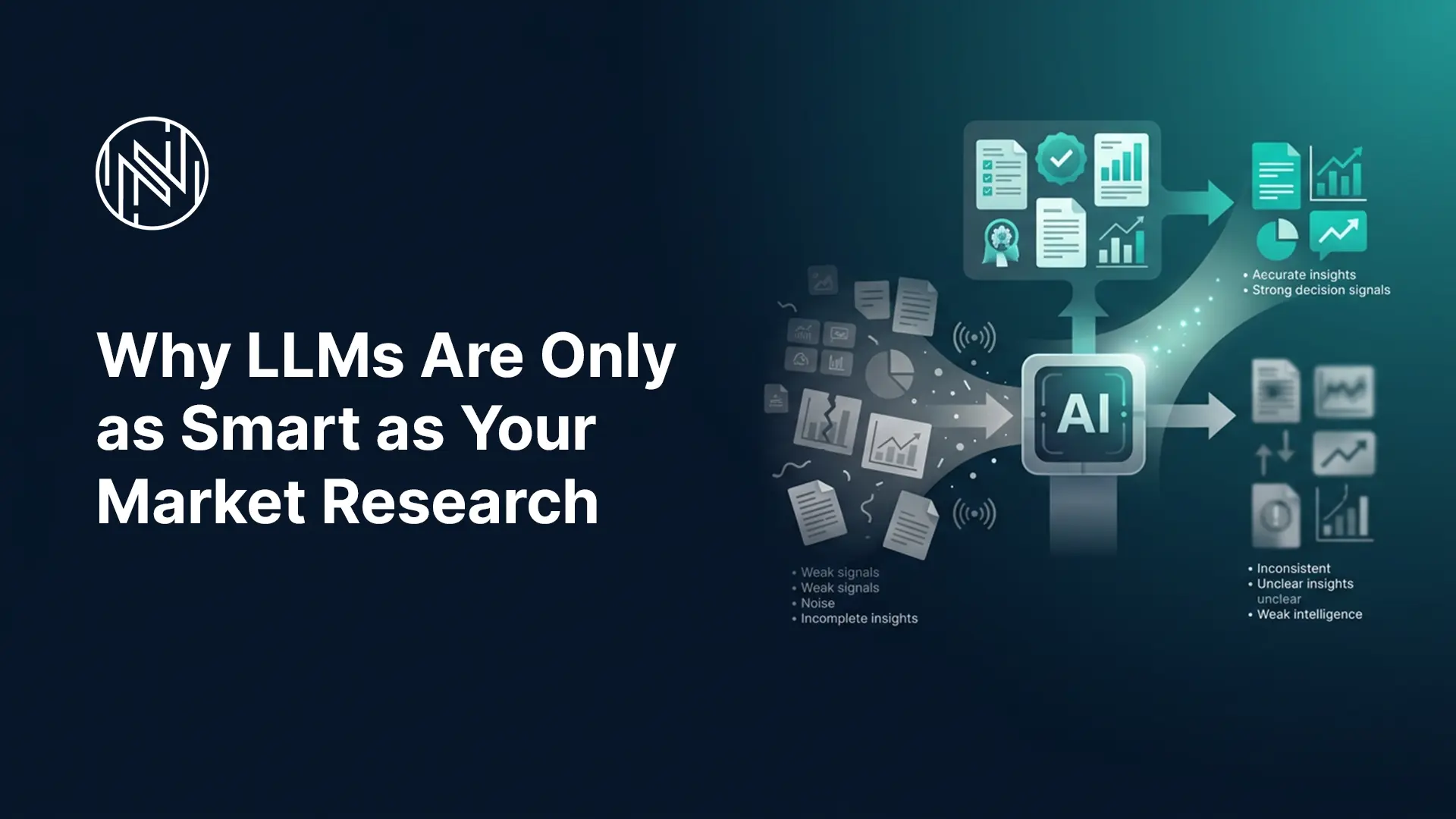
Why LLMs Are Only as Smart as Your Market Research
Large language models can produce fluent answers fast, but they do not create reliable business insight from thin air. The quality, freshness, and relevance of the information they are provided with or can access can make it or break it, and that is why in a lot of cases, good market research can make or break an AI output, whether it is generic or actually useful.
Asking better prompts is not the only aspect of LLM market research. It has to do with providing AI systems with improved evidence, more refined context, and business questions. The success of an AI marketing strategy is based not on the model itself but rather on the research on which it is based.
That is important to decision makers. A model can generalize the information about people in a few clicks, yet tends to dump at the statistical median of what is already extensively covered on the web. Practically, AI market research is what will see a fluent model transform into a more pertinent strategic assistant.
What does it mean to say that LLMs are as smart as your market research?
It implies that the power of AI systems tends to be the power of their inputs. When you provide them with general information about the population, you are likely to receive general responses. Provided that you provide them with confirmed customer understanding, market cues, competitive setting, and apparent limitations, the feedback is much more beneficial.
Here, the accuracy of the LLM and the quality of data are directly related. A model can sound confident, but that does not mean confidence, which is the opposite of precision. More relevant evidence enhances the relevance, minimizes the speculation, and supplies the system with something better than the generic internet averages.
What makes generic LLM text so convincing and yet not so insightful?
LLMs tend to think of themselves as intelligent since they come up with refined language. But smoothing language may conceal empty thought. Analysis by experts of the behavior of LLM has often characterized this as an average knowledge problem: models can summarize vast volumes of public writing, and therefore replicate commonplace talking points without the delicacy required of real operators.
This is the reason why market research that is powered by AI should not be mistakenly compared with automatic truth. Synthesis, clustering, and summarization can be sped up by AI. It can assist teams to work at a higher pace. However, weak recommendations remain as a result of weak LLM input quality.
A founder who poses, “What do we do to grow?” might receive reasonable, yet self-evident advice: Work on pricing, retention, or acquisition efficiency. A system that is informed by research can even tell you which segment is price-sensitive, which competitor message is performing well, and what message is an objection that is slackening conversion. Language fluency and business intelligence differ in that way.
Why market research is important when LLMs encounter niche, new, or privileged information.
LLMs are most challenged by situations when the answer requires information that is new, specialized, proprietary, or underrepresented on the web. Knowledge handling studies have demonstrated that models can work well with informative external knowledge, but fail in cases where retrieval is poor, where context is incompatible with prior trained knowledge, or when the required knowledge is just out there.
That is important in the real market. The most precious pieces of information can be your customer interviews, closed-won and closed-lost notes, survey data, analyst calls, and internal win-loss reviews. In the absence of that, the model will fall into public-facing patterns. This is the reason why marketing intelligence and AI are not to be used separately, but together.
This is a strategic point for startups, SMBs, and investors. Generic information is hardly ever a competitive advantage. It typically lies in category nuance, buyer objections, timing indicators, and unmet needs which can only be understood through disciplined research.
The role of market research in enhancing AI outputs in real-life business scenarios.
Market research enhances AI in four practical ways.
- It cuts the question. Research informs you of what the buyers are really concerned about.
- It enhances context. The model is able to reason out against actual customer language, as opposed to assumptions.
- It minimizes noise. Validated inputs reduce the chances of overreaction to anecdotes.
- It renders outputs more practical. Leaders are able to tie AI recommendations to segments, markets, and decisions.
The inputs that produce the largest difference in the research.
The most handy inputs tend to be:
- Customer interviews
- Quantitative surveys
- Win-loss analysis
- Competitor positioning reviews
- Search demand patterns
- CRM and support themes
- Pricing and objection information
- Analyst and category reports
This is particularly the case with teams developing an AI strategy for CMOs. Marketing leaders do not simply require content velocity. They require credible messages, positioning, prioritizing, and evidence.
| Input type | What it gives the model | Business value |
| Customer interviews | Real buyer language and pain points | Better messaging and positioning |
| Surveys | Pattern-level evidence | Better prioritization |
| Win-loss data | Objections and decision criteria | Better sales enablement |
| Competitive analysis | Market framing and differentiation | Better strategic clarity |
| CRM and support data | Friction points and recurring questions | Better lifecycle optimization |
Prompt hacks are not the surest way to enhance the outputs of LLM. It is a superior research design, superior retrieval, and superior business framing. Such a notion is also consistent with timely research publication recommendations, which focus on responding to actual buyer queries using plausible, well-organized data.
Generic prompting vs research-informed prompting
| Approach | Typical output | Likely problem | Better outcome |
| Generic prompt | Broad best practices | Sounds smart but vague | Limited decision value |
| Prompt + customer research | Segment-specific recommendations | Requires preparation | Higher relevance |
| Prompt + market data + internal context | Actionable strategy options | Needs data discipline | Stronger decisions |

The decision makers need to develop what to scale in AI first before scaling it throughout the business.
Prior to scaling AI, leaders are encouraged to create a lightweight research layer around it.
It involves specifying the decisions AI will be supporting, collecting the evidence the decisions will be based on, and determining what data the system can rely on. It is setting freshness, ownership, review, and escalation rules as well.
An easy market research checklist to achieve improved AI.
Simply put, the better AI outcomes of market research are associated with developing a superior evidence system about the model, rather than purchasing a more sophisticated model.
| Checklist item | Why it matters |
| Define the business question clearly | Prevents generic outputs |
| Gather validated market evidence | Improves accuracy and relevance |
| Separate facts from assumptions | Reduces confident errors |
| Use fresh sources where timing matters | Helps with fast-moving markets |
| Add human review for high-stakes use | Protects decisions and trust |
Where human judgment is still the most.
Even with high market stakes, niche market, or incomplete data, human review remains necessary. The comparison of the results of the use of the LLMs and traditional market research showed that the models may effectively act as proxies, but cannot fully substitute the traditional methods, and their results may differ.
This is why leaders ought to have a human in the loop because:
- Category entry decisions
- Pricing changes
- Product positioning
- Investor narratives
- Guided or delicate claims
- Branding in new marketplaces
That is, AI can be used to speed up analysis, but it is not to be the ultimate determiner of strategic truth.
The strategic lesson of founders, VCs, and CMOs.
The businesses that benefit most from AI are not using the LLMs as omniscient consultants. They are using them as force multipliers to powerful research systems.
Such an attitude alters all things. Rather than question what model to utilize, the question to ask is, “What evidence are we providing to the model, and how credible is it?”
In the case of founders, that results in a more acute positioning. In the case of VCs, it results in higher pattern recognition and support of diligence. In the case of CMOs, it results in more grounded messaging, segmentation, and planning.
It is not AI that is the actual benefit. It is the blend of rigorous studies, an organized environment, and prudent human reason. That is what makes a quick solution a helpful one.
Transform market noise into actionable intelligence using Nexus Expert Research.
Choose evidence-based inputs that can guide your AI to create better strategy, positioning, and more reliable results.
